Perplexity has quietly become one of the most important AI engines for B2B buyer research. Unlike ChatGPT, Perplexity runs a real-time web index and cites its sources by default, which means a single new article, schema fix, or third-party mention can show up in answers within hours instead of waiting for the next training cycle. If your brand is not in those citation panels, you are invisible at the exact moment a buyer is comparing vendors.
That real-time index is also why Perplexity is the first place a serious GEO programme should be measured. Movement is fast, citations are visible, and the feedback loop is short enough to actually optimise against. The problem is that most "AI visibility" platforms still treat Perplexity as one tab among many, with shallow prompt coverage, no source-page attribution, and refresh cadences that miss the swings that matter.
This guide compares the 7 best Perplexity citation trackers in 2026, with pricing, prompt coverage, source attribution depth, and a decision framework for in-house SEOs and brand managers who specifically need Perplexity monitoring rather than generic all-engine reporting.
TL;DR for most in-house teams, Profound is the strongest enterprise Perplexity citation tracker, Peec AI is the best mid-market pick with deep source attribution, and Otterly AI is the cheapest focused option if you only need prompt and citation monitoring.
Best Perplexity citation trackers: a brief overview
- Profound: Best enterprise Perplexity citation tracker, with the deepest prompt volume, source URL attribution, and a Perplexity-specific share-of-voice view for multi-brand portfolios.
- Peec AI: Best mid-market Perplexity brand tracker, with strong source page attribution, competitive benchmarking, and a workflow that connects citation drops to fixable on-page issues.
- Otterly AI: Best lightweight Perplexity citation monitoring tool for SMBs and solo operators, with a focused prompt tracker and a clean cost model.
- AthenaHQ: Best Perplexity AI monitoring platform for technical SEO teams, with strong entity coverage and an emphasis on the structured data that Perplexity rewards.
- Scrunch AI: Best Perplexity visibility checker for content teams, with prompt simulation, content gap analysis, and writer-friendly recommendations.
- BrandPulse: Best Perplexity brand sentiment tracker, with a sentiment and narrative layer on top of standard citation monitoring.
- BrightEdge AI Catalyst: Best Perplexity tracker for enterprises already running BrightEdge, with native integration into existing organic search workflows.
| Tool | Key strength | Pricing | Platforms |
|---|---|---|---|
| Profound | Deepest enterprise Perplexity prompt coverage and source URL attribution | Custom enterprise pricing, demo required | Web app, API, Slack |
| Peec AI | Source page attribution tied to fixable on-page issues | From around 89 USD per month, free trial | Web app, API |
| Otterly AI | Focused, low cost Perplexity prompt and citation monitor | From around 29 USD per month, free trial | Web app |
| AthenaHQ | Entity and schema focused Perplexity monitoring for technical SEO | From around 199 USD per month, demo available | Web app, API |
| Scrunch AI | Prompt simulation and content gap analysis for writers | From around 99 USD per month, free tier | Web app |
| BrandPulse | Sentiment and narrative tracking on top of citations | From around 149 USD per month, free trial | Web app, API |
| BrightEdge AI Catalyst | Native AI search layer inside an existing enterprise SEO suite | Custom enterprise pricing, requires BrightEdge | Web app, API |
1. Profound, best enterprise Perplexity citation tracker
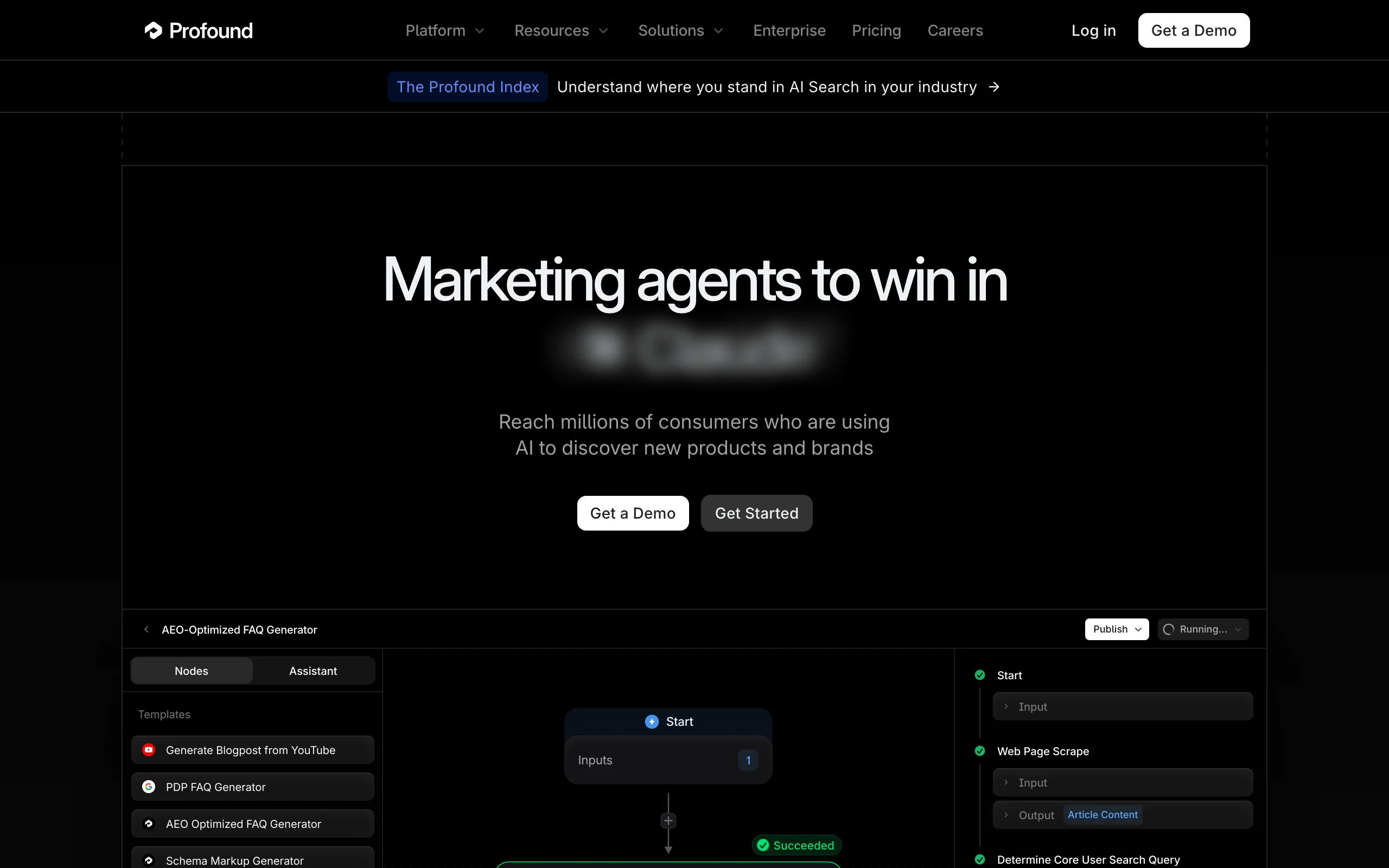 Perplexity Citation Tracker: Profound
Profound is a generative engine optimization platform that tracks brand citations across Perplexity, ChatGPT, Gemini, Claude, and Google AI Overviews, with a Perplexity-specific view that drills into prompt volume, cited domains, and competitive share-of-voice. It is the platform most often picked by large in-house teams running multi-brand portfolios and by agencies serving enterprise B2B clients.
What makes Profound stand out for Perplexity specifically is the prompt depth and the source-URL attribution. Instead of telling you only that "your brand was cited," it shows which Perplexity answer, which sourced URLs surfaced, and how your share-of-voice compares against named competitors over time. That detail matters because Perplexity citations move fast, and you need to know whether a swing came from a new third-party article, a fresh schema deployment, or a competitor outranking you on a key source.
Key features
- Perplexity-specific share-of-voice and citation tracking
- Source URL attribution showing which pages Perplexity cited
- Competitor benchmarking on shared prompts
- Topic and prompt clustering for narrative analysis
- API and Slack integrations for alerts
Best for
- Enterprise in-house SEO and brand teams running multi-brand portfolios on Perplexity
- Agencies that need defensible Perplexity reporting for B2B clients
Pricing
- Custom enterprise pricing, demo required
- No free tier, paid pilots available
Pros
- Deepest Perplexity prompt coverage in the category
- Source URL attribution makes it possible to actually act on citation swings
- Clean multi-brand and multi-market reporting
Cons
- Pricing is enterprise level and not a fit for SMBs
- Onboarding can take a few weeks to map all relevant prompts
2. Peec AI, best mid-market Perplexity brand tracker
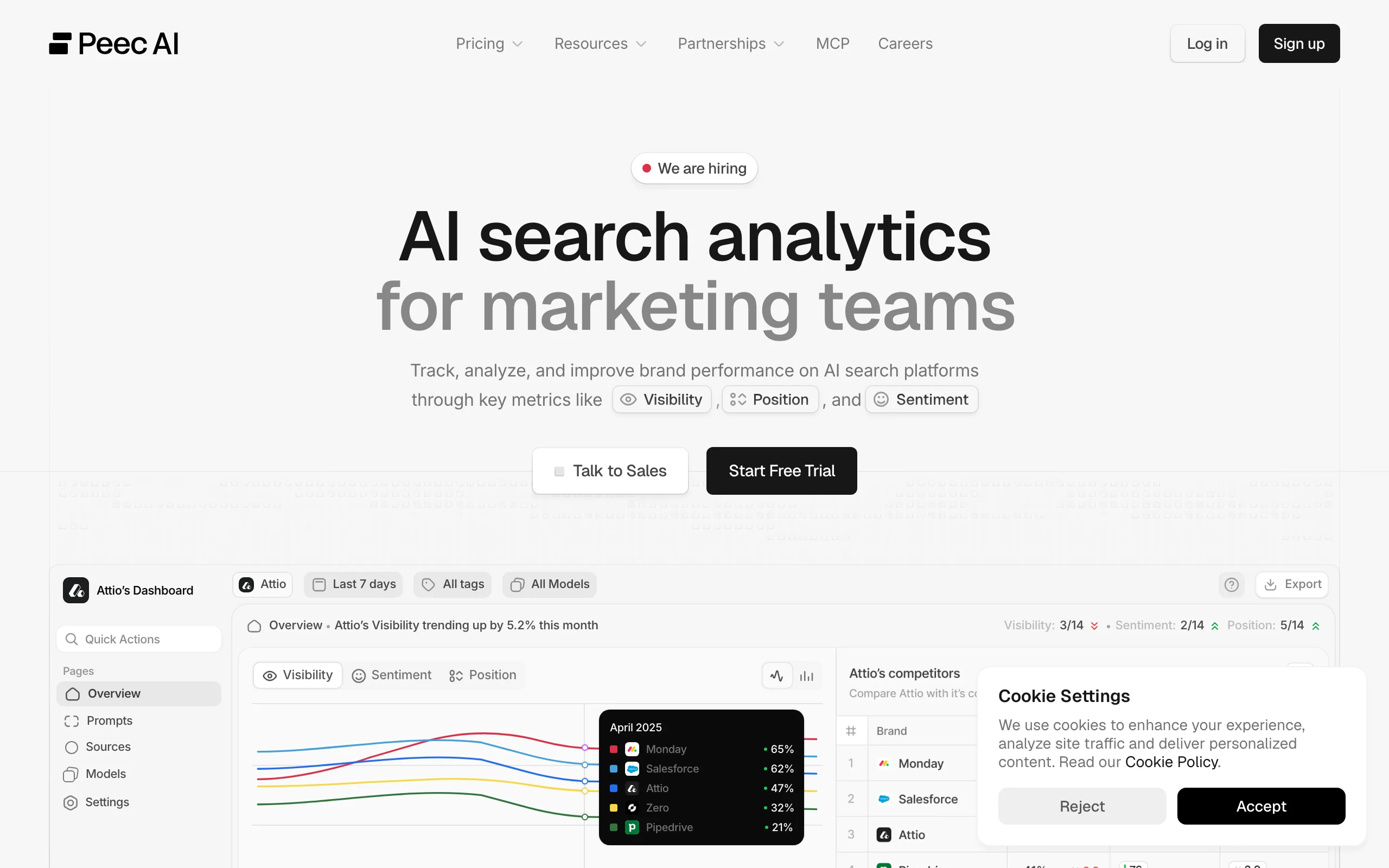 Perplexity Citation Tracker: Peec AI
Peec AI is a Perplexity brand tracker built for in-house marketing and SEO teams who need citation monitoring tied directly to the pages that need fixing. It runs a defined set of buyer prompts on a regular cadence across Perplexity, ChatGPT, Gemini, and AI Overviews, then maps every citation back to the cited page and flags gaps where you are mentioned but not cited.
The differentiator is how tightly Peec AI couples Perplexity citation data with on-page work. When your share-of-voice drops on a key prompt, the dashboard shows the cited source URLs from competitors, what type of content is winning, and a prioritised list of fixes for your own pages. For mid-market B2B teams that already produce content but want to actually move the Perplexity needle, this is the most workflow-friendly option.
Key features
- Perplexity prompt tracking with daily and weekly refreshes
- Source page attribution tied to recommended on-page fixes
- Competitor citation benchmarking
- Brand mention and citation gap detection
- API access on higher tiers
Best for
- In-house SEO and brand managers tracking 50 to 200 Perplexity prompts
- Mid-market B2B teams who want recommendations, not just dashboards
Pricing
- Free trial
- Paid tiers start from around 89 USD per month for a single brand
Pros
- Strong source page attribution on Perplexity citations
- Recommendations are specific to on-page and schema fixes
- Sensible pricing for in-house teams
Cons
- Multi-brand portfolios get expensive on higher tiers
- Less polished than Profound for very large enterprise reporting
3. Otterly AI, best lightweight Perplexity citation monitor
 Perplexity Citation Tracker: Otterly AI
Otterly AI is a focused Perplexity citation monitoring tool that does one job well, tracking brand and prompt visibility across Perplexity, ChatGPT, and Google AI Overviews on a regular refresh, with a minimal interface and predictable pricing. It is the tool of choice for solo founders, lean marketing teams, and agencies who want a starter Perplexity tracker without a six-month enterprise rollout.
The Perplexity coverage is solid for the price. You define a set of prompts, Otterly runs them on schedule, and you get citation counts, brand mentions, and links to the cited sources. There is no entity graph, no on-page recommendation engine, and no enterprise reporting, but for teams who just need to see "are we cited on the prompts that matter" the simplicity is the feature.
Key features
- Perplexity prompt tracking with scheduled refresh
- Brand mention and citation detection
- Cited source link capture
- Multi-engine coverage including ChatGPT and AI Overviews
- Simple weekly email reports
Best for
- SMBs and solo operators starting their first Perplexity tracking programme
- Agencies who need a low-cost Perplexity visibility checker per client
Pricing
- Free trial with limited prompts
- Paid tiers start from around 29 USD per month
Pros
- One of the cheapest credible Perplexity trackers on the market
- Simple, fast to set up, low learning curve
- Clean weekly reporting
Cons
- No on-page recommendations or entity graph
- Light on enterprise reporting and multi-brand workflows
4. AthenaHQ, best Perplexity AI monitoring for technical SEO
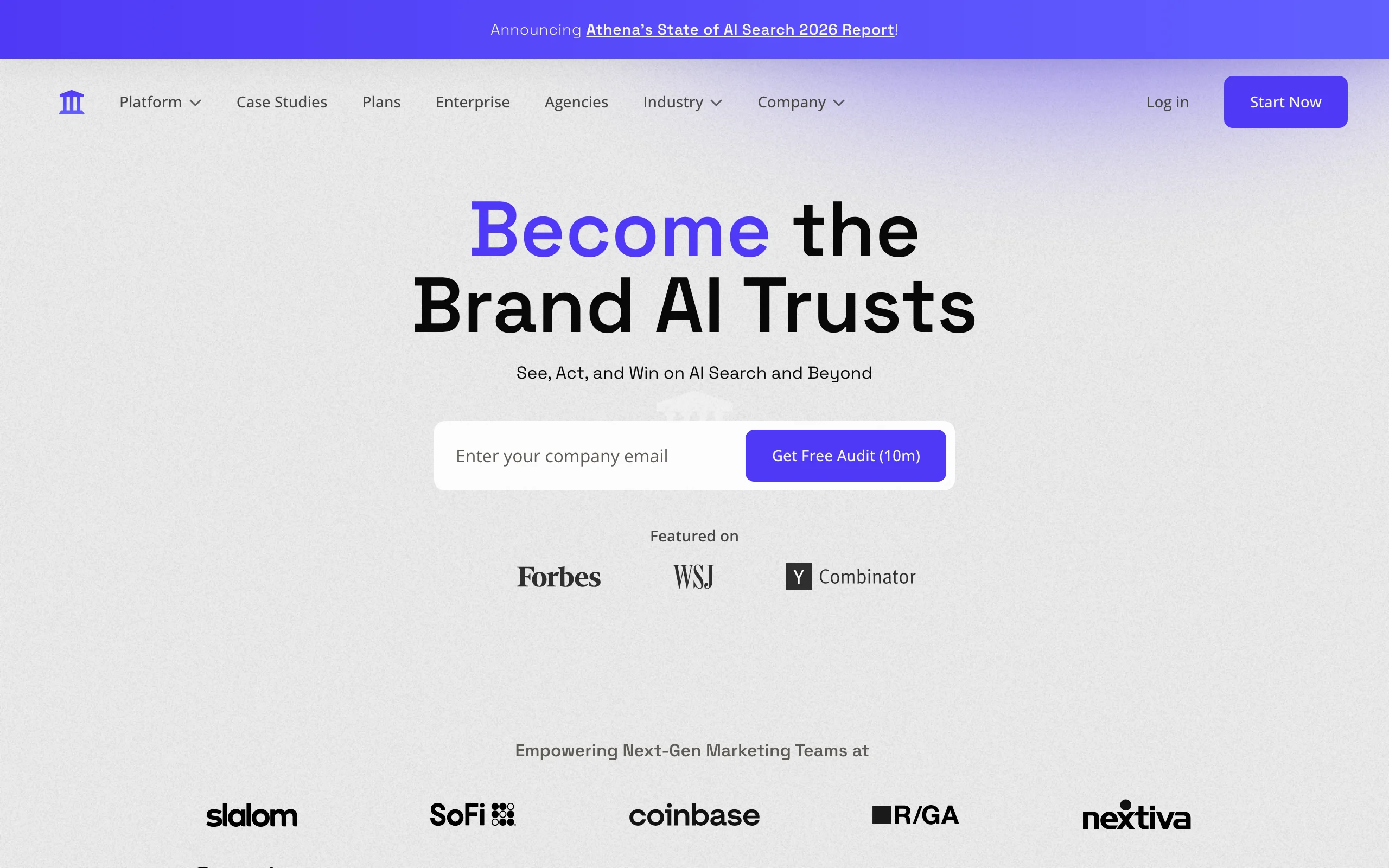 Perplexity Citation Tracker: AthenaHQ
AthenaHQ is a Perplexity AI monitoring platform aimed at technical SEO teams who already understand that Perplexity rewards clean entity coverage, structured data, and authoritative source pages. It pairs prompt tracking with an entity and schema layer, surfacing where your brand has weak knowledge-graph coverage that is dragging down Perplexity citations.
The Perplexity angle here is less about counting citations and more about understanding why you are or are not being cited. AthenaHQ inspects the source pages Perplexity is pulling from on your key prompts, checks the structured data, entity mentions, and authority signals, and flags fixes. For technical SEO teams already used to Schema.org work, it is the most natural fit.
Key features
- Perplexity prompt tracking with source page diagnostics
- Entity coverage and knowledge graph analysis
- Structured data and schema audit on cited pages
- Competitor source page comparison
- API access for integration into existing SEO stacks
Best for
- Technical SEO leads at B2B SaaS and ecommerce companies
- Teams that already run JSON-LD and entity work as a discipline
Pricing
- Demo required
- Paid plans start from around 199 USD per month
Pros
- Strong entity and schema lens on Perplexity citations
- Useful for diagnosing why competitors are cited and you are not
- Integrates well with existing technical SEO workflows
Cons
- Steeper learning curve for non-technical marketers
- Less useful if you are not willing to do schema and entity work
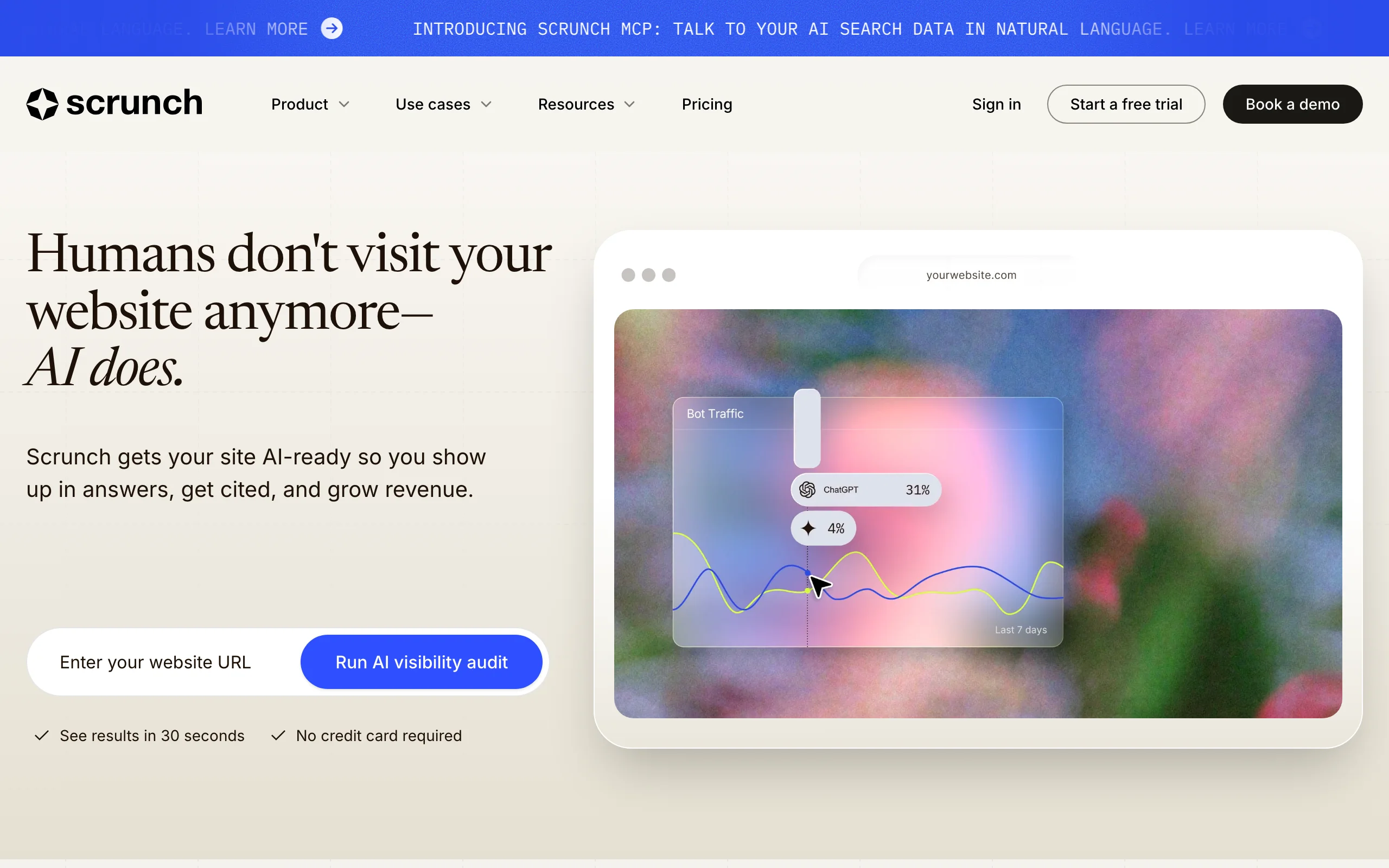
5. Scrunch AI, best Perplexity visibility checker for content teams
 Perplexity Citation Tracker: Scrunch AI
Scrunch AI is a Perplexity visibility checker built for content marketing and editorial teams who want to see how their articles, comparisons, and listicles show up in Perplexity answers, and where they should be writing next. It combines prompt tracking with content gap analysis, surfacing topics where competitors are cited and you are not.
For content teams, the workflow is the draw. You can take a target prompt, see which sources Perplexity is currently citing, compare against your own coverage, and get a writer-friendly outline of what is missing. It is less a deep technical platform than a content production assistant with citation tracking attached, which suits in-house content leads more than SEO engineers.
Key features
- Perplexity prompt tracking with citation breakdown
- Content gap analysis against cited competitors
- Writer-friendly outlines tied to under-served prompts
- Multi-engine support including ChatGPT
- Free tier for small prompt sets
Best for
- In-house content marketing and editorial teams
- B2B SaaS and ecommerce brands prioritising content as the citation lever
Pricing
- Free tier with limited prompts
- Paid tiers start from around 99 USD per month
Pros
- Strongest content workflow of any Perplexity tracker
- Gap analysis is practical and immediately actionable
- Friendly pricing for content teams
Cons
- Lighter on entity and schema depth than AthenaHQ
- Not the right pick for technical SEO led programmes
6. BrandPulse, best Perplexity brand sentiment tracker
 Perplexity Citation Tracker: BrandPulse
BrandPulse is a Perplexity brand tracker with a sentiment and narrative layer on top of standard citation monitoring. It is the option to pick when you care not only whether you are cited in Perplexity answers, but how you are described, in what context, and against which competitors.
The Perplexity use case is specifically narrative monitoring. You watch how Perplexity describes your brand on commercial-intent prompts, flag negative framings or factual errors, and track sentiment over time as you push PR, content, and authority work. For comms and brand teams alongside the SEO function, this is a useful complement to a pure citation tracker.
Key features
- Perplexity citation tracking with sentiment scoring
- Narrative and topic clustering across cited answers
- Competitor framing comparison
- Alerting on negative or inaccurate mentions
- API for integration with PR and brand tooling
Best for
- B2B brand and comms teams co-owning AI search with SEO
- Companies in reputation-sensitive categories such as fintech and healthcare
Pricing
- Free trial
- Paid tiers start from around 149 USD per month
Pros
- Adds a sentiment and narrative dimension most trackers miss
- Useful for crisis response and reputation work
- Reasonable pricing for the depth of analysis
Cons
- Sentiment scoring is helpful but should not be treated as exact
- Light on on-page recommendations
7. BrightEdge AI Catalyst, best Perplexity tracker for enterprise SEO suites
 Perplexity Citation Tracker: BrightEdge AI Catalyst
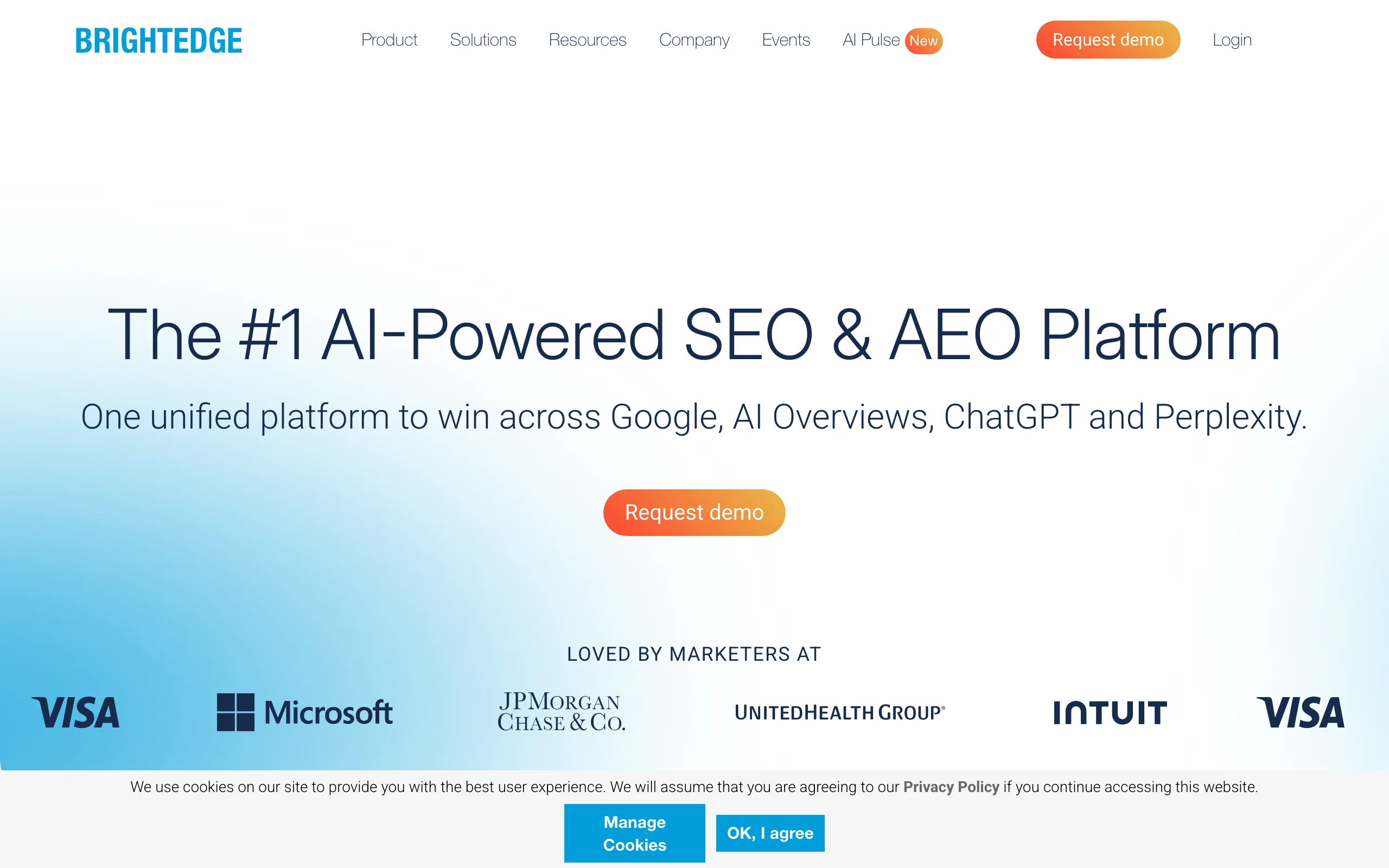
BrightEdge AI Catalyst is the AI search module inside the BrightEdge enterprise SEO platform, with Perplexity, ChatGPT, Gemini, and AI Overviews tracking layered on top of the keyword, content, and reporting stack BrightEdge customers already use. It is the natural choice for enterprises who do not want to add a separate Perplexity citation tracker to their stack.
The Perplexity functionality is solid rather than category-leading, but the integration is the point. AI Catalyst surfaces Perplexity citation data inside the same dashboards as organic rankings, share-of-voice, and content briefs, which makes adoption inside large SEO orgs easier than rolling out a new tool. For brands already on BrightEdge, this is the path of least resistance.
Key features
- Perplexity, ChatGPT, Gemini, and AI Overviews citation tracking
- Native integration with BrightEdge keyword, content, and reporting modules
- Enterprise-grade reporting and role-based access
- Recommendations engine layered across organic and AI search
- API and connectors for existing data warehouses
Best for
- Large enterprises already running BrightEdge as the SEO platform
- Teams who prefer one consolidated tool over a best-of-breed stack
Pricing
- Custom enterprise pricing
- Bundled with BrightEdge subscription
Pros
- Removes the need for a separate Perplexity tracker
- Strong enterprise reporting and access controls
- Connects AI search directly to existing organic data
Cons
- Perplexity depth is shallower than focused tools like Profound
- Only viable if you are already a BrightEdge customer
How to choose the best Perplexity citation tracker for your team
There is no single best Perplexity citation tracker, only the right one for your maturity, team shape, and budget. Walk through these four decisions before committing.
1) Are you tracking Perplexity only, or all AI engines?
Perplexity is the fastest moving citation surface, but ChatGPT and Google AI Overviews still drive a meaningful share of brand discovery for most B2B categories.
- If you are starting from zero on AI search and want a Perplexity-first programme, pick a focused tracker like Otterly AI or Peec AI and run a 4-week pilot tracking your top 20 buyer prompts.
- If you need true multi-engine coverage with Perplexity as the headline view, Profound and Peec AI both handle this well, with Profound stronger at enterprise scale.
- If you are evaluating multiple trackers, the AI visibility checker is a free starting point for benchmarking before you commit to a paid tool.
2) Do you need citation counting, or citation diagnostics?
Counting citations is easy. Understanding why they move is the harder, more valuable problem.
- If you only need to report "are we cited on Perplexity," Otterly AI or Scrunch AI are enough.
- If you need to diagnose why citations move, including which source pages Perplexity is pulling from and what fixes will close the gap, Profound, Peec AI, and AthenaHQ are the strongest picks.
- If sentiment and narrative matter as much as citation counts, BrandPulse adds a dimension the others miss.
3) What is your in-house capability?
Tools surface the problem, but moving Perplexity citations requires entity work, schema, content, and authority deployment.
- If you have a strong technical SEO team that already runs JSON-LD and entity work, AthenaHQ pairs well with that capability.
- If your team is mostly content-led, Scrunch AI is the most natural fit because the outputs land directly in the writer workflow.
- If your team is strong on strategy but light on execution bandwidth, a tool alone will not move the needle. You will need either headcount or an external partner to run the GEO programme behind the tracker.
4) Total cost of ownership over twelve months
Sticker price is only part of the cost. Factor in onboarding time, prompt set up, integration work, and the team hours required to act on the data.
- Lightweight tools like Otterly AI and Scrunch AI have low setup time but require more manual analysis.
- Enterprise platforms like Profound and BrightEdge AI Catalyst cost more up front but reduce the team hours needed to produce reporting.
- Run a 4-week pilot with one focused tool, on a defined set of 20 to 50 buyer prompts, before signing an annual contract.
If you have picked your Perplexity citation tracker but want a partner to run the GEO programme behind it, including entity architecture, authority deployment, and ongoing citation work across Perplexity, ChatGPT, Gemini, and AI Overviews, that is what AY Rank does. We help B2B teams go from invisible to consistently cited in Perplexity answers, with a four-step programme covering AI Ranking Audit, Entity Architecture, Authority Deployment, and Validation. Book a free AI ranking audit to see where your brand currently shows up in Perplexity and what is missing.
For more context on the wider category, see our guide to the best AI citation tracking tools and the best AI SEO tools in 2026, plus our deep dive on how to optimise for Perplexity.
FAQ
What is a Perplexity citation tracker? A Perplexity citation tracker is a tool that monitors whether and how your brand is cited in Perplexity AI answers across a defined set of buyer prompts. It tracks citation counts, source URLs, share-of-voice against competitors, and movement over time, so SEO and brand teams can measure and improve their visibility inside Perplexity. Most modern trackers also cover ChatGPT, Gemini, and Google AI Overviews in the same dashboard.
Why track Perplexity specifically instead of all AI engines together? Perplexity runs a real-time web index and cites its sources by default, which makes it the fastest moving and most measurable AI search surface in 2026. Changes to your content, schema, and third-party mentions can show up in Perplexity citations within hours, whereas ChatGPT often lags by weeks or months because of its training cadence. Tracking Perplexity specifically gives you the tightest feedback loop for a GEO programme.
Is there a free Perplexity citation tracker? Yes, several Perplexity citation tools offer free tiers or free trials, including Otterly AI, Scrunch AI, and Peec AI. The free tiers typically cap the number of prompts and refresh cadence, so they are good for piloting before a paid plan. For a free one-off check of how your brand shows up across AI engines, the AI visibility checker is a useful starting point.
How is Perplexity citation tracking different from traditional SEO rank tracking? Traditional SEO rank tracking measures where your pages sit in the Google search results for a keyword. Perplexity citation tracking measures whether your brand and pages are referenced inside an AI-generated answer, including which source URLs were cited and how that compares to competitors. The two are complementary, but Perplexity citations are driven by entity coverage, structured data, and authority signals more than by classic ranking factors.
Which Perplexity citation tracker is best for small teams? For small in-house teams and solo operators, Otterly AI is usually the strongest pick because it offers focused Perplexity prompt tracking from around 29 USD per month with a low learning curve. Scrunch AI is a good alternative if your team is content-led and wants writer-friendly recommendations. Both let you run a meaningful pilot on a small prompt set before scaling up.
Can a Perplexity citation tracker actually increase my citations? A tracker on its own does not move citations, it only measures them. To increase Perplexity citations you need to do the underlying GEO work, including entity architecture, structured data, authority deployment, and content production aligned to buyer prompts. The tracker tells you what is working and what is not, and a GEO programme or in-house team does the execution that moves the needle.
Should I run Perplexity GEO in-house or hire an agency? Running Perplexity GEO in-house works well if you have a senior SEO lead with bandwidth and a content team aligned to buyer prompts. Most mid-market B2B teams do not, which is why a specialist GEO agency often produces faster results, especially in the first six months when entity and authority foundations need to be built. A reasonable hybrid is to keep tracking and content in-house and bring in an external partner for entity architecture and authority deployment.
This post is part of our AI SEO guide. Related reading: Best AI Overview Rank Trackers, Best AEO Tools, Best LLMO Agencies.

Walid founded AY Rank to help businesses dominate AI search. He leads the GEO methodology and oversees client strategy across 50+ cities in Europe, Middle East, and North Africa.
Full Bio →