5. SE Ranking AI tracker
 AI Overview Rank Tracker: SE Ranking AI tracker
, best traditional SEO suite with an AI Overview module
SE Ranking is a long-standing SEO suite that has added AI Overview tracking as a first-class feature inside its Rank Tracker and Keyword Research workflows. If you already use SE Ranking for classic SERP tracking, the AI Overview module slots in next to your existing keyword set, which is the lowest-friction way to add Overview tracking without a second contract.
The depth is not on the level of Profound or AthenaHQ, but the breadth is significant: large keyword volumes, position history, AI Overview presence, and the usual technical SEO and backlink modules in one place.
Key features
- AI Overview presence flag inside Rank Tracker for every monitored keyword
- Overview source URL extraction for analysis
- AI Overview SERP feature share at the project level
- Bundled with full classic SEO suite (technical audit, backlinks, on-page)
- API and reporting integrations
Best for
- In-house SEO leads who want classic SERP plus AI Overview tracking in one suite
- Agencies running multi-client SEO programmes with mixed traditional and AI search needs
- Teams who already track 1,000+ keywords and want to layer AI signals on top
Pricing
- Paid tiers from around $65 per month for entry plans
- 14-day free trial
Pros
- Excellent value for teams that need full SEO suite plus AI Overview tracking
- Mature, stable product with clean reporting
- Reasonable entry pricing for small and mid-sized teams
Cons
- AI Overview module is less specialised than dedicated tools like Profound
- Coverage of ChatGPT, Perplexity, and Gemini is thinner than the multi-engine platforms
6. Semrush AI Overview tracking
 AI Overview Rank Tracker: Semrush AI Overview tracking
, best for existing Semrush users
Semrush has integrated AI Overview tracking directly into Position Tracking, its core rank-monitoring product. For the millions of teams already paying for Semrush, this is the path of least resistance: no new tool, no new contract, just an AI Overview column inside your existing keyword set.
The trade-off is that Semrush is fundamentally a classic SEO and PPC platform with AI Overview features bolted on. It is less ambitious than purpose-built AI search platforms.
Key features
- AI Overview presence and citation status inside Position Tracking
- Domain-level AI Overview share inside Organic Research
- AI Overview filter on Keyword Magic Tool for opportunity discovery
- Integrated with the wider Semrush ecosystem (backlinks, on-page, content)
- API access for higher tiers
Best for
- Existing Semrush customers who want to extend visibility into AI Overviews
- Agencies running consolidated reporting across SEO and AI search
- Teams with a strong classic SEO programme adding AI Overviews as a parallel surface
Pricing
- Bundled inside Semrush paid plans from $139.95 per month
- 14-day trial through promotional offers
Pros
- Zero net-new contract or onboarding if you already use Semrush
- Solid AI Overview opportunity discovery via Keyword Magic Tool
- Familiar UX for any SEO already inside the platform
Cons
- AI Overview signal is shallower than dedicated tools like Profound or AthenaHQ
- Coverage of non-Google AI engines (ChatGPT, Perplexity, Gemini) is limited compared with multi-engine platforms
7. Ahrefs AI Overview module
 AI Overview Rank Tracker: Ahrefs AI Overview module
, best for keyword-first workflows
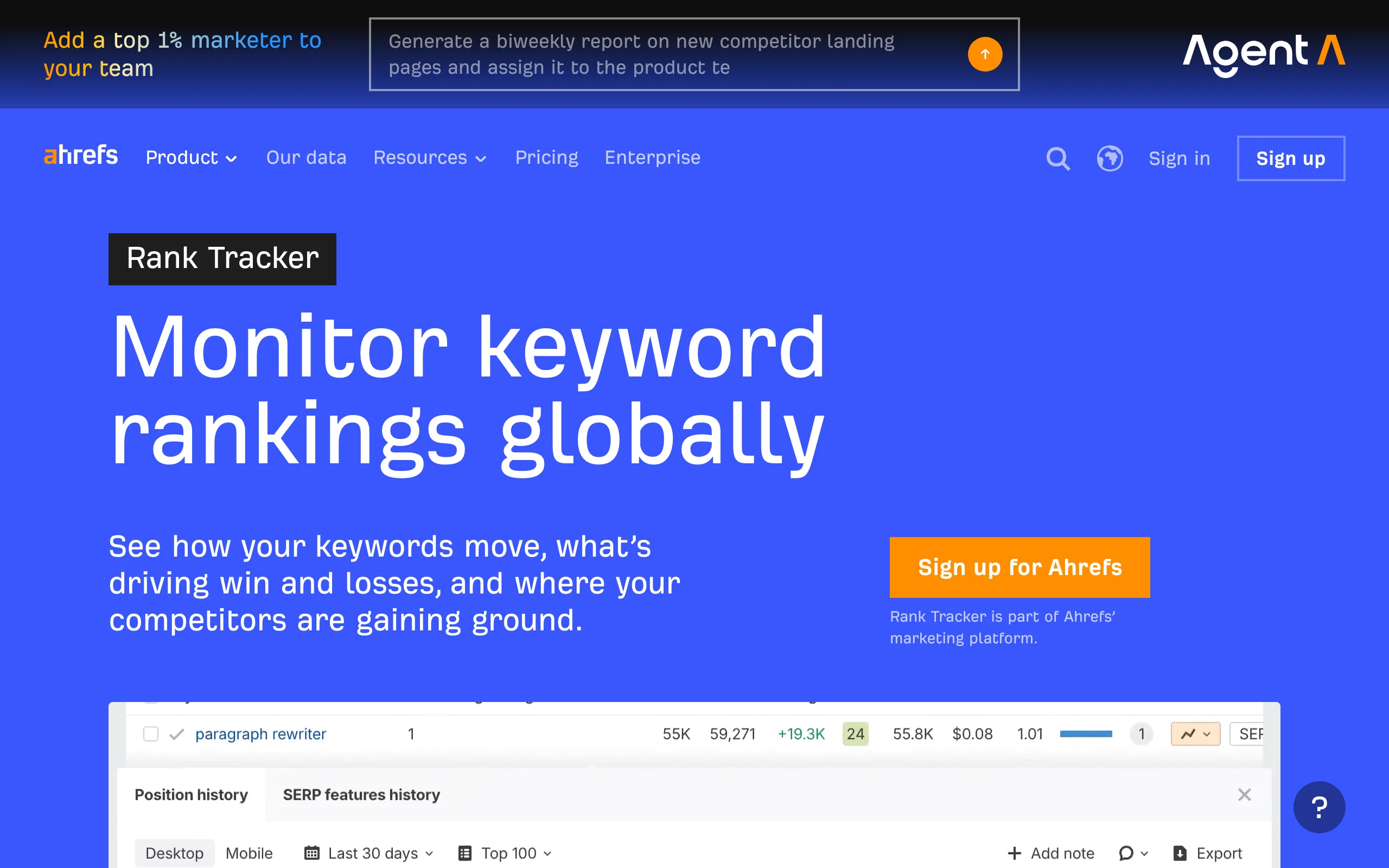
Ahrefs has added AI Overview signals into Rank Tracker, Keywords Explorer, and Site Explorer. For SEO teams that already live inside Ahrefs for keyword research and backlink analysis, the AI Overview module exposes which tracked keywords now trigger an Overview, who is being cited, and how the Overview composition has shifted over time.
Like Semrush, Ahrefs is a classic SEO suite extending into AI search. The strength is the depth of the underlying keyword and backlink graph, which gives valuable context to AI Overview movements.
Key features
- AI Overview indicator on tracked keywords inside Rank Tracker
- AI Overview filter inside Keywords Explorer for opportunity sizing
- Source URL extraction with backlink context
- Domain-level AI Overview share trend
- Strong integration with Ahrefs' wider authority and link metrics
Best for
- SEO teams that run keyword-first workflows and already use Ahrefs as their primary stack
- Content strategists pairing AI Overview signals with backlink and traffic data
- Agencies building AI Overview opportunity decks for clients
Pricing
- Bundled inside Ahrefs paid plans from $129 per month
- Limited free Ahrefs Webmaster Tools for your own verified domain
Pros
- Pairs AI Overview signals with the strongest backlink graph in the industry
- Familiar Ahrefs UX for any keyword-first SEO
- Good for sizing Overview opportunities at scale
Cons
- Coverage of ChatGPT, Perplexity, and Gemini is limited compared with multi-engine platforms
- AI Overview module is a layer on top of classic SEO, not the core product
How to choose the best AI Overview rank tracker for your team
1) Tool only or tool plus agency execution
An AI Overview rank tracker shows you where you stand. It does not move the citation needle. If your team has the capacity to read the data, brief content, ship schema, and run authority work, a tool by itself is enough. If your team is already maxed out, pairing a tracker with a GEO programme that runs the entity, content, and authority work behind the scenes is the faster path to actual citation gains. Many teams start with Otterly or Peec for tracking, then layer in agency execution once the data shows where to invest.
2) Number of AI engines you actually care about
If your buyers ask questions in Google AI Overviews and that is where the revenue impact sits, a focused Overview tracker like SE Ranking, Semrush, or Ahrefs is enough. If your category is also active inside ChatGPT, Perplexity, and Gemini, a multi-engine platform like Profound, AthenaHQ, Otterly, or Peec is worth the extra spend. A useful proxy: run your top 20 buyer prompts by hand or in the AY Rank app, then count how many AI engines actually return relevant answers. That tells you whether a single-engine or multi-engine tracker fits.
3) Depth of analysis versus reporting speed
Prompt-level analysis tools like AthenaHQ and Profound are built for analysts and content strategists who need raw data, source URLs, and pattern detection. Self-serve tools like Otterly and Peec are built for marketing teams who need a weekly digest and a clean chart for the executive update. Both are valid choices, and the wrong fit feels like friction every week. If your team will not use the deeper data, pay for the simpler tool.
4) Total cost of ownership, not sticker price
A $499 platform with full prompt curation, onboarding, and a clear share-of-voice metric is often cheaper than a $65 tool that requires a senior SEO to maintain prompt lists and build their own reporting. Factor in onboarding time, ongoing prompt curation, and the cost of internal reporting work before deciding. A good rule: run a four-week pilot tracking your top 50 buyer prompts on a free tier or trial before committing to an annual contract.
If you have picked your AI Overview tracker but want a partner to actually run the GEO programme behind it, including entity architecture, schema work, authority deployment, and ongoing citation work across ChatGPT, Perplexity, Gemini, and Google AI Overviews, that is what AY Rank does. We help B2B brands go from invisible to consistently cited inside AI answers, and pair the dashboard data your team is already collecting with the execution work that moves citation share. Book a free AI ranking audit to see where your brand currently shows up across AI Overviews and the main AI engines.
For deeper reading on the wider toolset, see our companion guides to the best AI SEO tools in 2026 and the best GEO tools in 2026, or read how to appear in Google AI Overviews for the content and entity playbook behind the citations these trackers measure.
For classic Google positions as data rather than AI Overview presence, see rank tracking APIs compared.
FAQ
What is an AI Overview rank tracker?
An AI Overview rank tracker is a tool that monitors when Google's AI Overview appears for a given keyword, which sources are cited inside that Overview, and how your brand's presence in those citations changes over time. Unlike a classic SERP rank tracker, it tracks a synthesised answer block rather than a position in the ten blue links, and reports metrics like citation share and source attribution rather than position 1 to 10.
How is AI Overview tracking different from SERP tracking?
Classic SERP tracking reports the position of your URL in Google's ten blue links for a given keyword. AI Overview tracking reports whether an AI Overview appears at all for that keyword, which URLs Google pulled into the synthesised answer, and what share of those citations your domain represents. A keyword can rank #1 in classic SERP and still be absent from the AI Overview, which is the gap these trackers are built to expose.
Can free tools track AI Overviews?
Yes, partially. Otterly AI has a usable free tier covering a small number of prompts. The free AY Rank AI visibility checker is a quick readiness estimate, not a tracker, so run it before you pay for one. For ongoing programme-level tracking with daily refreshes, large prompt volumes, and competitor analysis, a paid tool is generally required.
How accurate is AI Overview tracking?
Accuracy varies by tool and by query. Google does not publish a stable AI Overview API, so trackers rely on scraping rendered SERPs across a rotating set of geographies and devices. The better tools (Profound, AthenaHQ, Otterly) refresh daily and run from multiple locations, which catches more of the variability. Expect a small amount of noise day to day and read trends over weeks, not single-day snapshots.
Does Google publish AI Overview data via API?
No. As of 2026, Google does not expose AI Overview presence or citation data through any public API. All tracking tools rely on scraping rendered search results, which means rate limits, geography rotation, and parsing logic are part of what you pay for. Tools that claim API access are exposing their own data, not Google's.
Which tool covers the most prompts per dollar?
At the entry level, Otterly AI's free tier and low-cost paid plans offer the best prompt-per-dollar ratio for small teams. At scale, SE Ranking and Semrush bundle AI Overview tracking inside a wider SEO suite, which lowers the marginal cost if you already need classic SERP tracking. Enterprise platforms like Profound and AthenaHQ cost more per prompt but include analysis, source attribution, and multi-engine coverage that the cheaper tools do not.
Can I track AI Overviews and ChatGPT in one tool?
Yes. Multi-engine platforms like Profound, AthenaHQ, Otterly, and Peec track Google AI Overviews alongside ChatGPT, Perplexity, and Gemini in one dashboard. SE Ranking, Semrush, and Ahrefs are stronger on AI Overviews and Google-side signals but provide thinner coverage of the other AI engines. If your buyers ask questions inside ChatGPT and Perplexity as well as Google, a multi-engine platform avoids stitching three tools together.
Do I need a tool or an agency to actually move AI Overview citations?
You need both, in sequence. A tracker shows you the gap. Moving the citation needle requires entity architecture, schema markup, authoritative content, and consistent brand mentions across the wider web, which is programme work rather than a SaaS feature. Many B2B teams start with a tracker for monthly visibility data, then add a GEO agency partner once they see which prompts and competitors need targeted execution work.