Buyer research has shifted from Google's ten blue links to ChatGPT, Perplexity, Gemini, Claude, and Google AI Overviews. When a prospect asks an answer engine "what's the best CRM for a Series B SaaS," your brand is either cited in that answer or it isn't. Answer engine optimization (AEO) is the discipline of making sure you are.
Tracking that visibility, and figuring out which prompts, entities, and citations actually move the needle, is what AEO tools are built for. This guide compares the seven strongest AEO platforms in 2026 across pricing, AI engine coverage, prompt depth, and the kind of team each one fits. Every entry includes honest pros and cons, plus a decision framework at the end.
TL;DR: for most marketing teams, Profound is the strongest all-in-one AEO platform; if you want a lighter, cheaper citation tracker, Otterly AI or Peec AI are focused picks; if AEO is one workflow inside a larger SEO suite, SE Ranking and Surfer SEO already cover it.
Best AEO tools in 2026: a brief overview
Each tool below earns a unique "best for" slot. The list is ordered by overall fit for a typical B2B marketing team running a structured AEO programme, not by alphabetical or vendor preference.
- Profound: Best overall AEO platform for enterprise and mid-market teams. Tracks brand share-of-voice across ChatGPT, Perplexity, Gemini, Claude, and Google AI Overviews in one dashboard, with prompt-level drill-downs and competitor benchmarks.
- Otterly AI: Best lightweight AEO tracker for SMBs and solo operators. Monitors brand mentions and citations across the major answer engines on a fixed prompt list, with a free trial for getting started.
- Peec AI: Best AEO analytics tool for in-house marketing teams. Strong on prompt clustering, citation source analysis, and weekly trend reports that plug into existing marketing dashboards.
- AthenaHQ: Best AEO platform for agencies and multi-brand operators. Built around multi-workspace tracking, white-label reports, and competitor share-of-voice across dozens of brands at once.
- SE Ranking AEO: Best AEO module inside a full SEO suite. Adds AI Overview tracking and LLM mention monitoring to an established rank tracker, useful for teams that already pay for traditional SEO tooling.
- Surfer SEO: Best content-side AEO workflow. Optimizes existing pages for answer engine extraction with entity coverage scoring, schema suggestions, and structured-content guidance baked into the content editor.
- Frase: Best AI-assisted brief and FAQ builder for AEO content. Generates question clusters, FAQ blocks, and answer-engine-friendly outlines from real SERP and AI search data.
| Tool name | Key strength | Pricing | Platforms |
|---|---|---|---|
| Profound | Multi-engine citation tracking with prompt-level analytics | Custom enterprise pricing; demo on request | Web app, API |
| Otterly AI | Simple, affordable LLM citation monitoring | Free trial; paid from around $29 per month | Web app |
| Peec AI | Prompt clustering and citation source reporting | Free trial; paid from €85 per month | Web app, API |
| AthenaHQ | Multi-brand and white-label AEO tracking | Custom pricing; agency tiers available | Web app, API |
| SE Ranking AEO | AI Overview tracking inside a full SEO suite | From around €59-79 per month for the suite, depending on billing | Web app, API, browser extension |
| Surfer SEO | Content optimization for answer engine extraction | From around $99 per month (billed monthly) | Web app, browser extension |
| Frase | AI brief and FAQ generation for AEO content | From $39 per month billed yearly ($49 monthly) | Web app, browser extension |
1. Profound, best overall AEO platform for mid-market and enterprise teams
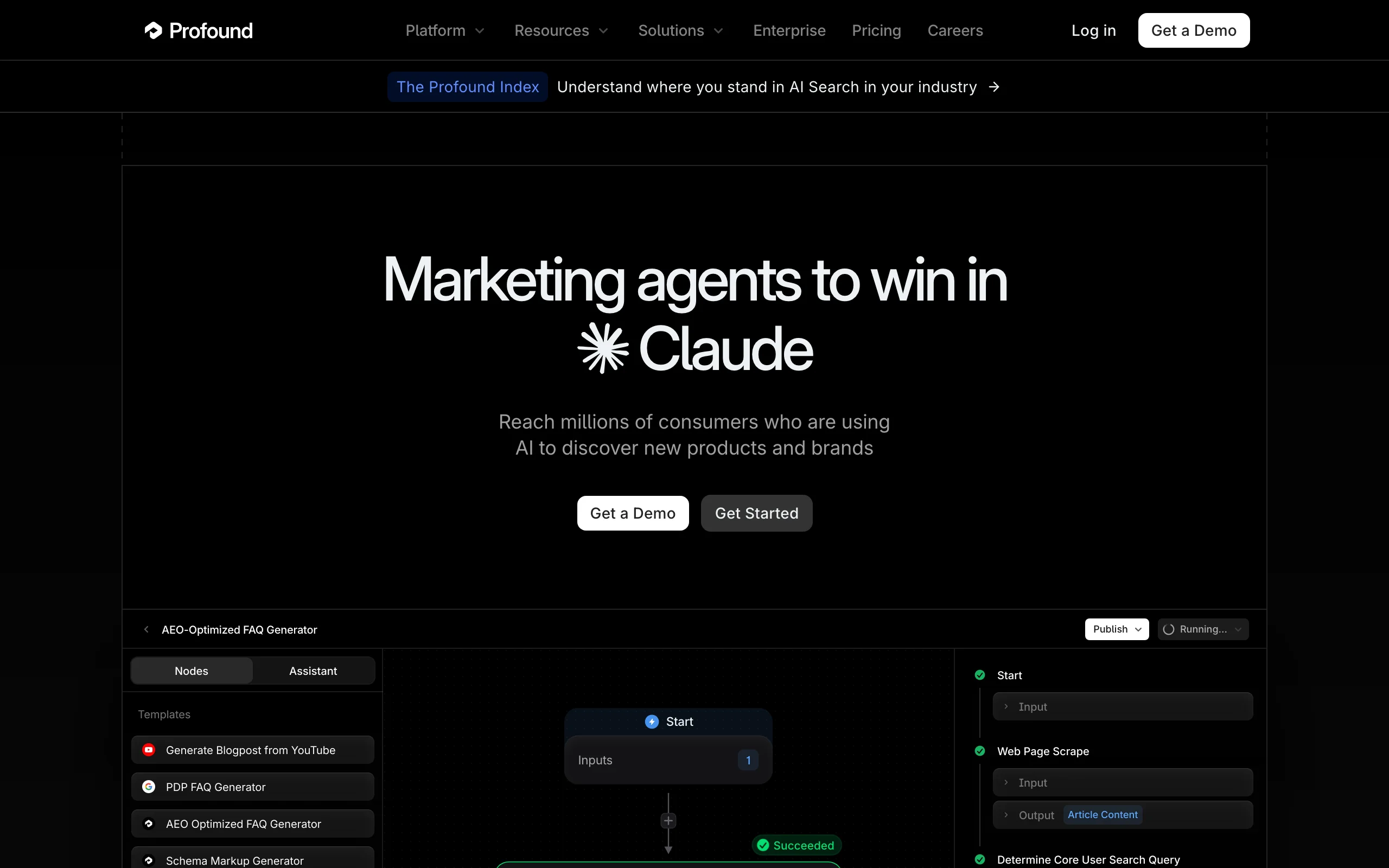 AEO Tools with Profound
Profound is an answer engine optimization platform that tracks how often your brand is cited across ChatGPT, Perplexity, Gemini, Claude, and Google AI Overviews for a defined set of buyer prompts. It runs scheduled prompt queries against each engine, captures the full answer text and citation sources, and reports share-of-voice against competitors over time.
The platform is built for marketing and SEO leaders who treat AEO as a core programme, not a side experiment. Most users monitor between 100 and 2,000 prompts, segmented by funnel stage, persona, and product category. Internal dashboards surface which prompts your brand wins, which competitors dominate, and which citation sources (your own pages, third-party reviews, Reddit threads, news articles) the engines are pulling from.
Key features
- Multi-engine prompt tracking across ChatGPT, Perplexity, Gemini, Claude, and Google AI Overviews
- Share-of-voice scoring versus a defined competitor set
- Citation source breakdown, including own-domain, third-party, and UGC sources
- Prompt clustering by intent, funnel stage, and topic
- Historical trend lines with daily or weekly refresh cadence
- API access for piping data into Looker, Tableau, or custom dashboards
Best for
- Mid-market and enterprise marketing teams running a dedicated AEO programme
- Brands with named competitors they need to benchmark against
- Teams that want one source of truth across all major answer engines
Pricing
- Custom enterprise pricing, typically in the four to five-figure monthly range
- Demo and pilot available on request
Pros
- Broadest engine coverage in the category, including Claude and Google AI Overviews
- Citation source analysis is genuinely actionable, not just descriptive
- Strong competitor benchmarking out of the box
Cons
- Pricing puts it out of reach for small teams and solo operators
- Setup and prompt curation requires real effort to get value
- No on-page or content recommendations, you bring the execution layer
2. Otterly AI, best lightweight AEO tracker for SMBs
 AEO Tools with Otterly AI
Otterly AI is a focused answer engine optimization tracker that monitors brand mentions and citations across ChatGPT, Perplexity, Gemini, and Google AI Overviews. It is designed for small teams and solo marketers who want to start measuring AEO visibility without a four-figure monthly commitment.
The product keeps the surface area small on purpose. You define a list of prompts and competitors, Otterly runs them on a schedule, and you get weekly reports showing mention rate, sentiment, and source citations. It is the easiest tool on this list to set up in under an hour.
Key features
- Prompt tracking across ChatGPT, Perplexity, Gemini, and Google AI Overviews
- Brand mention rate and basic sentiment scoring
- Competitor mention tracking on the same prompt list
- Weekly email reports with trend deltas
- Free trial with a meaningful prompt allowance
Best for
- Small marketing teams running their first AEO pilot
- Founders and solo operators who need a low-cost AEO baseline
- Teams that want to validate AEO before investing in enterprise tooling
Pricing
- Free trial rather than a permanent free tier
- Paid plans start around $29 per month and scale by prompt volume
Pros
- Simple onboarding, usable in a single afternoon
- Affordable entry point with a free trial to validate fit
- Covers the four most-asked answer engines
Cons
- Limited prompt depth and clustering compared to enterprise platforms
- No API on lower tiers
- Reporting is descriptive rather than prescriptive
3. Peec AI, best AEO analytics tool for in-house marketing teams
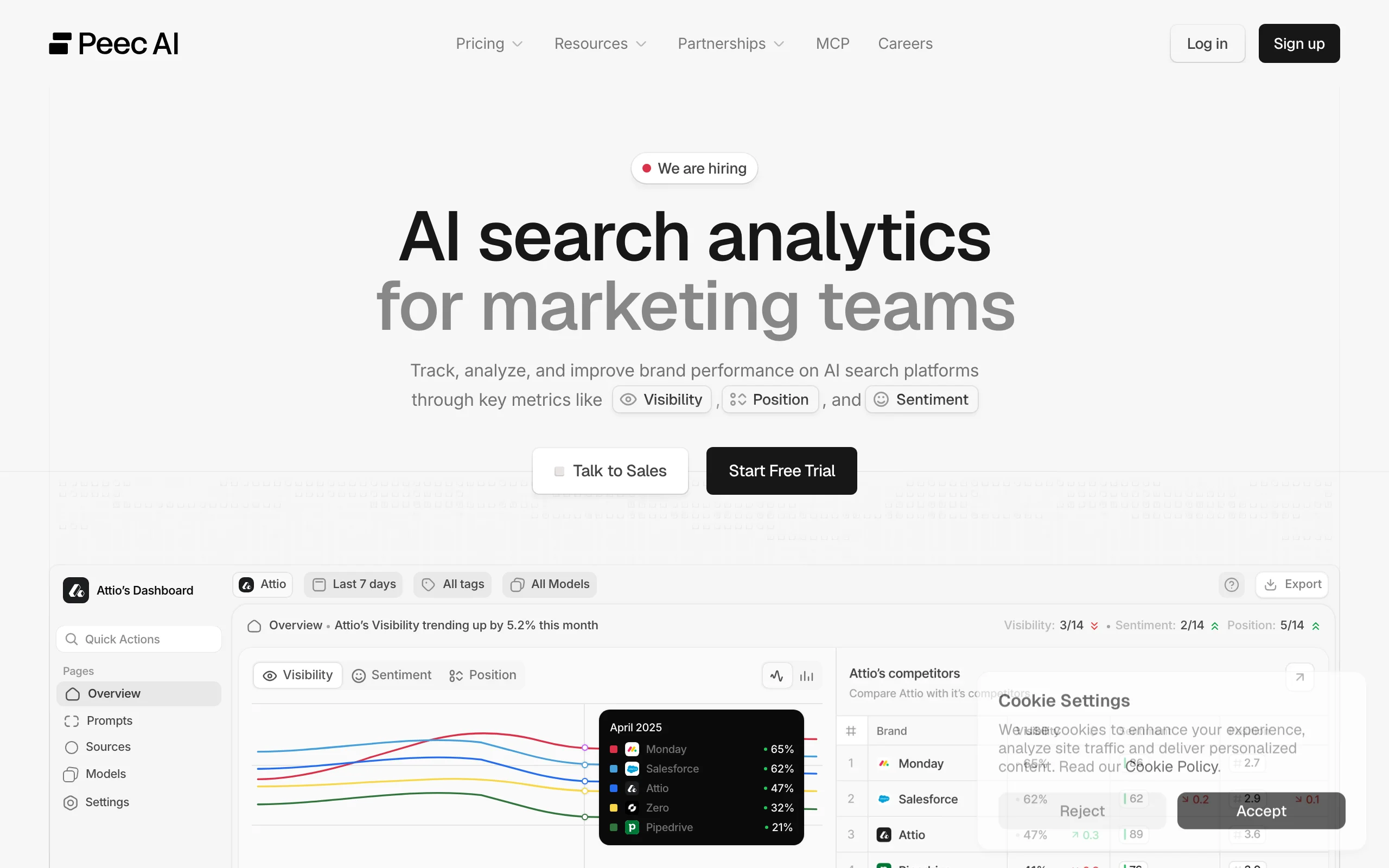 AEO Tools with Peec AI
Peec AI is an AEO analytics platform that focuses on prompt clustering and citation source analysis for in-house marketing teams. Where Otterly tracks mentions and Profound benchmarks share-of-voice, Peec leans into the analytics layer: which topics are gaining or losing AI search visibility, which sources are feeding the engines, and how that maps to your content programme.
The product fits teams that already publish content regularly and want a clear feedback loop between content produced and citations earned. Peec groups prompts into intent clusters, scores topic-level visibility, and surfaces the third-party sources (review sites, communities, publications) that need attention.
Key features
- Prompt clustering by topic, intent, and funnel stage
- Citation source reporting with own-domain versus third-party split
- Topic-level visibility scoring across answer engines
- Weekly trend reports with movement alerts
- API access for piping into BI tools
Best for
- In-house marketing teams with an active content programme
- Brands that need to understand which sources answer engines actually pull from
- Teams sitting between SMB and enterprise scale
Pricing
- Free trial available
- Paid plans start at €85 per month and scale by prompt volume and seats
Pros
- Strong analytics layer beyond raw mention counts
- Citation source insights connect AEO data to content and PR action
- Cleaner UX than most enterprise alternatives
Cons
- Engine coverage is solid but not as deep as Profound on Claude and AI Overviews
- Requires a content workflow already in place to extract full value
- Mid-tier pricing is a step up from purely entry-level trackers
4. AthenaHQ, best AEO platform for agencies and multi-brand operators
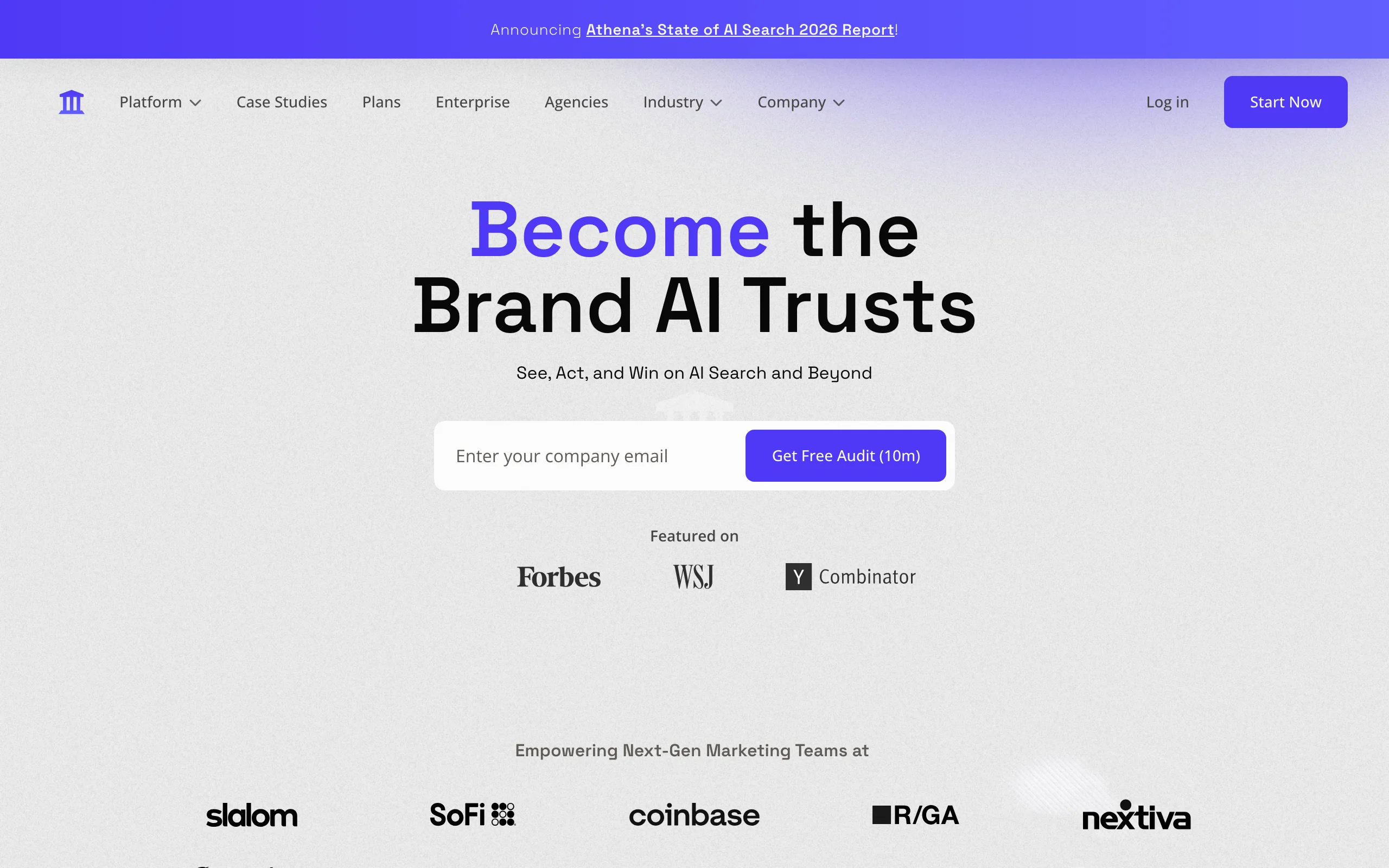 AEO Tools with AthenaHQ
AthenaHQ is an AEO tracking platform built for agencies, holding companies, and in-house teams managing multiple brands. It treats workspaces, white-label reporting, and bulk prompt management as first-class features rather than enterprise add-ons.
The platform supports tracking dozens of brands and their competitor sets in one account, with role-based access for client teams. Reports can be exported with agency branding, and prompt libraries can be cloned across workspaces so a proven template for one client scales to the next.
Key features
- Multi-workspace architecture for agencies and holding groups
- White-label reports and client-shareable dashboards
- Bulk prompt management and library templates
- Competitor share-of-voice across all engines
- Role-based access controls
Best for
- AEO and SEO agencies servicing multiple clients
- Holding companies tracking a portfolio of brands
- Consultants who run AEO audits as a standalone offering
Pricing
- Custom pricing, typically tiered by number of workspaces and prompts
- Agency-specific plans available
Pros
- Purpose-built for multi-brand workflows
- White-label output saves agencies real production time
- Centralized prompt library scales engagements faster
Cons
- Overkill for single-brand in-house teams
- Pricing transparency is limited until you book a call
- Less polished on deep analytics than Profound or Peec
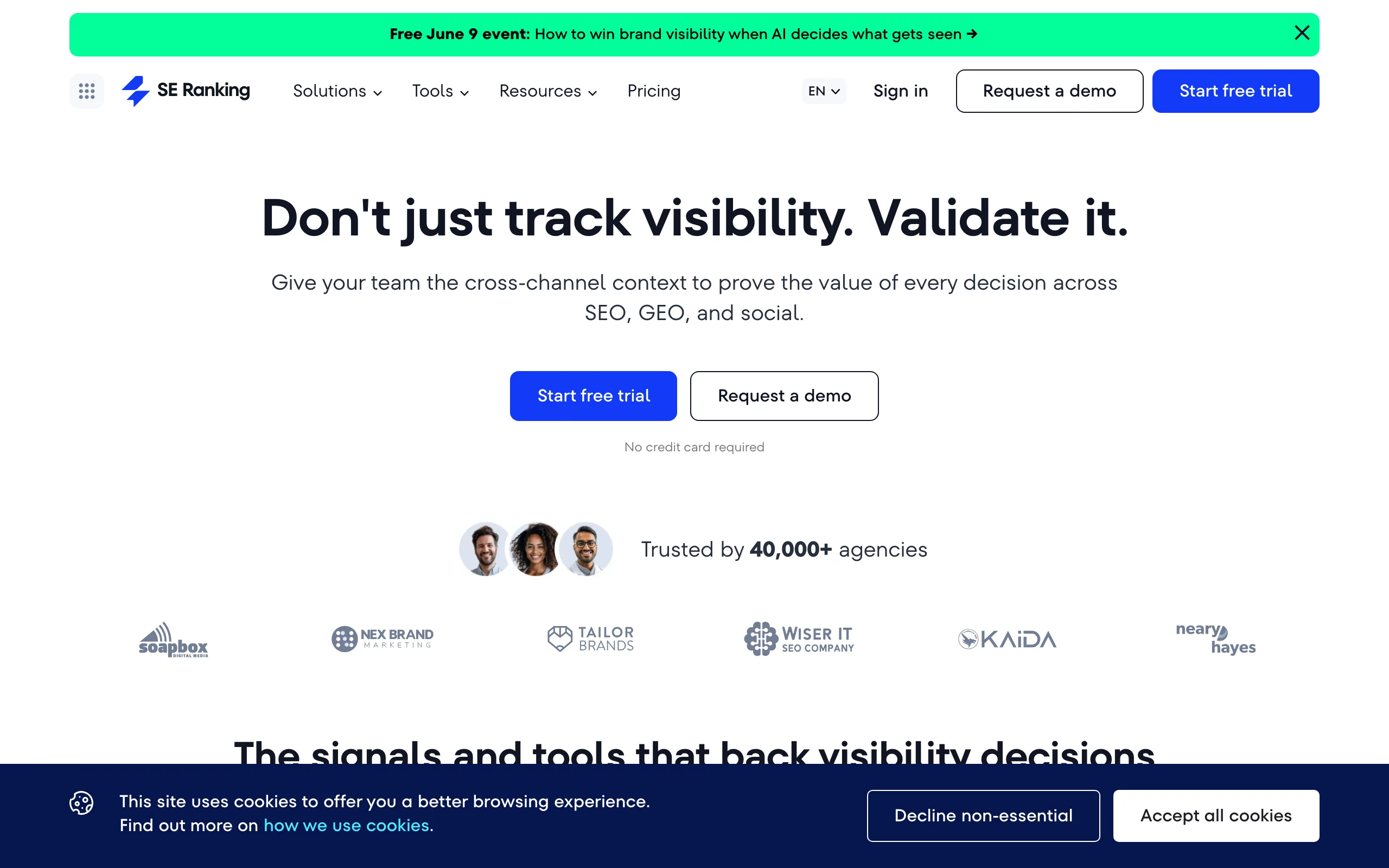
5. SE Ranking AEO, best AEO module inside a full SEO suite
 AEO Tools with SE Ranking
SE Ranking is a long-running SEO suite that has added a dedicated AEO module covering AI Overview tracking and LLM mention monitoring. For teams that already pay for SE Ranking for traditional rank tracking, keyword research, and site audits, the AEO layer is the cleanest way to add answer engine visibility without buying a second tool.
The AEO module tracks brand mentions and citations across ChatGPT, Perplexity, Gemini, and Google AI Overviews, with results plotted alongside traditional keyword rankings. That side-by-side view is genuinely useful for SEO leads who need to brief leadership on both classic and AI search performance in one report.
Key features
- AI Overview presence and citation tracking
- LLM mention monitoring across the major engines
- Side-by-side reporting with classic keyword rank data
- Integration with SE Ranking's site audit and keyword research modules
- API access on higher tiers
Best for
- Teams that already use SE Ranking for traditional SEO
- SEO leads who want one report for classic and AI search
- Mid-market brands that prefer one consolidated vendor
Pricing
- The full SE Ranking suite (including AEO features on appropriate tiers) starts at around €59-79 per month depending on billing and region
- AEO functionality typically sits on higher-tier plans
Pros
- Consolidates classic SEO and AEO into one workflow and one bill
- Side-by-side rank versus AI mention reporting is rare and useful
- Mature suite with strong site audit and keyword tooling
Cons
- AEO depth is less than dedicated platforms like Profound
- You may pay for SEO features you do not need just to access AEO
- Engine coverage and prompt depth lag the specialist tools
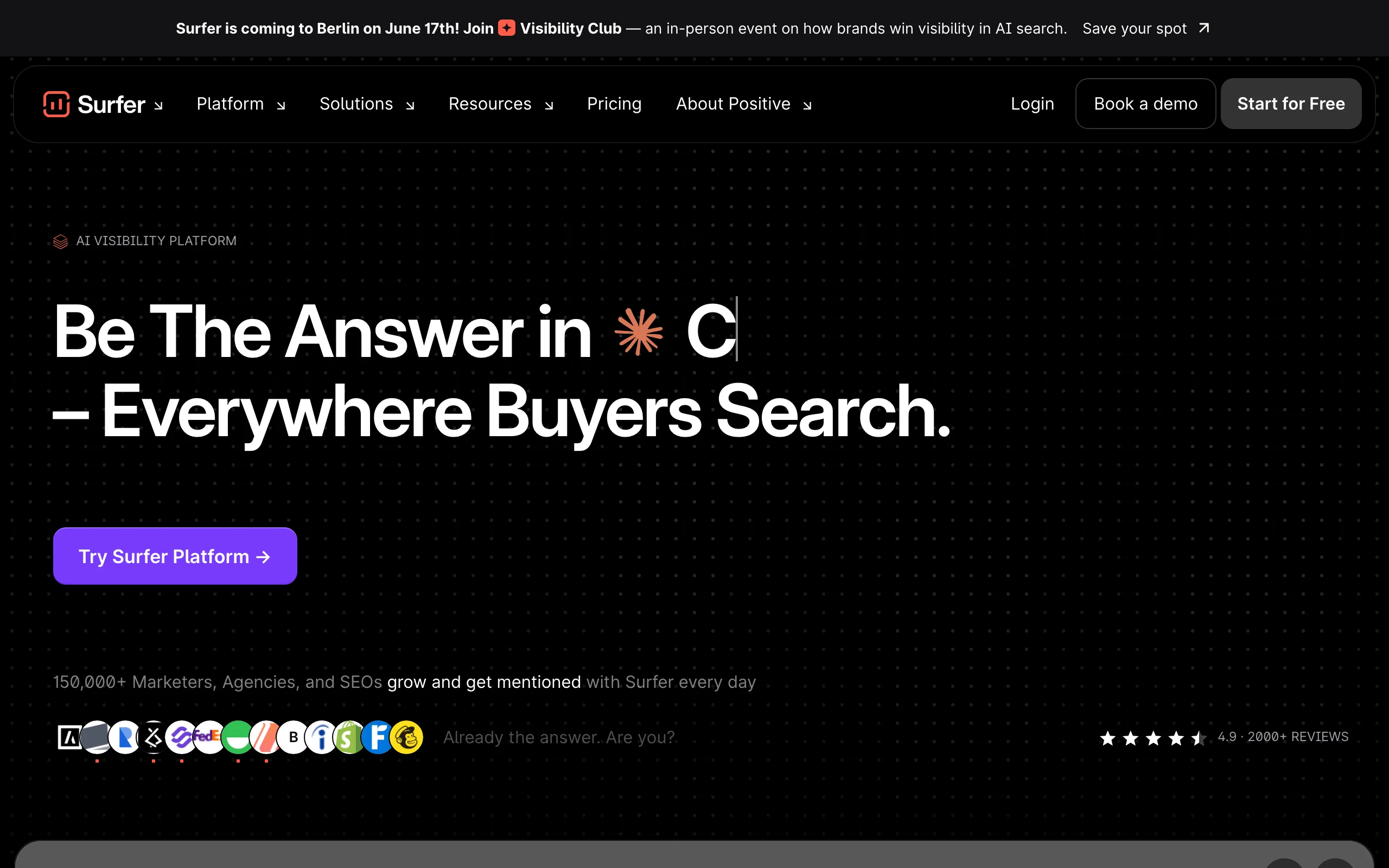
6. Surfer SEO, best content-side AEO workflow
 AEO Tools with Surfer SEO
Surfer SEO is a content optimization tool that has extended its NLP and entity coverage scoring into answer engine optimization. Where the tools above focus on tracking visibility, Surfer focuses on producing the kind of content that answer engines actually extract and cite.
Inside the content editor, Surfer scores draft pages on entity coverage, structured content patterns (FAQs, definition paragraphs, comparison tables), and schema completeness. For teams whose AEO bottleneck is execution rather than measurement, Surfer plugs into the writing workflow itself.
Key features
- Content editor with entity coverage scoring
- Structured content suggestions (FAQs, definitions, tables)
- Schema markup recommendations for articles and FAQs
- SERP and AI-source analysis for target queries
- Browser extension for in-CMS editing
Best for
- Content teams optimizing pages directly for answer engine extraction
- In-house marketers who already use a content optimizer and want AEO patterns built in
- Brands shipping high content volume and needing consistency at scale
Pricing
- Paid plans start around $99 per month billed monthly, less on annual plans
- Higher tiers add team seats, more content credits, and audits
Pros
- Closes the loop between AEO insight and on-page execution
- Entity coverage scoring is well-suited to LLM extraction patterns
- Mature editor with strong workflow integration
Cons
- Not a tracker, you still need a separate tool for measuring citations
- Content scoring can over-index on volume of entities versus quality
- Limited multi-brand support compared to agency-focused platforms
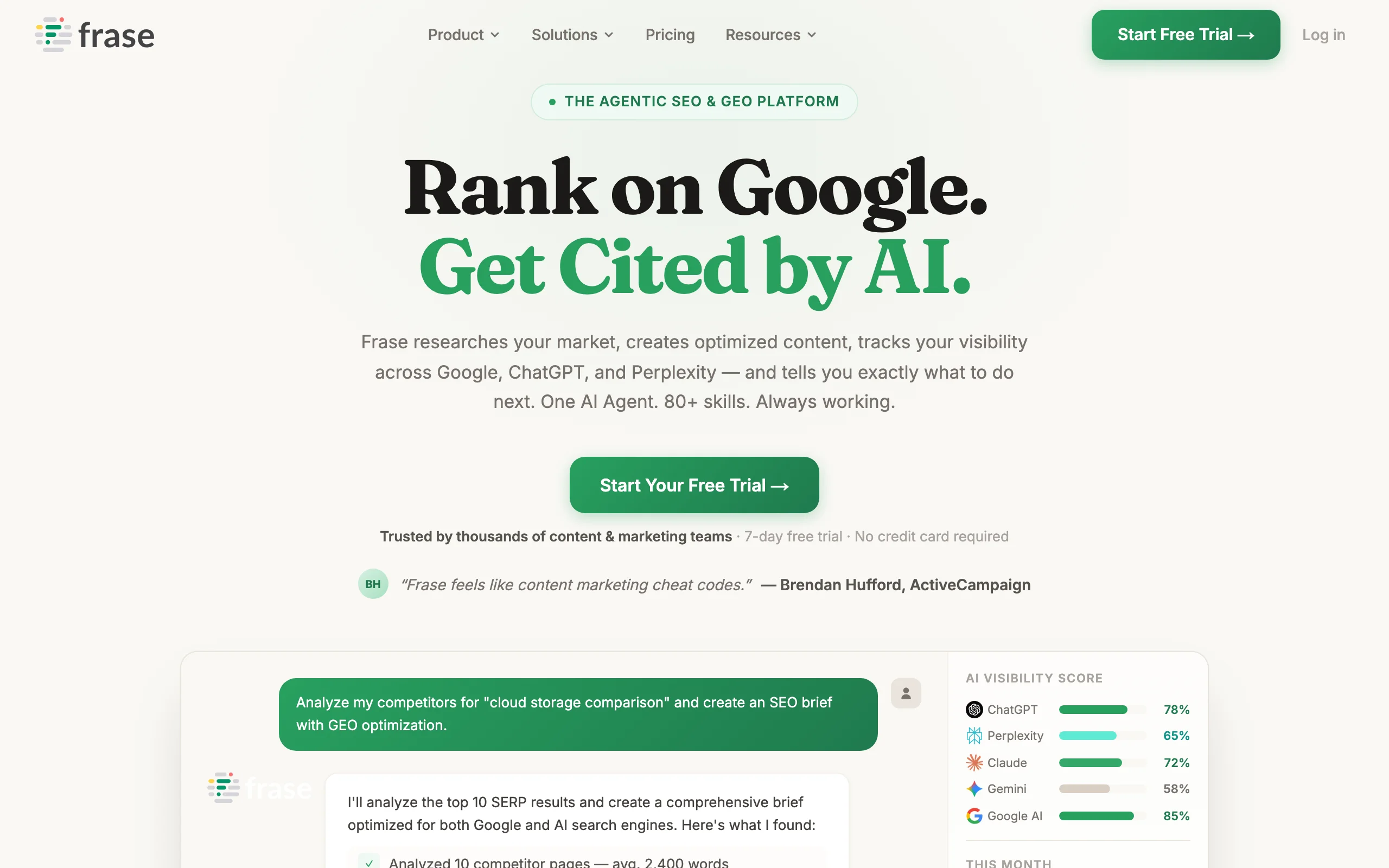
7. Frase, best AI-assisted brief and FAQ builder for AEO content
 AEO Tools with Frase
Frase is an AI-assisted content brief and FAQ builder that pulls real questions from SERPs, People Also Ask, and answer engine results to feed AEO-ready content. It is less of a tracker and more of an upstream tool that helps content teams ship pages structured for AI citation from day one.
The brief builder identifies high-value question clusters, generates FAQ blocks, and outlines content with sub-headings that match how answer engines extract information. For teams that want to convert AEO research into briefs and drafts quickly, Frase compresses the prep cycle from days to hours.
Key features
- Question and FAQ generation from real SERP and AI search data
- Content brief builder with AEO-friendly outlines
- Topic clustering and content gap analysis
- AI-assisted draft generation tied to brief data
- Browser extension for capturing questions in the wild
Best for
- Content marketers building AEO-optimized briefs at scale
- Editorial teams that need a faster prep-to-draft cycle
- Brands targeting question-led keywords as part of an AEO programme
Pricing
- Paid plans start at $39 per month billed yearly ($49 month to month)
- Higher tiers add seats, content credits, and AI usage allowances
Pros
- Strong question-mining workflow tied to AEO content patterns
- Fast brief-to-outline cycle for editorial teams
- Affordable entry point for small content teams
Cons
- No citation tracking, pair it with a tracker for the full loop
- AI-generated drafts still need significant human editing
- Less depth than a dedicated content editor like Surfer for on-page scoring
How to choose the best AEO tool for your team
Picking the right answer engine optimization tool comes down to a few practical decisions. Most teams stall not because they cannot find a tool, but because they have not framed the choice clearly.
1) Tracking only, or tracking plus content execution
If your bottleneck is "we have no idea where we show up in ChatGPT and Perplexity," start with a tracker like Profound, Otterly AI, or Peec AI. Get a baseline before you spend on execution tools.
If your bottleneck is "we know we are invisible and we need to ship content that gets cited," pair a lighter tracker with Surfer SEO or Frase for the content workflow. Many teams end up running both layers, one tracker and one content tool.
2) Engine coverage and prompt depth
If you only care about ChatGPT and Google AI Overviews, almost every tool here covers you. If your buyers also use Perplexity, Gemini, and Claude, look for tools with broad multi-engine coverage. Profound and AthenaHQ are the deepest on this dimension.
Prompt depth matters too. Tracking 50 prompts gives directional data. Tracking 500 to 2,000 prompts segmented by funnel stage and persona gives a real programme. If your shortlist of buyer prompts is well into the hundreds, eliminate any tool that caps you on volume.
3) In-house team versus agency versus multi-brand
Single-brand in-house teams should stay focused: pick one tracker and one content tool. Agencies and multi-brand operators should weigh AthenaHQ heavily for its workspace model and white-label output. SEO-led teams already on SE Ranking get a faster path by adding the AEO module rather than buying a fourth platform.
4) Pilot before you commit
Whichever tool you choose, run a four-week pilot tracking your top 20 to 50 buyer prompts before signing an annual contract. AEO data only gets meaningful with a few weeks of trend, and the tool that demos best is not always the one your team uses six months in.
If you want a deeper backgrounder on the discipline itself, the answer engine optimization guide covers the strategy layer underneath the tooling. For a broader look at adjacent platforms, the best AI SEO tools roundup compares the wider AI search software market.
Should you hire an AEO partner instead of (or alongside) a tool
If you have picked your AEO tool but want a partner to run the programme behind it, that is what AY Rank does. We help B2B brands move from invisible to consistently cited across ChatGPT, Perplexity, Gemini, Claude, and Google AI Overviews through a focused four-step programme: AI Ranking Audit, Entity Architecture, Authority Deployment, and Validation & Results. Most teams pair our GEO optimization service with the tracking tool of their choice. You can also stress-test where your brand currently shows up with the free AI visibility checker, or book a free AI ranking audit to see exactly which buyer prompts you are missing today. If you would rather hire an external team end-to-end, the best AEO agencies roundup compares the strongest specialist firms in 2026.
FAQ
What are AEO tools? AEO tools, or answer engine optimization tools, are software platforms that track how often your brand is cited in answers from ChatGPT, Perplexity, Gemini, Claude, and Google AI Overviews, and that help you produce content structured for those engines to extract. They sit on top of (or alongside) traditional SEO tools and focus on AI search visibility rather than classic keyword rankings.
What is the best AEO tool in 2026? For most mid-market and enterprise marketing teams, Profound is the strongest all-in-one AEO platform thanks to its multi-engine coverage and prompt-level analytics. For small teams and solo operators, Otterly AI offers the best balance of coverage and price. For agencies and multi-brand operators, AthenaHQ is purpose-built for the workflow.
Is there a free AEO tool? Otterly AI offers a free trial covering a limited number of prompts and engines, which is enough to validate the discipline before paying. Peec AI and Frase offer free trials rather than long-term free tiers. Most enterprise platforms (Profound, AthenaHQ) require a paid pilot or demo.
What is the difference between SEO tools and AEO tools? SEO tools track keyword rankings and organic traffic from search engine results pages, mainly Google and Bing. AEO tools track brand mentions and citations inside answers generated by AI engines like ChatGPT, Perplexity, Gemini, Claude, and Google AI Overviews. Many teams now run both layers, and a few suites (like SE Ranking) bundle them.
Which AEO tool is best for tracking Google AI Overviews? Profound, AthenaHQ, and SE Ranking AEO all track Google AI Overview presence and citations directly. Profound has the deepest prompt-level reporting, AthenaHQ is strongest for multi-brand views, and SE Ranking is the easiest pick if you already use the suite for classic SEO.
Should I run AEO in-house or hire an agency? If you have an experienced content and SEO team plus budget for a dedicated AEO tool, running it in-house is viable. If your team is already at capacity, or if you need entity work, schema, and authority signals built from scratch, hiring a specialist AEO partner is faster. Many brands run both: a tool for measurement and a specialist AEO partner for execution.
How long does it take to see results from AEO tools? Expect the first useful baseline within four weeks of tracking your top buyer prompts. Meaningful movement in citations and share-of-voice typically takes 90 to 180 days, because answer engines need time to re-index entities, schema, and authority signals. Tools surface that movement, but the underlying programme is what moves it.
Continue reading: 7 Best AI Search Monitoring Tools in 2026 (AI Visibility Tracking)
This post is part of our AI SEO guide. Related reading: Best LLMO Agencies, Best Gemini SEO Agencies, Best AEO Agencies.

Oussama leads technical and on-page SEO at AY Rank. He specializes in structured data engineering, crawl optimization, and building the entity architecture that makes AI models cite our clients.
Full Bio →