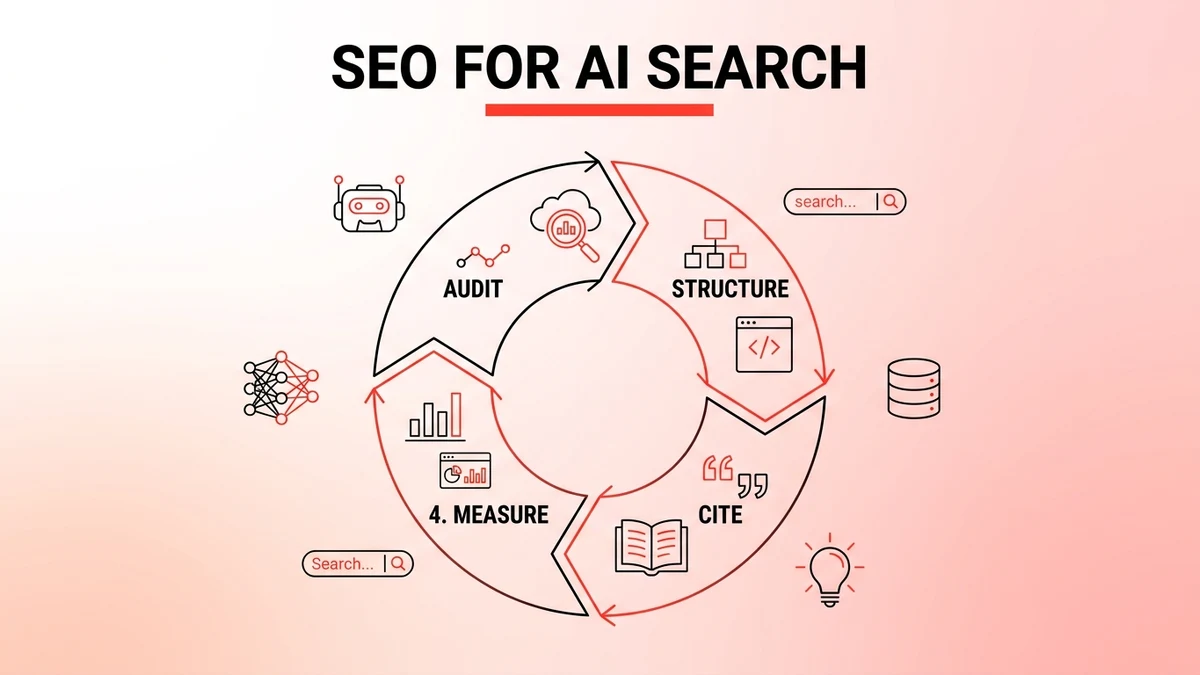
SEO for AI search is not a longer checklist bolted onto your existing SEO process. It is a different operating model: a loop of auditing, structuring, earning citations, and measuring, run on a cadence, because AI engines re-crawl, re-summarize, and re-cite your site on their own schedule, not yours. ChatGPT alone processes queries from 900 million weekly active users as of Q1 2026 (Sam Altman, OpenAI, February 2026), and Google's AI Overviews now appear on 48% of Google search results pages (BrightEdge Research, Q1 2026), up from roughly 15% in mid-2024.
Most "how to rank in AI Overviews" content treats this as a one-time punch list: add schema, write FAQs, done. That misses the part that actually determines whether you keep showing up. AI engines re-index and re-summarize on their own timelines, so a page that gets cited in March can quietly drop out by June with no warning and no ranking-position signal to alert you. This piece lays out the framework we run internally at AY Rank: four phases, run as a repeating cycle rather than a single project, with a fifth section walking through what one cycle looks like on a real page.
What is SEO for AI search, and how is it different from a checklist?
SEO for AI search is the practice of making a site's content extractable, verifiable, and citable by generative engines, ChatGPT, Perplexity, Gemini, and Google AI Overviews, rather than only rankable in a list of ten blue links. A checklist tells you what to add once. A framework tells you when to check whether what you added still works, and what to do when it stops.
The difference matters because the failure mode is different. Traditional SEO decay is usually visible: a keyword ranking slips from position 3 to position 11 and you can see it in Search Console. AI citation decay is often invisible until you go looking. A brand can be the top-cited source for a query in one month and absent the next, because the model updated its retrieval index, a competitor published a more current stat, or the query itself started returning a different kind of answer. Nothing in Google Search Console tells you that happened. You have to check.
Why does SEO for AI search need a repeating framework, not a one-time project?
Because the underlying systems are not static. Google's AI Overviews sat around 15% of SERPs in mid-2024 and reached 48% by Q1 2026 (BrightEdge), a shift big enough to change which of your pages are even eligible for a citation, let alone which ones currently win one. Run an audit once, in isolation, and you are measuring a moving target with a single frozen snapshot.
The four phases below map to a cycle: audit, structure, citations, measurement, then back to audit. Skipping straight to structure without an audit means guessing at priorities. Structuring content but never measuring means you find out something broke only when a client or a prospect mentions it in a sales call, which is the worst way to find out.
Phase 1: how do you audit a site for AI search visibility?
An AI search audit starts with three questions: can AI crawlers reach your content, can they parse it into a clean answer, and are you already being cited anywhere for the queries you care about.
Crawler access. Check robots.txt for explicit allow rules on GPTBot, PerplexityBot, ClaudeBot, and Google-Extended. A site that blocks these to "protect content" is opting out of citation entirely, not protecting anything, since a blocked crawler simply cannot cite you.
Extractability. Pull your top 10-20 pages and read them the way a language model does: does the first sentence under each heading actually answer the question the heading asks, or does it take three paragraphs to get there? Most enterprise content fails this test even when it ranks well in classic SEO, because classic SEO never penalized a buried answer the way an extraction-based engine does.
Existing citation footprint. Run your brand name and your 10-15 highest-value queries through ChatGPT, Perplexity, and Google AI Mode directly, then note which pages get cited, which get paraphrased without a link, and which queries return a competitor instead. This is manual and a little tedious. It is also the only way to get a true baseline before you change anything, which our own AI visibility audit is built to formalize when you want it done at scale rather than by hand.
Phase 2: how do you structure content so AI engines can extract it?
Structure work turns a page that ranks into a page that gets quoted. Three things do most of the work.
Answer-first writing. Every H2 phrased as a question needs its answer in the first sentence beneath it, not the third paragraph. Models extract the lead sentence far more often than they read and summarize an entire section, so a buried answer effectively does not exist to the model even if a human reader would eventually find it.
Structured data that matches the visible page. FAQPage and Article JSON-LD give the engine a machine-readable version of what you already say in prose. It has to match the visible content exactly. Markup-only claims that are not on the actual page are a real risk, not just an SEO best-practice violation, since Google treats mismatched schema as a manipulation signal.
Citable units. A citable unit is a self-contained fact: a number, a date, a named source, phrased so it can be lifted whole into another document without losing meaning. "AI search is growing fast" is not a citable unit. "AI Overviews grew from roughly 15% to 48% of Google SERPs between mid-2024 and Q1 2026 (BrightEdge Research)" is one, because a model can quote it verbatim and the claim still stands on its own.
| Structure element | What it does | Where it lives |
|---|---|---|
| Answer-first H2s | Gives models a clean lead sentence to extract | Body copy, every question-style heading |
| FAQPage JSON-LD | Machine-readable Q&A pairs | <script type="application/ld+json"> per page |
| Article schema | Confirms authorship, publish/update dates | Blog and pillar pages |
| Comparison tables | Higher extraction rate than prose for data | Body copy, 5-8 rows |
| Named, sourced stats | Citable units models can quote directly | Throughout body, with inline attribution |
| Organization/entity schema | Resolves "who is speaking" for the model | Sitewide, layout.tsx or equivalent |
Our schema markup for GEO guide covers the JSON-LD implementation details this phase depends on, and technical SEO covers the crawlability side that has to be solid before any of this matters.
Phase 3: how do you earn citations across AI platforms?
Structure makes you extractable. Citations make you found in the first place, and the two are not the same problem.
Being cited inside an AI Overview correlates with real downstream value: brands cited in an AI Overview get 35% more organic clicks and 91% more paid clicks on the same queries compared to uncited brands (Seer Interactive, 2025-2026 tracking). That is the commercial case for treating citation-earning as its own phase rather than an afterthought of "good content."
Three levers move citation rates:
- Third-party mentions on sites the model already trusts. AI engines weight corroboration: a claim repeated across your own site and two independent sources reads as more reliable than the same claim appearing only on your domain.
- Fresh, dated content on fast-moving topics. Models favor recency signals on anything time-sensitive. A pricing page or a "state of the industry" post updated within the last quarter outranks a stale but otherwise well-optimized competitor.
- Named-entity clarity. If your Organization schema, About page, and press mentions all describe the company the same way, with the same name, founders, and category, the model resolves "who this is" faster and cites with more confidence. Inconsistent naming across your own properties works against you here.
- Consistent entity naming across site, schema, and third-party bios
- Dated, sourced stats refreshed on a set cadence
- Coverage on independent sites the model already trusts
- Content that answers the exact phrasing people put to the AI, not just the phrasing they type into Google
- Claims that only exist on your own domain with no outside corroboration
- Stale statistics presented without a date
- Schema that describes content the page doesn't actually contain
- Generic company descriptions that read the same as ten competitors
Phase 4: how do you measure SEO for AI search results?
Standard rank tracking does not see any of this. Measurement in this framework has three layers, and skipping any one of them leaves a real blind spot.
Direct citation checks. Query ChatGPT, Perplexity, and Google AI Mode with your target prompts on a fixed schedule (weekly for competitive topics, monthly otherwise) and log whether you're cited, paraphrased, or absent. This is the only layer that shows you the actual answer text, not a proxy for it.
Referral-traffic segmentation. AI platforms increasingly show up as distinct referrers in analytics (chatgpt.com, perplexity.ai). Segment this traffic separately from organic search, because its behavior, and its value, is genuinely different: AI-referred visitors often arrive already informed and closer to a decision, which changes what a "good" conversion rate even looks like for that segment.
Share of voice against named competitors. For your 10-20 highest-value queries, track not just whether you're cited but who else is, and how often. A citation rate that looks stable in isolation can still be losing ground if a competitor's citation share is climbing in the same window.
| Measurement layer | What it catches | Frequency |
|---|---|---|
| Direct AI query checks | Actual citation, paraphrase, or absence | Weekly (competitive) to monthly |
| Referral traffic segmentation | Volume and behavior of AI-driven visitors | Ongoing, reviewed monthly |
| Share of voice vs named competitors | Relative citation trend, not just your own | Monthly to quarterly |
| Schema validation | Silent markup breakage | After every content update |
Audit tells you where you stand. Structure makes you extractable. Citations make you found. Measurement tells you when any of the first three quietly stopped working, which is the phase most teams skip and the one that actually closes the loop.
How long does one cycle of the framework take?
A full cycle runs 4-8 weeks for a focused set of priority pages: roughly one week for the audit, two to three weeks for structure and schema fixes, ongoing citation-building work that overlaps with the next audit, and measurement running continuously in the background rather than as a discrete step at the end. Sites with large content libraries or multiple product lines typically run the cycle on a rolling basis, auditing a new segment of the site every month rather than the whole domain at once.
This is slower than a one-time checklist, and that is the point. A checklist gets you cited once. A cycle is what keeps you cited as the underlying platforms keep changing, which they have been doing at a fast enough pace that a framework frozen in early 2024 would already be missing Google's move from roughly 15% to 48% AI Overview coverage.
A worked example: one page through all four phases
Take a product comparison page that ranks on page one of Google but never appears in ChatGPT or Perplexity answers for the same topic.
Audit finds the page has no FAQ schema, buries its recommendation in paragraph four, and returns zero citations across three AI engines for its 12 target queries. Structure work moves the direct recommendation to the first sentence under each H2, adds FAQPage schema matching the visible FAQ section, and converts a dense feature list into a comparison table. Citations work gets the underlying data point (a specific benchmark number) picked up by two independent industry sites that already rank well and get crawled by AI bots regularly. Measurement, run four weeks later, shows the page now gets cited in Perplexity for 5 of the 12 target queries and appears as a paraphrased (unlinked) source in two ChatGPT answers, a partial result that itself becomes the input for the next audit cycle: which of the remaining 7 queries still return nothing, and why.
That's the loop in miniature. It is also, in outline, how our own GEO optimization work runs for clients: not a one-off deliverable, but a standing cycle through these same four phases, adjusted for how competitive a given query set is.
Frequently asked questions
What is SEO for AI search?
SEO for AI search is the practice of structuring, sourcing, and maintaining content so generative engines like ChatGPT, Perplexity, Gemini, and Google AI Overviews can extract and cite it directly, rather than only ranking it in a traditional list of search results. It overlaps heavily with generative engine optimization (GEO) and answer engine optimization (AEO), and in practice most teams use the terms interchangeably.
How is SEO for AI search different from traditional SEO?
Traditional SEO optimizes primarily for ranking position and click-through from a results page; SEO for AI search optimizes for whether a model extracts and cites your content directly inside its generated answer. The two overlap on fundamentals like crawlability and content quality but diverge on structure: answer-first writing, machine-readable schema, and citable, sourced stats matter more for AI extraction than they do for classic ranking.
How often should I re-audit for AI search visibility?
Re-audit your highest-value pages monthly, and your full site on a rolling quarterly basis, because AI citation status can change without any corresponding shift in your traditional Google ranking. A page cited reliably in March can drop out of AI answers by June with zero warning in standard rank-tracking tools, which is why content freshness signals matter more here than in classic SEO.
Do I need separate content for ChatGPT, Perplexity, and Google AI Overviews?
Not separate content, but you do need to check each platform separately, because citation behavior differs by engine. A page well-structured for extraction generally performs across all of them, but each platform re-crawls and re-indexes on its own schedule, so a citation gain or loss on one doesn't necessarily show up on the others at the same time.
Does blocking AI crawlers protect my content?
No. Blocking GPTBot, PerplexityBot, ClaudeBot, or Google-Extended in robots.txt prevents that crawler from citing you at all, so it trades a small and largely unenforceable content-protection benefit for a real, complete loss of citation eligibility on that platform.
How do I know if I'm already being cited by AI search engines?
Query ChatGPT, Perplexity, and Google AI Mode directly with your target questions and read the actual answer text for a citation, a paraphrase without attribution, or no mention at all. There is no automated report that gives you this for free; it has to be checked directly, which is the same baseline step our GEO audit checklist walks through in more detail.
What's the fastest phase to see results from?
Structure changes, especially fixing buried answers and adding valid FAQ schema, tend to show up in citation checks the fastest, sometimes within 2-4 weeks, because they don't depend on external factors like earned third-party mentions. Citation-building through outside coverage takes longer and compounds over a longer horizon.
Is this framework only for large sites?
No. The four-phase cycle scales down to a single high-value page and up to a large content library; what changes with size is the audit scope and cadence, not the phases themselves. A small site can run the full loop on its 10 most important pages in a few weeks.
Sources: Graphite / Similarweb research, BrightEdge Research Q1 2026, Seer Interactive, OpenAI (Sam Altman, February 2026)
This post is part of our GEO Optimization guide. Related reading: AI Search Engine Optimization, Does AI Search Optimization Actually Make, How to Do Keyword Research for GEO.

Walid founded AY Rank to help businesses dominate AI search. He leads the GEO methodology and oversees client strategy across 50+ cities in Europe, Middle East, and North Africa.
Full Bio →