- What it is: the practice of making your content and entity signals strong enough that ChatGPT, Perplexity, Gemini, and Google AI Overviews cite your business by name in their answers.
- How it differs from classic SEO: classic SEO earns a ranked position for a human to click; AI search engine optimization earns a citation inside an answer the human never has to click through to find.
- What actually moves citations: entity clarity, structured data, extractable answer-first content, and third-party authority signals, in roughly that order of impact for most sites.
- How long it takes: initial citations typically appear within 4 to 8 weeks; broader visibility across ChatGPT, Perplexity, and Gemini usually takes 3 to 6 months.
AI search engine optimization is the work of getting your business cited by name inside AI-generated answers, not just ranked in a list of ten blue links. ChatGPT alone now has more than 1 billion weekly active users, confirmed by OpenAI on August 6, 2026, and every one of those sessions runs on a question typed in plain language, not a keyword typed into a search box (Source: OpenAI, via TechCrunch). Ahrefs separately found that AI Overviews already cut click-through rates on top-ranking content by 58%, based on a December 2025 study of 300,000 keywords (Source: Ahrefs, Ryan Law and Xibeijia Guan, December 2025).
Those two facts describe the same shift from opposite ends. Fewer people are clicking through ten blue links to find an answer. More of them are asking an AI model directly and trusting whatever it says back, including which brand it names. This guide covers what AI search engine optimization actually means, how AI search differs from a traditional Google results page, the ranking and citation factors that actually move the needle, a practical implementation checklist, the tools worth using, and the questions people ask most often about doing this well.
What is AI search engine optimization?
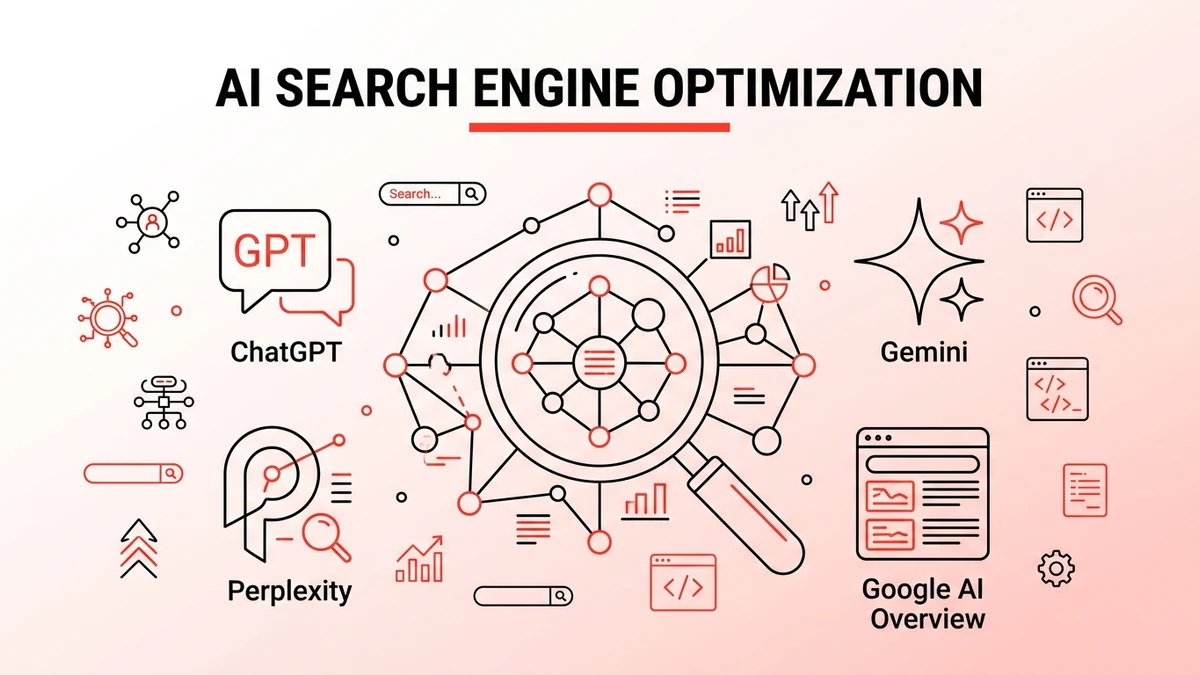
AI search engine optimization (AI SEO) is the practice of structuring your content, data, and online authority so that generative AI systems, ChatGPT, Perplexity, Gemini, Claude, Microsoft Copilot, and Google AI Overviews, choose your business as a source and cite it by name. It sits next to traditional SEO rather than replacing it. Traditional SEO earns a ranked position on a results page; AI SEO earns a mention inside a synthesized answer, which is often the only "result" a user ever sees.
The industry uses several overlapping labels for this: generative engine optimization (GEO), answer engine optimization (AEO), artificial intelligence search engine optimization, and simply "AI SEO." All four names describe the same underlying job, and the differences between them are mostly about scope rather than substance. GEO is the broadest term and usually covers full generative outputs across every AI platform. AEO leans more on the older featured-snippet and voice-search tradition. In practice, most teams treat all of these as the same job: get named in an AI-generated answer instead of just ranked in a list beneath it.
Two related but distinct searches often get lumped into "AI SEO" and are worth separating early:
- AI search engine optimization (this guide's subject): optimizing your content and entity signals so AI search engines cite you.
- AI in SEO / AI for SEO: using AI tools to do SEO work faster, keyword clustering, content drafting, technical audits, internal linking suggestions. That is a workflow question, not a visibility question, and it is covered in its own section below.
How does AI search differ from a traditional Google results page?
AI search replaces a ranked list with a single synthesized answer, which changes what "winning" a query even means. On a classic Google results page, ten sites compete for a click, and a user can compare snippets before choosing. Inside an AI Overview or a ChatGPT response, a handful of sources get synthesized into one paragraph, and most users read that paragraph and stop, whether or not it names a specific brand.
| Factor | Traditional SEO | AI search engine optimization |
|---|---|---|
| Unit of success | Ranked position (1 to 10) | Being cited or named inside the answer |
| Primary signal | Backlinks, keyword relevance, on-page optimization | Entity clarity, structured data, extractable answer format |
| Content format | Long-form articles targeting a keyword | Direct-answer paragraphs, definitions, tables the model can lift |
| Discovery mechanism | Crawling + indexing for ranking | Crawling + retrieval + synthesis into a generated answer |
| Click behavior | User clicks through to the site | Often no click; the answer itself satisfies the query |
| Measurement | Rankings, organic traffic, CTR | Citation rate, brand mention share, AI-referred traffic |
| Refresh cadence | Google's index updates continuously | Each AI platform has its own retrieval and training refresh schedule |
The gap between the two systems is not theoretical. Graphite's analysis of Similarweb data across more than 40,000 of the largest US websites found organic traffic down 2.5% year over year in aggregate, a small number on its own. But AI Overviews now appear on roughly 30% of searches, and on that specific slice, organic click-through rate drops 35% (Source: Graphite, using Similarweb data, 2026).
Seer Interactive's campaign-level study of 42 client organizations and 3,119 search terms found a steeper version of the same pattern: organic CTR on AI-Overview queries fell from 1.76% to 0.61% between June 2024 and September 2025, a 61% decline over 15 months. Brands that got cited inside the Overview saw 35% more organic clicks and 91% more paid clicks on those same queries (Source: Seer Interactive, November 2025). Getting cited, not just getting crawled, is the difference between losing that traffic and capturing a share of it.
What ranking and citation factors actually matter for AI search engines?
AI models do not use a single ranking algorithm the way Google uses one core algorithm with hundreds of signals. Each platform retrieves and synthesizes differently. But across ChatGPT, Perplexity, Gemini, and Google AI Overviews, four categories of signal show up consistently in what actually gets cited.
Entity clarity. AI models need to resolve "who is this business, what do they do, and are they a real, distinct entity" before they will cite it confidently. Consistent naming, a clear About page, Organization schema, and a Wikipedia or Wikidata presence all feed this. A business that reads as vague or interchangeable with ten competitors is harder for a model to cite by name, even if its content is otherwise good.
Structured data and technical readiness. Schema markup (Organization, Article, FAQPage, Product, HowTo where relevant) gives AI crawlers an explicit, machine-readable version of your content instead of forcing them to infer structure from prose. Clean semantic HTML, fast load times, and a sitemap that actually reflects your live pages all matter for the same reason: retrieval systems favor content they can parse cheaply and reliably.
Extractable, answer-first content. Models tend to lift the first sentence under a heading, so burying the actual answer in paragraph three costs you the citation even if the information is technically there. Definitions, direct numbers, and comparison tables get pulled into synthesized answers at a noticeably higher rate than dense prose that makes a reader work for the point.
Authority and third-party validation. AI models weight source authority partly through the same signal traditional SEO has always used: backlinks and mentions from other credible sites. A brand that shows up consistently across review sites, industry publications, forums like Reddit, and comparison content builds the kind of cross-source corroboration a model treats as trust, not just a single well-optimized page claiming to be the best.
How do ChatGPT, Perplexity, Gemini, and Google AI Overviews each choose sources?
They overlap heavily on the four factors above, but the mechanics differ enough to matter for where you put your effort.
ChatGPT blends its training data with live web browsing when it decides a query needs current information. Its August 2026 shift toward heavier use of site-specific searches inside its fan-out logic changed which sources surface for a given prompt, and caused a documented drop in Reddit's citation share that month (Source: Promptwatch data, via Search Engine Land and Semrush). ChatGPT SEO leans harder on structured, well-linked content that a live crawl can parse quickly, on top of whatever it already learned in training.
Perplexity runs closer to real-time retrieval than any other major platform, citing sources inline with visible links for nearly every claim. That transparency is an advantage for AI SEO: you can often see exactly which pages Perplexity pulled from for a given query and reverse-engineer what made them citable.
Gemini draws heavily on Google's existing search index and Knowledge Graph, which means the entity and structured-data work that helps you rank in classic Google search carries over more directly here than it does for the other platforms.
Google AI Overviews sit on top of Google's own index and use the query fan-out approach described earlier, generating an answer from several related searches rather than one. Content that already ranks well organically has a real head start here, but ranking well is not sufficient on its own; the content also has to be structured in a way the summarization layer can lift cleanly.
No single platform-specific trick beats getting the fundamentals right everywhere: a clear entity, structured data, answer-first content, and real third-party authority. Platform-specific tuning is a second-order optimization on top of that base, not a substitute for it.
How do you implement AI search engine optimization? A practical checklist
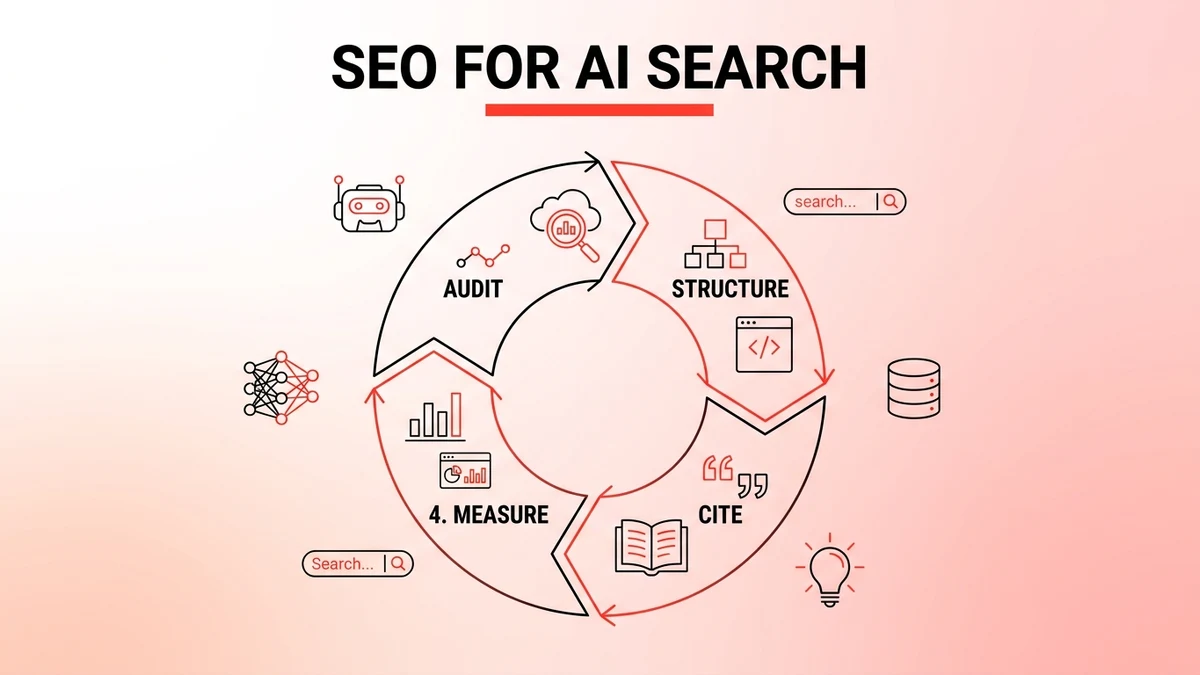
Treat this as four phases rather than a single project, since AI SEO is closer to ongoing infrastructure work than a one-time optimization pass.
Phase 1: audit your current AI visibility
Before changing anything, find out where you already stand. Run your brand name and your core product terms through ChatGPT, Perplexity, and Google AI Overviews directly and note whether you get mentioned, cited with a link, or not mentioned at all. A free tool like AY Rank's AI Visibility Checker automates a version of this across platforms in one pass instead of running each query by hand.
Phase 2: fix entity and structured data foundations
Add or clean up Organization schema on your homepage, FAQPage schema on pages with real Q&A content, and Article schema on your blog. Our schema markup guide for GEO covers the exact JSON-LD blocks that matter most. Make sure your business name, description, and key facts are consistent across your site, your Google Business Profile, LinkedIn, and any industry directories. Inconsistent naming or conflicting facts across sources is one of the most common reasons a model hedges instead of citing confidently.
Phase 3: rewrite content to be citation-ready
Rework your highest-value pages so the direct answer sits in the first sentence under each heading, not the third paragraph. Add comparison tables anywhere you are describing options, since models extract and cite tabular data at a noticeably higher rate than prose. Add a genuine FAQ section, not a fake one built purely for schema, to your most important pages.
Phase 4: monitor citations and iterate
Track which platforms cite you, for which queries, and which competitor gets cited instead when you do not. AI-referred traffic typically shows up in analytics under referral (chatgpt.com, perplexity.ai, copilot.microsoft.com) rather than organic search, so a setup that lumps everything into "organic" will undercount this channel entirely. Review monthly and adjust based on which content types are actually earning citations versus which ones are not.
- No added cost beyond your own time and any tools you buy
- Direct control over every change, with nothing lost in a handoff
- Works fine for a single site with a small, well-defined page set
- Schema and entity work has a real learning curve most in-house teams have not built yet
- Monitoring citations across five or six AI platforms by hand does not scale past a handful of queries
- Easy to optimize the wrong signal and see no citation movement for months
Which tools actually help with AI search engine optimization?
The tooling category is still young, and it splits into two groups: tools that track AI citations, and traditional SEO tools that have added AI-visibility features on top of what they already did. Our own AI SEO checklist walks through a 50-point audit if you want the longer version of the phase 1 audit above.
| Tool | Category | What it actually does |
|---|---|---|
| Profound | Dedicated AI citation tracker | Monitors brand mentions and citations across ChatGPT, Perplexity, and Gemini over time |
| Otterly.ai | Dedicated AI citation tracker | Tracks visibility and competitor mentions inside AI-generated answers |
| Peec.ai | Dedicated AI citation tracker | Runs recurring prompts across AI platforms to track citation share |
| Ahrefs (Brand Radar) | Traditional SEO suite, AI feature added | Adds brand-mention tracking inside AI Overviews on top of its existing keyword and backlink data |
| Semrush | Traditional SEO suite, AI feature added | Adds AI visibility tracking alongside its existing keyword research and site audit tools |
| AY Rank AI Visibility Checker | Free diagnostic tool | Checks current citation presence across major AI platforms in one pass, no login required |
None of these tools change your citation rate by themselves. They tell you where you stand and where a competitor is winning a query you are not, which is the input the actual optimization work in the checklist above runs on.
Is "AI in SEO" the same thing as AI search engine optimization?
No, and mixing them up sends teams optimizing for the wrong outcome. "AI in SEO" and "AI for SEO" usually describe using AI tools to speed up SEO tasks: drafting content, clustering keywords, generating meta descriptions, or running technical audits faster than a human could alone. That is a productivity question about your SEO workflow.
AI search engine optimization, the subject of this guide, is a visibility question: whether AI systems cite your business when someone else asks them a question. You can use AI tools heavily in your SEO process and still be invisible in ChatGPT and Perplexity results, and you can do AI search engine optimization well with a completely manual, no-AI-tools workflow. The two are related in name only. Teams that confuse them tend to invest in AI-assisted content production while never touching the entity clarity, structured data, and answer-first formatting that actually earns a citation.
FAQ
What is AI search engine optimization?
AI search engine optimization is the practice of structuring content, entity data, and online authority so generative AI platforms, ChatGPT, Perplexity, Gemini, and Google AI Overviews, cite your business by name in their answers. It builds on traditional SEO fundamentals but adds entity optimization, structured data, and content formatted for extraction rather than for a click.
How is AI SEO different from traditional SEO?
Traditional SEO competes for a ranked position that a human then clicks; AI SEO competes to be the source an AI model names inside a generated answer, which the user may never click through from. The underlying skills overlap heavily, technical health, content quality, authority signals, but the unit you are optimizing for is different: a citation instead of a rank.
How long does AI search engine optimization take to show results?
Most businesses see initial AI citations within 4 to 8 weeks of implementing the fixes in the checklist above. Full visibility across ChatGPT, Perplexity, and Gemini typically takes 3 to 6 months, since each platform refreshes its retrieval index and training data on a different schedule.
Do I need AI SEO if I already rank well on Google?
Yes, because ranking well in classic Google search and being cited inside an AI Overview or a ChatGPT answer are measured and won separately. A page can hold the top organic position and still get skipped when the AI summarization layer picks its sources, particularly if the content is not structured for the model to lift cleanly. GEO optimization closes that specific gap rather than duplicating what your existing SEO already does.
Does blocking AI crawlers in robots.txt help or hurt AI SEO?
It hurts, in almost every case. Blocking GPTBot, PerplexityBot, ClaudeBot, or Google-Extended prevents your content from being crawled and considered for citation in the first place, so you lose the visibility opportunity entirely rather than protecting anything meaningful. The tradeoff only makes sense for sites with a specific, deliberate reason to keep content out of AI training data.
What tools help track AI search engine optimization performance?
Dedicated AI citation trackers like Profound, Otterly.ai, and Peec.ai monitor brand mentions across ChatGPT, Perplexity, and Gemini over time, while traditional platforms like Ahrefs and Semrush have added AI-visibility features on top of their existing keyword and backlink tools. AY Rank's free AI Visibility Checker gives a quick baseline read across platforms without a login.
Can a small business do AI search engine optimization without hiring an agency?
Yes, for a small, well-defined site, the audit-fix-monitor loop in the checklist above is doable in-house, particularly the entity and structured data phases. The harder part to scale alone is ongoing citation monitoring across five or six AI platforms and knowing which content changes are actually moving citations versus which ones are cosmetic, which is where a dedicated AI SEO agency tends to close the gap faster.
Is "AI in SEO" a different topic from AI search engine optimization?
Yes. "AI in SEO" and "AI for SEO" typically describe using AI tools to speed up SEO tasks like content drafting or keyword clustering, a workflow question. AI search engine optimization is about whether AI platforms cite your business in their answers, a visibility question, and the two do not automatically improve together.
Sources: OpenAI, via TechCrunch, August 6, 2026, Ahrefs, December 2025 AI Overviews CTR study, Gartner, B2B Buyer survey, May 2026, Graphite, Similarweb data, 2026, Seer Interactive, November 2025, Google Search Central, May 15, 2026
This post is part of our GEO Optimization guide. Related reading: Does AI Search Optimization Actually Make, How to Do Keyword Research for GEO, How to Optimize for Microsoft Copilot.

Adel tracks AI citation rates across ChatGPT, Perplexity, Gemini, and AI Overviews. He turns raw visibility data into actionable insights that guide our optimization strategy.
Full Bio →