"ChatGPT SEO" gets searched inside AI tools roughly 1,600 times a month, and it peaked near 2,900 in December 2025, making it the single biggest search term in the GEO niche by a wide margin (20 to 60 times the volume of adjacent terms like "geo agency" or "llm seo," per AY Rank's own DataForSEO tracking, pulled 2026-09-01). People asking that phrase into an AI tool want one thing: how do I get my business to show up when someone asks ChatGPT a question, instead of just ranking on Google.
That is a different job than classic SEO, and this guide covers what actually changes. ChatGPT SEO is the practice of shaping your content and your presence across the web so that ChatGPT retrieves, understands, and cites your brand when it answers a relevant question. It borrows some of the same groundwork as Google SEO (clear writing, structured pages, real authority) and adds a layer that traditional SEO never had to think about: you are optimizing for a model's retrieval and citation behavior, not a ranking algorithm sorting ten blue links.
What does "ChatGPT SEO" actually mean?
ChatGPT SEO means making your brand, your product, and your content easy for ChatGPT to find, understand, and quote back to a user, whether that user is researching a purchase, comparing tools, or just asking a question your business happens to answer well.
It is not the same as ranking a page on Google, and it is not the same as buying an ad. ChatGPT does not have a results page with ten slots you compete for. Instead, it generates an answer, and inside that answer it may (or may not) mention your brand, describe your product, or link to one of your pages as a source. Your job is to increase the odds of that happening, consistently, across the questions your buyers actually ask.
Three things sit underneath every ChatGPT SEO effort:
- Entity clarity: does ChatGPT (and the systems it draws on) know who you are, what you sell, and who it's for, without ambiguity?
- Retrievability: is your content structured so a retrieval system can pull a clean, accurate answer out of it?
- Third-party corroboration: do other sources on the web (reviews, comparisons, forums, press) say the same thing about you, in language ChatGPT can cross-reference?
Get those three right and citations follow. Skip them and no amount of on-page keyword stuffing will help, because ChatGPT isn't running a keyword match against your page title.
How is ChatGPT SEO different from Google SEO?
The mechanics diverge even though some of the inputs overlap. Google SEO optimizes for a ranking position; ChatGPT SEO optimizes for the probability of being cited inside a generated answer, which depends on retrieval quality and how well your content maps to a specific question.
| Factor | Traditional Google SEO | ChatGPT SEO |
|---|---|---|
| Target | A ranking position on a results page | A citation or mention inside a generated answer |
| Core signal | Backlinks, keyword targeting, page authority | Entity clarity, structured/extractable content, third-party corroboration |
| Content format | Long-form pages built around a keyword | Direct, quotable answers a retrieval system can lift cleanly |
| Where you're evaluated | Your own domain, mostly | Your own domain plus every third-party page mentioning you |
| Feedback loop | Search Console rankings and clicks | Manual prompt testing, citation tracking tools, no official dashboard |
| Update cadence | Algorithm updates every few weeks | Model and retrieval behavior can shift with any release, no changelog |
Two consequences follow from that table. First, you cannot fully control ChatGPT SEO the way you can control an on-page SEO checklist, because a meaningful share of what ChatGPT cites lives on domains you don't own: G2, Reddit threads, comparison blogs, review sites. Second, there is no public analytics dashboard for it yet. Most teams track it by running the same prompts on a schedule and logging what comes back, or by using a citation-tracking tool built for that purpose.
How does ChatGPT source and cite information?
ChatGPT pulls from three separate places, and understanding which one it's using for a given answer changes what you should optimize. For factual, current, or brand-specific questions, ChatGPT increasingly runs a live web search (through Bing and OpenAI's own crawling and indexing) and cites the pages it pulls from directly in the answer, similar to a footnote.
For broader, more conceptual questions, it can also draw on patterns learned during training, meaning your visibility depends on how consistently your brand appeared across the training data's snapshot of the web, not just on what's live today. And for anything involving a specific, recent, or niche fact, live retrieval tends to win over training-time knowledge, because the model is built to prefer a citable source when one is available.
That live-retrieval behavior is exactly why crawler access matters. If GPTBot or OpenAI's other crawlers are blocked in robots.txt, you are opting out of citation eligibility for anything requiring current information, full stop.
What actually moves the needle for ChatGPT SEO?
Six things consistently affect whether ChatGPT surfaces and cites a brand, in roughly the order most teams should tackle them.
Fix crawler access first. Check robots.txt for GPTBot, OAI-SearchBot, and any other named OpenAI agent. If they're disallowed, nothing else on this list matters, because ChatGPT can't retrieve pages it isn't allowed to fetch.
Write answer-first content. Structure pages so the direct answer to a likely question appears in the first sentence of a section, then expand with detail. Retrieval systems lift the first clean sentence far more often than a buried conclusion three paragraphs down.
Add FAQ and Article schema. Structured data gives retrieval systems an unambiguous, machine-readable version of your content to pull from, separate from parsing prose. It is not the only signal, but it removes ambiguity a crawler would otherwise have to guess at.
Build entity clarity across your own site. Consistent naming, a clear "who this is for" statement, and an About or company page that states what you do in plain language, without marketing fog, help both the model and any retrieval layer resolve who you are.
Earn mentions on third-party pages ChatGPT already trusts. Comparison articles, review platforms, Reddit threads, and industry roundups carry weight because they're independent corroboration, not your own marketing copy. This is closer to digital PR and community presence than classic backlink building.
Keep content current. Pages with recent, verifiable dates and updated facts are more likely to win a citation over stale content covering the same topic, especially for anything time-sensitive.
Crawler access and entity clarity come first because everything else is wasted effort without them. A page ChatGPT can't fetch, or a brand it can't confidently identify, doesn't get cited no matter how well-written the content is.
How does ChatGPT SEO relate to GEO and AEO?
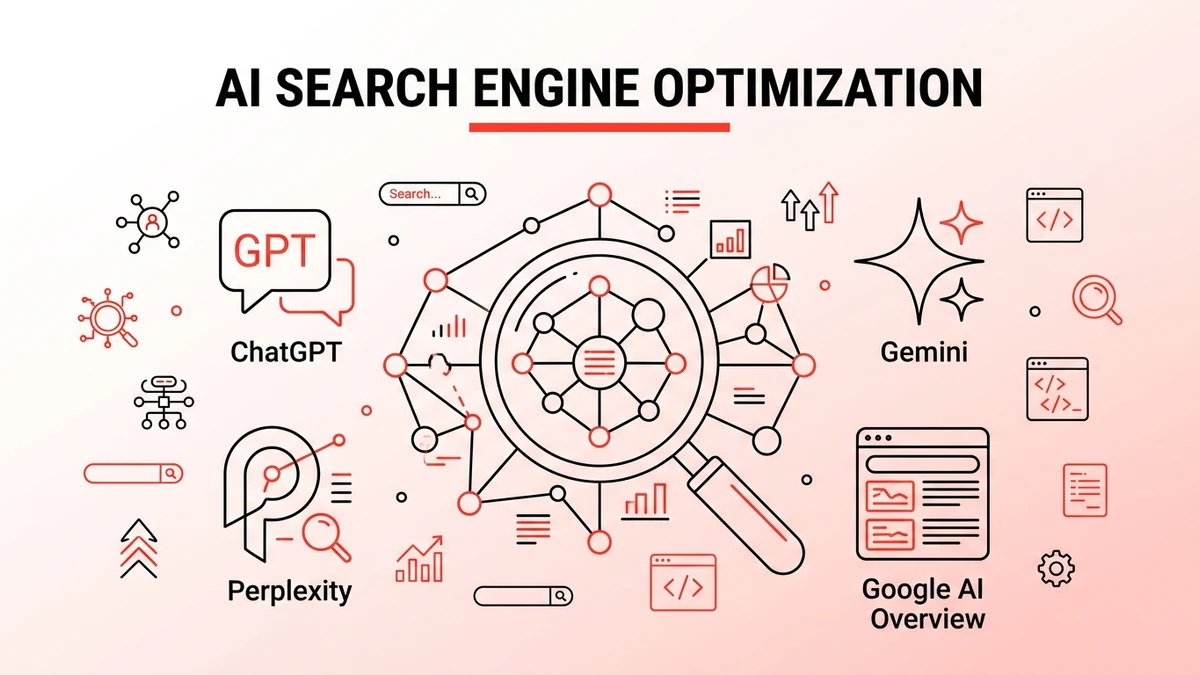
ChatGPT SEO is one channel inside the broader discipline of generative engine optimization (GEO), not a separate practice with its own rulebook. GEO covers optimizing for how AI systems in general (ChatGPT, Perplexity, Gemini, Google AI Overviews) retrieve and cite content; ChatGPT SEO is what that work looks like when the target engine specifically is ChatGPT.
The overlap with answer engine optimization (AEO) is close enough that most practitioners use the terms loosely. If you're building the underlying muscle (structured content, schema, entity clarity, third-party corroboration), the same work lifts your visibility across ChatGPT, Perplexity, and AI Overviews together. See our breakdown of how generative engine optimization works and how to optimize for large language models for the wider mechanics that ChatGPT SEO sits inside.
Where ChatGPT SEO earns its own name is in the platform-specific details: ChatGPT's citation format, its mix of live browsing and training-time knowledge, and the fact that it's currently the highest-volume AI search term by a wide margin, which is why it deserves tactics of its own rather than being folded entirely into a generic GEO checklist.
Should you build ChatGPT SEO in-house or bring in help?
Both are workable, and the right call depends mostly on how much time your team has to run the unglamorous parts: crawlability audits, schema implementation, and the ongoing work of earning third-party mentions.
- Crawler access and basic schema fixes are one-time technical tasks most dev teams can knock out in a day
- You already understand your own product and audience better than any outside team starting cold
- Manual prompt testing (asking ChatGPT the questions your buyers ask, weekly) costs nothing but time
- Early movers face little competition, most brands in most categories have not touched this yet
- Earning third-party mentions on Reddit, review sites, and comparison content is closer to a PR/outreach skillset than an SEO one
- Citation tracking across multiple AI engines takes dedicated tooling most in-house teams haven't built
- Measurement is still immature industry-wide, so knowing what "working" looks like takes prior pattern-matching across accounts
- Model behavior shifts without a changelog, someone needs to notice when tactics stop working
If you're evaluating outside help, our roundup of ChatGPT SEO agencies worth shortlisting in 2026 compares options by focus and pricing, and the step-by-step in how to rank in ChatGPT walks through the tactical checklist in more depth than fits here.
AY Rank runs this work end to end through our GEO optimization service and AI SEO service, covering crawler and schema fixes, entity clarity, and the third-party mention-building that individual teams often don't have bandwidth for.
FAQ
What is ChatGPT SEO?
ChatGPT SEO is the practice of optimizing your content and web presence so ChatGPT retrieves, understands, and cites your brand when answering relevant questions. It combines technical fixes (crawler access, schema), content structure (answer-first writing), and off-site work (earning mentions on third-party sites ChatGPT trusts).
How is ChatGPT SEO different from regular SEO?
Regular SEO optimizes for a ranking position on a search results page; ChatGPT SEO optimizes for the odds of being cited inside a generated answer. The inputs overlap (structured content, real authority) but the target and the feedback loop are different, and there's no equivalent to Google Search Console for tracking it yet.
Does ChatGPT actually cite sources?
Yes. When ChatGPT answers using live web search, which it increasingly does for current or specific questions, it shows inline citations linking to the pages it pulled information from, similar to footnotes. Answers drawn purely from training-time knowledge typically don't carry citations.
How do I know if ChatGPT can even see my site?
Check robots.txt for GPTBot, OAI-SearchBot, and any other OpenAI-named crawler. If any of them are disallowed, ChatGPT can't retrieve your pages for live-search answers, which blocks citation eligibility regardless of how good the content is.
What's the difference between ChatGPT SEO, GEO, and AEO?
GEO (generative engine optimization) is the umbrella discipline for optimizing across all AI answer engines; AEO (answer engine optimization) is close enough in practice that the terms are used interchangeably; ChatGPT SEO is what that same work looks like when applied specifically to ChatGPT's retrieval and citation behavior.
How long does ChatGPT SEO take to show results?
There's no fixed timeline because there's no public ranking tracker to benchmark against, but most teams start seeing citation changes within 4 to 8 weeks of fixing crawler access and schema, faster for narrow, low-competition questions and slower for broad category questions with many established sources already cited.
Can small businesses compete with big brands on ChatGPT SEO?
Yes, more easily than on Google in many cases, because ChatGPT SEO currently has far less competition. Most businesses in most categories haven't touched crawler access, schema, or structured answer content yet, which means the entity-clarity and third-party-mention work matters more than raw domain authority right now.
Should I block AI crawlers to protect my content?
Blocking GPTBot and similar crawlers via robots.txt keeps your content out of ChatGPT's live retrieval, which also removes you from citation eligibility entirely. For most businesses trying to be found by AI-search users, that trade works against the goal, unless you have a specific reason to withhold content from AI training and retrieval altogether.
Sources: AY Rank internal AI-search-volume tracking via DataForSEO (pulled 2026-09-01), OpenAI GPTBot and crawler documentation
This post is part of our GEO Optimization guide. Related reading: GEO Implementation Guide for 2026, SaaS SEO Checklist for 2026, Free AI Rank Tracking Tools.

Adel tracks AI citation rates across ChatGPT, Perplexity, Gemini, and AI Overviews. He turns raw visibility data into actionable insights that guide our optimization strategy.
Full Bio →