New to GEO? Start with the definitive guide: What is Generative Engine Optimization (GEO)?
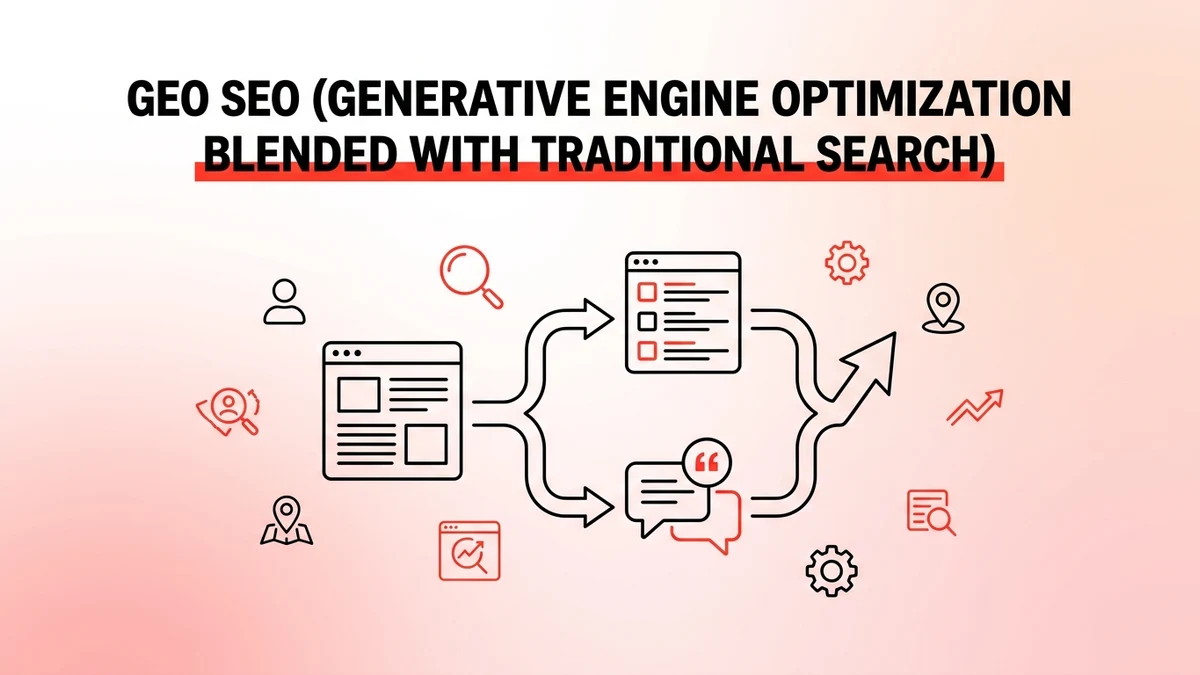
GEO SEO combines two disciplines that used to sit in separate teams: ranking in Google's blue links and getting quoted inside ChatGPT, Perplexity, and Google AI Overviews. Gartner projects traditional search engine volume will drop 25% by 2026 as users shift to AI assistants for answers (Source: Gartner, 2024). That projection has not played out at the aggregate level: a 2026 analysis of 40,000+ sites found organic traffic down just 2.5% year over year, though CTR on queries where an AI Overview appears specifically crashed 61% (full breakdown). If your content strategy only accounts for rankings, you are optimizing for a shrinking share of how people actually find answers.
This guide breaks down what GEO SEO means in practice, how it differs from a standard SEO program, and what a GEO SEO service actually delivers. You will also see the specific technical and content changes that move the needle, plus a framework for measuring results that goes beyond keyword rankings.
What Is GEO SEO?
GEO SEO is the practice of optimizing a website so it ranks in traditional search engines and gets cited as a source inside AI-generated answers. The term merges GEO (generative engine optimization) with conventional SEO because the two now share infrastructure: the same site, the same content, and increasingly the same technical foundation. (The sister discipline focused purely on the models themselves is LLM SEO.)
The distinction matters because AI models do not crawl and rank pages the way Google's algorithm does. ChatGPT, Perplexity, and Gemini pull from a mix of their training data, live web retrieval, and licensed data partnerships. A page can rank #3 in Google and never get mentioned by an AI model, or the reverse: a page buried on page 4 of Google can be the single source an AI cites for a specific factual claim.
BrightEdge research found that AI Overviews now appear on 47% of Google searches for informational queries (Source: BrightEdge, 2026). That means nearly half the time, a searcher's first exposure to your brand is not your blue link. It is whether an AI model chose to reference you at all.
How Does GEO SEO Differ From Traditional SEO?
Traditional SEO optimizes for a ranking algorithm that returns a list of links. GEO SEO optimizes for a language model that generates a synthesized answer and decides, sentence by sentence, whether to cite a source. The mechanics overlap but the priorities shift.
Traditional SEO rewards keyword targeting, backlink volume, and page-level relevance signals. GEO rewards entity clarity (does the model understand who you are and what you do), extractable structure (can a paragraph be lifted cleanly into an answer), and consistency across the web (do other sources corroborate your claims). You can read a deeper breakdown in our guide to what generative engine optimization actually is.
| Factor | Traditional SEO | GEO SEO |
|---|---|---|
| Target | Ranking position in blue links | Citation inside an AI-generated answer |
| Primary signal | Backlinks + keyword relevance | Entity clarity + structured, extractable content |
| Content format | Long-form articles optimized for scanning | Direct-answer paragraphs an AI can quote verbatim |
| Measurement | Rankings, organic traffic, CTR | Citation frequency, brand mention rate, AI referral traffic |
| Update cycle | Ranking changes over weeks | AI model indexes can shift in days |
| Tools | Ahrefs, Semrush, Search Console | AI citation trackers plus traditional SEO tools |
How Does GEO SEO Actually Work?
GEO SEO works by making three things unmistakably clear to a language model: who you are, what you know, and why your claim is trustworthy. That happens through a combination of technical markup, content structure, and off-site corroboration.
Entity clarity
AI models build an internal representation of your brand as an entity, similar to a knowledge graph node. Structured data (Organization schema, sameAs links to verified profiles, consistent NAP data) tells the model exactly who you are instead of leaving it to infer from unstructured text. Our technical SEO audit service checks entity signals across 150+ points, including schema completeness and crawlability for AI bots specifically.
Extractable content structure
AI models favor content that answers a question directly in the first sentence, then supports it with specifics. Long preambles before the answer reduce the chance of being quoted. This is why every FAQ section on a GEO-optimized page should open each answer with a direct, factual sentence rather than a lead-in.
Freshness and update signals
Semrush data shows pages updated within the last 90 days get cited by AI models at a measurably higher rate than stale content (Source: Semrush, 2026). GEO SEO treats content freshness as an ongoing signal, not a one-time publish-and-forget task.
GEO SEO is not a replacement for traditional SEO. It is an additional layer of entity clarity and extractable structure layered on top of a site that already ranks. Start with schema markup and direct-answer FAQ content on your five highest-traffic pages before expanding site-wide.
What Does a GEO SEO Service Include?
A GEO SEO service typically bundles four workstreams: an AI visibility audit, technical implementation, content restructuring, and ongoing citation monitoring. Here is what each one covers in practice.
AI visibility audit. A baseline check of how often your brand currently appears in ChatGPT, Perplexity, Gemini, and Google AI Overviews across your target queries, plus a gap analysis against competitors who are already getting cited.
Technical implementation. Schema markup (Organization, FAQPage, Article), an llms.txt file that gives AI crawlers a clean map of your site, and robots.txt rules that allow (rather than accidentally block) AI crawler user agents. See our complete guide to llms.txt for the file structure AI crawlers expect.
Content restructuring. Rewriting or building new pages with direct-answer openings, comparison tables, and FAQ sections structured for extraction. Our GEO optimization service handles this as an ongoing content workstream rather than a one-time pass.
Citation monitoring. Tracking which queries return your brand as a cited source, week over week, across the major AI platforms. Without this, you are optimizing blind. Our AI visibility monitoring guide walks through the tooling and methodology.
Should You Handle GEO SEO In-House or Hire an Agency?
The right answer depends on how much bandwidth your team has for ongoing technical monitoring, since GEO SEO is not a set-and-forget project. AI model behavior changes without warning, which means a citation rate that looked strong last quarter can quietly drop if a platform updates its retrieval logic.
- Full control over content and publishing timelines
- No agency ramp-up period on your brand voice
- Lower direct cost if you already have SEO staff
- Institutional knowledge stays inside the company
- Citation tracking tools and methodology are still maturing, so most teams build this from scratch
- AI model behavior changes without warning, and most in-house teams lack bandwidth to monitor weekly
- Structured data implementation often requires specialized technical SEO skills most marketing teams do not have
- Slower to benchmark against competitors without access to a broader client dataset
One SaaS client in the HR software space came to AY Rank with zero AI citations across their top 20 queries. After a technical implementation pass (schema, llms.txt, FAQ restructuring), citations rose to 14 out of 20 tracked queries within 90 days. In our experience, the technical fixes move faster than the content fixes, so a GEO SEO engagement should sequence infrastructure first and content expansion second.
How Do You Measure GEO SEO Results?
You measure GEO SEO results by tracking citation frequency, not just keyword rankings. Set up a fixed list of 15-25 target queries relevant to your business, then manually or programmatically check whether ChatGPT, Perplexity, and Google AI Overviews cite your domain for each one, on a weekly or biweekly cadence.
Pair citation tracking with referral traffic segmentation in your analytics tool. AI platforms increasingly pass referral traffic with identifiable source parameters, which lets you separate AI-driven visits from standard organic search and measure their conversion rate separately.
Frequently Asked Questions
What is GEO SEO?
GEO SEO is the combined practice of optimizing a website for traditional search engine rankings and for citation inside AI-generated answers from tools like ChatGPT, Perplexity, and Google AI Overviews. It layers entity clarity, structured data, and extractable content on top of a standard SEO foundation.
How is GEO SEO different from AEO?
GEO (generative engine optimization) and AEO (answer engine optimization) overlap heavily and are often used interchangeably, but GEO typically refers to optimizing for full generative AI platforms like ChatGPT and Gemini, while AEO leans toward direct-answer features like Google's featured snippets and voice search results. Both rely on the same direct-answer content structure.
Does GEO SEO replace traditional SEO?
No, GEO SEO does not replace traditional SEO. It is an additional layer built on top of a site that already targets rankings, backlinks, and technical health. A site with weak traditional SEO fundamentals will struggle with GEO SEO too, since AI models still weight domain authority and content quality signals.
How long does GEO SEO take to show results?
Technical GEO SEO changes, such as schema markup and llms.txt implementation, can influence AI citations within 4-8 weeks. Content-driven citation gains typically take longer, closer to the 3-6 month timeline associated with traditional SEO, since AI models need repeated corroboration across sources before treating a domain as authoritative.
How does GEO SEO apply to e-commerce businesses?
E-commerce GEO SEO focuses on making product data, reviews, and comparison content extractable so AI shopping assistants can recommend specific products by name. This includes structured product schema, clear pricing and availability data, and comparison tables between similar products.
What is the first step in a GEO SEO service?
The first step is an AI visibility audit that establishes your current citation rate across a fixed set of target queries on ChatGPT, Perplexity, Gemini, and Google AI Overviews. Without this baseline, you cannot measure whether later technical and content changes actually moved the needle. AY Rank runs this audit as the entry point to every GEO optimization engagement: see our AI SEO agency page for how the full engagement is structured.
Can small businesses benefit from GEO SEO?
Yes, small businesses can benefit from GEO SEO, particularly local businesses where AI assistants increasingly answer "best [service] near me" queries directly. Local SEO signals like Google Business Profile completeness and consistent citations feed directly into AI recommendation logic. Our local AI search visibility service covers the specific tactics that apply at smaller scale.
Do I need new content for GEO SEO or can I update existing pages?
Most GEO SEO programs start by updating existing high-traffic pages rather than building new content from scratch. Restructuring an existing page's FAQ section, adding schema markup, and tightening the first sentence of each section is usually faster to implement and faster to show results than a full content buildout.
How do you track GEO SEO rankings and AI citations?
Classic rank tracking covers the Google half. The GEO half is tracked by prompt sampling: running a fixed set of buyer queries through ChatGPT, Perplexity, Gemini, and Google AI Overviews on a schedule and logging every brand mention and citation. Dedicated AI citation tracking tools automate this, and pairing both views is what shows whether GEO SEO work is actually compounding.
Sources: Gartner, 2024, BrightEdge, 2026, Semrush, 2026
This post is part of our GEO Optimization guide. Related reading: AY Rank vs Trailblazer Marketing, GEO for SaaS, How to Get Cited by AI Search Engines.

Adel tracks AI citation rates across ChatGPT, Perplexity, Gemini, and AI Overviews. He turns raw visibility data into actionable insights that guide our optimization strategy.
Full Bio →