AI-referred website sessions grew 527% year-over-year in the first five months of 2025 (Source: Previsible, 2025). That number is not slowing down. Generative engine optimization (GEO) is the practice of structuring your content, data, and online presence so that AI search engines like ChatGPT, Perplexity, Google AI Overviews, and Gemini cite your business in their responses. If traditional SEO earned you a spot among ten blue links, GEO earns you a place among the two to seven sources an LLM actually names when answering a question. If you want the two disciplines run as one combined program, our GEO SEO guide breaks down how they share infrastructure.
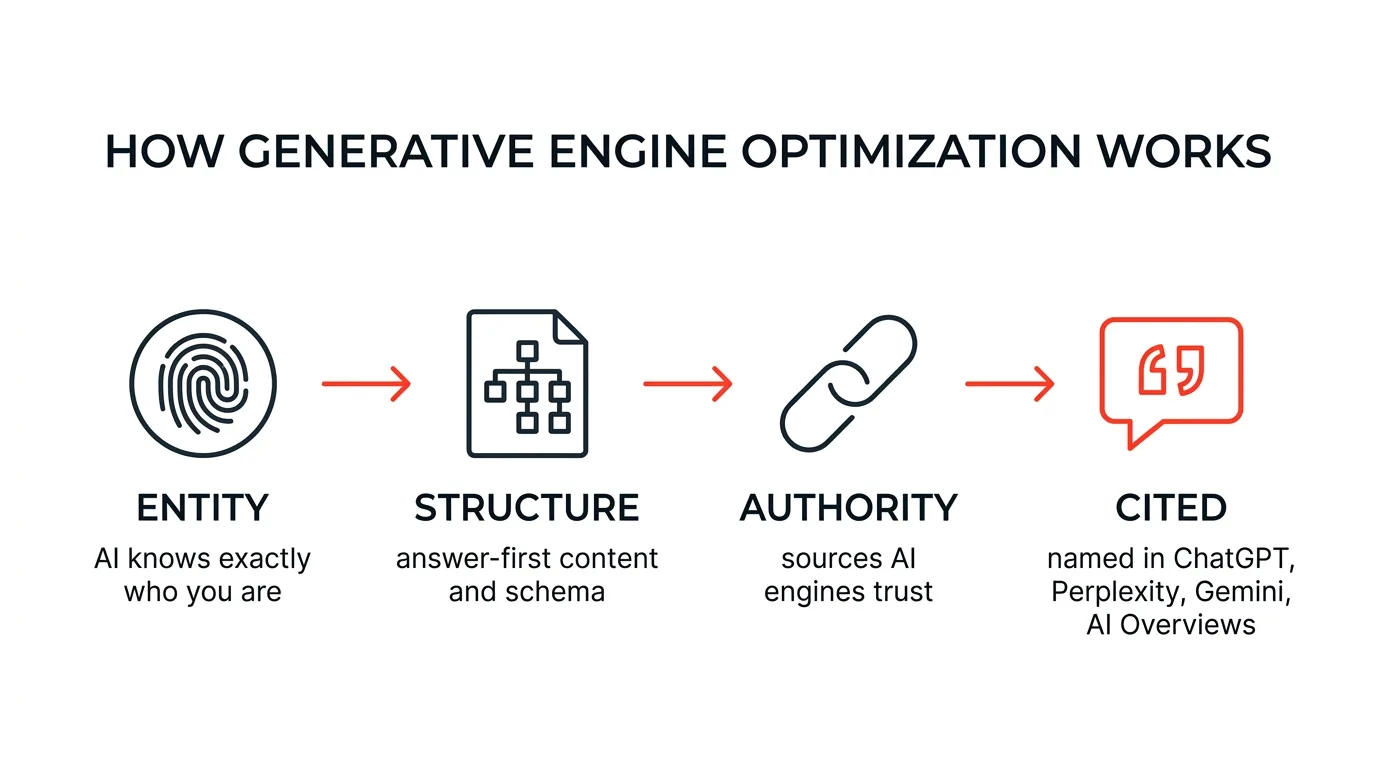 How generative engine optimization works: entity clarity, answer-first structure, and authority signals lead to being cited by ChatGPT, Perplexity, Gemini, and AI Overviews
This guide covers what GEO is, why it matters more than ever in 2026, how it differs from traditional SEO, which strategies produce measurable results (like Wearview's climb from zero to $36K MRR), and how to track whether it is working. By the end, you will know exactly what to do on day one.
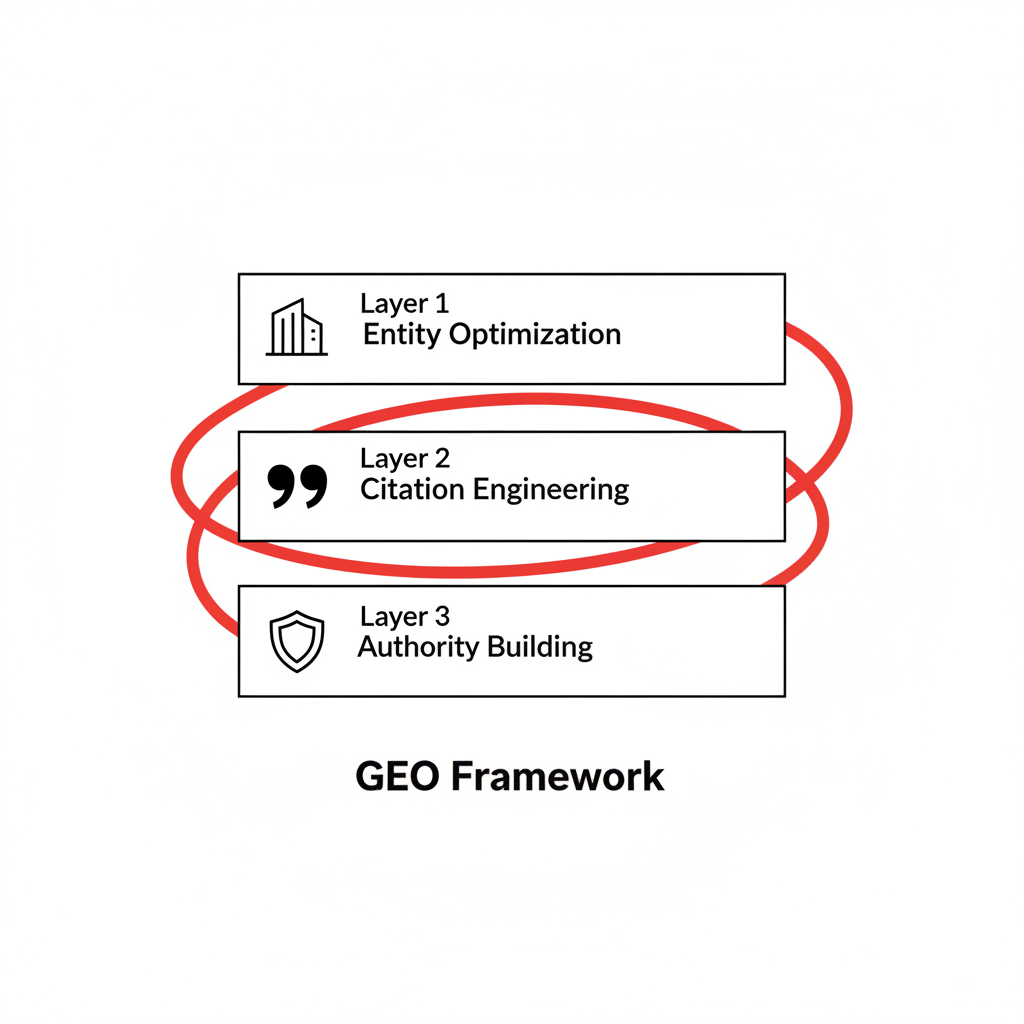 The GEO Framework: three layers of Entity Optimization, Citation Engineering, and Authority Building
The three-layer GEO framework that drives AI citations.
The GEO Framework: three layers of Entity Optimization, Citation Engineering, and Authority Building
The three-layer GEO framework that drives AI citations.
How Does Generative Engine Optimization Work?
Traditional search engines rank pages. Generative engines synthesize answers. When someone asks ChatGPT "what is the best CRM for startups," the model does not return a list of links. It reads dozens of pages, extracts the most relevant and trustworthy claims, and assembles a single answer that cites specific sources.
This process relies on Retrieval-Augmented Generation (RAG). The model retrieves candidate documents from the web (or its index), scores them for relevance and authority, then generates a response grounded in those documents. Your content either makes it into that retrieval set, or it does not exist in the AI's answer.
Three factors determine whether your content gets retrieved and cited:
- Entity clarity. Does the AI model understand what your business is, what it does, and who it serves? Structured data, consistent NAP information, and a well-linked Wikipedia or Wikidata presence all feed entity recognition.
- Fact density. Content packed with specific numbers, named sources, and direct claims gets cited more than vague overviews. A Princeton study found that adding statistics to content increased AI citation frequency by up to 40% (Source: Princeton GEO Study, 2024).
- Source authority. Domain authority still matters, but so does topical authority. A niche site with deep expertise on one subject can outperform a high-DR generalist site in AI citations for that topic.
Why Does Generative Engine Optimization Matter in 2026?
The shift is not theoretical. It is measurable.
65% of Google searches now end without a click to any website (Source: SparkToro/Datos, 2024). Google's own AI Overviews appear in roughly 47% of informational queries. Meanwhile, ChatGPT processes over 1.7 billion visits per month (Source: SimilarWeb, 2025), and Perplexity handles more than 780 million queries monthly.
For businesses, this means a growing share of potential customers never see your website in a traditional search result. They see an AI-generated answer. If your brand is cited in that answer, you win. If not, your competitor does.
The conversion angle matters too. AI-referred visitors convert at 14.2% compared to 2.8% for traditional organic traffic (Source: FirstPageSage, 2025). That is a 5x difference. When ChatGPT recommends your product by name, the visitor arrives with higher intent and more trust than someone who clicked a blue link.
The first-mover window is closing
Most businesses have not started GEO. We track AI citation rates across client verticals, and the average mid-market company appears in fewer than 4% of AI-generated answers relevant to their category. The companies investing now are locking in citation dominance before their competitors wake up.
What is the Difference Between GEO and Traditional SEO?
GEO does not replace SEO. It layers on top of it. Many GEO best practices (structured data, topical authority, fresh content) also improve traditional rankings. But the emphasis shifts.
| Factor | Traditional SEO | Generative Engine Optimization |
|---|---|---|
| Goal | Rank in top 10 blue links | Get cited in AI-generated answers |
| Primary signal | Backlinks and keyword relevance | Entity clarity and fact density |
| Content format | Long-form articles optimized for dwell time | Extractable, citable snippets with clear claims |
| Measurement | Rankings, traffic, CTR | Citation rate, brand mentions, AI referral traffic |
| Timeline | 3-6 months for results | 4-8 weeks for initial citations |
| User behavior | User scans results, picks one | User reads AI answer, may click cited source |
The biggest mental shift: in SEO, you optimize pages. In GEO, you optimize your entity. The AI model needs to understand your brand as a discrete thing in the world, with clear attributes, relationships, and expertise areas. That is why GEO optimization starts with entity audits and structured data, not keyword research.
Where they overlap
Both disciplines share a common foundation. Technical health (fast load times, clean crawlability, valid schema markup) matters for both. High-quality backlinks strengthen your entity in AI models just as they strengthen your domain authority in Google. Content depth and originality remain non-negotiable.
The practical difference is where you spend marginal effort. With GEO, that effort goes into making every key claim extractable, every entity relationship explicit, and every data point sourced.
GEO is not a replacement for SEO. It is an additional optimization layer focused on making your content citable by AI models. Start with your existing SEO foundation and add entity clarity, fact density, and structured data on top.
Which Generative Engine Optimization Strategies Actually Work?
We have tested dozens of tactics across client accounts. Not all of them move the needle. Here are the five that produce measurable citation improvements, ranked by impact.
1. Structured data and schema markup
AI models rely heavily on structured data to understand entities and relationships. Adding Organization, FAQPage, HowTo, and Product schema to your key pages gives AI crawlers explicit signals about what your content means, not just what it says.
A technical SEO audit typically reveals that most sites have fewer than 30% of their pages properly marked up. Fixing that gap is the single highest-ROI GEO action for most businesses.
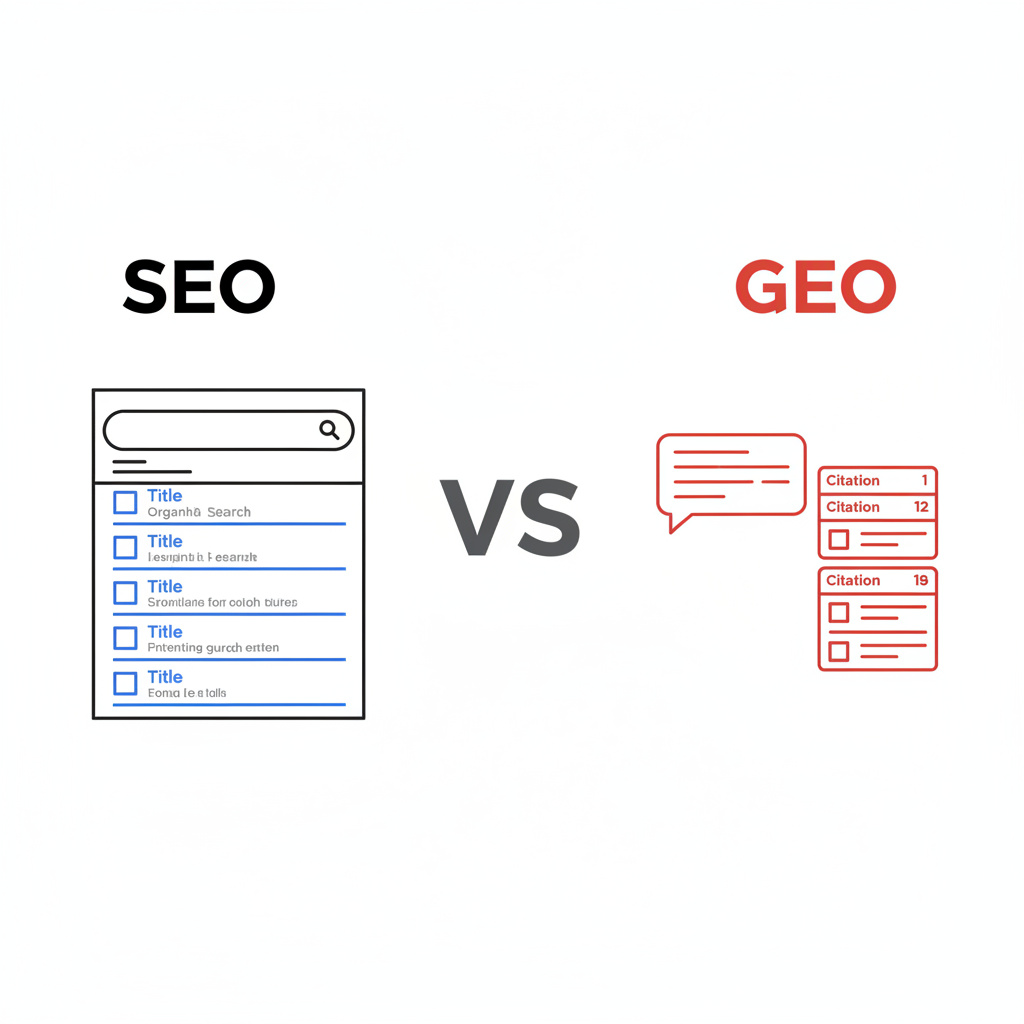 SEO vs GEO comparison: traditional search results page versus AI-generated citation response
SEO targets blue links. GEO targets AI-generated citations.
SEO vs GEO comparison: traditional search results page versus AI-generated citation response
SEO targets blue links. GEO targets AI-generated citations.
2. Fact-dense, extractable content
Every key page needs clear, factual claims that an AI model can pull into a citation. Instead of writing "Our software helps teams collaborate better," write "Teams using our platform reduce meeting time by 34% and ship features 2.1x faster (Source: internal data, Q4 2025)."
The structure matters as much as the substance. Use short paragraphs (2-4 sentences). Lead each section with a direct answer to a question. Place statistics near the top of paragraphs, not buried in the middle.
3. Question-format headers
AI models extract question-answer pairs at a higher rate than any other content structure. Phrase your H2 and H3 headings as questions that match real user queries. "How much does GEO cost?" pulls better than "GEO Pricing Information."
Our content SEO service builds every article around the exact questions AI models surface for a given topic. We map these using Perplexity's "Related" suggestions and ChatGPT's follow-up prompts.
4. Authoritative sourcing and citations
Content that cites authoritative sources gets cited more by AI models. This creates a virtuous cycle: cite good sources, become a source yourself.
Include links to primary research, industry reports, and recognized experts. Name the source and the year. AI models weigh recency heavily. 50% of content cited in AI answers is less than 13 weeks old (Source: Frase, 2025).
5. Entity building across platforms
Your website is not the only place AI models look. They also pull from:
- Wikipedia and Wikidata entries
- LinkedIn company profiles
- Crunchbase, G2, and Capterra listings
- Industry directories and association memberships
- Press mentions and earned media
Building consistent, detailed profiles across these platforms strengthens your entity graph. When an AI model encounters your brand name across multiple trusted sources with consistent information, it gains confidence in citing you.
How Do AI Models Decide What to Cite?
Understanding the mechanics helps you optimize more precisely. Different platforms use different retrieval approaches, but they share common patterns.
ChatGPT (with browsing)
ChatGPT uses Bing's search index for real-time queries. It retrieves pages, reads them, and selects passages to cite. Pages that appear in Bing's top results have an advantage, but ChatGPT also weighs content clarity and directness. Wikipedia accounts for 47.9% of ChatGPT's top cited sources (Source: Frase, 2025).
Perplexity
Perplexity runs its own web crawler and maintains a proprietary index. It tends to cite more diverse sources than ChatGPT, including Reddit threads, niche blogs, and forum posts. Reddit accounts for 46.7% of Perplexity's top source citations (Source: Frase, 2025). Perplexity indexes in near real-time, making content freshness especially important.
Google AI Overviews
AI Overviews draw from Google's existing search index. Pages that rank well organically have an advantage, but Google also pulls from Knowledge Graph data and structured markup. Pages with FAQ schema, product schema, and clear entity markup appear disproportionately in AI Overviews.
| Platform | Index source | Freshness weight | Source diversity | Best tactic |
|---|---|---|---|---|
| ChatGPT | Bing search index | Medium | Low (Wikipedia-heavy) | Authoritative, well-structured pages |
| Perplexity | Own crawler | High (near real-time) | High (Reddit, forums, niche) | Fresh, detailed, community-validated |
| Google AI Overviews | Google search index | Medium | Medium | Strong traditional SEO + schema markup |
| Gemini | Google search index | Medium | Medium | Similar to AI Overviews |
How Do You Measure Generative Engine Optimization Results?
Measurement is the biggest challenge in GEO right now. The tooling is maturing fast, but it is not as simple as checking Google Search Console.
What to track
AI referral traffic. In Google Analytics 4, filter traffic by source to identify visits from ChatGPT (chat.openai.com), Perplexity (perplexity.ai), and other AI platforms. This is the most direct GEO metric.
Citation rate. For your top 20 target queries, run them through ChatGPT, Perplexity, and Gemini weekly. Record whether your brand is mentioned, linked, or absent. Track the trend over time.
Brand mention volume. Tools like Mention, Brand24, or manual tracking can measure how often your brand name appears in AI-generated content across platforms.
Entity recognition. Ask ChatGPT and Perplexity "What is [your company name]?" If the response is accurate and detailed, your entity is well-established. If it is vague or wrong, you have work to do.
Tools for GEO tracking
The tool landscape is still early. Dedicated AI visibility tracking platforms are emerging, but many teams start with manual audits supplemented by GA4 referral data. We run citation audits across all major AI platforms as part of our client reporting.
What Does a GEO Implementation Look Like on Day One?
Theory is useful. Action is better. Here is a practical first-week plan for a business starting GEO from scratch.
Day 1-2: Entity audit. Ask ChatGPT, Perplexity, and Gemini about your company. Record what they say. Identify inaccuracies, gaps, and missing information. This is your baseline.
Day 3: Structured data. Add Organization schema to your homepage, FAQPage schema to your top 5 content pages, and Product or Service schema to your offering pages. Validate with Google's Rich Results Test.
Day 4-5: Content optimization. Take your top 5 highest-traffic pages and restructure them for citability. Add question-format headers, lead with direct answers, include sourced statistics, and break long paragraphs into 2-3 sentence blocks.
Day 6-7: External entity building. Update or create profiles on Crunchbase, LinkedIn (company page), G2, and relevant industry directories. Ensure consistent naming, description, and categorization across all profiles.
This first sprint is not about perfection. It is about establishing a baseline, making your content citable, and building signals that AI models can use to understand your entity. A full SEO audit can identify the complete list of technical and content improvements, but these four actions deliver the fastest initial results.
What are Common GEO Mistakes to Avoid?
Not everything marketed as GEO actually works. Some tactics are actively counterproductive.
Blocking AI crawlers. Some businesses block GPTBot, PerplexityBot, and other AI crawlers via robots.txt. This protects content from training data scraping, but it also prevents your pages from appearing in AI-generated answers. For most businesses, the visibility trade-off is not worth it.
Keyword stuffing for AI. AI models are better at detecting keyword stuffing than traditional search engines. Over-optimized content reads as low quality and gets deprioritized.
Ignoring traditional SEO. GEO builds on SEO fundamentals. A site with poor technical health, thin content, and no backlinks will not suddenly win AI citations by adding schema markup. Fix the foundation first.
Treating all AI platforms the same. ChatGPT, Perplexity, and Google AI Overviews use different retrieval mechanisms and weight different signals. A strategy optimized for one platform may underperform on others.
Optimizing only your website. AI models pull entity information from dozens of sources. If your website says one thing and your Crunchbase profile says another, the model loses confidence in both.
- AI-referred traffic converts at 5x higher rates than organic
- First-mover advantage while most competitors have not started
- Compounds over time as AI models learn your entity
- Many GEO tactics also improve traditional SEO performance
- Measurement tools are still maturing and require manual effort
- AI model behavior changes without notice or documentation
- Results can be inconsistent across different AI platforms
- Requires structured data expertise most marketing teams lack
Frequently Asked Questions About Generative Engine Optimization
What is generative engine optimization (GEO)?
Generative engine optimization is the practice of optimizing your content, structured data, and online presence to get cited by AI search engines like ChatGPT, Perplexity, and Google AI Overviews. Unlike traditional SEO, which focuses on ranking in search results, GEO focuses on being named as a source in AI-generated answers. The term was popularized by a 2024 Princeton University research paper that tested nine optimization strategies.
How is GEO different from SEO?
GEO and SEO share common foundations like technical health and quality content, but they differ in goals and signals. SEO targets rankings in traditional search results, while GEO targets citations in AI-generated responses. The primary GEO signals are entity clarity, fact density, and structured data, whereas SEO emphasizes backlinks and keyword relevance.
How long does generative engine optimization take to show results?
Most businesses see initial citation improvements within 4-8 weeks of implementing structured data and content optimization. This is faster than traditional SEO (3-6 months) because AI models update their retrieval indexes more frequently than Google updates its rankings. However, consistent entity building over 3-6 months is needed for sustained citation presence.
Can small businesses benefit from GEO?
Small businesses often benefit disproportionately from GEO because AI models value topical authority over domain size. A local bakery with detailed, well-structured content about artisan sourdough can outperform a national food magazine in AI citations for that specific topic. Starting with local SEO combined with GEO tactics is the most efficient path for small businesses.
What tools do I need for generative engine optimization?
At minimum, you need Google Analytics 4 (to track AI referral traffic), Google Search Console (for indexing), and a schema markup validator. For monitoring, a simple spreadsheet tracking citation presence across platforms works well. Paid tools like Scrunch AI, Peec AI, and Profound are emerging but not yet essential for most businesses.
Does GEO work for e-commerce businesses?
E-commerce businesses see some of the strongest GEO results because product recommendations are among the most common AI query types. When someone asks ChatGPT "best running shoes for flat feet," the brands cited in the response capture high-intent traffic. Product schema markup, detailed specifications, and review aggregation are the most impactful e-commerce GEO tactics.
Is GEO the same as AEO (Answer Engine Optimization)?
GEO and AEO overlap significantly but are not identical. AEO originally focused on optimizing for Google's featured snippets and voice search answers. GEO is broader, covering optimization for all generative AI platforms including ChatGPT, Perplexity, Claude, and Gemini. In practice, most agencies (including AY Rank) treat them as part of the same discipline.
How much does generative engine optimization cost?
GEO costs vary widely based on scope. A focused GEO audit and initial optimization for a small site might cost $2,000-5,000. Ongoing GEO optimization services for mid-market companies typically run $3,000-8,000 per month, covering entity building, content optimization, structured data maintenance, and citation monitoring. Enterprise programs with multi-platform tracking start at $10,000 per month.
Sources: Previsible AI Traffic Report (2025), Princeton GEO Study (2024), SparkToro Zero-Click Study (2024), SimilarWeb ChatGPT Traffic (2025), Frase GEO Guide (2026), FirstPageSage AI Conversion Data (2025), Authoritas AI Overview Study (2025)
FAQ
What is generative engine optimisation in simple terms? Generative engine optimisation (GEO) is making your business one of the sources AI engines name when they answer a question. Where classic SEO competes for a ranked position in a list of links, GEO competes for a citation inside the generated answer itself, in ChatGPT, Perplexity, Gemini, and Google AI Overviews.
What is the difference between GEO and SEO? SEO optimises for rankings in classic search results; GEO optimises for citations inside AI-generated answers, which depend on entity clarity, extractable structure, and source authority rather than keyword positions. The two overlap and most brands need both; our GEO vs SEO comparison covers when each matters.
Is GEO the same as AEO? They are close siblings. AEO (answer engine optimisation) targets deterministic answer surfaces such as featured snippets and voice assistants; GEO targets generative surfaces where a model composes a new answer and cites sources. The industry increasingly uses the terms together; the three-way breakdown lives in our SEO vs AEO vs GEO guide.
How do I start with GEO? Start by measuring whether AI engines can even read your site: crawler access in robots.txt, structured data, and an entity AI models can recognise. The free GEO Readiness Checker scores those fundamentals in minutes, and a free AI ranking audit shows where your brand currently appears in AI answers.
This post is part of our GEO Optimization guide. Related reading: 12 Best AI SEO Tools for Visibility Tracking, Best GEO Agency for SaaS, AI Citation Tracking & Citation Rate.

Adel tracks AI citation rates across ChatGPT, Perplexity, Gemini, and AI Overviews. He turns raw visibility data into actionable insights that guide our optimization strategy.
Full Bio →