Google's AI Overviews now appear on over 70% of informational queries (Source: SE Ranking, 2026). That single stat has rewritten the rules of search marketing. If you're comparing GEO vs SEO and wondering whether to throw out your old playbook, you're asking the right question at the right time.
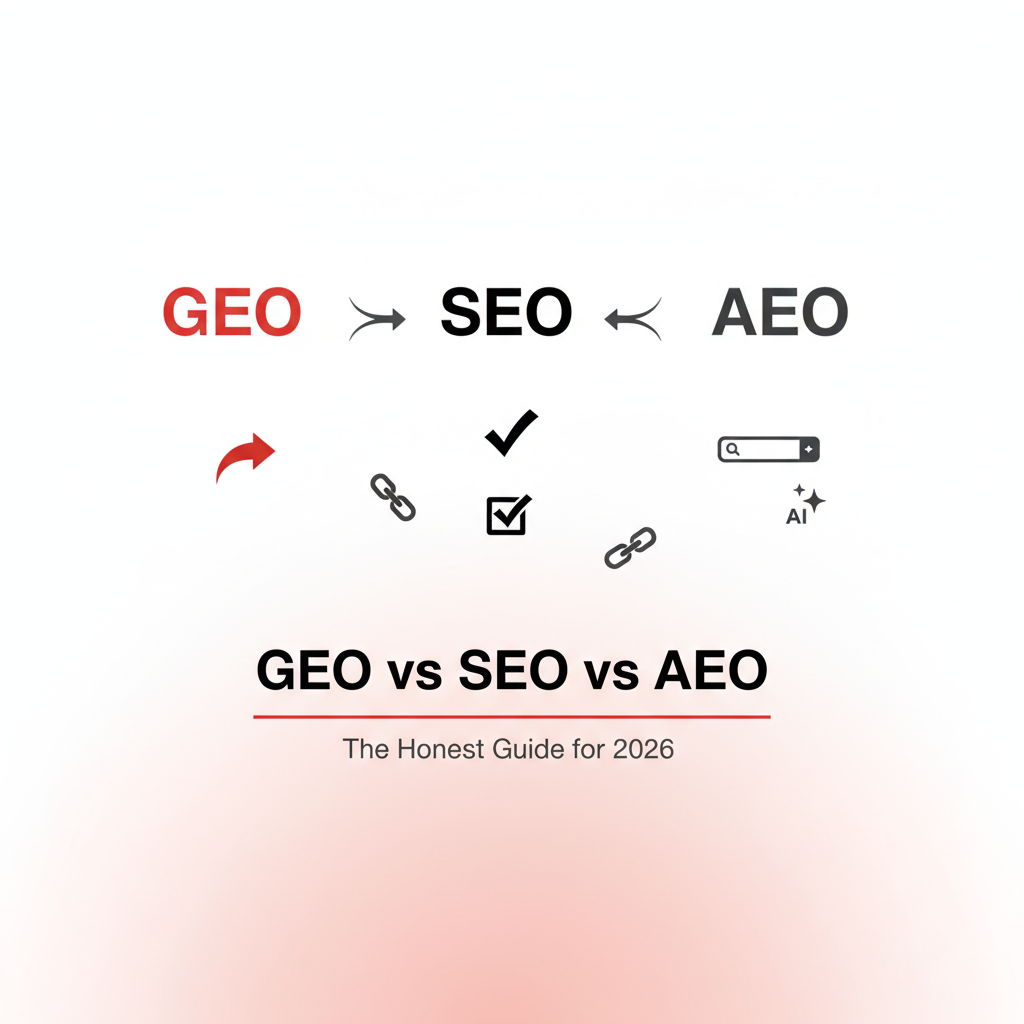
But here's the honest answer most agencies won't give you: none of these three acronyms replaces the others. GEO, SEO, and AEO solve different problems at different layers of the same funnel. Some of that is real. Some of it is vendor hype dressed up in new jargon.
This guide breaks down all three, feature by feature, with data. No fluff, no buzzwords, no "everything is changing" hand-waving. By the end, you'll know exactly which strategy fits your situation and where to start.
What Is GEO, and Why Does It Matter Now?
Generative Engine Optimization (GEO) is the practice of structuring your content so that large language models cite your brand in their generated responses. For how GEO and classic SEO combine into a single program, see our GEO SEO guide. The "engines" here are ChatGPT, Perplexity, Claude, and Gemini, not Google's traditional index.
When someone asks Perplexity "What's the best agency for AI search visibility?", the model synthesizes an answer from multiple sources. GEO determines whether your brand gets named in that synthesis or gets skipped entirely.
The stakes are binary. Traditional SEO has positions 1 through 10. GEO has cited or not cited. There is no position 2 inside an AI-generated paragraph.
Research from the GEO study at Princeton and Georgia Tech found that content with inline citations, statistics, and expert quotes received up to 40% more citations from generative models compared to generic prose (Source: GEO Study, arxiv.org, 2024).
What GEO optimizes for
- Entity authority: Is your brand clearly defined across the web with consistent name, description, and expertise signals?
- Factual density: Does your content contain specific data points that a model can extract and attribute?
- Structured data: Does your schema markup help models understand what your page is about?
- Source triangulation: Do multiple reputable sites confirm the same claims about your brand?
If you want to understand how this works in practice, our GEO optimization service walks through the full methodology.
What Is SEO in 2026? (It's Not Dead, But It Has Changed)
Search Engine Optimization (SEO) still drives the majority of commercial web traffic. Google processes over 8 billion searches per day, and even with AI Overviews eating into click-through rates, organic search remains the largest single traffic channel for most websites.
What has changed: the click curve. Ahrefs data shows organic CTR drops from 1.76% to 0.61% on queries where AI Overviews appear (Source: Ahrefs, 2026). That is a 61% decline. For informational queries, this is devastating. For transactional and navigational queries, the impact is smaller.
SEO in 2026 means optimizing for a blended results page: traditional blue links, AI Overviews, featured snippets, video carousels, and People Also Ask boxes. The skill set is broader than it was in 2020, but the fundamentals (technical health, content quality, backlinks) still apply.
Where SEO still wins outright
- Transactional queries: "Buy running shoes" still produces product listings, not AI paragraphs
- Navigational queries: "HubSpot login" goes straight to the site
- Local intent: "Dentist near me" triggers the map pack
- Long-tail commercial: Detailed product comparisons where users want to click and browse
Our AI SEO services combine traditional ranking signals with the new AI visibility layer so you don't have to choose one or the other.
What Is AEO, and How Is It Different from GEO?
Answer Engine Optimization (AEO) predates GEO by several years. AEO optimizes content for featured snippets, voice assistant answers, and Google's "People Also Ask" boxes. The goal: become the single extracted answer for a specific question.
AEO is about making your content easy to extract. You write a clear question heading, put a concise 40-60 word answer directly below it, and structure your FAQ sections so that Google (or Alexa, or Siri) can grab the answer without the user ever visiting your site.
GEO is different. GEO is about making AI models trust your brand enough to cite you when synthesizing a new answer from multiple sources. AEO targets extraction. GEO targets selection.
In practice, AEO and GEO share many tactics: FAQ schema, structured headings, concise answers, and entity clarity. The difference is the platform they target and the depth of authority signals required.
How Do GEO, SEO, and AEO Compare Feature by Feature?
Here is the comparison that actually matters. Ten dimensions, three strategies, no marketing spin.
| Feature | SEO | GEO | AEO |
|---|---|---|---|
| Primary target | Google SERPs (blue links) | LLM responses (ChatGPT, Perplexity, Gemini) | Featured snippets, voice answers |
| Success metric | Rankings, organic traffic, CTR | Brand citations in AI responses | Featured snippet ownership |
| Content format | Long-form, keyword-optimized pages | Fact-dense, citable, entity-rich content | Concise Q&A pairs, structured FAQs |
| Key ranking signal | Backlinks + relevance + technical health | Entity authority + source triangulation | Direct answer clarity + schema markup |
| User interaction | User clicks to your site | User reads AI answer citing you (may not click) | User hears/reads extracted answer (no click) |
| Traffic model | High volume, moderate conversion | Low volume, high conversion (4.4x higher) | Zero-click (brand awareness only) |
| Time to results | 3-6 months | 4-8 weeks for initial citations | 2-4 weeks for snippet capture |
| Measurement tools | Google Search Console, Ahrefs, Semrush | AI citation trackers (Otterly, Profound) | SERP feature tracking, position zero tools |
| Cost range | $2K-15K/month (agency) | $3K-10K/month (specialist agency) | Often bundled with SEO |
| Competitive moat | Moderate (anyone can build links) | High (entity authority is hard to replicate) | Low (snippets flip frequently) |
Is GEO Replacing SEO? (The Honest Answer)
No. And anyone telling you to abandon SEO for GEO is either selling GEO services or misreading the data.
Here's what the data actually says. Gartner predicted a 25% drop in traditional search volume by 2026 due to AI assistants (Source: Gartner, 2024). That prediction did not hold at the aggregate level: a 2026 analysis of 40,000+ sites found organic traffic down just 2.5% year over year, not 25% (full breakdown). What did happen is more specific: informational queries are migrating to AI chat interfaces and losing 61% of their CTR when an AI Overview appears, while transactional and navigational queries remain largely on Google.
The math is simple. If 25% of your traffic comes from informational queries, and those queries see a 61% CTR decline from AI Overviews, you lose roughly 15% of your organic traffic. That is significant but not fatal.
What replaces that lost traffic? AI-referred visitors. And those visitors convert 4.4x better than traditional organic (Source: Semrush, 2025). So the total conversion value can actually increase if you're cited in AI responses.
The real shift is not replacement. It is layering.
Smart brands in 2026 run SEO as the foundation and add GEO as an amplifier. SEO gets you indexed and ranked. GEO gets you cited in the AI layer that sits on top of those rankings.
If you want to see how your brand currently appears across AI platforms, our AI visibility audit measures citation rates across ChatGPT, Perplexity, Gemini, and Google AI Overviews.
What Happens If You Ignore GEO Entirely?
The risk is not immediate collapse. The risk is slow erosion that compounds quarterly.
93% of AI search sessions end without a site visit (Source: Ahrefs, 2026). Users get their answer from the AI response and never click through. If your competitor is cited in that response and you are not, the user forms a brand preference before they ever land on either site.
ChatGPT only cites 15% of the pages it retrieves during a query (Source: Position Digital, 2026). That means 85% of indexed content gets retrieved, evaluated, and discarded. Being indexed is no longer enough. Your content needs to be structured for citation, not just for ranking.
The brands ignoring GEO today will notice the impact in two ways:
- Declining branded search volume as fewer users encounter their name during research
- Shrinking conversion rates on organic traffic as the highest-intent users shift to AI-first research
Which Strategy Should You Start With in 2026?
The answer depends on where you are today, not on which acronym sounds newest.
If you have no SEO foundation: Start with SEO. You need indexable pages, clean technical health, and basic keyword targeting before GEO can work. AI models pull from indexed web content. If your content is not ranking at all, it is unlikely to be retrieved by AI models either.
If you rank well but AI traffic is flat: Add GEO. Your content is already indexed and authoritative. Now you need to restructure it for citation: add inline statistics, expert attribution, FAQ schema, and entity markup. This is where content SEO services and GEO overlap most.
If you already own featured snippets: You have a head start on AEO, and the jump to GEO is short. Your content is already structured for extraction. The next step is adding the depth of sourcing and entity signals that generative models require.
If you sell B2B / high-ticket: Prioritize GEO alongside SEO. AI-referred visitors convert at dramatically higher rates, and the lifetime value of each conversion justifies the investment in citation optimization. Our SaaS SEO services are built specifically for this use case.
A practical 90-day plan
| Week | Action | Strategy |
|---|---|---|
| 1-2 | Audit technical SEO health, fix crawl errors | SEO |
| 3-4 | Add FAQ schema and structured data to top 20 pages | AEO + GEO |
| 5-6 | Rewrite top 10 pages with inline citations and statistics | GEO |
| 7-8 | Build entity authority: consistent brand info across directories | GEO |
| 9-10 | Publish 4-6 new content pieces optimized for both SEO and GEO | SEO + GEO |
| 11-12 | Measure: track AI citations, organic rankings, and conversion rates | All |
GEO is not a replacement for SEO. It is an additional layer that ensures your content gets cited in AI-generated responses. Start with your strongest channel, then add the others. The brands winning in 2026 treat SEO, GEO, and AEO as three layers of the same visibility strategy, not competing priorities.
How Much Does GEO Cost vs. SEO vs. AEO?
Budget is where hype meets reality. Here is what agencies actually charge in 2026.
| Cost Factor | SEO | GEO | AEO |
|---|---|---|---|
| Monthly retainer (agency) | $2,000-15,000 | $3,000-10,000 | Usually bundled with SEO |
| In-house headcount | 1-3 specialists | 0.5-1 specialist (often shared with SEO) | Part of SEO team scope |
| Tools | $200-500/mo (Ahrefs, Semrush) | $100-400/mo (Otterly, Profound, manual tracking) | Included in SEO tools |
| Content production | $500-2,000 per article | $800-3,000 per article (higher research depth) | Minimal incremental cost |
| Time to ROI | 4-8 months | 6-12 weeks for first citations | 2-6 weeks for snippet capture |
| ROI measurement | Clear (traffic x conversion rate) | Emerging (citation rate x brand lift) | Difficult (zero-click attribution) |
The honest take: GEO is not cheap, but it is more affordable than most agencies suggest. The core work (structured data, entity optimization, citation-ready content) overlaps heavily with good SEO. If your SEO agency is competent, adding GEO might cost 30-50% more, not double.
At AY Rank, we bundle GEO and SEO into a single engagement because separating them creates duplicate work and inconsistent strategy.
What Are the Biggest Myths About GEO vs SEO?
Misinformation spreads fast in a new category. Here are the claims we see most often, checked against data.
Myth 1: "SEO is dead." False. Google still processes 8+ billion queries daily. Organic search drives more traffic than all AI chat platforms combined. What is true: the composition of that traffic is changing, and click-through rates on informational queries are declining.
Myth 2: "GEO is just SEO with a new name." Partially true, partially false. The tactics overlap (structured data, quality content, authority), but the optimization targets are different. SEO optimizes for ranking algorithms. GEO optimizes for language model retrieval and citation behavior. The skill set is adjacent but not identical.
Myth 3: "You need a separate GEO agency." Usually false. The best results come from integrating GEO into your existing SEO workflow, not running parallel strategies. A separate GEO agency often duplicates content audits, keyword research, and technical work your SEO team already handles.
Myth 4: "AEO is outdated." False. Featured snippets and voice answers still drive significant brand visibility. AEO tactics (clear Q&A structure, FAQ schema) are foundational to GEO. Think of AEO as a subset of GEO, not a competitor.
Frequently Asked Questions
What is GEO (Generative Engine Optimization)?
GEO is the practice of optimizing your digital presence so that AI-powered platforms like ChatGPT, Perplexity, and Gemini cite your brand in their generated responses. It focuses on entity authority, factual density, and structured data rather than traditional keyword rankings. Research shows content with inline statistics and citations receives up to 40% more AI citations (Source: GEO Study, Princeton/Georgia Tech, 2024).
What is AEO (Answer Engine Optimization)?
AEO optimizes content for direct answer extraction by search engines and voice assistants. It targets featured snippets, Google's "People Also Ask" boxes, and voice search results. AEO relies on clear question-answer formatting, FAQ schema markup, and concise responses under 60 words. Many AEO tactics now feed directly into GEO optimization strategies.
Is GEO replacing SEO in 2026?
GEO is not replacing SEO. Both serve different functions in the search ecosystem. SEO drives rankings and organic traffic through Google's traditional index. GEO ensures your brand gets cited when AI models generate answers. Gartner estimated a 25% decline in traditional search volume by 2026, but the actual 2026 data shows organic traffic down just 2.5% year over year, and organic search still accounts for the majority of web traffic (details).
Do I need both GEO and SEO, or can I pick one?
Most businesses need both. SEO provides the indexed content foundation that AI models retrieve from. GEO structures that content for citation. Without SEO, your pages may never enter the AI model's retrieval set. Without GEO, your pages get retrieved but not cited. The overlap in tactics (structured data, quality content) means running both is 30-50% more effort than SEO alone, not double.
How much does GEO cost compared to SEO?
GEO agency retainers typically range from $3,000-$10,000/month, compared to $2,000-$15,000/month for SEO. The most cost-effective approach bundles both into a single strategy, since 60-70% of the work (technical audits, content optimization, schema markup) overlaps. At AY Rank, we integrate GEO into every SEO engagement rather than charging separately.
Which should I start with: GEO, SEO, or AEO?
Start with SEO if you have no organic foundation. Your pages need to be indexed and ranking before AI models will retrieve them. If you already rank well, add GEO next by restructuring your top-performing content with inline citations, entity markup, and FAQ schema. AEO tactics are a natural byproduct of good GEO work and rarely need a standalone effort. Book a free AI visibility audit to see where your gaps are.
Sources: SE Ranking AI Statistics 2026, Ahrefs AI Search Data, Semrush AI Conversion Study 2025, Gartner Search Predictions 2024, GEO Study, Princeton/Georgia Tech 2024, Position Digital AI SEO Statistics
Go deeper: the three-way comparison, SEO vs AEO vs GEO: What's the Difference?, covers where answer engine optimisation fits alongside GEO and classic SEO.
This post is part of our GEO Optimization guide. Related reading: What is Generative Engine Optimization, 12 Best AI SEO Tools for Visibility Tracking, Best GEO Agency for SaaS.

Oussama leads technical and on-page SEO at AY Rank. He specializes in structured data engineering, crawl optimization, and building the entity architecture that makes AI models cite our clients.
Full Bio →