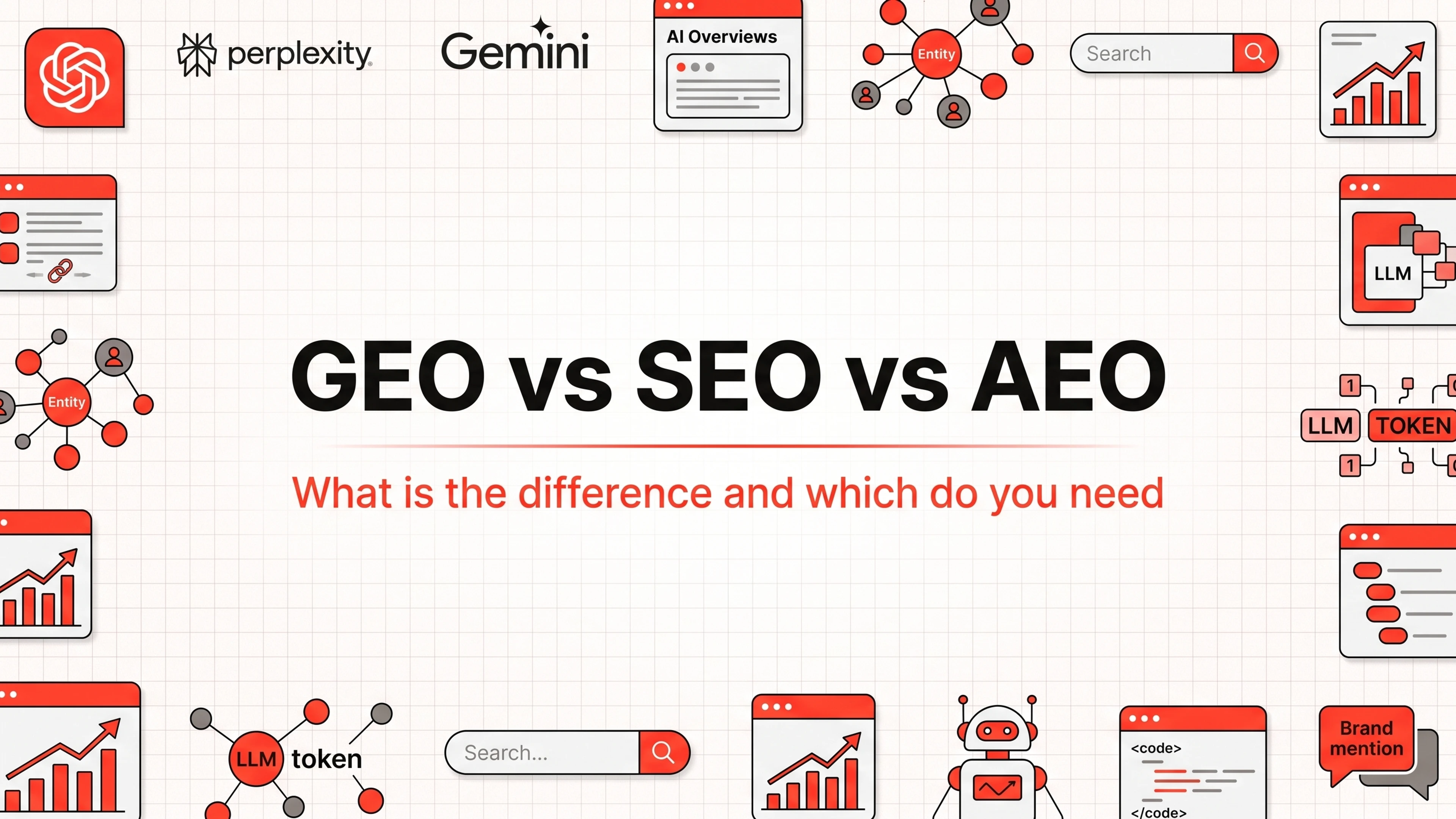
SEO gets you ranked in Google's classic results, AEO gets you extracted as the direct answer in answer boxes and voice assistants, and GEO gets you cited inside AI-generated answers from ChatGPT, Perplexity, Gemini, and Google AI Overviews. Most brands in 2026 need SEO plus GEO, with AEO practices folded into both. The sections below break down where each discipline wins and which mix your brand actually needs; for the two-way version, see our GEO vs SEO comparison.
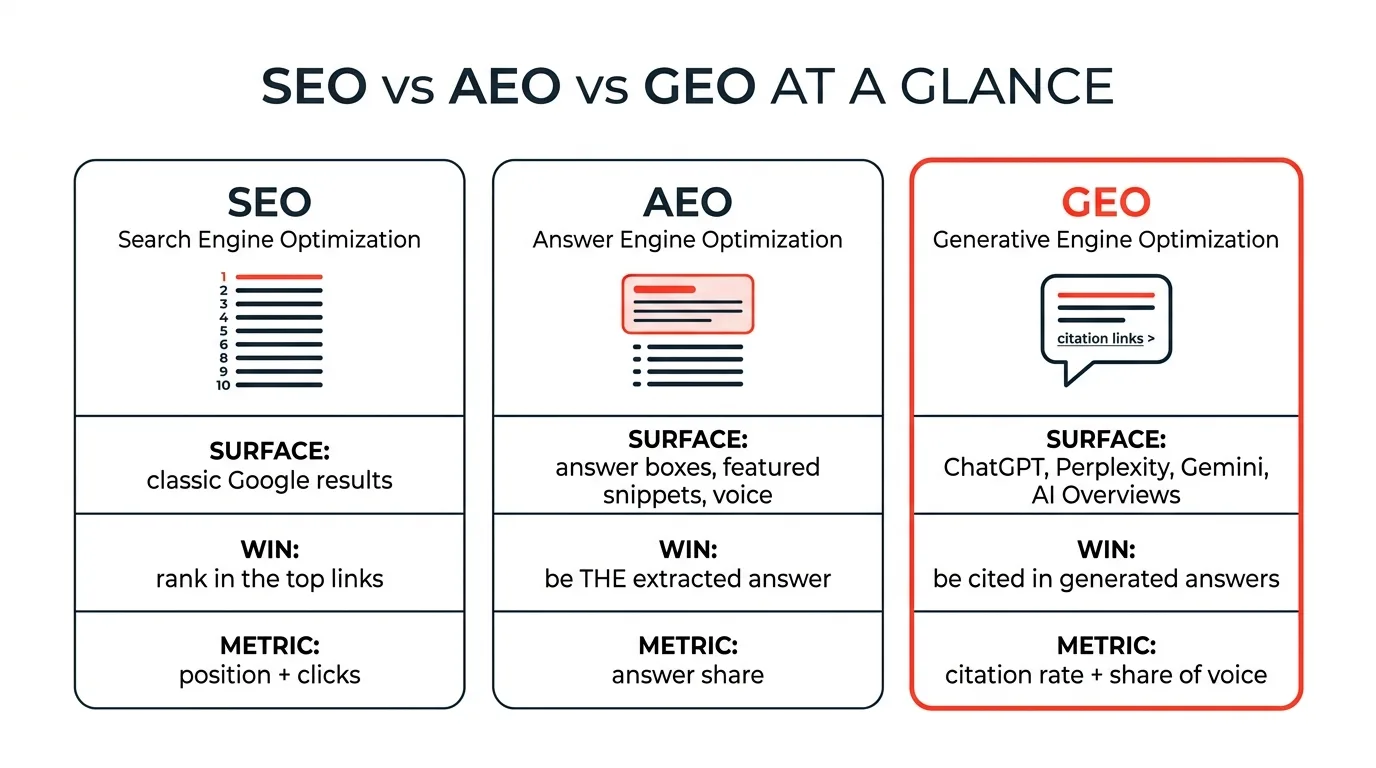 SEO vs AEO vs GEO at a glance: SEO wins classic Google rankings, AEO wins the extracted answer, GEO wins citations in AI-generated answers
The Search Landscape Has Fragmented
For two decades, search optimization meant one thing: ranking in Google. You optimized for keywords, built backlinks, improved page speed, and tracked your position in the SERPs. The discipline was called Search Engine Optimization, and it was the undisputed king of digital discovery.
That era of simplicity is over.
Today, people discover information through multiple channels: traditional search engines, AI-powered answer boxes, voice assistants, and generative AI platforms like ChatGPT and Perplexity. Each channel has its own algorithms, its own ranking signals, and its own optimization requirements.
This fragmentation has given rise to three distinct but overlapping optimization disciplines:
- SEO, Search Engine Optimization
- AEO, Answer Engine Optimization
- GEO, Generative Engine Optimization
Understanding the differences between these three, and knowing when to invest in each, is now a strategic imperative for any business that depends on digital discovery.
Defining Each Discipline
What is SEO (Search Engine Optimization)?
SEO is the practice of optimizing your website to rank higher in traditional search engine results pages (SERPs). It targets search engines like Google, Bing, and Yahoo, where results are displayed as a list of links that users click through to visit websites.
SEO has been practiced since the mid-1990s and encompasses:
- On-page optimization: Keyword research, content creation, title tags, meta descriptions, heading structure, internal linking, and image optimization.
- Off-page optimization: Backlink building, brand mentions, social signals, and digital PR.
- Technical SEO: Site architecture, crawlability, indexation, page speed, mobile-friendliness, Core Web Vitals, and structured data.
- Content strategy: Topic research, content calendars, editorial quality, and content freshness.
SEO's primary goal is to drive organic traffic, visitors who find your website by clicking on a search result. The key metric is ranking position, and the core mechanism is Google's ranking algorithm, which evaluates hundreds of signals to determine which pages deserve to appear for a given query.
What is AEO (Answer Engine Optimization)?
AEO is the practice of optimizing your content to appear in direct-answer formats, featured snippets, knowledge panels, voice search results, and People Also Ask boxes. It targets the "position zero" placements that appear above traditional organic results.
AEO emerged as a distinct discipline around 2016-2018, driven by:
- The growth of Google's featured snippets (now appearing on approximately 12-15% of search queries)
- The rise of voice assistants (Alexa, Siri, Google Assistant) that read a single answer aloud
- Google's People Also Ask (PAA) expansion
- The increasing prevalence of knowledge panels and instant answers
AEO optimization focuses on:
- Question identification: Finding the specific questions your audience asks and creating content that directly answers them.
- Structured data markup: Implementing FAQ schema, HowTo schema, and other structured data that helps search engines extract answers.
- Concise answer formatting: Structuring content so that a clear, extractable answer appears within the first 40-60 words of a section.
- Voice search optimization: Optimizing for natural language queries and conversational phrasing.
- Knowledge panel optimization: Managing your entity presence to influence what appears in knowledge panels.
AEO's primary goal is to own the direct-answer placements. The key metric is featured snippet and PAA ownership. In voice search, the goal is to be the single answer the assistant reads aloud.
What is GEO (Generative Engine Optimization)?
GEO is the practice of optimizing your digital presence to be cited, referenced, or recommended in AI-generated responses. It targets generative AI platforms like ChatGPT, Google AI Overviews, Perplexity, Claude, and enterprise AI assistants.
GEO is the newest of the three disciplines, having emerged in 2024-2025 as generative AI platforms became mainstream search alternatives. It encompasses:
- Entity optimization: Building a well-defined, authoritative entity profile that AI engines can confidently reference.
- Content citability: Structuring content so that AI engines can extract, attribute, and cite specific claims and recommendations.
- Technical AI accessibility: Ensuring AI crawlers (GPTBot, ClaudeBot, PerplexityBot) can access your content, implementing llms.txt, and optimizing for RAG retrieval.
- Authority signal building: Earning brand mentions, expert citations, and cross-platform presence that signal source reliability to AI engines.
- Structured data depth: Going beyond basic schema markup to provide thorough, interconnected structured data that AI engines use for entity resolution and fact verification.
GEO's primary goal is brand visibility in AI-generated answers. The key metric is citation rate, how often your brand is mentioned when AI engines answer queries relevant to your business. For a complete introduction, see our guide: What is Generative Engine Optimization?
Detailed Comparison: GEO vs SEO vs AEO
Core Differences at a Glance
| Dimension | SEO | AEO | GEO |
|---|---|---|---|
| Primary Target | Google, Bing SERPs | Featured snippets, voice assistants, PAA | ChatGPT, Perplexity, AI Overviews, Claude |
| User Interaction | User clicks a link to visit your site | User reads/hears a direct answer | User receives an AI-synthesized response citing sources |
| Success Metric | Organic traffic, ranking position | Snippet ownership, voice answer rate | Citation rate, AI mention frequency |
| Content Goal | Detailed, keyword-relevant page | Concise, directly answering question | Authoritative, citable, entity-rich content |
| Key Technical Factor | Crawlability, speed, mobile-first | Schema markup, answer extraction | AI crawler access, llms.txt, structured data depth |
| Authority Signal | Backlinks from relevant domains | Topical authority for question topics | Entity presence, brand mention density, cross-platform authority |
| Traffic Model | Direct click-through from SERP | Reduced CTR (answer shown in SERP) | Variable (some AI platforms include source links, some do not) |
| Maturity | Mature (25+ years) | Established (8+ years) | Emerging (2+ years) |
| Competition Level | Extremely high | High | Moderate (early-mover advantage available) |
| Time to Results | 3-12 months | 1-6 months | 1-6 months for RAG; 6-18 months for training data |
How Each Discipline Approaches Content
The content strategies for SEO, AEO, and GEO share common ground but differ in emphasis:
SEO content priorities:
- Targeting specific keywords with measurable search volume
- Broad coverage of a topic to satisfy user intent
- Internal linking to distribute page authority
- Optimized title tags and meta descriptions for click-through
- Content length calibrated to competitive analysis (often 1,500-3,000+ words)
AEO content priorities:
- Identifying specific questions and providing concise, direct answers
- Using question-answer format with clear heading structure
- Formatting answers for extraction (tables, numbered lists, definition paragraphs)
- Keeping the core answer within 40-60 words for featured snippet eligibility
- Implementing FAQ and HowTo schema markup
GEO content priorities:
- Making definitive, factual statements that AI can confidently cite
- Including original data, statistics, and research
- Building wide-ranging topic hubs that demonstrate expertise depth
- Citing authoritative sources to increase content trustworthiness
- Structuring content with clear entity references and relationships
- Ensuring all claims are accurate and consistent with other authoritative sources
How Each Discipline Approaches Technical Optimization
SEO technical focus:
- Google crawlability and indexation
- Core Web Vitals (LCP, FID/INP, CLS)
- Mobile-first design and responsive rendering
- XML sitemap and robots.txt for search engines
- Canonical tags and URL structure
- Hreflang for international targeting
AEO technical focus:
- Schema.org structured data (FAQ, HowTo, QAPage)
- Speakable schema for voice search
- Clean HTML structure for answer extraction
- Fast server response times (answer engines need speed)
- Mobile-first (most voice searches are mobile)
GEO technical focus:
- AI crawler permissions (GPTBot, ClaudeBot, PerplexityBot)
- llms.txt implementation for AI content discovery
- Server-side rendering (AI crawlers have limited JS execution)
- Full structured data (Organization, Article, Person, nested schemas)
- API availability for RAG systems
- Content accessibility without authentication barriers
The Traffic Question
One of the most important differences between these disciplines is how they generate business value:
SEO drives direct traffic. A user clicks your search result and lands on your website. You can measure this traffic, attribute conversions, and calculate ROI directly.
AEO often reduces direct traffic. When a featured snippet answers the user's question directly in the SERP, many users never click through. However, appearing in position zero builds brand authority and trust, and some studies show that featured snippet owners actually see increased CTR for more complex queries.
GEO has a more complex traffic model. Some AI platforms (like Perplexity) include source links that drive referral traffic. ChatGPT with browsing sometimes includes links. Google AI Overviews include expandable source citations. But many AI citations do not include links at all, the value is brand visibility and trust, not necessarily direct traffic.
This does not mean GEO has lower ROI. Brand visibility in AI-generated recommendations drives trust, consideration, and branded search, which then converts through traditional channels. The attribution is indirect but the business impact is real.
When to Invest in Each
Invest in SEO When:
- You need direct, measurable organic traffic. SEO remains the highest-volume organic traffic channel for most businesses.
- Your audience uses traditional search. For many queries, users still prefer to browse search results and choose their own sources.
- You are in a competitive market with established search demand. If there is significant search volume for your target keywords, SEO is the proven path to capturing it.
- You need a trackable, attributable channel. SEO's measurement infrastructure is mature, you can track rankings, traffic, conversions, and revenue with high confidence.
- You are starting from zero. If you have no digital presence, SEO fundamentals (site structure, content, technical health) are the foundation everything else builds on.
Invest in AEO When:
- Your content answers specific, common questions. If your audience asks clear, answerable questions, AEO helps you own those answer placements.
- Voice search is relevant to your audience. If your customers use voice assistants for research or purchasing decisions, AEO is essential.
- You want to build topical authority. Owning featured snippets for a cluster of related questions signals expertise to both users and search engines.
- You are in a local or service-based business. Voice search and direct answers are disproportionately important for local and service queries.
- You already have strong SEO. AEO builds on SEO fundamentals. If your pages already rank well, AEO helps you capture the enhanced placements above organic results.
Invest in GEO When:
- Your audience uses AI tools for research. If your customers are knowledge workers, tech-savvy consumers, or early adopters, they are likely using ChatGPT, Perplexity, or AI Overviews.
- You are in a considered purchase category. For high-value B2B services, SaaS, professional services, and complex purchases, AI-driven research is growing fastest.
- You want to capture early-mover advantage. GEO is still emerging, and competitive intensity is low. Investing now builds compounding advantages.
- Your competitors are being cited and you are not. If competitors appear in AI-generated answers for your target queries, you are losing market share in this channel.
- You want to future-proof your digital strategy. AI search is growing rapidly. Brands that ignore it will face an increasingly difficult catch-up challenge.
- You already have strong SEO and AEO foundations. GEO builds on many of the same fundamentals. If your site is well-structured, technically sound, and content-rich, GEO optimization is a natural extension.
The Combined Strategy Framework
The most effective approach is not choosing between SEO, AEO, and GEO, it is building a unified optimization strategy that draws on all three. Here is how to think about it:
Layer 1: SEO Foundation
Everything starts with SEO fundamentals. Without a technically sound, well-structured, content-rich website, neither AEO nor GEO will be effective.
Foundation checklist:
- Site architecture that is logical and crawlable
- Core Web Vitals meeting Google's thresholds
- Keyword-targeted content covering your primary topics
- Internal linking structure that distributes authority
- Backlink profile that signals domain authority
- Mobile-first, fast-loading pages
Layer 2: AEO Enhancement
Once your SEO foundation is solid, add AEO optimizations to capture direct-answer placements.
Enhancement checklist:
- FAQ schema on high-traffic question-answering pages
- HowTo schema on tutorial and guide content
- Concise, extractable answers at the top of each content section
- Question-based headings that match common search queries
- Speakable schema for voice search eligibility
Layer 3: GEO Extension
With SEO and AEO in place, extend into GEO to capture the AI search channel.
Extension checklist:
- AI crawler access verified and optimized (robots.txt, llms.txt)
- Complete entity profiles (Wikidata, Knowledge Panel, consistent NAP)
- Deep structured data (nested schemas, Organization with full properties)
- Content restructured for citability (definitive statements, original data)
- Brand mention and citation building strategy
- AI visibility monitoring and measurement
Resource Allocation
How you split resources depends on your current maturity and audience:
| Scenario | SEO | AEO | GEO |
|---|---|---|---|
| Starting from scratch | 70% | 20% | 10% |
| Established SEO, new to AEO/GEO | 40% | 25% | 35% |
| Strong SEO + AEO, new to GEO | 30% | 20% | 50% |
| Mature across all three | 30% | 25% | 45% |
Note that GEO allocation increases over time because AI search market share is growing. In 2027-2028, we expect GEO to command equal or greater investment than traditional SEO for most digitally mature organizations.
ROI Comparison
Comparing ROI across these disciplines requires acknowledging that they measure different things and have different time horizons.
SEO ROI
- Time to ROI: 6-12 months for competitive keywords
- Measurement confidence: High, direct traffic attribution is reliable
- Typical ROI range: 5-10x over 24 months for well-executed campaigns
- Compounding effect: Strong, domain authority and content assets appreciate over time
- Risk: Algorithm updates can cause significant ranking volatility
AEO ROI
- Time to ROI: 2-6 months for featured snippet targeting
- Measurement confidence: Medium, snippet ownership is measurable, but business impact of voice search is harder to attribute
- Typical ROI range: 3-8x over 12 months (often measured as incremental SEO value)
- Compounding effect: Moderate, snippet ownership can be volatile, but topical authority compounds
- Risk: Google frequently changes snippet formats and eligibility criteria
GEO ROI
- Time to ROI: 1-3 months for RAG-based visibility; 6-18 months for training data influence
- Measurement confidence: Lower (but improving), AI visibility monitoring tools are maturing rapidly
- Typical ROI range: Difficult to benchmark industry-wide, but early adopters report significant brand lift and pipeline influence
- Compounding effect: Very strong, entity authority, content depth, and citation momentum all compound
- Risk: AI platform landscape is evolving rapidly; optimization strategies may need frequent adjustment
To estimate the potential return on GEO for your business, try our GEO ROI Calculator.
The Future: Convergence or Divergence?
An important strategic question is whether SEO, AEO, and GEO will converge into a single discipline or continue to diverge.
Our view: partial convergence with persistent specialization.
Here is what we expect:
Converging elements:
- Content quality requirements are converging. All three disciplines reward in-depth, authoritative, well-structured content.
- Technical foundations are converging. Structured data, site speed, and clean architecture benefit all three.
- Brand authority requirements are converging. Backlinks, brand mentions, and entity presence all contribute to all three.
Diverging elements:
- Measurement and attribution will remain distinct. Each channel has different metrics and different attribution models.
- Technical optimization details will remain specialized. AI crawler management, llms.txt, and RAG optimization are GEO-specific. Voice search optimization is AEO-specific. Core Web Vitals tuning is SEO-specific.
- Content formatting requirements will remain different. What makes a featured snippet (concise, extractable) differs from what makes an AI citation (definitive, data-rich, contextually complete).
The practical implication: you need a unified strategy with specialized execution. One team, one content calendar, one brand voice, but with specialized tactics for each discovery channel.
Getting Started
If you are reading this and wondering where to begin, here is our recommendation:
- Assess your current state. Where do you stand in SEO, AEO, and GEO today? Use our GEO Readiness Checker for the GEO component.
- Identify your audience's behavior. Are your customers using AI tools for research? The answer varies by industry, demographic, and use case.
- Strengthen your foundation. If your SEO is not solid, start there. GEO and AEO build on SEO fundamentals.
- Add GEO incrementally. You do not need to do everything at once. Start with technical accessibility (robots.txt, llms.txt), then move to entity optimization, then content citability.
- Measure and iterate. Set up monitoring for all three channels and adjust your resource allocation based on results.
The brands that thrive in the next era of digital discovery will be those that master all three disciplines and integrate them into a coherent strategy. The time to start is now.
Need help building your unified SEO + AEO + GEO strategy? Explore our GEO services or book a free audit to get a personalized assessment of your AI search opportunity.
FAQ
What is the difference between SEO, AEO and GEO? SEO (search engine optimisation) earns rankings in classic Google results; AEO (answer engine optimisation) earns the extracted answer in featured snippets, answer boxes, and voice assistants; GEO (generative engine optimisation) earns citations inside AI-generated answers from ChatGPT, Perplexity, Gemini, and Google AI Overviews. They overlap heavily: strong structure and entity signals feed all three, but the surfaces and success metrics differ.
What is the difference between GEO and AEO? AEO targets deterministic answer surfaces, featured snippets, People Also Ask, and voice responses, where one source is extracted as the answer. GEO targets generative surfaces, where an AI model composes a new answer and cites its sources. The industry increasingly uses the terms together and the boundary is still contested; what matters is covering both extraction and citation, not the label.
Do I need SEO, AEO and GEO at the same time? Most brands need SEO and GEO together, with AEO folded into both rather than run as a separate programme. Classic rankings still drive today's traffic, AI citations increasingly decide tomorrow's shortlists, and the structured, answer-first content that wins snippets is the same foundation both need. Treat GEO as an extension of your search programme, not a replacement.
Is AEO the same as SEO? No. AEO is a specialisation of SEO focused on being extracted as the direct answer rather than just ranked. It shares SEO's foundations of crawlability, structure, and authority, but optimises for answer boxes and voice assistants, where position zero is the only position that matters.
This post is part of our GEO Optimization guide. Related reading: GEO vs SEO vs AEO, What is Generative Engine Optimization, 12 Best AI SEO Tools for Visibility Tracking.

Walid founded AY Rank to help businesses dominate AI search. He leads the GEO methodology and oversees client strategy across 50+ cities in Europe, Middle East, and North Africa.
Full Bio →