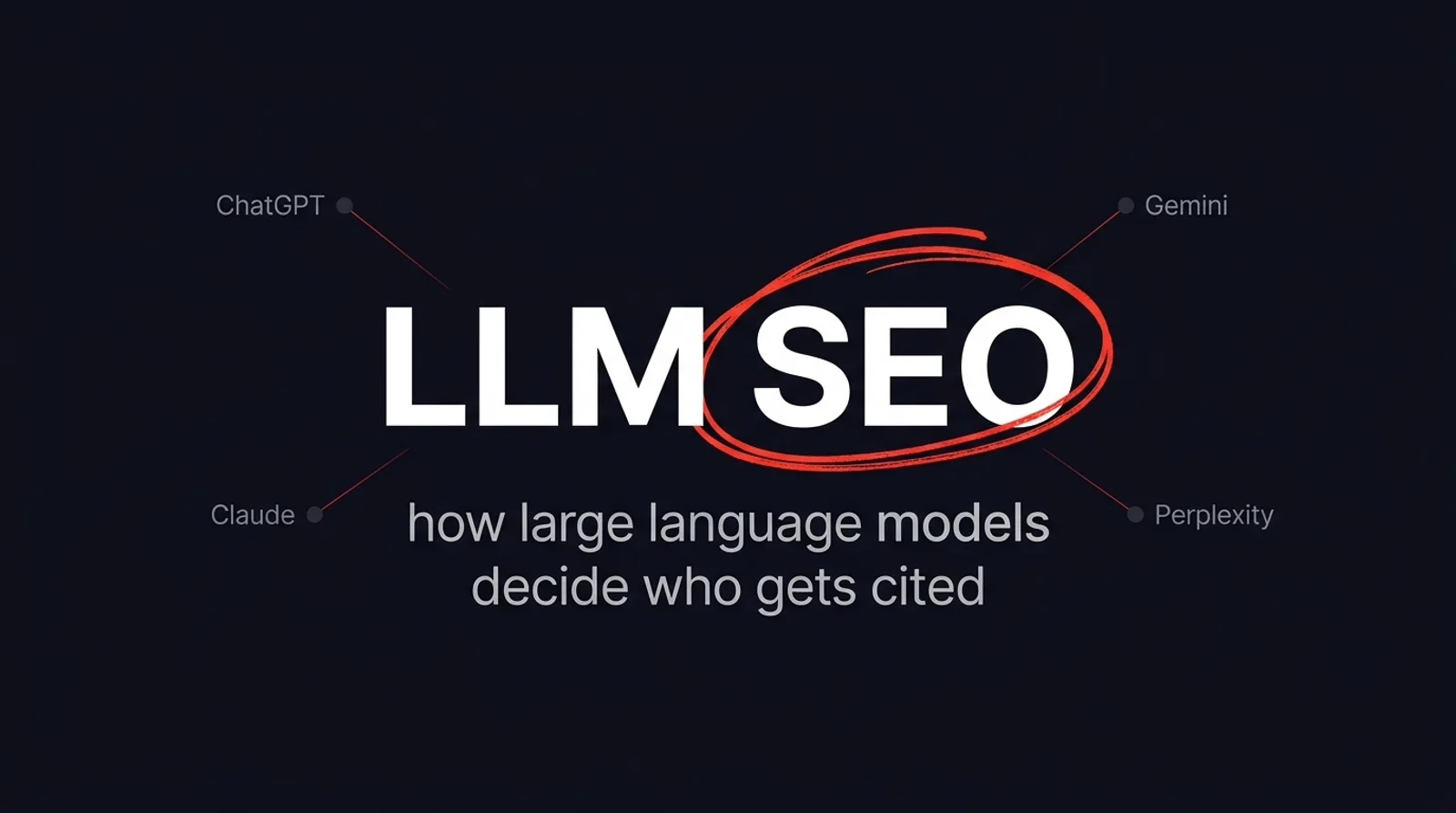
- What is LLM SEO? Optimising your website and brand entity so ChatGPT, Claude, Gemini, and Perplexity cite you in their answers.
- Is it the same as GEO? Same outcome and largely the same tactics. GEO is the discipline name; LLM SEO is what practitioners with an SEO background call it.
- Does classic SEO still matter? Yes. AI assistants start with a live web search, so ranking in the candidate set is the entry ticket.
- Bottom line: Two jobs with one name. Teach the training layer who you are, and win the retrieval layer with answer-first, citable pages.
LLM SEO is the practice of optimising your website and brand presence so that large language models (ChatGPT, Claude, Gemini, Perplexity's models) cite and recommend you in their answers. Traditional SEO earns you a position on a results page. LLM SEO earns you a place inside the answer itself.
That distinction matters more every quarter. Gartner projects that traditional search engine volume will drop 25% by 2026 as users shift to AI assistants and chatbots. That projection has not held at the aggregate level: 2026 data across 40,000+ sites shows organic traffic down just 2.5% year over year, though CTR on AI-Overview-triggered queries specifically crashed 61% (full breakdown). When a founder asks ChatGPT "which agency should I hire for AI search?", there is no page two. The model names a handful of brands, and either you are one of them or you are invisible.
This guide explains how LLMs actually decide what to cite, the two separate systems you need to influence (training data and live retrieval), and the concrete optimisation work that moves the needle. You will also see where LLM SEO overlaps with AI SEO and GEO, and where it differs.
What is LLM SEO?
LLM SEO is the process of making your content and brand entity legible and quotable to large language models, so the model surfaces you when users ask questions in your category. It covers two distinct targets: what the model learned during training, and what the model retrieves from the live web at answer time.
The term sits inside a cluster of overlapping labels. GEO (Generative Engine Optimisation) describes optimising for AI answer engines as a discipline. AEO (Answer Engine Optimisation) leans towards featured-answer formats. LLMO (Large Language Model Optimisation) is a near-synonym you will see in tool marketing. LLM SEO is the phrasing practitioners with a traditional SEO background reach for first, which is why it deserves its own treatment: the mental model that comes with it ("do SEO, but for LLMs") is half right and half misleading.
Half right, because clean technical foundations, strong content, and authority signals still matter. Half misleading, because LLMs do not rank a list of ten links. They synthesise one answer and attribute it to a small set of sources. The optimisation target is selection, not position.
How do LLMs choose what to cite?
Large language models pull from two separate systems, and each one responds to different optimisation work.
1. The training layer (parametric knowledge)
During pre-training, a model ingests a snapshot of the web: Common Crawl, Wikipedia, news, forums, documentation. Whatever your brand looked like in that corpus is what the model "knows" about you without searching. If your category and your brand co-occur across many independent, credible sources, the model learns the association. If you only exist on your own domain, you barely exist at all.
You influence this layer slowly, through entity building: consistent brand descriptions across the web, third-party mentions, directory and review presence, Wikipedia-adjacent citations, and digital PR. Think of it as reputation compounding into model weights.
2. The retrieval layer (RAG and live search)
When ChatGPT browses, when Perplexity answers, when Google generates an AI Overview, the model runs a live search, reads the top results, and composes an answer with citations. This layer behaves much more like classical search: crawlable pages, fast responses, clear structure, and ranking well enough to be in the candidate set.
The difference is what happens after retrieval. The model extracts passages, and it strongly favours passages that answer a question directly, carry a citable fact, and stand alone without surrounding context. A Princeton-led study on generative engine optimisation found that adding quotations, statistics, and cited sources to a page improved its visibility in AI-generated answers by up to 40%.
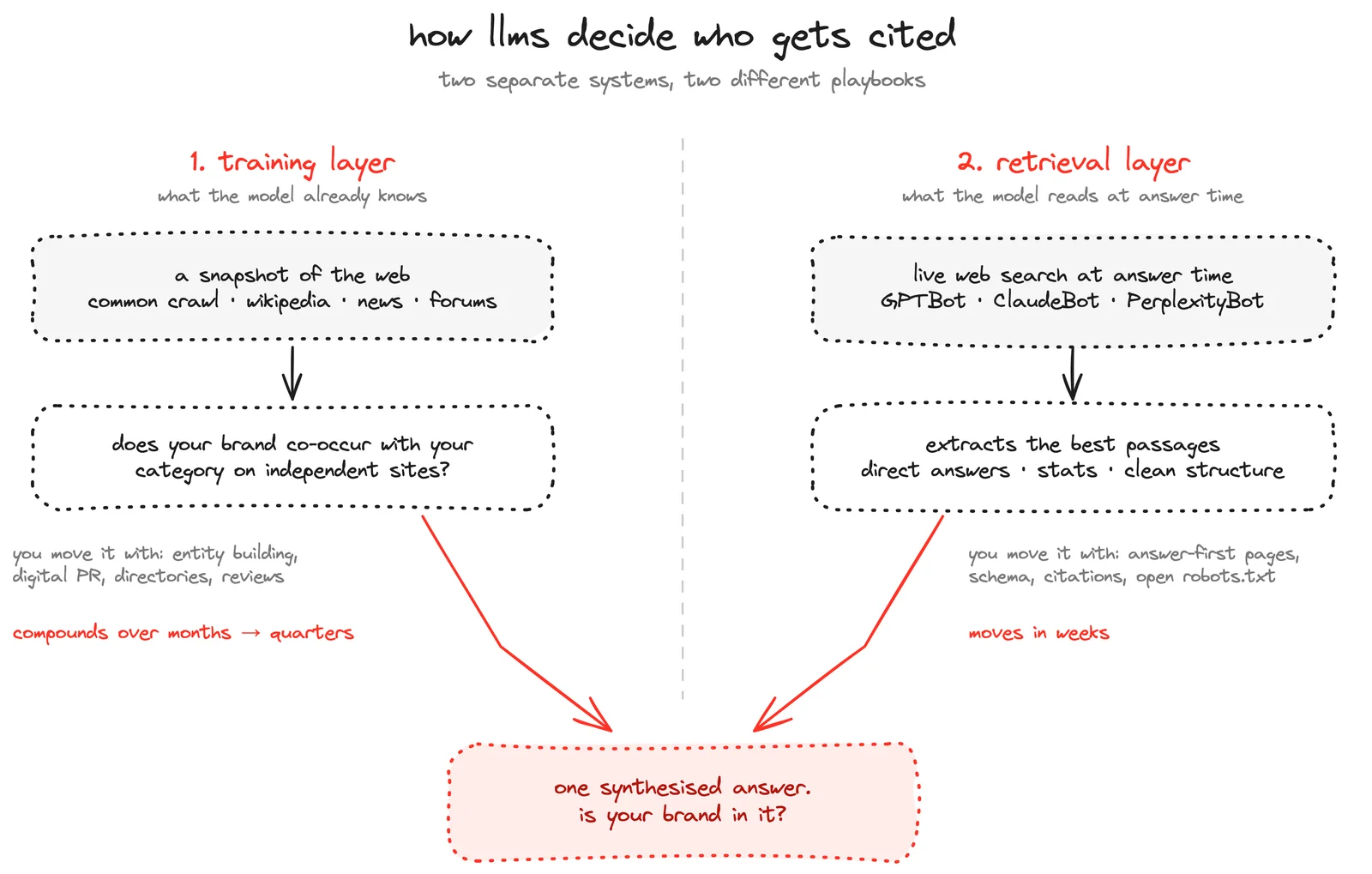 The two layers of LLM SEO: the training layer learns your brand from independent sites over months, while the retrieval layer reads answer-first, citable pages in weeks. Both converge on one synthesised answer that either names your brand or leaves it invisible
LLM SEO vs traditional SEO: what actually changes?
The core shift: traditional SEO optimises pages to rank in a list of links, while LLM SEO optimises passages and entities to be selected for a synthesised answer. Here is how that plays out signal by signal.
| Dimension | Traditional SEO | LLM SEO |
|---|---|---|
| Goal | Rank in the top 10 links | Be named inside the answer |
| Unit of optimisation | The page | The passage and the entity |
| Key signals | Backlinks, keywords, UX | Entity clarity, citable facts, structure |
| Content style | Long-form, keyword-mapped | Answer-first, extractable blocks |
| Crawlers | Googlebot, Bingbot | GPTBot, ClaudeBot, PerplexityBot, Google-Extended |
| Measurement | Rankings, clicks | Citations, brand mentions in answers |
| Feedback loop | Days to weeks | Opaque, checked by prompt sampling |
Two rows deserve emphasis. First, the crawler row: if your robots.txt blocks GPTBot or PerplexityBot, you have opted out of the retrieval layer entirely. Our guide to robots.txt for AI crawlers walks through the exact directives. Second, the measurement row: there is no Search Console for ChatGPT. You measure LLM visibility by systematically asking the models your target questions and logging whether you appear, or by using citation-tracking tools built for this purpose.
How do you optimise a site for LLMs?
The work falls into five areas. None of them is exotic. The discipline is in doing them for the passage and the entity, not just the page.
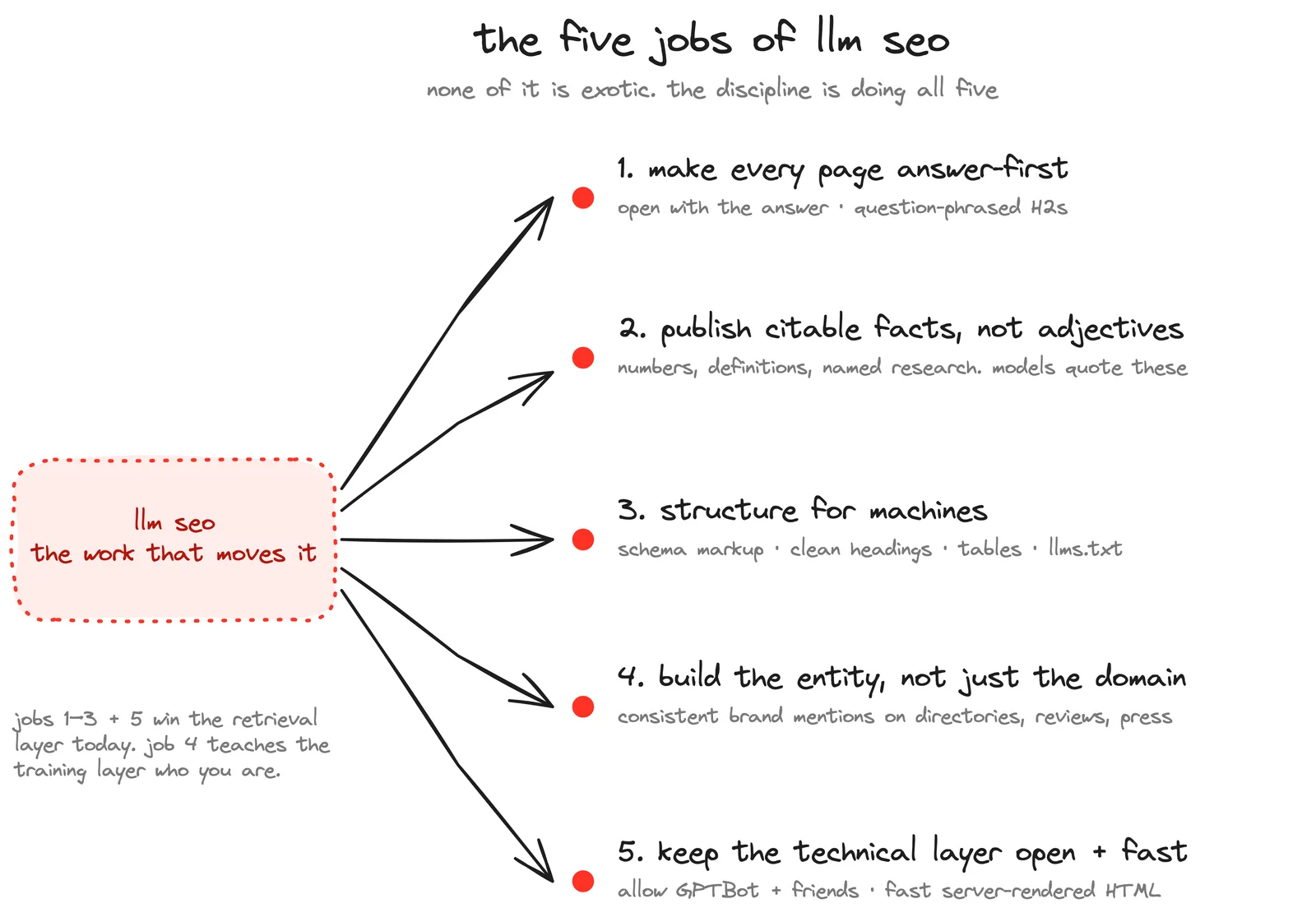 The five jobs of LLM SEO: make every page answer-first, publish citable facts instead of adjectives, structure content for machines with schema and llms.txt, build the brand entity on third-party sites, and keep the technical layer open and fast for AI crawlers
Make every important page answer-first
Open each page with a direct, self-contained answer to the question the page targets, then expand. LLMs extract passages, and a paragraph that defines the topic in plain language, names the entity, and includes a concrete fact is the most extractable unit you can publish. Question-phrased H2s help, because they map cleanly onto the prompts users actually type.
Publish citable facts, not adjectives
Models quote numbers, definitions, and named research. They do not quote "industry-leading solutions". Add original data where you have it, cite reputable sources where you do not, and attribute clearly. The Princeton study cited above found citation-rich pages outperform keyword-stuffed ones in generative answers; that finding is the whole content strategy in one sentence.
Structure for machines as well as readers
Schema markup (Article, FAQPage, Organization), clean heading hierarchies, tables for comparisons, and an llms.txt file all reduce the work a model has to do to understand you. Structured data is also how you nail down your entity: same name, same description, same identifiers everywhere. Our complete guide to llms.txt covers the file format and what to include.
Build the entity, not just the domain
Get your brand described consistently on third-party sites: directories, review platforms, partner pages, podcasts, industry press. Co-occurrence between your brand name and your category across independent sources is what teaches the training layer who you are. This is classic digital PR with a sharper target. A GEO optimisation programme typically front-loads this entity work before touching content.
Keep the technical layer open and fast
Allow the AI crawlers you want (GPTBot, ClaudeBot, PerplexityBot, Google-Extended), serve fast server-rendered HTML, and keep key content out of JavaScript-only rendering paths. A technical SEO audit that includes AI-crawler access checks will surface most blockers in a day.
How do you measure LLM SEO results?
Direct measurement is still immature, so practitioners triangulate from four signals.
Prompt sampling comes first: build a fixed list of 20 to 50 questions your buyers ask, run them through each model on a schedule, and log every brand mention and citation. This is the closest thing to rank tracking that exists for LLMs. Dedicated AI citation tracking tools automate the sampling and trend the results.
Referral traffic is the second signal. ChatGPT, Perplexity, and Gemini all pass referrer data in most contexts, so segment them in your analytics. Third, watch branded search volume: users often see a brand in an AI answer, then Google it, so a lift in branded queries frequently follows a lift in citations. Fourth, ask inbound leads how they found you. "ChatGPT recommended you" is showing up in intake forms across service industries, and it is the only attribution that survives every measurement gap.
Run a fixed list of 20 to 50 buyer questions through each model on a schedule and log every mention.
Segment ChatGPT, Perplexity, and Gemini referrers in your analytics.
A lift in branded queries often follows a lift in citations.
Ask inbound leads how they found you. "ChatGPT recommended you" survives every measurement gap.
LLM SEO is two jobs with one name: teach the training layer who you are through entity building and third-party presence, and win the retrieval layer with answer-first, citation-rich, structurally clean pages. Measure it with scheduled prompt sampling, because no native analytics exist. Teams that only do one of the two jobs stall.
Is LLM SEO worth prioritising in 2026?
For most revenue-generating businesses, yes, and the reason is timing rather than volume. AI assistants still send less referral traffic than Google search sends clicks. But the users who arrive from an AI recommendation have already been pre-sold by the model, and competition for citations remains thin in most categories. The cost of becoming a default answer is low now and rises as more brands do this work.
There is a defensive case as well. If a model answers questions in your category without you, it answers them with your competitors. That gap compounds in the training layer: today's citations become tomorrow's training data, which becomes the model's default framing of your market.
The honest caveat: measurement is immature, model behaviour shifts without notice, and nobody can guarantee a citation. Any AI SEO service promising a fixed number of ChatGPT mentions is overpromising. What a serious programme can do is systematically raise the probability of citation across every model at once, because the underlying signals (entity clarity, citable content, open technical access) are shared.
- Visitors from AI answers arrive pre-sold by the model
- Competition for citations is still thin in most categories
- Today's citations become tomorrow's training data
- The same signals raise visibility across every model at once
- Measurement is immature; there is no Search Console for ChatGPT
- Model behaviour shifts without notice
- Nobody can guarantee a specific citation
- AI referral volume is still smaller than Google clicks
FAQ
What is LLM SEO?
LLM SEO is the practice of optimising your website and brand entity so that large language models such as ChatGPT, Claude, and Gemini cite or recommend you in their answers. It targets both the model's training data (through entity building and third-party mentions) and its live retrieval layer (through answer-first, structured, crawlable content).
Is LLM SEO the same as GEO?
They overlap heavily and pursue the same outcome: visibility in AI-generated answers. GEO (Generative Engine Optimisation) is the broader discipline name, popularised by a 2023 Princeton-led research paper; our GEO SEO guide covers how it combines with classic SEO in one program. LLM SEO is the phrasing traditional SEO practitioners tend to use, with more emphasis on the models themselves. In practice the tactics are the same, and the terms are used interchangeably alongside AEO and LLMO.
Does traditional SEO still matter for LLM visibility?
Yes, because the retrieval layer of most AI assistants starts with a conventional web search. If your pages cannot rank in the candidate set, they cannot be read or cited by the model. Strong traditional SEO is the entry ticket; LLM SEO is what gets you selected from the candidates.
How do LLMs decide which sources to cite?
At answer time, models retrieve top-ranking pages for the query, then favour passages that directly answer the question, contain concrete facts or statistics, come from sources with clear authority, and are easy to extract without surrounding context. Research on generative engines found that adding citations, quotations, and statistics improved a page's visibility in AI answers by up to 40%.
How long does LLM SEO take to show results?
Retrieval-layer changes (answer-first restructuring, schema, crawler access) can influence citations within weeks, because they affect what models read live. Training-layer changes (entity building, third-party mentions) compound over months and only fully register when models retrain or refresh their indexes. Plan for early signals within 4 to 8 weeks and durable gains over two to three quarters.
Should I block AI crawlers to protect my content?
Blocking GPTBot, ClaudeBot, or PerplexityBot removes your content from those models' retrieval and training pipelines, which means your competitors define your category in your absence. For most commercial sites the visibility loss outweighs the content-protection benefit. If you have premium content to protect, block selectively by directory rather than site-wide.
How is LLM SEO measured?
Primarily through prompt sampling: running a fixed set of buyer questions through each model on a schedule and logging brand mentions and citations. Supporting signals include AI referral traffic in analytics, branded search volume trends, and self-reported attribution from inbound leads. An AI visibility audit establishes the baseline before optimisation starts. If you would rather have a team run it end to end, that is what our AI SEO agency service does.
What does an LLMO agency do, and is that different from LLM SEO?
Nothing structural: LLMO (large language model optimization) and LLM SEO name the same discipline. An LLMO agency runs the entity building, schema work, and citation-ready content described in this guide as a managed service. The label a provider uses matters far less than whether they can show real citation counts across models.
Which tools can track brand citations in LLM responses?
Prompt-sampling platforms such as Otterly.ai, Peec AI, and LLMrefs run fixed query sets through the major models on a schedule and log where your brand appears. We compare the current options in our roundups of AI citation tracking tools and LLMO tools. Whatever the tool, the metric that matters is citation share of voice on your buyer queries, trended over time.
Sources
Sources: Gartner search volume prediction, GEO: Generative Engine Optimization (Aggarwal et al., KDD 2024), OpenAI GPTBot documentation
This post is part of our AI SEO guide. Related reading: AI Visibility Monitoring, How to Rank in ChatGPT, Best AI SEO Agencies.

Oussama leads technical and on-page SEO at AY Rank. He specializes in structured data engineering, crawl optimization, and building the entity architecture that makes AI models cite our clients.
Full Bio →