ChatGPT has over 1 billion weekly active users, officially confirmed by OpenAI on August 6, 2026, up from 900 million in February 2026 (Source: OpenAI, via TechCrunch). Yet only 12% of the URLs it cites overlap with Google's top 10 results (Source: Atomic AGI). If you want to learn how to rank in ChatGPT, the playbook looks nothing like traditional SEO. Different signals, different content formats, different timelines.
This guide breaks down the exact steps we use at AY Rank to get client brands cited by ChatGPT, backed by data from over 1 million tracked AI citations. You will walk away with a repeatable process, not theory.
Why Does Ranking in ChatGPT Matter for Your Business?
Google still drives the majority of web traffic. But AI-referred visitors convert at 14.2% compared to 2.8% for traditional organic search (Source: Superprompt, 12M visits analyzed). That is a 5x conversion advantage.
The reason is intent. Someone asking ChatGPT "what is the best GEO agency for SaaS companies" is further down the funnel than someone typing the same query into Google. ChatGPT gives a direct recommendation, and users trust it.
Three shifts make this urgent right now:
- Search behavior is fragmenting. 58% of US adults under 30 have used ChatGPT for search-style queries (Source: Pew Research, 2025).
- AI traffic is compounding. Generative AI referral traffic grew 796% year-over-year through 2025 (Source: WebFX).
- First-mover advantage is real. Most competitors have not started optimizing for AI search. The window to establish your brand as an entity ChatGPT recognizes is open now, but narrowing.
If your AI SEO strategy does not account for ChatGPT, you are leaving high-intent traffic on the table.
How Does ChatGPT Decide What to Cite?
Before diving into tactics, you need to understand how ChatGPT builds its answers. It does not rank pages. It synthesizes information from multiple sources and cites the ones it finds most authoritative and relevant.
ChatGPT's citation hierarchy works like this:
- Training data (pre-trained knowledge from web crawls up to its cutoff date)
- Real-time web browsing (via Bing search when using ChatGPT with browsing enabled)
- Plugin and tool results (for specialized queries)
The practical implication: your content needs to be strong in both the training corpus (long-term mentions across authoritative sites) and in real-time search results (Bing indexation and freshness).
| Factor | Impact on ChatGPT Citations | How to Optimize |
|---|---|---|
| Entity clarity | High: ChatGPT must recognize your brand | Schema markup, Wikipedia, Wikidata |
| Content structure | High: extractable answers get cited | H2-H3 hierarchy, direct-answer openers |
| Source authority | High: trusted domains get preference | Earn mentions on G2, Capterra, Reddit |
| Content freshness | Medium-High: 3.2x citation boost within 30 days | Monthly content refresh cycles |
| Bing indexation | Medium: powers real-time browsing | Submit to Bing Webmaster Tools |
| Structured data | Medium: 3-5x citation increase | FAQ, Article, Organization schema |
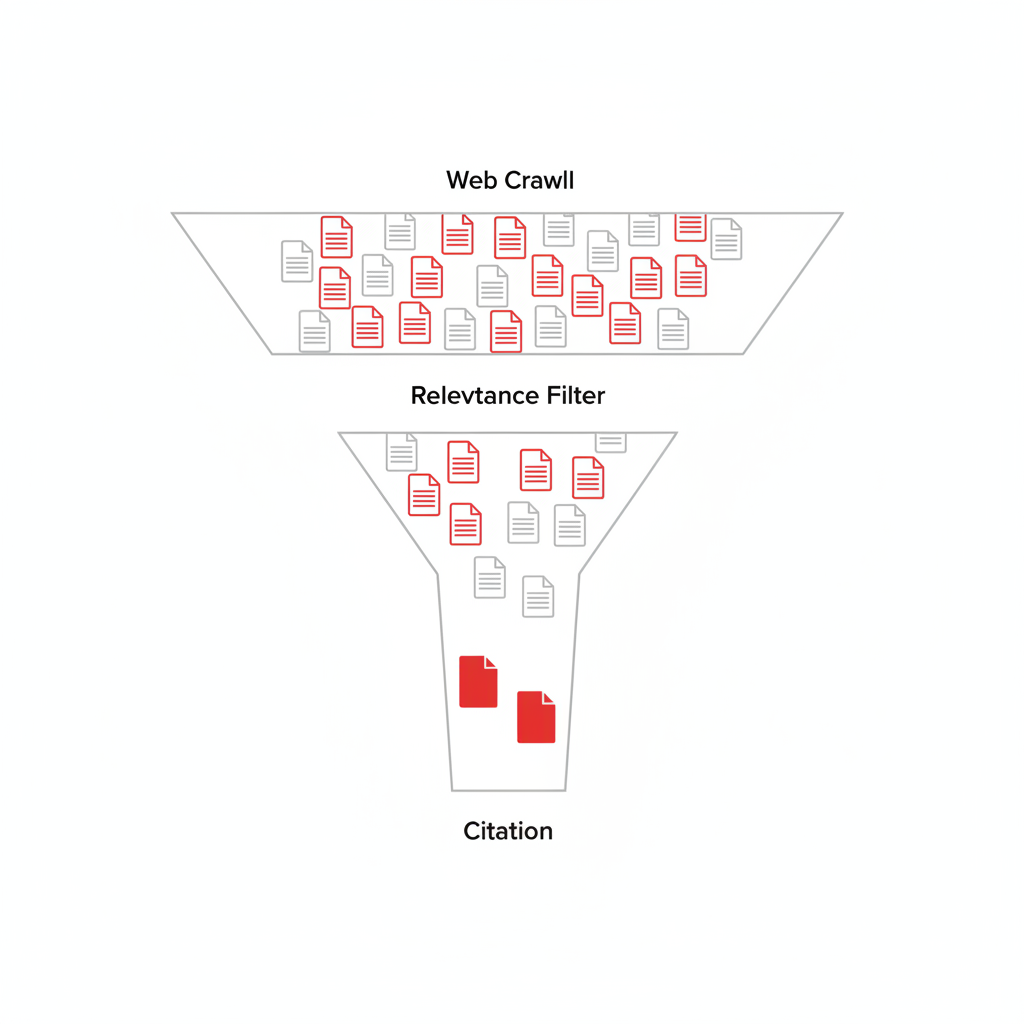 How ChatGPT selects sources: from web crawl to relevance filter to final citation
How ChatGPT narrows thousands of pages down to 2-7 cited sources.
How ChatGPT selects sources: from web crawl to relevance filter to final citation
How ChatGPT narrows thousands of pages down to 2-7 cited sources.
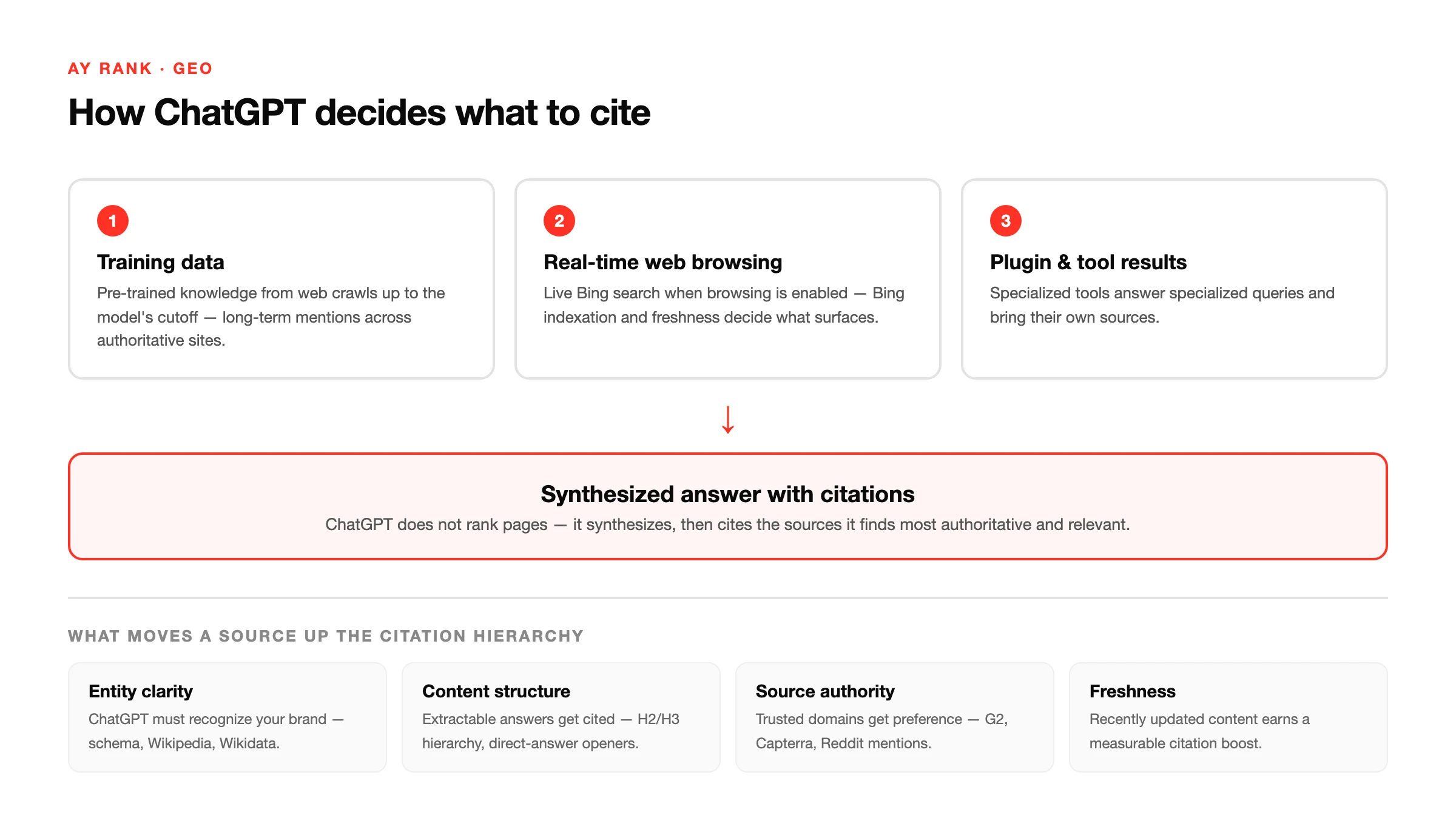 How ChatGPT decides what to cite: training data, real-time Bing browsing, and tool results are synthesized into one answer, with entity clarity, content structure, source authority, and freshness moving a source up the citation hierarchy
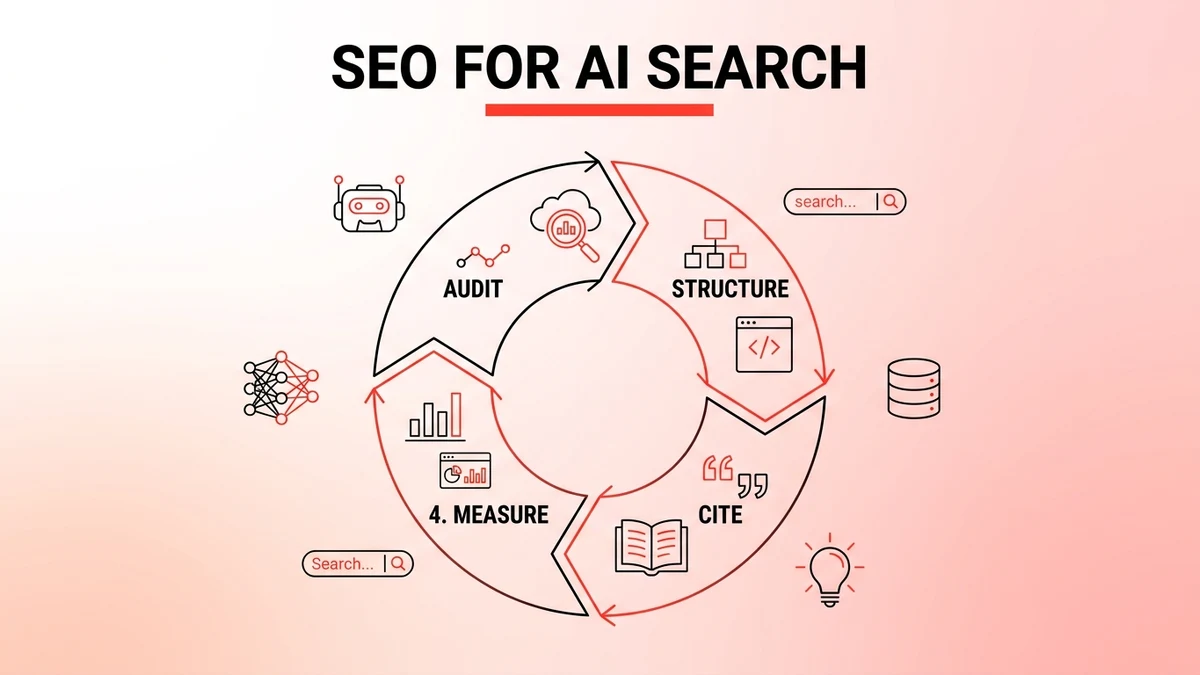
Step 1: How Do You Audit Your Current ChatGPT Visibility?
Before optimizing, measure your baseline. Search ChatGPT for 10-15 queries your target customers would ask. Record:
- Does ChatGPT mention your brand? (Yes/No for each query)
- Does it link to your website? (Citation vs. mention without link)
- Which competitors does it cite instead?
- What sources does it pull from? (Your site, third-party reviews, Reddit, Wikipedia)
Create a simple spreadsheet tracking these across queries. This becomes your benchmark for measuring progress.
For a more structured approach, tools like Otterly.ai, Peec AI, and LLMrefs track AI citation share of voice over time. We use a combination at AY Rank when running GEO optimization campaigns. The underlying discipline, influencing both training data and live retrieval, is covered in our LLM SEO guide.
Run this audit across ChatGPT, Perplexity, and Google AI Overviews. Each platform pulls from different source pools, and your visibility gaps will differ.
Step 2: How Do You Build Your Brand Entity for ChatGPT?
ChatGPT's knowledge graph connects brands to categories. "Apple" connects to "iPhone" and "Steve Jobs." Your brand needs similar connections to your industry terms.
Entity building checklist:
- Claim your Wikipedia page (or ensure your company is mentioned on relevant Wikipedia articles in your category). Wikipedia is the single largest citation source for ChatGPT.
- Create or update your Wikidata entry. This feeds structured entity data directly into AI training pipelines.
- Verify your Crunchbase profile with accurate founding date, category, description, and leadership.
- Claim Google Knowledge Panel via Google Search Console brand verification.
- Publish on industry authority sites. Guest posts, data studies, and expert commentary on publications ChatGPT's training data includes.
The goal: when ChatGPT encounters your brand name, it should have enough context to categorize you correctly. A SaaS company should be recognized as a SaaS company in the AI marketing space, not confused with an unrelated entity.
Entity recognition is the foundation. Without it, ChatGPT cannot recommend your brand even if your content is perfectly optimized. Start with Wikipedia mentions, Wikidata, and Crunchbase before touching on-page content.
Step 3: How Should You Structure Content for ChatGPT Citations?
ChatGPT does not read content the way humans do. It extracts structured, factual claims and attributes them to sources. Your content architecture needs to make extraction easy.
The answer-first format:
Start every H2 section with a 40-60 word direct answer to the question posed in the heading. This is the snippet ChatGPT is most likely to extract and cite. Follow with supporting evidence, examples, and nuance.
Structural rules that increase citations by 40% (Source: Wellows Research):
- Use clear H2-H3 heading hierarchy (never skip heading levels)
- Include comparison tables for any "vs" or "which is better" topics
- Add FAQ sections with structured question-answer pairs
- Write named claims: "AY Rank clients see a 73% average increase in AI citations" is more citable than "our clients see significant improvement"
- Keep paragraphs to 2-4 sentences maximum
What to avoid:
Long, unbroken walls of text. ChatGPT struggles to extract specific claims from dense prose. If your key insight is buried in paragraph 7 of a 500-word section, it will not get cited.
Pages with strong technical SEO foundations and clean HTML structure are 3-5x more likely to receive AI citations than pages with cluttered markup (Source: Otterly.ai).
| Content Format | Citation Likelihood | Best Use Case |
|---|---|---|
| FAQ with direct answers | Very High | Product/service pages, educational content |
| Comparison tables | Very High | Category comparisons, feature matrices |
| Numbered step-by-step | High | How-to guides, processes |
| Definition + example | High | Glossary terms, concept explanations |
| Long-form narrative | Low | Thought leadership, opinion pieces |
| Listicles without data | Low | Generic roundups without original insight |
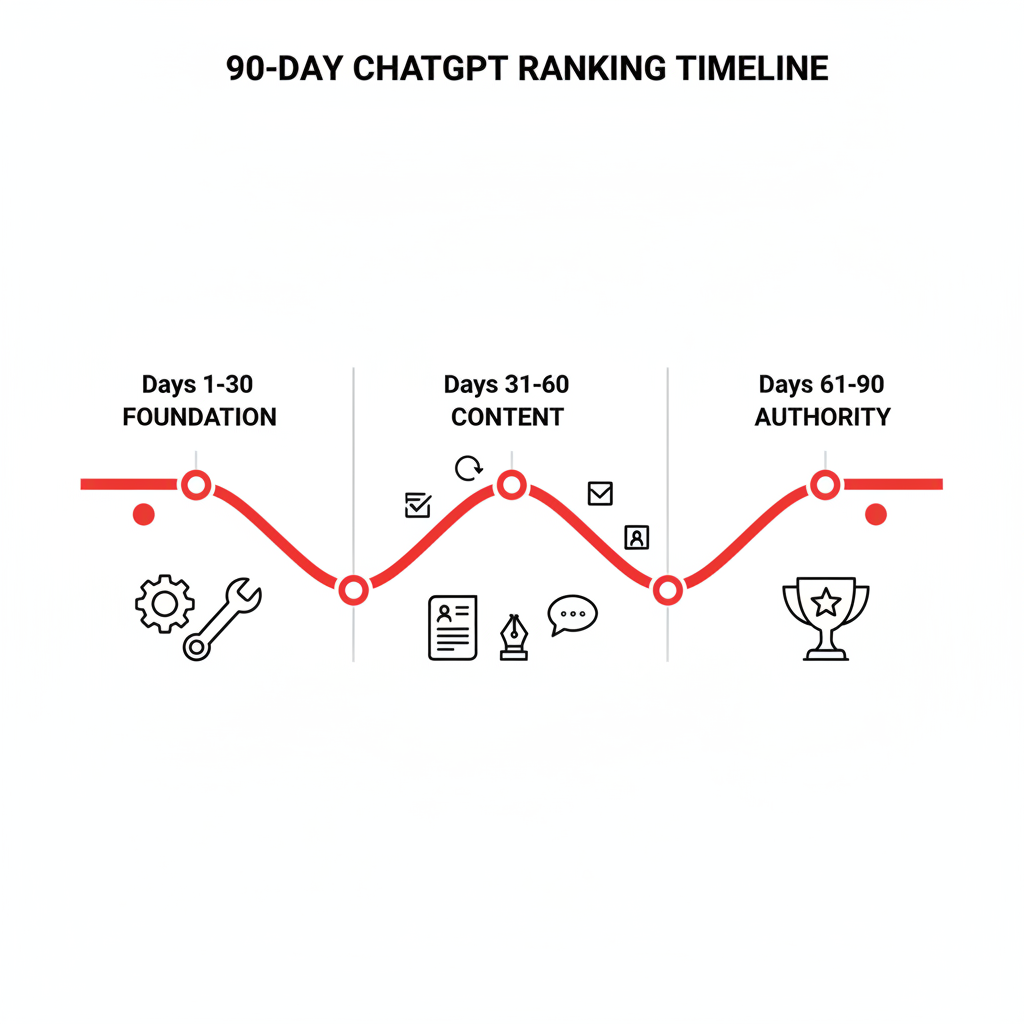 90-day ChatGPT ranking timeline: Foundation, Content, and Authority phases
The 90-day roadmap from invisible to cited by ChatGPT.
90-day ChatGPT ranking timeline: Foundation, Content, and Authority phases
The 90-day roadmap from invisible to cited by ChatGPT.
Step 4: What Technical Setup Does ChatGPT Require?
Several technical factors determine whether ChatGPT can even access and process your content.
Allow AI crawlers in robots.txt:
73% of websites still block AI crawlers (Source: Otterly.ai). Check your robots.txt for these user agents:
GPTBot(ChatGPT's web crawler)ChatGPT-User(ChatGPT's browsing agent)Google-Extended(Gemini's crawler)PerplexityBotanthropic-ai(Claude's crawler)ClaudeBot
If any are blocked with Disallow: /, you are invisible to that platform. Unblock them, but consider blocking specific directories (like /admin/ or /staging/) you do not want indexed.
Implement structured data markup:
Three schema types have the highest impact on AI citations:
- Organization schema with name, URL, logo, sameAs links (social profiles, Wikipedia, Crunchbase)
- Article schema on blog posts with author, datePublished, dateModified
- FAQPage schema on any page with Q&A content
Pages with structured data receive 3-5x more AI citations than equivalent pages without it (Source: Otterly.ai).
Create an llms.txt file:
Place a plain-text file at your domain root (/llms.txt) that describes your site for AI crawlers. Include your brand name, category, key offerings, and links to your most important pages. Think of it as a README for AI models.
Ensure Bing indexation:
ChatGPT's real-time browsing is powered by Bing. If your site is not indexed in Bing, ChatGPT cannot find your content during live search. Submit your sitemap to Bing Webmaster Tools and verify your site there.
Step 5: How Do You Earn Third-Party Mentions That ChatGPT Trusts?
On-page optimization alone is not enough. ChatGPT's training data is heavily influenced by third-party sources: review platforms, community discussions, editorial publications, and reference sites.
Tier 1: High-authority review platforms
- G2, Capterra, TrustRadius for software/service companies
- Clutch, GoodFirms, DesignRush for agencies
- Google Business Profile for local businesses
These platforms appear in ChatGPT's citations consistently. Create or claim profiles, gather reviews, and keep information current.
Tier 2: Community platforms
Reddit and Quora together capture 52.5% of AI citations across platforms (Source: Otterly.ai, 1M+ citations analyzed). Participate genuinely in relevant subreddits and Quora topics. Answer questions thoroughly. Link to your content only when it directly answers the question.
Tier 3: Editorial and industry publications
Publish original research, data studies, and expert commentary on industry sites. One well-placed article on a DR 70+ publication can influence ChatGPT's understanding of your brand for months.
The pattern is clear: ChatGPT trusts sources that other people trust. Building your presence on platforms where your audience already discusses your category is the fastest path to AI citations.
Tier 4: Co-occurrence signals
Citation co-occurrence (being mentioned alongside category-defining terms and competitors) has a 0.74 correlation with ChatGPT citation frequency (Source: Atomic AGI). Domain authority alone only correlates at 0.27. Being mentioned in the right context matters more than raw authority.
Step 6: How Often Should You Update Content for ChatGPT?
Content freshness is one of the strongest signals for AI citations. Data from Lureon.ai shows content updated within 30 days receives 3.2x more citations than older content.
Recommended update cadence:
| Content Type | Update Frequency | What to Update |
|---|---|---|
| Core service pages | Every 30 days | Stats, case study references, pricing |
| Pillar blog posts | Every 30-60 days | New data points, recent examples, timestamps |
| FAQ pages | Every 60 days | Add new questions, update answers with fresh stats |
| Comparison pages | Every 30 days | Pricing changes, feature updates, new competitors |
| Glossary/definitions | Every 90 days | Evolving definitions, new industry terms |
Updating does not mean rewriting. Small, meaningful changes work: swap an outdated stat for a current one, add a recent case study reference, update the "last updated" date.
The key is that dateModified in your Article schema reflects the actual update date. AI models check this signal. A page that claims to be "updated May 2026" but has not actually changed since 2024 will eventually lose credibility.
For clients running content SEO campaigns, we schedule monthly content refreshes tied to their highest-traffic pages first.
Step 7: How Do You Track and Measure ChatGPT Rankings?
Traditional rank tracking does not work for AI search. ChatGPT does not have a fixed results page. Answers vary by phrasing, context, and the user's conversation history. You need different metrics.
Metrics that matter:
- Citation frequency: How often your brand/URL appears in ChatGPT responses for target queries
- Share of voice: Your citation count vs. competitors for the same query set
- Citation context: Are you cited as the primary recommendation or a secondary mention?
- Conversion from AI traffic: Track referral traffic from ChatGPT in your analytics (look for
chatgpt.comin referrer data)
Tools for tracking:
- Otterly.ai tracks citation share of voice across AI platforms
- Peec AI monitors brand mentions in AI responses
- LLMrefs provides citation count and competitive analysis
- Google Analytics 4 with referrer filters for
chat.openai.comandchatgpt.com
Run your target query set monthly and compare against your baseline audit from Step 1. Expect measurable citation improvements within 8-12 weeks of starting optimization, with sustained AI search presence building over 3-6 months.
What Is the Difference Between Ranking in ChatGPT vs. Google?
This is the most common question we hear from clients starting their AI SEO journey. The fundamental difference: Google ranks pages, ChatGPT synthesizes answers.
| Dimension | Google Search | ChatGPT |
|---|---|---|
| Output | Ranked list of links | Synthesized answer with citations |
| Primary signal | Backlinks + relevance | Entity clarity + source authority |
| Content format | Long-form, keyword-optimized | Extractable, structured claims |
| Freshness weight | Moderate | High (3.2x boost within 30 days) |
| Measurement | Position 1-100 | Citation frequency, share of voice |
| User intent | Browse and choose | Get a direct answer |
| Conversion path | Click > land > convert | Read answer > click citation > convert |
| Optimization timeline | 3-6 months | 8-12 weeks for initial results |
The overlap: strong content, authoritative backlinks, and good technical SEO help in both channels. The difference is emphasis. ChatGPT rewards structured, citable content with clear entity signals, while Google still weighs backlink profiles and user engagement metrics more heavily.
- AI-referred traffic converts at 5x the rate of organic
- Most competitors have not started, creating first-mover advantage
- Faster initial results (8-12 weeks vs. 3-6 months for traditional SEO)
- Same content improvements also boost Google rankings
- Measurement tools are still maturing and standardizing
- AI model behavior changes without advance notice
- Attribution is harder than traditional search analytics
- Requires ongoing content freshness investment
A 90-Day Action Plan to Rank in ChatGPT
Here is the exact timeline we recommend to clients who are starting from zero AI search visibility.
Weeks 1-2: Foundation
- Run the ChatGPT visibility audit (Step 1)
- Fix robots.txt to allow AI crawlers
- Implement Organization and Article schema
- Create or update llms.txt
- Submit site to Bing Webmaster Tools
Weeks 3-4: Entity Building
- Claim or update Crunchbase, G2, Capterra profiles
- Ensure Wikipedia mentions in category articles
- Create or update Wikidata entry
- Verify Google Knowledge Panel
Weeks 5-8: Content Optimization
- Restructure top 10 pages with answer-first format
- Add FAQ sections with FAQPage schema
- Add comparison tables to relevant pages
- Update all pages with current stats and dates
- Publish 2-3 new content pieces targeting ChatGPT query patterns
Weeks 9-12: Authority and Measurement
- Launch Reddit/Quora participation strategy
- Publish 1-2 guest articles on industry publications
- Set up citation tracking (Otterly.ai or equivalent)
- Run second ChatGPT visibility audit and compare to baseline
- Refine strategy based on which queries improved and which did not
By week 12, you should see measurable improvement in citation frequency for your target queries. The compounds from here: each month of consistent optimization builds stronger entity signals and more third-party mentions.
Frequently Asked Questions About How to Rank in ChatGPT
How long does it take to rank in ChatGPT?
Most brands see initial citation improvements within 8-12 weeks of starting optimization. Sustained AI search presence takes 3-6 months to build. The speed depends on your starting authority, the competitiveness of your category, and how aggressively you update content and build third-party mentions.
Does traditional SEO help with ChatGPT rankings?
Traditional SEO and ChatGPT optimization overlap significantly but are not identical. Strong technical SEO, structured data, and authoritative backlinks help in both channels. The key difference is that ChatGPT places more weight on entity clarity, content structure, and source freshness than Google does. A combined AI SEO and traditional SEO approach produces the strongest results.
Can you pay to rank in ChatGPT?
No, there is currently no paid placement within ChatGPT's organic responses. ChatGPT's citations are based on content quality, authority signals, and entity recognition. OpenAI has explored advertising models, but as of May 2026, all citations in ChatGPT responses are organic.
What types of content does ChatGPT cite most often?
ChatGPT favors structured, factual content with clear claims and authoritative sourcing. FAQ pages, comparison tables, and data-backed guides receive the highest citation rates. Wikipedia (47.9% of top citations) and Reddit (contributing to 52.5% of community-sourced citations across platforms) are the most frequently cited source categories (Source: Profound, Otterly.ai).
How do you rank in ChatGPT for local business queries?
Local businesses should focus on Google Business Profile optimization, local directory listings, and city-specific content with structured data. ChatGPT pulls local recommendations from review platforms (Google Reviews, Yelp, TripAdvisor) and local business directories. Our local SEO services include AI search optimization for location-based queries.
Is ranking in ChatGPT different from ranking in Perplexity or Gemini?
Yes. Each AI platform has distinct source preferences. ChatGPT relies heavily on Wikipedia and editorial sources. Perplexity indexes in near real-time and favors Reddit and community platforms (46.7% of its citations come from Reddit). Gemini pulls from Google's search index. A GEO optimization strategy should account for these differences and optimize across all major platforms.
What is the ROI of ranking in ChatGPT?
AI-referred visitors convert at 14.2% compared to 2.8% for traditional organic (Source: Superprompt). For a B2B SaaS company receiving 1,000 AI-referred visits per month at a $500 average contract value, that translates to approximately $71,000 in monthly pipeline from AI search alone. The ROI depends on your conversion funnel, but the conversion rate advantage makes even modest citation volumes valuable.
Should I block or allow AI crawlers?
Allow them. 73% of sites still block AI crawlers (Source: Otterly.ai), which means they are invisible to ChatGPT, Perplexity, and other AI search tools. The risk of content being used for training without attribution is real, but blocking crawlers also means zero AI search visibility. The better approach: allow crawlers, optimize for citations, and monitor how your content appears in AI responses.
Sources: TechCrunch, Superprompt, WebFX, Otterly.ai, Lureon.ai, Profound, Atomic AGI, Pew Research
This post is part of our AI SEO guide. Related reading: Best AI SEO Agencies, AI SEO Agency, Best Reddit Citation Services.

Adel tracks AI citation rates across ChatGPT, Perplexity, Gemini, and AI Overviews. He turns raw visibility data into actionable insights that guide our optimization strategy.
Full Bio →