Over 60% of B2B buyers now consult AI search tools (ChatGPT, Perplexity, Gemini) before contacting a vendor. That shift has created a new category of marketing partner: the AI SEO agency. But the label is already being slapped onto traditional SEO shops that bolt on a few AI tools, agencies that launched last month, and everything in between.
Choosing the wrong one costs more than money. It costs the 6 to 12 months you spend waiting for results that never arrive.
This guide gives you a 10-point evaluation checklist, real pricing ranges, and the exact questions to ask before signing. By the end, you will know how to separate agencies that actually deliver AI search visibility from those riding the hype cycle.
What Does an AI SEO Agency Actually Do?
An AI SEO agency optimizes your online presence so that AI-powered search engines cite, recommend, and surface your brand. This goes beyond traditional Google rankings.
The work spans three layers:
Traditional SEO foundations. Technical health, backlinks, keyword targeting. These still matter because AI models pull heavily from top-ranking organic pages.
Generative Engine Optimization (GEO). Structuring content so that ChatGPT, Perplexity, Gemini, and Google AI Overviews can extract and cite it. This includes entity clarity, structured data markup, FAQ schema, and citation-friendly formatting.
AI visibility monitoring. Tracking where and how often your brand appears in AI-generated answers across platforms. Traditional rank trackers do not capture this.
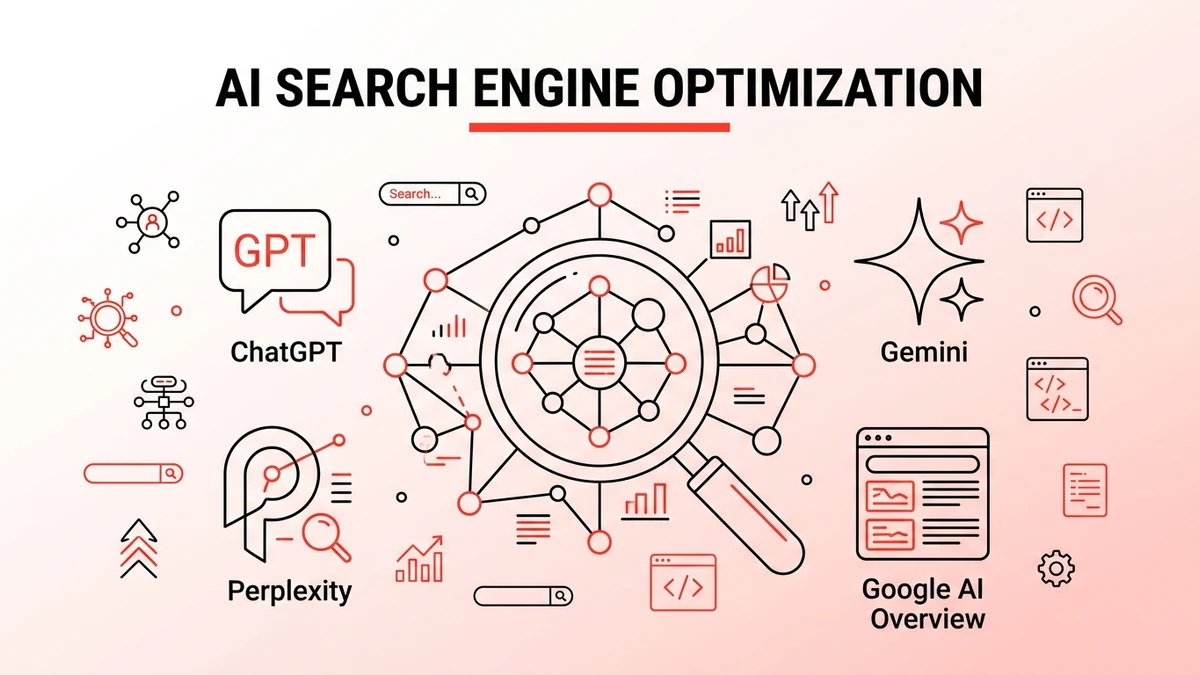
A legitimate AI SEO agency operates across all five of these platforms. If a prospective agency only mentions Google, they are not doing AI SEO. They are doing regular SEO with a new label.
Why Does Picking the Right AI SEO Agency Matter So Much?
The wrong choice does not just waste budget. It creates opportunity cost during a land-grab phase.
AI search is still early. Fewer than 15% of businesses have an active GEO optimization strategy, according to a 2026 survey by Semrush. That means the window for first-mover advantage is open right now, but it is closing.
An agency that spends 4 months "auditing" before doing any actual optimization burns through the advantage window. One that applies generic SEO playbooks to AI search will not move the needle on citations. And one that cannot measure AI visibility cannot prove results.
The stakes are real. We have seen companies sign 12-month contracts with agencies that had no AI citation tracking in place. Six months in, the client had no data on whether anything improved.
The 10-Point AI SEO Agency Evaluation Checklist
Here is the checklist we recommend to any business evaluating an AI SEO agency. Score each criterion from 0 (not met) to 2 (fully met). Any agency scoring below 14 out of 20 should raise concerns.
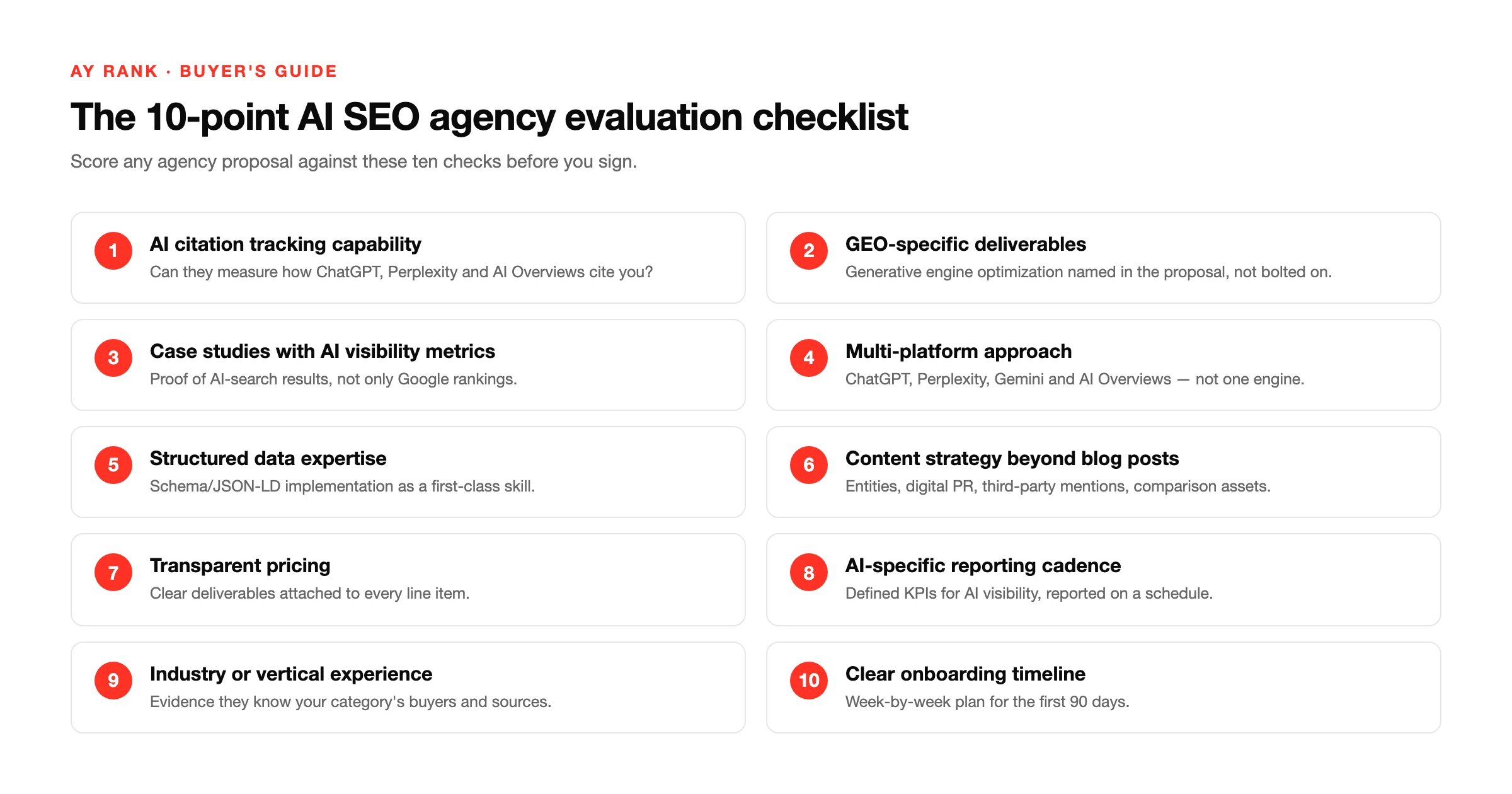 The 10-point AI SEO agency evaluation checklist: citation tracking, GEO deliverables, AI-visibility case studies, multi-platform coverage, structured data, content strategy, transparent pricing, reporting cadence, vertical experience, onboarding timeline
1. AI citation tracking capability
Ask the agency: "Can you show me a dashboard of where our brand currently appears in AI-generated answers?" If the answer is no, or if they rely on manual spot-checks, that is a baseline gap. Real AI SEO requires automated monitoring across ChatGPT, Perplexity, Gemini, and Google AI Overviews.
2. GEO-specific deliverables in the proposal
Look for line items like "entity optimization," "structured data for AI extraction," "citation-format content," and "AI answer targeting." If the proposal reads like a traditional SEO scope with "AI" added to the headers, it probably is.
3. Case studies with AI visibility metrics
Traditional metrics (rankings, traffic) are necessary but not sufficient. The agency should show before/after data on AI citations, brand mentions in LLM responses, and AI-referred conversions. Ask for specifics: "How many AI citations did Client X gain in 90 days?"
4. Multi-platform approach
An agency focused only on Google AI Overviews is missing half the picture. Buyers are using Perplexity for research, ChatGPT for recommendations, and Gemini for comparisons. The agency should have a strategy for each platform.
5. Structured data expertise
Schema markup (Organization, Product, FAQ, HowTo, Article) is the foundation of AI citability. Ask: "What schema types will you implement, and why?" If they cannot answer in detail, they lack the technical depth for this work.
6. Content strategy beyond blog posts
AI models do not just cite blog posts. They pull from product pages, FAQ sections, landing pages, and even PDF documentation. The agency should have a content plan that touches every citable asset on your site.
7. Transparent pricing with clear deliverables
Vague "monthly retainer" proposals with no itemized deliverables are a warning sign. You should know exactly what you are paying for each month: number of pages optimized, schema implementations, content pieces, and reporting frequency.
8. Defined reporting cadence with AI-specific KPIs
Monthly reports should include: AI citation count by platform, citation sentiment (positive, neutral, negative mentions), AI-referred traffic, and traditional SEO metrics. Quarterly business reviews should tie AI visibility to revenue impact.
9. Industry or vertical experience
An agency that has optimized SaaS companies for AI search will approach the work differently than one experienced in e-commerce or local services. Ask for case studies in your vertical, or at least in a similar business model.
10. Clear onboarding timeline
The best agencies can outline what happens in weeks 1 through 4: audit, strategy, first implementations. If the onboarding process is "we will get back to you," expect delays throughout the engagement.
What Should You Expect to Pay for AI SEO Services?
AI SEO agency pricing in 2026 ranges from $2,000 to $25,000+ per month, depending on scope, business size, and industry competitiveness (Source: Stackmatix, 2026). Here is how it typically breaks down:
| Tier | Monthly Cost | Best For | What You Get |
|---|---|---|---|
| Starter | $2,000-$4,000 | Small businesses, local focus | Technical audit, basic schema, 5-10 pages optimized |
| Growth | $4,000-$8,000 | Mid-market, regional reach | Full GEO strategy, content optimization, monthly reporting |
| Scale | $8,000-$15,000 | Enterprise, national/global | Multi-platform tracking, entity strategy, dedicated team |
| Enterprise | $15,000-$25,000+ | Large brands, competitive verticals | Custom AI visibility platform, weekly reporting, C-suite briefings |
A few pricing facts worth knowing:
AI-focused SEO services cost 20 to 50% more than traditional SEO retainers at comparable agencies (Source: Digital Agency Network, 2026). The premium reflects the added complexity of multi-platform optimization and the newer tooling required.
Project-based pricing also exists. A one-time AI readiness audit typically runs $3,000 to $8,000. Schema implementation projects range from $5,000 to $15,000 depending on site complexity.
How Do AI SEO Agencies Differ from Traditional SEO Firms?
This is the question most buyers get wrong. They assume an AI SEO agency is just a traditional firm with better tools. The differences go deeper.
| Dimension | Traditional SEO Agency | AI SEO Agency |
|---|---|---|
| Primary goal | Rank in Google top 10 | Get cited in AI-generated answers |
| Content format | Long-form blog posts, pillar pages | Extractable snippets, structured Q&A, entity-rich content |
| Technical focus | Page speed, crawlability, meta tags | Schema markup, entity graphs, AI crawler access |
| Link building | Domain authority via backlinks | Authority signals that AI models trust (citations, mentions) |
| Tracking | Rankings, traffic, conversions | AI citations, brand mentions, AI-referred revenue |
| Platforms | Google, Bing | ChatGPT, Perplexity, Gemini, Google AI Overviews, Claude |
| Typical timeline | 3-6 months for results | 4-8 weeks for initial AI citations, 6 months for compounding |
The best agencies combine both skill sets. Traditional SEO is not going away. Google still drives the majority of search traffic, and AI models pull heavily from top-ranking organic content. But an agency that only does traditional SEO is leaving the AI search channel untouched.
Our AI SEO services combine traditional optimization with GEO to cover both channels from day one.
What Red Flags Should You Watch For?
Not every agency advertising AI SEO capabilities can deliver. Here are the warning signs we see most often.
"We use AI tools for SEO" is not the same as AI SEO. Many agencies use ChatGPT or Jasper to write content faster. That is AI-assisted content production, not AI search optimization. Using AI tools and optimizing for AI search engines are fundamentally different things.
No proprietary tracking. If the agency relies entirely on third-party tools with no custom monitoring, they cannot track AI citations at the granularity this work requires. Ask to see their tracking setup during the sales process.
Guaranteed AI citations. No agency can guarantee that ChatGPT or Perplexity will cite your brand. These platforms update their models and retrieval systems constantly. An agency that guarantees specific citation counts is either uninformed or dishonest.
No technical team. AI SEO requires structured data implementation, server-side changes, and sometimes custom development. If the agency is all strategists and content writers with no technical staff, the implementation will stall.
Locked-in contracts with no performance clauses. A 12-month contract is reasonable for SEO work, but it should include performance benchmarks at month 3 and month 6 with exit clauses if targets are missed.
The biggest red flag is an agency that cannot show you their AI citation tracking dashboard during the sales process. If they cannot measure it, they cannot optimize it. Ask to see real client data (anonymized) before signing any contract.
What Questions Should You Ask During the Sales Process?
Beyond the checklist, here are specific questions to ask during agency evaluation calls. The answers will tell you a lot about the agency's depth.
"Walk me through your AI visibility audit process." A strong answer includes specific tools, a defined scope (which platforms, which queries), and a timeline. A weak answer is vague generalities about "analyzing your online presence."
"What structured data types will you implement on my site?" Expect to hear specific schema types: Organization, Product, FAQ, HowTo, Article, BreadcrumbList. If the answer is "we will add some schema," that is not enough.
"How do you track AI citations across platforms?" Look for specifics. Which platforms do they monitor? How frequently? What does the reporting look like? Can they show you a sample report?
"What does month one look like?" The answer should be concrete: technical audit in week 1, strategy presentation in week 2, first implementations in weeks 3 and 4. If the answer is "we will start with a discovery phase," ask how long that phase lasts.
"What is your approach to content that AI models can cite?" Listen for concepts like entity clarity, citation-format content, extractable facts, and structured Q&A. If the answer focuses only on "writing high-quality content," they are describing traditional content marketing.
"Can you share AI citation data from a current client?" Even anonymized, this data proves the agency can track and improve AI visibility. No data means no proof of capability.
How Should You Structure the Agency Relationship?
The engagement model matters as much as the agency you choose. Here is what works based on what we have seen across dozens of AI SEO engagements. For a concrete shortlist in one vertical, our B2B SaaS SEO agency comparison applies these criteria to seven named agencies.
Start with an audit, not a retainer. A paid AI visibility audit ($3,000 to $8,000) lets you evaluate the agency's depth before committing to a monthly retainer. Good agencies welcome this because it showcases their expertise.
Set 90-day milestones. AI search visibility should show measurable improvement within 90 days. Not final results, but directional movement: more AI citations, improved structured data coverage, content optimized for extraction. If there is no movement at 90 days, something is wrong.
Require a dedicated point of contact. AI SEO is complex and evolving. You need someone who knows your account, not a rotating cast of junior coordinators.
Insist on access to tracking tools. You should be able to log into the AI citation tracking platform and see your data anytime. If the agency controls all access and only shares screenshots in monthly reports, that limits your ability to verify results.
Plan for 9 to 12 months. AI SEO compounds over time. The first 3 months build the foundation (technical fixes, structured data, content optimization). Months 4 through 6 show initial citation growth. Months 7 through 12 are where the compounding returns appear. Budget accordingly.
| Phase | Timeline | Expected Outcome |
|---|---|---|
| Foundation | Months 1-3 | Technical audit complete, schema implemented, 20-30 pages optimized |
| Growth | Months 4-6 | First AI citations appearing, content pipeline producing 4-8 pieces/month |
| Scale | Months 7-9 | Citation count growing month-over-month, AI-referred traffic measurable |
| Compound | Months 10-12 | AI visibility entrenched, citations driving qualified leads |
How Does AY Rank Approach AI SEO Differently?
We built AY Rank specifically for the AI search era, not as a bolt-on to an existing SEO agency. Here is what that means in practice.
One client per category per market. We do not take competing clients in the same vertical and geography. If we work with a SaaS HR platform in London, we decline other SaaS HR companies targeting London. That exclusivity means our work for you never conflicts with another client.
Full-stack technical capability. Our team includes developers who implement structured data, not just strategists who write recommendations. Schema markup, entity optimization, and server-side changes happen in-house, not via a subcontracted dev shop.
AI citation tracking from day one. We do not wait until month 3 to start measuring. Our AI visibility audit establishes your baseline across ChatGPT, Perplexity, Gemini, and Google AI Overviews before any optimization begins.
Transparent pricing. Every line item in our proposals maps to a specific deliverable. You know exactly what you are paying for and when it will be delivered.
We have driven a 73% average increase in AI citations across client accounts within 6 months. That number comes from real tracking data, not estimates.
If you want to see where your brand currently stands in AI search, book a free AI visibility audit. We will show you your current citation rate across all major AI platforms and identify the fastest paths to improvement.
 AY Rank's AI SEO agency page: entity optimisation, structured data and citation-ready content aimed at getting brands cited by ChatGPT, Perplexity, Gemini and Claude
Frequently Asked Questions
What is an AI SEO agency?
An AI SEO agency optimizes your digital presence to appear in AI-generated search results from platforms like ChatGPT, Perplexity, Gemini, and Google AI Overviews. This includes structured data implementation, entity optimization, citation-format content, and AI visibility tracking, going beyond traditional Google rankings to cover the full AI search landscape.
How much does an AI SEO agency cost?
AI SEO agency retainers range from $2,000 to $25,000+ per month in 2026, with most mid-market businesses spending $4,000 to $8,000 monthly (Source: Stackmatix, 2026). Pricing depends on your industry competitiveness, the number of AI platforms targeted, and whether you need content creation or just optimization of existing assets.
How is an AI SEO agency different from a traditional SEO firm?
Traditional SEO firms focus on Google rankings through backlinks, keywords, and technical fixes. An AI SEO agency adds generative engine optimization, which structures content for extraction by AI models. The key differences are multi-platform tracking (beyond Google), structured data depth, and the ability to measure AI citations rather than just rankings.
How long does it take to see results from an AI SEO agency?
Initial AI citations typically appear within 4 to 8 weeks of structured data implementation and content optimization. Meaningful business impact (AI-referred traffic and leads) usually takes 4 to 6 months. The compounding effect becomes significant at 9 to 12 months, which is why short contracts often fail to capture the full value.
What should I look for in an AI SEO agency proposal?
Look for AI-specific deliverables (entity optimization, schema implementation, citation tracking), clear pricing tied to outputs, multi-platform coverage beyond just Google, case studies with AI citation metrics, and a defined onboarding timeline. Red flags include vague "AI-powered" language without specifics and guaranteed citation counts.
Can I do AI SEO in-house instead of hiring an agency?
You can handle some elements in-house, particularly if you have a developer comfortable with structured data and a content team trained in citation-format writing. The challenge is AI visibility tracking, which requires specialized tools most in-house teams do not have access to. A hybrid approach (agency for strategy and tracking, in-house for execution) works for many companies.
What AI platforms should an AI SEO agency cover?
At minimum, an agency should optimize for and track visibility across Google AI Overviews, ChatGPT (with web browsing), Perplexity, and Gemini. Some agencies also cover Claude and Microsoft Copilot. The more platforms covered, the broader your AI search visibility. Our AI SEO approach covers all five major platforms from the start.
How do I measure the ROI of an AI SEO agency?
Track three metrics: AI citation count (how often your brand appears in AI answers), AI-referred traffic (visitors who arrive via AI platforms), and AI-referred conversions (leads or sales from AI traffic). Compare these against your monthly retainer to calculate cost per AI-referred lead. Most agencies should be able to report on all three within 90 days of engagement.
Sources: Stackmatix AI SEO Pricing Guide, Digital Agency Network Pricing Comparison, Semrush State of Search 2026, Onely AI SEO Agency Evaluation
This post is part of our AI SEO guide. Related reading: Best Reddit Citation Services, Best Perplexity Citation Trackers, Best AI Overview Rank Trackers.

Oussama leads technical and on-page SEO at AY Rank. He specializes in structured data engineering, crawl optimization, and building the entity architecture that makes AI models cite our clients.
Full Bio →