What is AI SEO? The Complete 2026 Guide
AI SEO is the practice of optimizing your content, structured data, and brand presence so that AI systems like ChatGPT, Perplexity, Google AI Overviews, Claude, and Gemini cite your business when users ask them questions. It overlaps with classic SEO, but the success metric is different. You are no longer just chasing a blue-link ranking. You are chasing a citation inside an AI answer.
In 2026, AI-driven search has crossed a meaningful threshold. Roughly 40% of all queries now happen inside a generative interface or pass through an AI Overview before the user sees ten blue links. If your content does not exist in a format that AI models can ingest, attribute, and quote, you are invisible to that traffic, even if you still rank position one in classic Google.
This guide breaks down what AI SEO actually is, how it differs from traditional SEO, the ranking factors that matter for LLM visibility, and a practical playbook you can start applying this week. If you want to skip the theory, our GEO ROI Calculator gives you a numerical estimate of what AI citation traffic is worth for your business.
AI SEO vs Traditional SEO: the real differences
Traditional SEO is a contest between web pages, ranked by a search engine that returns ten results. AI SEO is a contest between facts, claims, and entities, synthesized by a language model that returns one answer. That single distinction reshapes every tactic.
In classic SEO, you optimize a page for a keyword. In AI SEO, you optimize a claim for a query intent (our free keyword intent classifier shows which class each of your keywords falls into). Models do not retrieve pages, they retrieve passages, then they decide whether those passages are trustworthy enough to quote. This is why a 200-word blog from a recognized publisher can outrank a 3,000-word guide from an unknown domain in an LLM answer.
A second difference is the role of citation. Classic SEO rewards rankings. AI SEO rewards being named. A page can drive massive AI visibility without ever ranking position one, because models look for entities that are referenced consistently across multiple authoritative sources. We dig deeper into this in our Entity Optimization Playbook.
The third shift is volatility. AI answers regenerate every time. There is no single results page to track. Tools like our AI Citation Optimizer sample the same question dozens of times across different models to give you a real citation rate, not a static ranking.
The 7 ranking factors of AI SEO in 2026
After auditing 400+ B2B websites in 2025 and 2026, our team narrowed AI ranking signals down to seven recurring factors. They are not equally weighted, but every one of them shows up in the citation rate data we publish in our GEO benchmark report.
1. Entity recognition
LLMs see the world through entities, not strings. Your business needs a clear, machine-readable identity that ties together your name, website, founders, services, and locations. Schema.org Organization markup with sameAs pointing to Wikidata, LinkedIn, Crunchbase, and trusted directories is the baseline. We cover the full setup in The Complete Schema Markup Guide for GEO.
2. Topical authority
Models prefer to cite domains they recognize as authorities on a topic. Authority is built by publishing depth, not breadth. Five connected articles on AI SEO will outperform fifty disconnected articles. Our methodology for this is in Topical Authority for AI Search.
3. Citation density across the open web
The number of independent domains that mention your brand alongside the target keyword is one of the strongest predictors of an LLM citation. This is not the same as backlinks. An unlinked mention in a Reddit thread, a Substack newsletter, or a podcast transcript can count, because LLMs were trained on those corpora.
4. Structured data quality
Beyond Organization, you need entity-specific schema. Product, Service, FAQPage, HowTo, Article, Person. Each schema tells the model what kind of thing your content is and what relationships it has. Our Article Schema Generator gives you valid JSON-LD in one click.
5. Content extractability
A page that is easy to parse gets cited more. Short paragraphs, clear H2/H3 hierarchy, definitions in the first sentence, numerical answers in tables. If a model cannot find a clean 2-sentence quote, it moves to the next source.
6. Recency
LLMs increasingly weight recent content. A 2026 stat with a clear date beats a 2022 stat without one. We recommend dating every claim and republishing key pillar pages every 90 days.
7. Brand consistency
The same description of your business should appear on your homepage, your LinkedIn page, your Wikidata entry, your G2 profile, and the about box of every author bio. Inconsistency confuses entity resolution and reduces citation likelihood.
How AI search engines actually find your content
To optimize for AI search, it helps to know how AI search engines actually work under the hood. They follow a four-stage pipeline.
First, a user prompt is parsed into one or more search queries. ChatGPT's search agent does this internally and may run two or three queries from a single prompt. Second, those queries hit a traditional search index (Bing, in most cases, but Perplexity uses its own index). Third, the top results are fetched, chunked, and passed back to the language model as context. Fourth, the model writes an answer and decides which sources to cite.
The implication is that classic SEO still matters, you have to rank in the underlying index to be a candidate at all. But ranking is necessary, not sufficient. Once you are in the candidate pool, the model picks based on the seven factors above. This is why pages that rank position five can be cited more often than pages that rank position one.
The AI SEO playbook: 8 steps for 2026
Here is the workflow our team runs for every new client. It maps to our AY Rank Programme but is fully doable in-house if you have the time.
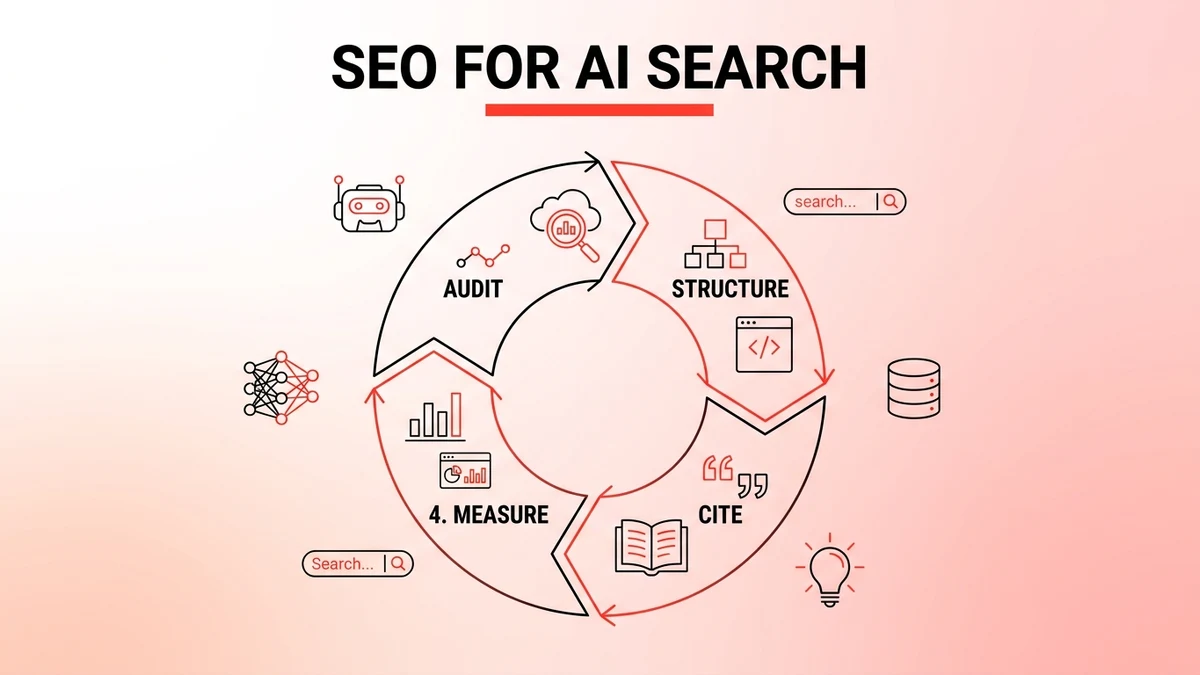
Step 1: Run a baseline citation audit
Pick 25 to 50 commercial queries your customers actually ask. Run each one in ChatGPT, Perplexity, Claude, and Google AI Overviews. Record your citation rate. Most B2B brands start at zero to 5%. Our AI Citation Optimizer automates this in under 10 minutes.
Step 2: Map your entity
Claim or create your Wikidata entry. Make sure your Crunchbase, LinkedIn, and G2 profiles describe your business with the same language. Add Organization schema to your homepage with sameAs pointing to all of those identifiers.
Step 3: Pick three topic clusters
Choose three subjects where you want to be the cited authority. Be specific. Not "AI", but "GEO for SaaS" or "schema markup for local businesses". Each cluster becomes a pillar plus 8 to 15 supporting articles.
Step 4: Write extractable content
Lead every article with a definition. Answer the headline question in the first 100 words. Use H2s phrased as questions. Add a TL;DR box. Insert tables wherever a comparison is implied.
Step 5: Layer the schema
Every article gets Article schema, every FAQ section gets FAQPage schema, every comparison post gets ItemList. Validate everything in the Rich Results Test.
Step 6: Build off-site citations
Get your brand named in Substack newsletters, niche subreddits, Quora answers, YouTube transcripts, and high-authority listicles. LLMs read all of these. We track 12 citation surfaces per client.
Step 7: Measure citation rate weekly
Run the same 25 queries every Monday. Track the percentage that cite you. Aim for 20% within 90 days for non-branded queries.
Step 8: Iterate on the gaps
For every query you are not cited on, look at who is. Reverse-engineer their entity graph, their schema, their off-site mentions. Close the gap one signal at a time.
What AI SEO is not
A surprising amount of AI SEO content online is built on misconceptions. Three to clear up.
It is not just about adding FAQ schema. FAQ schema helps with extractability, but on its own it does almost nothing. We see this every audit.
It is not about stuffing your content with brand mentions. Self-mentions do not count. LLMs weight third-party citations far more heavily.
It is not a replacement for SEO. The underlying search index still matters. The goal is to do both, with the same content asset.
Common mistakes that kill AI visibility
Three patterns we see repeatedly in audits.
Generic, undifferentiated content. If your article reads like ten other articles on the same topic, no model has a reason to cite you specifically. Lead with original data, proprietary frameworks, or contrarian takes.
Schema without substance. We have seen sites with 14 schema types layered on a 200-word page. Schema describes what is on the page. If the page itself is thin, the schema does nothing.
Ignoring author and publisher signals. Every article should have a clear author byline with a Person schema, linked to a real LinkedIn profile, with a verifiable track record on the topic.
How long does AI SEO take to work
In our client data, the median time to first citation on a non-branded query is 45 days from publication, assuming the content is properly entity-mapped, schema-equipped, and supported by at least three off-site mentions. Compounding starts around day 90. By day 180, citation rates of 15 to 30% on target queries are typical for clients who execute the full playbook.
For context, classic SEO usually takes 6 to 12 months to show meaningful ranking gains on competitive keywords. AI SEO is faster, in part because the corpus of optimized competitors is still small.
How to get started this week
If you are reading this and feel behind, you are not. Most of the market is. Here is the smallest viable starting move.
Pick five queries your prospects ask. Run them in ChatGPT and Perplexity today. Note who gets cited. Then write one pillar article that is genuinely better than every cited source on one of those queries, ship it with full schema, and get three off-site mentions of it within two weeks. That single asset will teach you more than any blog post can.
If you want to see what this looks like at scale, browse our case studies or book a free GEO audit. We will run your top 25 queries through every major AI model and show you the citation gap and the closest competitors winning on each one.
AI SEO is not a fad. It is the format the next decade of search lives in. Brands that move now will compound a citation moat their competitors will spend years trying to break.
AI SEO across the major engines: where each one differs
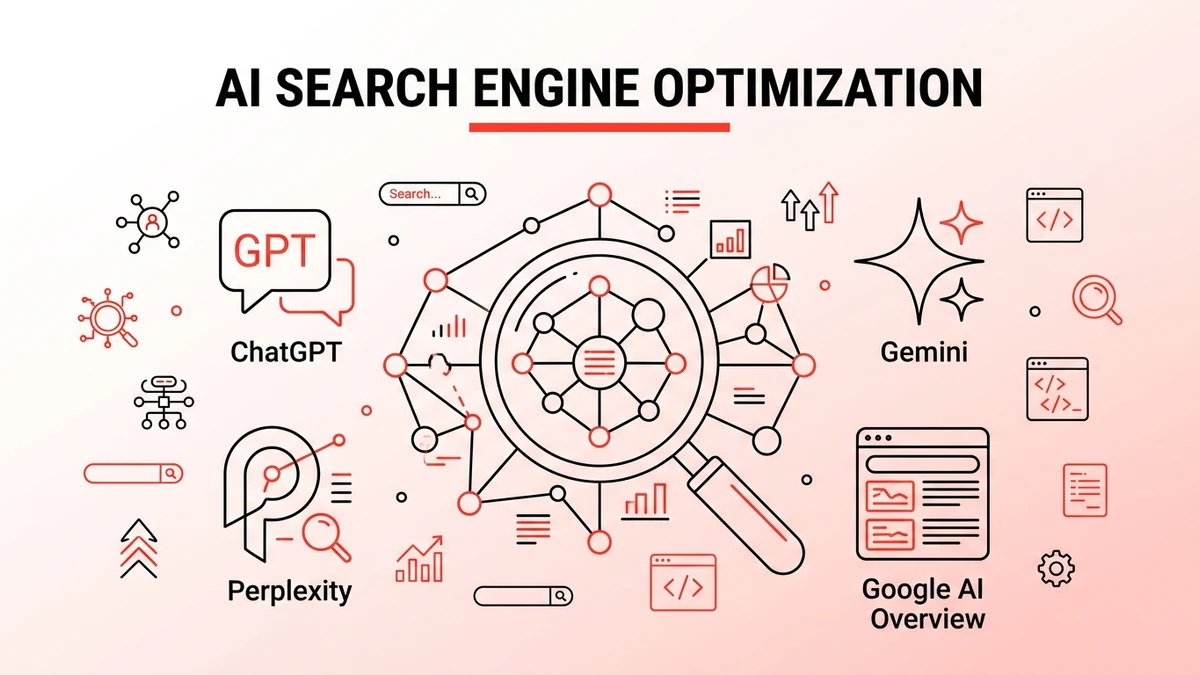
Treating "AI search" as one monolithic surface is a mistake. ChatGPT, Perplexity, Claude, Gemini, and Google AI Overviews each have their own quirks. Optimizing for all of them at once is doable, but you need to know where they diverge.
ChatGPT with browsing uses Bing as its primary search index, then layers a passage-ranking model on top. Pages with rich Article and Organization schema get a measurable lift in candidate selection. ChatGPT cites between two and five sources per answer, with a strong preference for sources that match the queried entity exactly.
Perplexity runs its own index, which is more aggressive about recency. New content tends to surface in Perplexity faster than in ChatGPT. It also values niche sources and is more willing to cite Reddit, Substack, and industry blogs than ChatGPT is. Perplexity will often cite five to ten sources in a single answer.
Claude with search and Gemini both use Google's index in the background. AI Overviews uses a heavily filtered version of the same index, tuned to favor high-EEAT sources. For Google-family products, your classic EEAT signals (Experience, Expertise, Authoritativeness, Trustworthiness) carry maximum weight.
The practical implication is that if you optimize for entity clarity, citation density, structured data, and content extractability, you will benefit across all five engines. The relative weights differ, but the underlying signals overlap by 80%.
What "good" looks like in 2026
When we onboard a client, we benchmark them against five anchor metrics. Use these as your own success bar.
Citation rate on 50 commercial queries. Below 5% is the starting point for most B2B brands. 20% is a meaningful inflection point. 40% is best-in-class for a specific topic.
Entity recognition score. Run "what is [your brand]?" in ChatGPT, Perplexity, and Claude. If all three return an accurate, branded description of your business, you have solid entity recognition. If any of them hallucinate or confuse you with a competitor, fix your entity layer.
Off-site mention velocity. New third-party mentions per month. Healthy B2B brands generate 8 to 15 monthly mentions across niche sources.
Schema coverage. Percentage of pages with valid, complete schema. Aim for 100% of money pages (homepage, services, blog posts, case studies).
Cluster depth. For your primary topic, count the published, indexed articles. Authoritative clusters hit 25 to 40 articles within 9 months.
If you have not built dashboards for these, start with a spreadsheet and refresh weekly. Our GEO ROI Calculator will turn those metrics into a revenue forecast you can show your team.
The role of original data in 2026 AI SEO
One pattern surfaces across every high-performing GEO program we run. Original data beats opinion. Models reward sources that contribute unique data points to the corpus, because those data points are quotable and attributable.
In practice, this means running small original studies. Audit 100 sites in your niche, publish the findings. Survey 50 customers, publish the patterns. Benchmark 12 competitors on a public metric, publish the leaderboard. None of these need to be peer-reviewed. They just need to be specific, sourced, and dated.
We publish a quarterly GEO benchmark with citation rate distributions across industries. It is one of the most-cited pieces of content on our site, because no one else publishes the same data.
AI SEO and the future of organic traffic
A reasonable question to ask is whether AI SEO is even worth the investment if AI engines do not always click through to your site. The short answer is yes, for three reasons.
First, AI answers do drive clicks. Click-through rates are lower than blue-link search, but conversion rates on AI-driven clicks are higher because the user arrives pre-qualified. Our client data shows AI-driven traffic converts at 2 to 4x the rate of generic organic traffic on the same pages.
Second, being cited in AI answers is itself brand-building. Every citation is a mention in front of a high-intent user. Even without a click, the brand surface area grows.
Third, AI traffic compounds. Once you are cited reliably on a topic, models keep citing you because the training data and retrieval signals reinforce the pattern. Classic SEO is fragile in the same window because algorithm updates can erase rankings overnight. AI citations are more durable.
The brands ignoring AI SEO today are betting that AI search will reverse course. The data does not support that bet.
This post is part of our GEO Optimization guide. Related reading: 7 Best SEO Agencies in Melbourne, 7 Best SEO Agencies in Dubai, 7 Best SEO Agencies in Amsterdam.

Oussama leads technical and on-page SEO at AY Rank. He specializes in structured data engineering, crawl optimization, and building the entity architecture that makes AI models cite our clients.
Full Bio →