Large language model optimization (LLMO) is no longer a side project for technical SEO teams. ChatGPT, Perplexity, Gemini, Claude, and Google AI Overviews now answer a growing share of buyer queries, and most B2B brands are invisible inside those answers even when they still rank well in classic search. The fix is structural, not editorial: entity coverage, schema engineering, llms.txt, content chunking, and citation monitoring at the model layer.
This guide compares the seven strongest LLMO platforms for technical buyers in 2026. Each entry covers what the tool actually does at the underbody level, who it fits, pricing, pros, and honest cons. You will also get a decision framework for picking between them.
TL;DR: for full-stack entity and schema work plus multi-engine citation tracking, Profound is the strongest all-in-one LLMO platform; if you only need lightweight prompt monitoring, Otterly AI is the cheapest credible pick.
Best LLMO tools in 2026: a brief overview
If you need a full LLMO platform (track plus optimize):
- Profound: Best overall LLMO platform for enterprise B2B teams running entity, schema, and citation programmes in parallel.
- AthenaHQ: Best for technical marketers who want answer engine analytics tied directly to brand entity coverage.
- Scrunch AI: Best for product and content teams that need crawler-level visibility into how LLMs see their site.
- BrightEdge AI Catalyst: Best for enterprise SEO teams already on a legacy SEO suite that want a bolt-on LLM visibility layer.
If you need a focused single-job tool:
- Otterly AI: Best lightweight LLM citation monitor for SMBs and lean in-house teams.
- Daydream: Best for content and PR teams optimizing narrative coverage across LLMs.
- Goodie: Best for technical buyers who want llms.txt, schema, and entity tooling without a full platform commitment.
| Tool name | Key strength | Pricing | Platforms |
|---|---|---|---|
| Profound | Full-stack LLMO platform spanning entity, schema, and citation tracking across LLMs | From $499 per month; demo on request | Web app, API, Slack |
| AthenaHQ | Answer engine analytics tied to entity coverage and prompt share-of-voice | From $299 per month; free trial | Web app, API |
| Otterly AI | Lightweight LLM citation monitor with daily prompt refresh | From $29 per month; free tier available | Web app |
| Daydream | LLM narrative and citation tracking for content and PR teams | From $499 per month; demo on request | Web app, API |
| Scrunch AI | Crawler-level audit of how LLMs see and cite your site | From $199 per month; free audit | Web app, browser extension |
| BrightEdge AI Catalyst | Enterprise SEO suite with bolt-on LLM visibility module | Enterprise pricing; demo only | Web app, API |
| Goodie | Technical LLMO tooling for llms.txt, schema, and entity audits | From $49 per month; free tier available | Web app, CLI |
1. Profound, best overall LLMO platform for enterprise B2B teams
 LLMO Tools with Profound
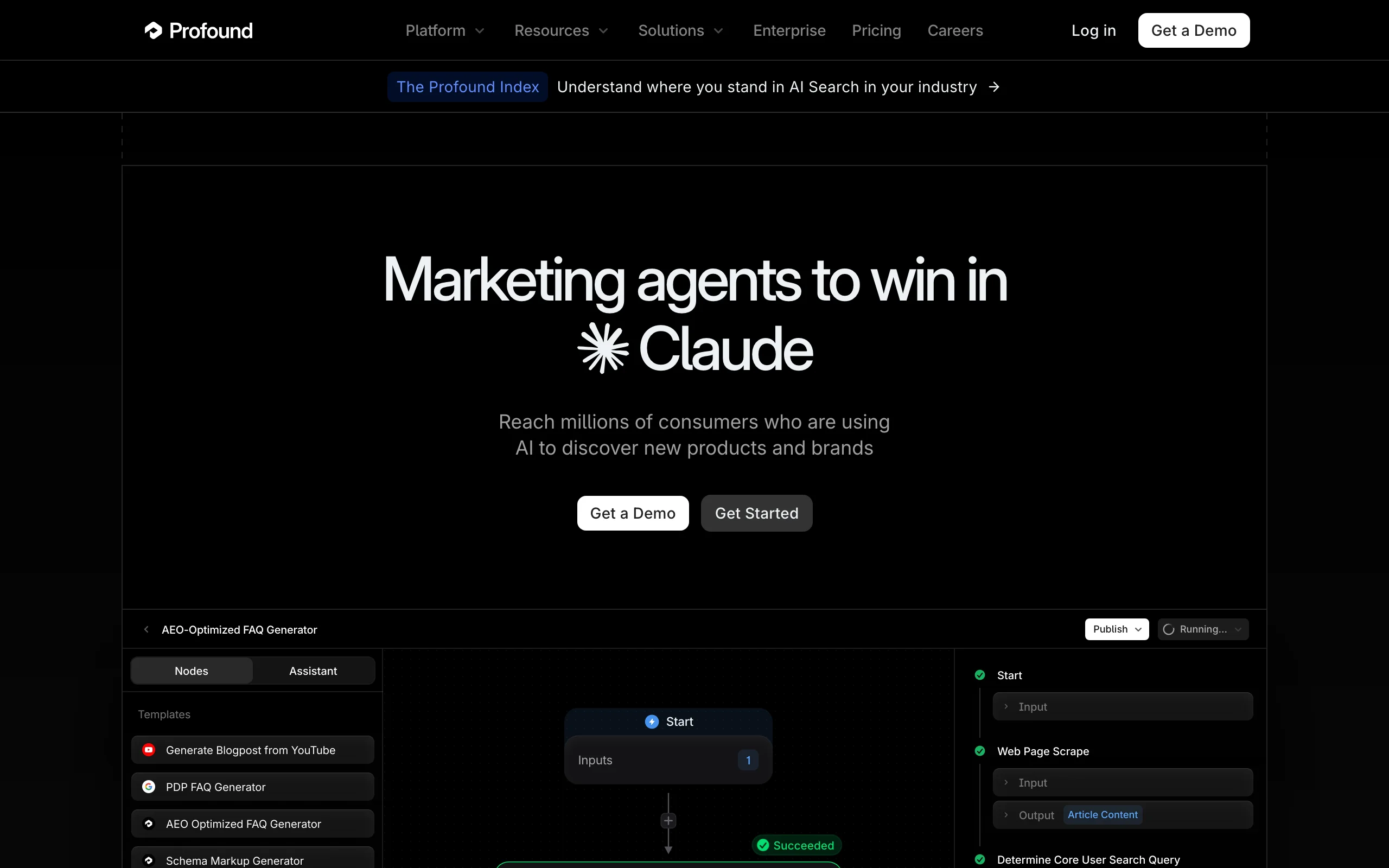
Profound is an LLMO platform that tracks brand citations across ChatGPT, Perplexity, Gemini, Claude, and Google AI Overviews and links the data to entity coverage and on-page schema gaps. It is built for teams running a structured GEO programme, not a one-off audit, and pairs prompt-level analytics with recommendations on entity, schema, and content chunking.
The platform stands out because it closes the loop between measurement and execution. Most competitors stop at prompt tracking. Profound surfaces the specific entity gaps, missing schema types, and content sections that explain why a competitor is being cited instead of you.
Key features
- Daily prompt tracking across ChatGPT, Perplexity, Gemini, Claude, and Google AI Overviews
- Entity coverage scoring against your knowledge graph and Wikidata
- Schema recommendations tied to specific buyer prompts
- Competitor citation share dashboards
- API for piping LLM share-of-voice into BI tools
Best for
- Enterprise B2B SaaS and services teams tracking 200 plus buyer prompts
- In-house SEO leads with engineering support to deploy schema and entity work
- Brands running a multi-quarter LLMO programme rather than a point-in-time audit
Pricing
- Paid tiers start from $499 per month
- Custom enterprise pricing for multi-brand and agency accounts
- No free tier, demo on request
Pros
- Closes the loop between citation data and structural fixes, so the dashboard drives action
- Multi-engine coverage in one place removes the need for three separate trackers
- Strong API and Slack integration for embedding LLMO data into existing reporting
Cons
- Mid-market pricing puts it out of reach for solo founders and small in-house teams
- Requires engineering bandwidth to act on schema and entity recommendations, which limits value for non-technical teams
2. AthenaHQ, best for technical marketers tying analytics to entity coverage
 LLMO Tools with AthenaHQ
AthenaHQ is an answer engine analytics platform that maps prompt share-of-voice to specific entities and topical clusters. It is designed for technical marketers who want to know not just whether they are cited, but which entities the LLMs associate with their brand and which competitors own the entity gap.
The differentiator is the entity layer. AthenaHQ pulls in your structured data, Wikidata presence, and topical entity coverage, then scores each tracked prompt against the entities most likely to trigger a citation. Teams use it to prioritize entity expansion work in measurable chunks.
Key features
- Prompt and topic tracking across ChatGPT, Perplexity, and Google AI Overviews
- Entity coverage scoring tied to Wikidata and schema.org types
- Topical cluster maps showing which entities competitors own
- Share-of-voice dashboards by prompt cluster
- API access on higher tiers
Best for
- Technical marketers and CTOs running entity-led LLMO programmes
- B2B SaaS brands competing on category-defining queries
- Teams that already understand entity SEO and want measurement to match
Pricing
- Paid tiers start from $299 per month
- Free trial available
- Custom pricing for multi-domain tracking
Pros
- Entity-level analytics are deeper than prompt-only competitors
- Strong fit for category-creation plays where entity coverage is the bottleneck
- Clear reporting framing that maps to executive narratives
Cons
- Steeper learning curve for marketers new to entity SEO
- Gemini and Claude coverage lag behind ChatGPT and Perplexity on the standard plan
3. Otterly AI, best lightweight LLM citation monitor for SMBs
 LLMO Tools with Otterly AI
Otterly AI is a focused LLM citation monitor that tracks how often your brand and competitors appear in answers from ChatGPT, Perplexity, and Google AI Overviews. It is the cleanest pick when you only need monitoring, not a full optimization platform, and the free tier is enough to validate the use case before paying.
The product strips LLMO down to one job and does it cheaply. You add prompts, pick the engines, and get daily refreshes with citation snippets. There is no entity layer, no schema recommendation engine, and no consulting overlay, which is exactly why teams pick it.
Key features
- Daily prompt tracking across ChatGPT, Perplexity, and Google AI Overviews
- Citation snippets with source attribution
- Competitor share-of-voice dashboards
- Email and Slack alerts on citation changes
- Public-link sharing for stakeholder reports
Best for
- SMBs and lean in-house teams validating LLMO as a channel
- Agencies offering LLM monitoring as a client add-on
- Teams that already have entity and schema work covered and only need measurement
Pricing
- Free tier with limited prompts and weekly refresh
- Paid tiers start from $29 per month
- Volume pricing for agencies tracking multiple brands
Pros
- Cheapest credible LLM citation tracker on the market
- Fast onboarding, usable within an hour
- Free tier removes the procurement barrier for pilots
Cons
- No entity coverage or schema recommendations, so it is measurement only
- Limited historical depth on the lower tiers
4. Daydream, best for content and PR teams optimizing LLM narrative
 LLMO Tools with Daydream
Daydream is an LLMO platform built around narrative tracking: which storylines and brand attributes LLMs associate with you, your competitors, and your category. It is the strongest pick for content and PR teams that need to influence how models talk about a brand, not just whether the brand is mentioned.
The product layers prompt tracking with sentiment, attribute extraction, and narrative clustering. Teams use it to brief content and earned-media campaigns that change the language LLMs use, which in turn changes who gets cited on competitive prompts.
Key features
- Narrative and attribute tracking across ChatGPT, Perplexity, and Gemini
- Sentiment analysis on brand mentions in LLM answers
- Competitor narrative comparison
- Content brief generator tied to narrative gaps
- API for content workflow integration
Best for
- Content and PR leaders running brand narrative programmes
- B2B brands competing on category positioning, not just product features
- Teams pairing earned media with on-page LLMO work
Pricing
- Paid tiers start from $499 per month
- Demo on request
- Custom pricing for multi-brand accounts
Pros
- Narrative and attribute analytics that pure citation trackers miss
- Strong fit for category-defining plays where positioning beats feature lists
- Useful brief generator that connects measurement to content output
Cons
- Overkill for teams that only need raw citation counts
- Premium pricing closes the door on smaller in-house teams
5. Scrunch AI, best for crawler-level LLM visibility
 LLMO Tools with Scrunch AI
Scrunch AI is an LLMO audit tool that simulates how LLMs and AI crawlers see your site. It captures the rendered content, structured data, llms.txt, and chunking patterns each model can extract, then flags gaps that block citation. It is the right pick when you suspect technical issues are throttling your visibility before any content or entity work can move the needle.
The tool sits closer to a technical SEO platform than a marketing dashboard. Teams use it to validate that pages are crawlable, that schema is parsing, that llms.txt is exposing the right resources, and that content is chunked the way LLMs prefer.
Key features
- AI crawler simulation across major LLM bots
- llms.txt and robots.txt validation
- Schema markup parsing and gap analysis
- Content chunking and extractability scoring
- Browser extension for spot-checking individual pages
Best for
- Technical SEO and engineering teams debugging LLM visibility issues
- Brands rolling out llms.txt and entity schema for the first time
- Agencies running technical LLMO audits as a paid engagement
Pricing
- Paid tiers start from $199 per month
- Free single-domain audit available
- Custom pricing for multi-domain monitoring
Pros
- Goes deeper into the technical stack than any prompt-tracking competitor
- Free audit lowers the barrier to test the product on a real site
- Strong fit alongside a free llms.txt generator for first-time rollouts
Cons
- Not a citation tracker, so you still need a prompt-level tool alongside it
- Browser extension is browser-only and not yet on Firefox
6. BrightEdge AI Catalyst, best enterprise SEO suite with an LLM module
 LLMO Tools with BrightEdge
BrightEdge AI Catalyst is the LLM visibility module bolted onto BrightEdge, a long-running enterprise SEO platform. It is the right pick when an enterprise SEO team is already standardized on BrightEdge and wants to add LLM tracking without onboarding a second vendor.
The strength is integration depth with the existing SEO suite. Rank tracking, content audits, and now LLM citation data sit in one dashboard, which simplifies executive reporting and procurement. The trade-off is that the LLM layer is newer than the rest of the platform and lags GEO-native tools on innovation pace.
Key features
- LLM citation tracking module across major engines
- Integration with BrightEdge SEO suite for unified reporting
- Enterprise governance, SSO, and audit logs
- Account management and onboarding support
- Custom dashboards for executive reporting
Best for
- Enterprise SEO teams already on BrightEdge
- Brands prioritizing vendor consolidation over best-of-breed
- Procurement environments that require SSO and enterprise contracts
Pricing
- Enterprise pricing only, demo required
- Custom contract length and seat counts
Pros
- Single-vendor consolidation for enterprise SEO and LLM visibility
- Strong governance and procurement fit
- Mature account management and onboarding compared to startup-stage tools
Cons
- LLM module is less mature than GEO-native competitors
- Enterprise pricing and contract length make pilots difficult
7. Goodie, best technical LLMO tooling for llms.txt, schema, and entities
 LLMO Tools with Goodie
Goodie is a technical LLMO toolkit that focuses on the structural layer: llms.txt generation and validation, schema deployment, and entity audits. It is positioned for technical buyers who want sharp, focused utilities without committing to a full platform contract.
The product is the closest thing to a Linux-style toolkit for LLMO. You can use the pieces independently, integrate them through a CLI or API, and ship structural changes without leaving your engineering workflow. It pairs well with a citation tracker on the measurement side.
Key features
- llms.txt generation, validation, and version diffing
- Schema markup builder with LLM-aware templates
- Entity audit against Wikidata and schema.org
- CLI for CI and CD integration
- API for engineering workflows
Best for
- CTOs and engineering-led teams deploying LLMO structurally
- Brands rolling out llms.txt and entity schema as part of a release pipeline
- Technical buyers who prefer composable utilities over all-in-one suites
Pricing
- Free tier with limited validations per month
- Paid tiers start from $49 per month
- Custom enterprise pricing for CI usage
Pros
- Sharpest fit for engineering-led LLMO rollouts
- CLI and API make it easy to embed into existing release pipelines
- Pairs cleanly with a free entity analyzer for first-pass audits
Cons
- No citation tracking, so it covers structure only
- Documentation assumes a baseline of technical SEO fluency
How to choose the best LLMO tool for your needs
1) Are you measuring, optimizing, or both?
This is the first fork. LLMO tools split cleanly into two camps, and picking the wrong camp burns budget.
- If you only need to measure prompt share-of-voice and citation share, Otterly AI and Daydream are focused picks at opposite price points
- If you need to optimize entity coverage, schema, and structure, Profound, AthenaHQ, Scrunch AI, and Goodie cover different slices of the stack
- If you need both in one place, Profound and AthenaHQ are the closest to all-in-one for technical buyers
2) Do you have engineering bandwidth to act on recommendations?
LLMO is a structural game. Most of the gap between brands cited in ChatGPT and brands ignored is entity coverage, schema, llms.txt, and content chunking, all of which require engineering work to deploy.
- If your team has engineering bandwidth, Profound, Scrunch AI, and Goodie pay back the most because they generate actionable structural work
- If you have a marketing team but limited engineering support, Otterly AI for measurement plus a partner running structural execution is the more honest stack
- If you are unsure, run a four-week pilot with one measurement tool and one structural audit before committing to a platform
3) Which LLMs and engines matter for your buyers?
Coverage matters. Tools track different sets of LLMs at different refresh cadences, and the wrong fit means blind spots on your most important channel.
- For B2B SaaS in the US and EU, ChatGPT, Perplexity, and Google AI Overviews are the priority and every tool here covers them
- For brands targeting developer audiences, Claude coverage matters more and Profound currently leads on that engine
- For ecommerce and consumer brands, Gemini and AI Overviews matter most because of Google distribution
4) Tool only or tool plus partner?
The biggest mistake technical buyers make is treating LLMO as a SaaS purchase. A dashboard tells you the score; it does not change the score. Moving citations requires entity architecture, schema work, content engineering, and authority deployment as an ongoing programme.
- If you have an internal team that owns the programme, pick the deepest measurement and structural tools and run them in-house
- If you do not, pair a tool with a partner that runs the GEO programme end to end
- If your gap is technical SEO foundations, fix those first with a technical SEO partner before layering LLMO on top
If you have picked your LLMO tool but want a partner to run the programme behind it, that is what AY Rank does. We help technical buyers go from invisible to consistently cited across ChatGPT, Perplexity, Gemini, and Google AI Overviews through entity architecture, schema engineering, authority deployment, and validation tied to share-of-voice in AI answers. For an agency-side view of who runs LLMO at the programme level, see the sibling guide on the best LLMO agencies in 2026. Book a free AI ranking audit to see where your brand currently shows up.
FAQ
What is LLMO? LLMO stands for large language model optimization, the practice of getting a brand consistently cited and accurately represented inside LLM answers from ChatGPT, Perplexity, Gemini, Claude, and Google AI Overviews. It overlaps with GEO and AEO but emphasizes the model layer: entity coverage, schema, llms.txt, and content chunking that LLMs extract during generation.
What are LLMO tools? LLMO tools are software platforms that measure or improve how LLMs cite and describe your brand. They span citation trackers like Otterly AI, full platforms like Profound and AthenaHQ, narrative trackers like Daydream, and technical toolkits like Scrunch AI and Goodie. Most teams end up using two tools, one for measurement and one for structural execution.
What is the difference between LLMO software and LLM SEO tools? LLMO software focuses on getting cited inside LLM answers through entity, schema, and content structure work, the discipline our LLM SEO guide covers end to end. Classic SEO tools optimize for Google ranking on the ten blue links. The two overlap on technical fundamentals like crawlability and schema, but LLM SEO tools without an entity and citation layer are not enough for LLMO programmes in 2026.
Is there a free LLMO platform? Yes, the free tiers on Otterly AI and Goodie are enough to validate the use case on a small set of prompts and a single domain. Scrunch AI also offers a free single-domain audit. None of the free tiers cover full multi-engine tracking at scale, so paid tiers kick in fast for serious programmes.
Which LLMO tool is best for tracking ChatGPT citations? For multi-engine teams, Profound and AthenaHQ both track ChatGPT alongside Perplexity, Gemini, and Google AI Overviews with daily refresh. For ChatGPT-only monitoring at the lowest cost, Otterly AI is the cleanest pick. Layer entity coverage analysis on top to understand why specific prompts cite competitors instead of you.
Should I run LLMO in-house or hire an agency? Run measurement in-house if you have a marketing team that owns reporting cadence. Run structural execution in-house only if you have engineering bandwidth dedicated to schema, entity, and llms.txt work for at least one quarter. For most B2B brands, the honest answer is a tool for measurement plus an agency partner running the programme, because LLMO execution sits at the intersection of SEO, engineering, and editorial work.
How does LLMO relate to schema and llms.txt? Schema markup and llms.txt are two of the highest-impact structural fixes in LLMO. Schema gives LLMs typed, extractable signals about entities, products, and content; llms.txt tells LLM crawlers which resources to prioritize. Tools like Profound, Scrunch AI, and Goodie surface gaps in both, and a free first-pass audit pairs well with hands-on schema deployment.
This post is part of our AI SEO guide. Related reading: Best ChatGPT SEO Agencies, Best Perplexity SEO Agencies, Best AI Mode SEO Checkers.

Walid founded AY Rank to help businesses dominate AI search. He leads the GEO methodology and oversees client strategy across 50+ cities in Europe, Middle East, and North Africa.
Full Bio →