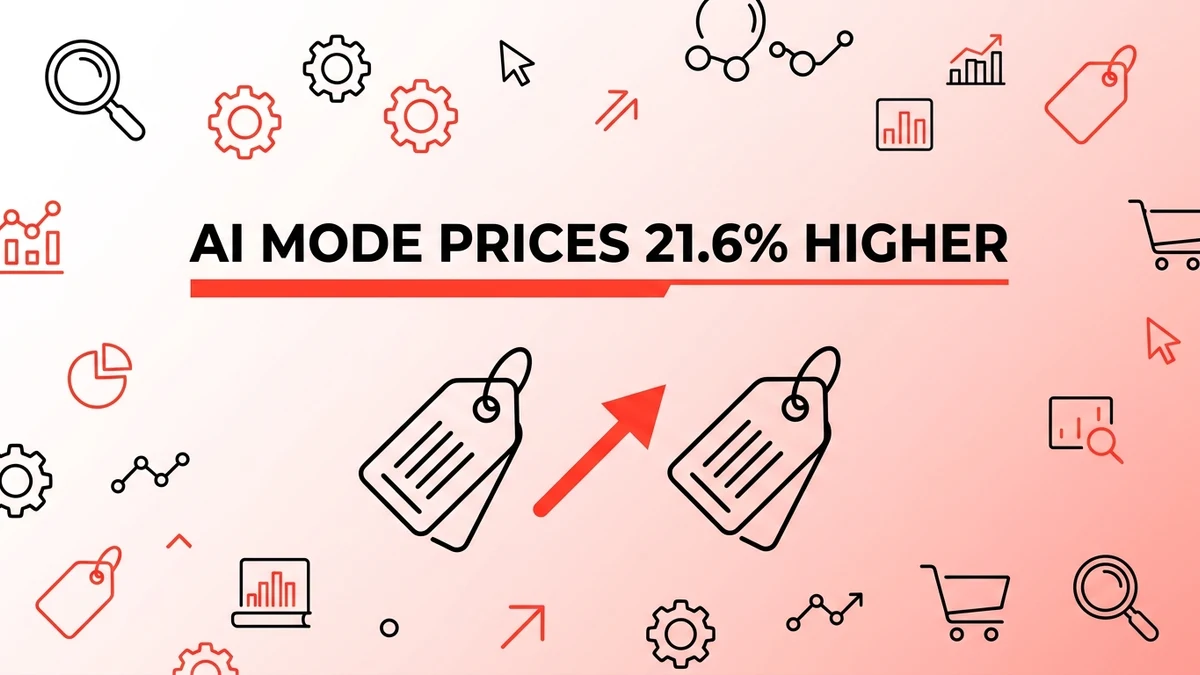
A study published September 5, 2026 by Productrise found that when the same product appeared in both Google AI Mode and traditional Google Search, the price shown in AI Mode was 21.6% higher on average. The bigger problem for brands is not the price gap itself. It is that AI Mode named a different seller entirely for the same product on 49.6% of matched listings, which means the seller a shopper sees for your product may not be the seller you'd choose to represent you.
Google has not independently verified the study and has pushed back on its framing, so treat this as one vendor's analysis rather than a settled fact. But the underlying mechanics it describes, a small, separately-selected shelf of AI Mode products that barely overlaps with traditional Search, are consistent with how AI Mode is built to work. That's worth understanding even before anyone replicates the numbers.
What did the Productrise study actually measure?
Productrise tracked more than 2 million product listings and analysed over 100,000 Google Search results pages and AI Mode responses between August 9 and August 31, 2026, across the United States and United Kingdom. For each query, the researchers matched products that appeared on both surfaces, using Google's stable product identifier where available, then compared the lead offer, meaning the price and seller Google chose to show first, on each surface.
Two more figures matter for context. Among products that matched across both surfaces, prices differed 38.1% of the time, and when they differed, AI Mode showed the higher price 68.4% of the time, so the gap skews toward AI Mode overpricing rather than splitting evenly in both directions. Across the full dataset, not just matched products, the median AI Mode listing was priced at $149 versus $100 in traditional Search, a 49% gap at the median. AI Mode also showed far fewer options per answer, an average of 3.9 products, against 27.8 in a traditional Search results page, so a shopper comparing options in AI Mode simply sees less.
Why is AI Mode showing higher prices for the same products?
Productrise's own numbers point to a selection problem, not proof that Google is deliberately marking prices up. The study measured which offer Google's system chose to display, not whether Google altered a price for an individual shopper, and it compared only the lead offer on each surface, not every price available once a shopper clicks through. Google's public response, given to Futurism, was that all shopping results run through its Shopping Graph and that shoppers can compare sellers themselves once they click into a product.
That response is reasonable as far as it goes, but it sidesteps the part of the study that matters most commercially: the 1.28% carousel overlap. If AI Mode were simply re-ranking the same candidate pool traditional Search already surfaces, you'd expect the leading offer to drift a little on price but rarely swap sellers entirely. Instead, AI Mode appears to be drawing from a largely separate pool of matched offers, one narrow enough that it lands on a different seller for roughly half of matched products. A brand's standard Shopping feed work, the kind that gets a listing into the traditional carousel, does not appear to guarantee the same listing shows up, or is chosen, in AI Mode.
Does this affect every brand equally, or mostly certain categories?
The study doesn't break results out by product category or brand type in the coverage available, so it's not possible to say from this data alone whether apparel, electronics, or another vertical is hit harder. What is clear is the mechanism: any brand whose product is sold through more than one channel, its own site plus one or more resellers, marketplaces, or distributors, is exposed to the seller-swap risk described above, because AI Mode has more than one seller to choose between in the first place. A brand that sells exclusively direct, with no third-party resellers in the market, has less exposure to this specific risk, though it's still subject to the pricing and product-selection differences the study documents.
What should brands actually do about this?
Three things, in order of how quickly they pay off.
First, check who AI Mode says is selling your products, and at what price, for your own top queries. This is a manual spot-check today: run the commercial searches your customers would actually type, in AI Mode, and record the seller and price shown. Don't assume your own listing is what appears, the 1.28% carousel-overlap figure is a specific warning that standard visibility in traditional Shopping doesn't carry over.
Second, treat product feed data as the input Google's system is choosing between, not a fire-and-forget task. Merchant Center titles, GTINs, structured price and availability data, and shipping details all feed into which offer gets selected as the lead result. Stale or incomplete data in any of these gives Google's system less reason to pick your own listing over a third party's.
Third, build a recurring check rather than a one-time audit. Run the same set of commercial queries in AI Mode on a schedule, log the seller and price shown each time, and flag anything that changes. A single spot-check tells you where things stand today. A repeated one tells you whether a seller swap or price mismatch is a one-off or a pattern worth escalating to whoever manages the retailer or distributor relationship.
Productrise's study is a single vendor-conducted analysis that Google has pushed back on, not an independently replicated finding, so hold the exact percentages loosely. What's harder to dismiss is the mechanism: AI Mode draws from a product pool that barely overlaps with traditional Search (1.28%), and it named a different primary seller on roughly half of matched products (49.6%). That means the question for brands isn't only "do we show up in AI Mode," it's "who does AI Mode say is selling us, and at what price," and that's not something existing Shopping feed work or citation tracking answers on its own.
This is a distinct problem from AI shopping agent selection generally, covered in our guide to AI shopping agents and GEO. That guide covers how ChatGPT, Perplexity, and other agents decide which merchant to pick for a purchase. This one is narrower: even when Google's AI Mode does show your product, the seller and price it attributes to that product may not be the ones you'd choose.
FAQ
Is the Productrise study independently verified?
No. Google has publicly stated it has not independently verified the study and, in a response to Futurism, said all shopping results run through its Shopping Graph and that shoppers can compare sellers themselves by clicking through. Productrise is a vendor with a commercial interest in this topic being taken seriously, so the specific percentages should be treated as one analysis, not settled fact, until independently replicated.
Does a 21.6% average price difference mean Google is manipulating prices?
The study itself doesn't support that conclusion. It measured which offer Google's system selected and displayed on each surface, not whether an individual shopper's price was altered, and it compared only the lead offer, not every price available after a shopper clicks through. The more defensible read is that AI Mode selects offers differently than traditional Search, not that it manipulates a single offer's price.
What is the seller-identity-mismatch risk and why does it matter more than the price gap?
It's Productrise's finding that AI Mode named a different primary seller than traditional Search on 49.6% of matched products, roughly half. A price gap is visible and shoppers can compare around it. A seller swap usually isn't something a brand is watching for, so if AI Mode attributes a reseller or marketplace listing to your product at a higher price than your own direct listing, a shopper may assume that's your pricing, and most brands have no process in place to catch that.
Does ranking well in Google Shopping's traditional carousel mean I'll show up correctly in AI Mode?
Not necessarily. Productrise found only 1.28% overlap between products shown in the traditional Shopping carousel and those shown in AI Mode for the same query and day. AI Mode appears to select from a largely separate pool of matched offers rather than re-ranking the same candidates, so standard Shopping feed optimisation doesn't guarantee AI Mode accuracy.
How can a brand check what AI Mode is showing for its products?
There's no dedicated tool yet that automates seller and price checks specifically inside Google AI Mode. The practical approach today is manual: run your top commercial search queries directly in AI Mode, on a recurring schedule, and record the seller and price shown for your product each time. Flag anything that doesn't match your own direct listing.
Sources: Productrise, "Google AI Mode shows the same products 21.6% more expensive", reporting via PPC Land and Search Engine Journal. Google's response, disputing independent verification and pointing to its Shopping Graph and seller-comparison features, was reported by Futurism.

Abdelmoghit drives the content engine at AY Rank. He researches keywords, plans content clusters, and produces citation-optimized articles that rank in both Google and AI search engines.
Full Bio →