AI-driven orders grew roughly 15x between January 2025 and January 2026, and AI platforms are projected to drive $20.9 billion in US retail spending in 2026, nearly four times what they drove in 2025 (Source: industry retail data cited across multiple 2026 market reports). ChatGPT now processes an estimated 50 million shopping-related queries a day. None of that volume goes through a search results page you can optimize the old way.
AI shopping agents are autonomous systems, ChatGPT with Instant Checkout, Perplexity's Comet browser, Amazon's Rufus, Google AI Mode shopping, that research, compare, and complete a purchase on a shopper's behalf from a single instruction like "order running shoes under $150 that arrive by Friday." The agent picks a merchant. Your product either gets picked, or it does not exist for that transaction. This guide covers what actually determines which brand an agent picks, and what to fix first, and how the work connects to the generative engine optimization fundamentals your team may already be running.
What is an AI shopping agent?
An AI shopping agent is software that completes some or all of a purchase autonomously on behalf of a user: it interprets a goal, evaluates products across merchants, and in the most advanced cases pays and checks out without the person visiting a website at all. This differs from a chatbot that merely recommends a product and links out; a true shopping agent can execute the transaction itself, inside a chat surface or a checkout protocol rather than a browser tab.
Four systems account for most current adoption. ChatGPT with Instant Checkout lets US merchants complete purchases directly inside the chat interface, using the Agentic Commerce Protocol (ACP) that OpenAI built with Stripe. Perplexity's Comet is an agentic browser that can navigate a merchant's own site and complete checkout using saved payment details. Amazon's Rufus helps shoppers within Amazon's catalog and increasingly acts on their behalf inside that ecosystem. Google AI Mode shopping surfaces and increasingly transacts products through Google's Universal Commerce Protocol (UCP), announced at NRF 2026.
Mechanically, ACP works by having the merchant expose a structured product and checkout feed that ChatGPT can call directly, so the transaction happens inside the chat session rather than redirecting to the merchant's site. This is the same shift that GEO already made for content: the platform (ChatGPT, Perplexity) becomes the surface where the decision and now the transaction happen, and the merchant's own site becomes one data source among several the agent can draw from, not the required destination.
How is this different from GEO for e-commerce generally?
Standard e-commerce GEO, structured product schema, review aggregation, category content optimized for AI citation, gets your products into a synthesized answer that a human reads and clicks. Agentic commerce adds a second, stricter layer on top: your product data has to be machine-readable and trustworthy enough for an agent to transact against it without a human double-checking the price, availability, or shipping promise first.
That distinction has real teeth. Amazon's own CEO has said publicly that most AI shopping agents still fail to deliver a satisfactory experience, citing inaccurate pricing and delivery estimates as recurring problems. An agent that gets burned by stale inventory data or an inconsistent price once will deprioritize that merchant going forward, the agentic equivalent of losing trust with a repeat customer, except it happens at machine speed and scale.
What do AI shopping agents actually check before recommending a product?
Every agent, regardless of which protocol it runs on, needs the same core signals to evaluate and trust a product, and most of these overlap with GEO fundamentals your team may already have in place.
| Signal | Why an agent checks it | Where it lives |
|---|---|---|
| Structured product data | Machine-readable price, availability, specs, no parsing required | Product schema (schema.org), product feeds |
| Real-time inventory accuracy | Agents transact directly; stale stock data breaks the purchase | Feed sync frequency, API freshness |
| Price consistency | A price shown to the agent must match checkout, or trust drops | Feed and live-page price parity |
| Review volume and recency | Agents weigh third-party validation, not just brand claims | Review platforms, on-site review schema |
| Checkout protocol support | Determines whether the agent can complete the purchase at all | ACP (OpenAI/Stripe), UCP (Google), platform APIs |
| Crawler and agent access | An agent that cannot fetch your data cannot recommend it | robots.txt, GPTBot/PerplexityBot/agent-specific access |
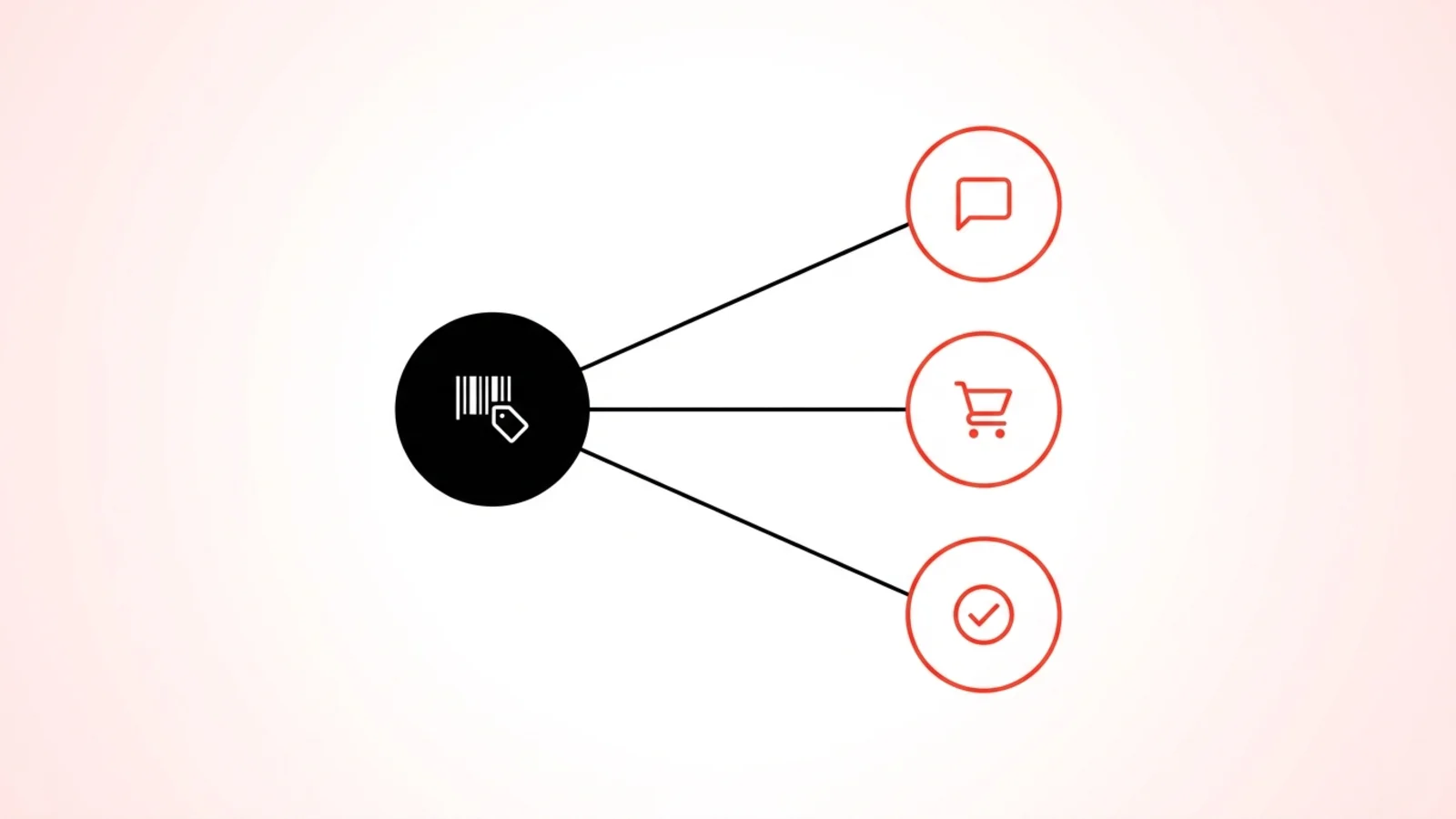 A single highlighted node connected to three others in a small network diagram, representing one trusted data source feeding multiple AI shopping agents
Read that table as a checklist, not a ranking. A brand with perfect product schema but a price feed that lags checkout by even a few hours will still lose an agent's trust the first time it happens.
Agentic commerce does not replace GEO for e-commerce, it adds a transactional layer on top of it. Structured data and review signals get you cited; real-time feed accuracy and protocol support get you actually chosen and paid.
Should every e-commerce brand build for agentic commerce right now?
Not uniformly, and the honest answer depends on catalog size and margin structure more than hype.
- High-catalog retailers where feed accuracy work already exists for Google Shopping and can extend to ACP/UCP at low marginal cost
- Categories with frequent repeat purchases, where an agent's early trust compounds into recurring orders
- Brands already investing in review volume and structured data for standard GEO, since most of that work transfers directly
- Small catalogs without the engineering resource to maintain real-time feed sync, where a stale price is worse than no agent presence at all
- Highly considered, high-price purchases where shoppers still want to compare and decide themselves rather than delegate to an agent
- Merchants who have not yet done basic GEO groundwork, structured data and review strategy come first regardless
If your team does not have the engineering resource to own feed accuracy and protocol integration in-house, this is exactly the kind of specialized work a dedicated GEO agency for e-commerce is built to handle, since it sits at the intersection of technical SEO, data engineering, and a fast-moving set of platform integrations that changes every few months.
How should e-commerce brands prepare for AI shopping agents?
Start with the GEO fundamentals if they are not already in place: complete product schema on every SKU, a review strategy that builds real third-party volume, and confirmed crawler access for the AI platforms your buyers actually use. Our GEO for e-commerce guide covers this foundation in depth, structured data, category content, and crawl architecture for large catalogs.
From there, the agentic-specific layer is about data freshness and protocol support rather than content. Audit how often your product feed syncs against live inventory and pricing, since a mismatch an agent catches once is a lost transaction and a deprioritized merchant going forward. Check whether your platform (Shopify, BigCommerce, a custom stack) has announced or shipped support for the Agentic Commerce Protocol or Google's Universal Commerce Protocol, and confirm your robots.txt does not block the crawlers or agents these systems rely on.
Our technical SEO services cover the crawlability and structured-data side of this work, and our e-commerce SEO services extend that into the category and product-content layer that both classic GEO and agentic commerce depend on. Neither replaces the other: a citation gets a human to consider you, and it is still the same structured, trustworthy product data that lets an agent complete the purchase.
Frequently asked questions
What is an AI shopping agent?
An AI shopping agent is software, such as ChatGPT with Instant Checkout, Perplexity's Comet, or Amazon's Rufus, that researches, compares, and can complete a purchase on a shopper's behalf from a single natural-language instruction, without the person browsing a site and clicking buy themselves.
How is agentic commerce different from regular AI search visibility?
Regular AI search visibility (GEO) gets your product cited in an answer that a human reads and decides on; agentic commerce means the AI system itself selects and transacts with a merchant, so the product data has to be accurate and trustworthy enough for a machine to complete checkout without human verification.
What is the Agentic Commerce Protocol (ACP)?
The Agentic Commerce Protocol is a standard built by OpenAI and Stripe that powers ChatGPT's Instant Checkout, letting merchants expose product and checkout data in a format ChatGPT can transact against directly inside the chat interface.
Do I need separate structured data for AI shopping agents versus regular GEO?
You do not need entirely separate schema, but the same product schema, pricing, and inventory data must be accurate in real time rather than periodically updated, since an agent transacting on stale data breaks the purchase and erodes trust in your feed going forward.
Which AI shopping agents should e-commerce brands prioritize first?
Prioritize based on where your buyers already research: ChatGPT's Instant Checkout and Perplexity's Comet for general retail, Amazon's Rufus if a meaningful share of sales already runs through Amazon, and Google AI Mode shopping given Google's existing dominance in product search intent.
Can blocking AI crawlers protect my product data from being used without credit?
Blocking AI crawlers in robots.txt does stop that specific system from reading your product data, but it also removes you from consideration entirely for citations and agentic transactions on that platform, which for most e-commerce brands costs more in lost visibility than it protects.
Is agentic commerce only relevant to large retailers?
No, but the operational bar (real-time feed accuracy, protocol support) is easier to clear with existing e-commerce infrastructure, so smaller merchants should complete standard GEO fundamentals, schema and reviews, before investing further in agent-specific feed engineering.
Sources: AI Shopping Agents and Agentic Commerce 2026: Adoption Trends and Execution Limits (GlobeNewswire, August 2026), Why the AI Shopping Agent Wars Will Heat Up in 2026 (Modern Retail), 2026: The State of Agentic AI in Retail (Airia)
This post is part of our GEO Optimization guide. Related reading: Artificial Analysis Intelligence Index, AI SEO Checklist for 2026, ChatGPT SEO.

Abdelmoghit drives the content engine at AY Rank. He researches keywords, plans content clusters, and produces citation-optimized articles that rank in both Google and AI search engines.
Full Bio →