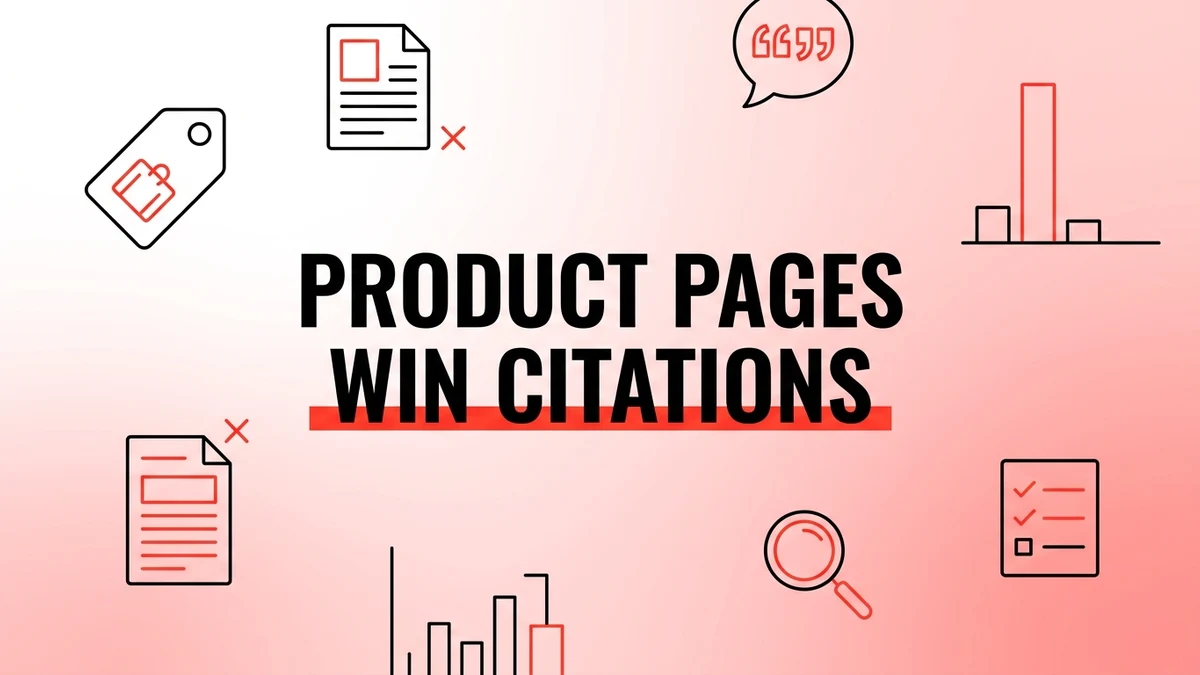
XFunnel tracked 768,000 citations across ChatGPT, Google AI Overviews, and Perplexity over a 12-week study and found that for B2B queries specifically, product pages, most often from the vendor's own company website, made up nearly 56% of citations. News content followed at roughly 9%, and research content at roughly 6%. Blogs, PR content, and general educational material trailed well behind all three.
That distribution runs against how most B2B content teams actually allocate their budget. B2B product pages ai citations share dwarfing blog citation share means the page type most B2B marketing teams treat as a lower-priority, sales-adjacent asset is the one AI engines cite most often when answering a buyer's evaluation-stage question.
What did the 768,000-citation B2B study actually find?
XFunnel's analysis broke down citation share by content type specifically for B2B evaluation and comparison queries, the kind a buyer types when comparing vendors rather than researching a general concept. Product pages led decisively at close to 56% of citations. News coverage of a company or product came next at around 9%, and research or data-backed content followed at around 6%. Blog posts, press releases, and general educational content each captured a meaningfully smaller share of the same citation pool.
Why do product pages outperform blogs for B2B evaluation queries?
A buyer asking an AI system "which tool handles X better, vendor A or vendor B" is asking a question a product page is built to answer directly: specific features, specs, pricing, and use-case fit, stated plainly rather than wrapped in narrative content built for a different reading context. A blog post optimized for a broad informational keyword rarely contains the same density of specific, comparison-ready facts a retrieval system needs to answer a head-to-head evaluation question.
For B2B evaluation-stage queries specifically, product pages are the single highest-value GEO asset by a wide margin, roughly 56% of citations versus single digits for blogs and PR. A content team optimizing blog output for GEO while under-investing in product page clarity is optimizing the wrong asset for this specific query type.
Should B2B teams stop investing in blog content for GEO?
No, but the data argues for a deliberate rebalancing rather than treating blog output as the default GEO investment. Blog content still earns citations for definitional, how-to, and conceptual queries, the questions a buyer asks earlier in their research before comparing specific vendors. The evaluation-stage query, where a buyer is actively choosing, is where product pages dominate, and that is often the highest-commercial-value moment in the entire buying journey, closer to a purchase decision than a top-of-funnel search ever gets.
This also reframes who inside a B2B organization should own GEO work. Product marketing and product pages typically sit outside the content or SEO team's direct control, often owned by product marketing or the product team itself, which means a GEO program that only touches the blog is structurally unable to reach the asset this data says matters most for evaluation-stage citations. Closing that gap usually means getting product marketing involved directly, not routing everything through the content calendar.
Our structured data for AI citation guide covers the schema work that makes a product page's specs, pricing, and feature set genuinely extractable rather than buried in marketing copy, and our GEO for B2B guide covers how this fits into a broader B2B GEO strategy across the full buyer journey, not just the evaluation stage this specific study measured. Our SaaS SEO services and content SEO services both work on the product-page side of this split directly, rather than treating a blog content calendar as the whole GEO program.
Frequently asked questions
What percentage of B2B AI citations come from product pages?
Roughly 56% of B2B evaluation-stage citations came from product pages, most often the vendor's own company website, according to XFunnel's analysis of 768,000 citations across ChatGPT, Google AI Overviews, and Perplexity.
Do blogs get cited less than product pages in AI search?
For B2B evaluation and comparison queries specifically, yes; blogs, PR content, and general educational material captured a meaningfully smaller citation share than product pages, news, or research content in this study, though blogs still perform for definitional and how-to queries outside the evaluation stage.
Why do product pages earn more AI citations than blog content for B2B queries?
Product pages typically contain specific, comparison-ready facts, features, specs, and pricing, stated directly, which matches what an AI system needs to answer a head-to-head vendor evaluation question, while blog content built for broad informational keywords rarely has the same factual density.
Should B2B SaaS companies deprioritize blog content entirely?
No; blog content still earns citations for conceptual and how-to queries earlier in the buyer journey, so the right response is rebalancing investment toward product page clarity for evaluation-stage queries rather than abandoning blog content altogether.
What content types were measured in the 768,000-citation study?
XFunnel's study measured citation share across product pages, news coverage, research and data-backed content, blog posts, PR content, and general educational material for B2B evaluation-stage AI queries across ChatGPT, Google AI Overviews, and Perplexity.
How can a B2B company improve its product pages for AI citation?
Structure product pages with explicit, extractable comparison data, specific features, pricing, and use-case fit, stated plainly and supported by structured data markup, rather than relying on narrative marketing copy that is harder for a retrieval system to lift directly.
Sources: AI Search Study: Product Content Makes Up 70% Of Citations (Search Engine Journal), Product Content Citations Dominate AI Search (MediaPost)
This post is part of our GEO Optimization guide. Related reading: 1 in 10 AI Citations Are From Self-Promo, Google Rank and AI Citations Overlap Under, GEO Scores Are Often Noise, Not a Real.

Oussama leads technical and on-page SEO at AY Rank. He specializes in structured data engineering, crawl optimization, and building the entity architecture that makes AI models cite our clients.
Full Bio →