The overlap between pages ranking in Google's top results and the sources AI engines actually cite has fallen from roughly 70% to under 20% since 2024, according to Brandlight analysis published in 5W's "GEO vs. SEO: The 2026 Venn Diagram" report on May 4, 2026. The research is not a small sample: it synthesizes 680 million citations across ChatGPT, Claude, Perplexity, Gemini, and Google AI Overviews, sampled from more than 10,000 buyer-intent prompts tracked quarterly, year over year.
Read plainly, that means a page ranking #1 on Google today is now more likely than not to be absent from the answer an AI engine gives to a closely related question. Google rank and AI citation overlap used to be a reasonable proxy relationship. The 2026 data says it no longer is, and the gap is widening, not narrowing.
What did the 5W research actually measure?
5W tracked more than 10,000 buyer-intent prompts, the kind a real purchaser types when comparing vendors or researching a category, across five engines on a quarterly cadence, then compared which domains ranked in Google's top results for the matching query against which domains those AI engines actually cited in their generated answers. The overlap metric is the share of top-ranking domains that also appeared as a cited source for the same query.
That overlap sat around 70% in 2024, when AI answer engines were newer and often leaned more heavily on the same crawled, indexed, and ranked web content Google itself surfaces. By early 2026, the same comparison, run on the same methodology, found overlap had fallen under 20%.
Why is the overlap between Google rankings and AI citations collapsing?
Because the two systems are optimizing for different things, and the gap between those things has grown as AI engines have matured past simply mirroring Google's own results. 5W's research points to a specific mechanism: Google's ranking algorithm still rewards persuasive brand voice, calls to action, and page authority signals built for a human clicking through a results page. AI engines preferentially extract a different shape of content entirely: listicles, comparison tables, step-by-step guides, definition-first sentences, and FAQ blocks, content structured to be lifted and summarized rather than read start to finish on the page itself.
How do Google's ranking signals differ from what AI engines actually cite?
The practical gap comes down to format and framing, not just backlinks or domain authority.
| Signal | What Google's ranking rewards | What AI citation extraction rewards |
|---|---|---|
| Content voice | Persuasive brand voice, calls to action | Neutral, factual prose |
| Structure | Long-form pages built around a keyword | Listicles, comparison tables, step-by-step guides |
| Answer format | Content a user reads in full on the page | Definition-first sentences an engine can lift directly |
| FAQ content | Helpful but not load-bearing for ranking | Directly extractable Q&A blocks |
| Primary signal | Backlinks, keyword targeting, page authority | Extractability, factual density, third-party corroboration |
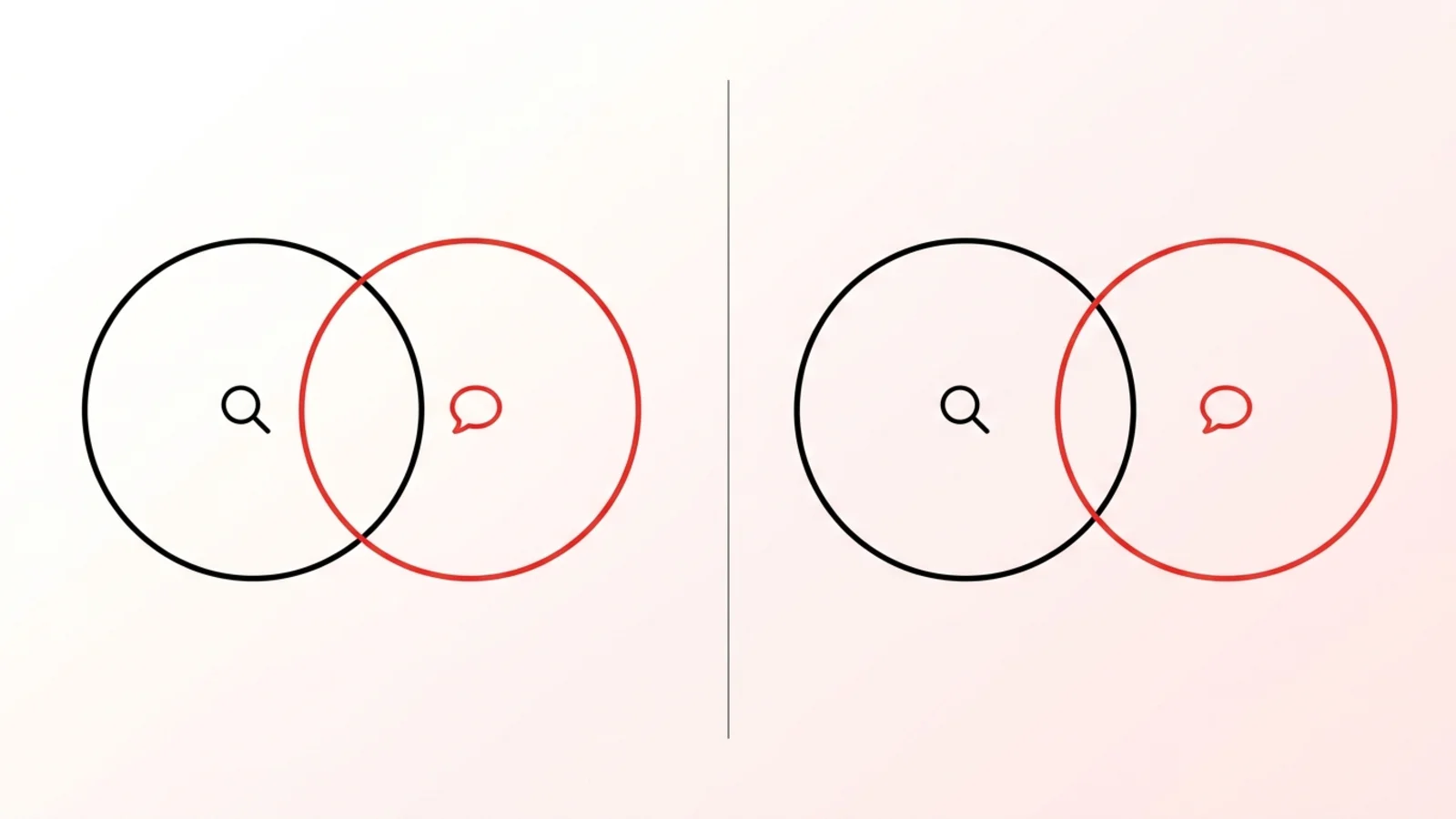 One search-ranking icon and one AI-citation icon shown as two circles that used to overlap heavily and now barely touch
Google rank and AI citation used to move together closely enough that ranking well was a reasonable GEO proxy. At under 20% overlap, that proxy has broken down, and a page needs to be evaluated for citation-readiness on its own terms, not assumed to inherit it from a strong ranking position.
Should SEO teams stop trusting rank position as a visibility signal?
Not entirely, but the data argues for treating it as a necessary condition rather than a sufficient one. A page still generally needs to be crawlable, indexed, and reasonably well-ranked to be in contention for an AI citation at all, since most AI engines still draw on the same crawled web. What rank position no longer predicts is whether that page's content is structured in a way an AI engine will actually extract and cite once it is in contention.
- Crawlability and technical indexing, since AI engines still largely draw on the crawled web
- Topical authority and backlink profile, which support entity recognition for both systems
- Being in the consideration set at all, which strong ranking still helps with
- Persuasive, brand-voice copy optimized for a human reading the full page
- Long-form structure without extractable definitions, tables, or FAQ blocks
- Assuming a #1 ranking means the citation work is already done
What should GEO teams do given this data?
Audit your highest-ranking pages specifically for extractability, not just ranking performance: does the page contain a clear, definition-first answer near the top, a comparison table where relevant, and FAQ-formatted content an engine can lift directly. Our structured data for AI citation guide covers the schema and formatting layer that supports this, and our GEO vs SEO vs AEO breakdown covers where these disciplines diverge in more depth than a single overlap statistic can.
Our content SEO services and GEO optimization services are built around exactly this gap: a page can already be ranking well and still need real restructuring work before it earns a citation, and treating those as the same task is the assumption this research directly argues against.
Frequently asked questions
Does ranking #1 on Google mean AI engines will cite you?
Not reliably as of 2026; research analyzing 680 million citations found the overlap between top Google rankings and AI-cited sources has fallen from roughly 70% in 2024 to under 20% in early 2026, meaning a top-ranking page is now more often absent from the AI-generated answer for the same query than present in it.
What is the 5W research on Google rankings and AI citations?
5W's "GEO vs. SEO: The 2026 Venn Diagram" report, published May 4, 2026, used Brandlight analysis of over 10,000 buyer-intent prompts tracked quarterly across ChatGPT, Claude, Perplexity, Gemini, and Google AI Overviews to measure how often top-ranking Google pages also appear as AI-cited sources.
Why do AI engines cite different sources than Google ranks highly?
Because Google's ranking algorithm still rewards persuasive brand voice and page authority built for human readers, while AI engines preferentially extract neutral, factual, structured content like listicles, comparison tables, and FAQ blocks that can be lifted and summarized directly.
Is SEO still worth doing if it does not guarantee AI citations?
Yes; crawlability, indexing, and topical authority from SEO work still support entity recognition and citation eligibility for AI engines, but ranking well is now a necessary condition for citation rather than a sufficient one, so citation-specific content restructuring is still required separately.
What content format do AI engines actually cite most often?
Per this research, AI engines preferentially extract listicles, comparison tables, step-by-step guides, definition-first sentences, and FAQ-formatted content, favoring extractable, factual structure over long-form persuasive copy.
How was the 70% to under 20% overlap figure calculated?
The overlap figure measures the share of domains ranking in Google's top results for a given query that also appear as a cited source in AI-generated answers for the same query, tracked across more than 10,000 buyer-intent prompts and 680 million citations quarterly from 2024 through early 2026.
Does this overlap collapse apply equally across all AI engines?
The research aggregates citations across ChatGPT, Claude, Perplexity, Gemini, and Google AI Overviews rather than breaking out the overlap trend engine by engine in the publicly reported findings, so brands should still track citation behavior per platform rather than assuming a uniform pattern.
Sources: New 5W Research: Overlap Between Top Google Rankings and AI-Cited Sources Has Collapsed From 70% to Under 20% (PR Newswire), The State of AI Search 2026 (5WPR)
This post is part of our GEO Optimization guide. Related reading: GEO Scores Are Often Noise, Not a Real, Why Grok Has the Highest AI Citation Rate, Google's AI Optimization Guide.

Adel tracks AI citation rates across ChatGPT, Perplexity, Gemini, and AI Overviews. He turns raw visibility data into actionable insights that guide our optimization strategy.
Full Bio →