Content freshness is a core reliability signal for AI search: ChatGPT, Perplexity, and Google AI Overviews prefer citing sources they can verify as current, through visible dates, accurate last-modified headers, sitemap lastmod entries, and substantive updates. This guide covers each signal and the update cadence that keeps pages citable.
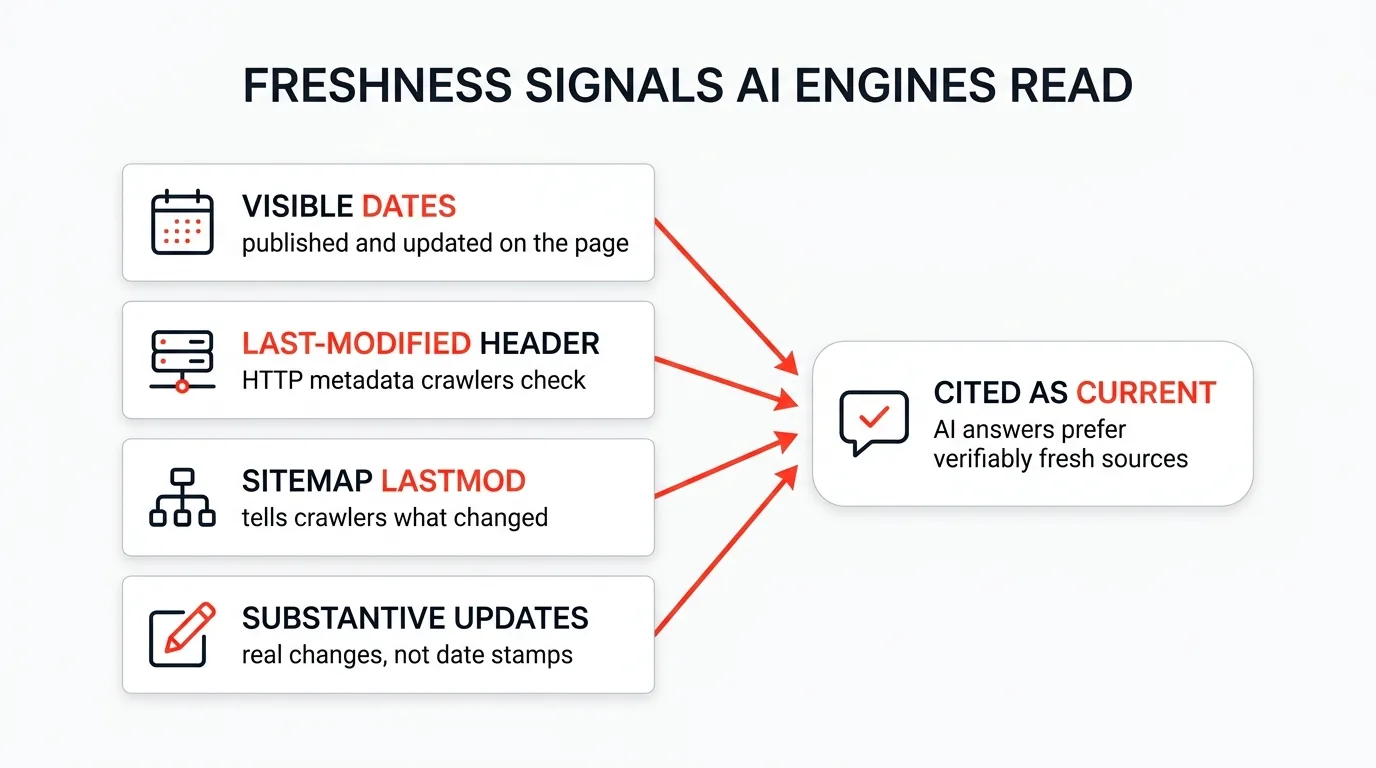 Freshness signals AI engines read: visible dates, last-modified headers, sitemap lastmod, and substantive updates converge into being cited as current
When a user asks ChatGPT, Perplexity, or Claude a question, these systems are not simply retrieving the most-linked page on the web. They are evaluating how reliable the information is, and freshness is one of the most important reliability signals available to them.
Yet most content teams approach freshness the same way they did in 2015: publish a blog post, move on, and hope for the best. In 2026, that strategy leaves significant citation potential on the table.
This guide explains exactly what freshness signals AI search engines detect, how each major platform weights them differently, and what you can do, technically and editorially, to ensure your content is treated as current.
Why Freshness Matters Differently in AI Search
Traditional search engines like Google have long used freshness as a ranking factor, but primarily for certain query types, breaking news, trending topics, recently updated products. For evergreen informational queries, a well-linked older page often outranked a fresher competitor.
AI search introduces a different dynamic:
1. LLMs have training cutoffs Every large language model is trained on a snapshot of the web. Content that was published or significantly updated after the training cutoff may be invisible to the base model, only visible if the system fetches it via real-time retrieval. This means freshness affects whether you are in the training data at all, not just how you rank within it.
2. AI search is used for advice and decisions Users asking AI search engines are disproportionately asking for recommendations, comparisons, and best practices. Stale content giving outdated recommendations is a trust risk for the AI platform, so they have a strong incentive to prefer demonstrably current sources.
3. Retrieval-Augmented Generation (RAG) systems check dates Perplexity and the GPT search mode use RAG, they fetch live pages and then synthesise answers from them. Their retrieval pipelines explicitly evaluate publication and modification dates when deciding which sources to include in the synthesis context.
4. Citation = endorsement When an AI platform cites your content, it puts its credibility on the line. If a cited source turns out to be outdated, users lose trust in the platform. This creates a structural incentive to cite fresher sources when freshness can be reliably detected.
The Two Dates That Matter: datePublished vs. dateModified
The most fundamental freshness signals are the two Schema.org date properties you declare in your structured data.
datePublished
datePublished records when the content was first made public. It is useful for:
- Establishing the original creation context
- News and time-sensitive content where the original date is the point
- Author credibility (a 2019 post by a recognised expert still signals expertise)
Do not backdate or falsify datePublished. AI retrieval systems cross-reference this against crawl history. Inconsistencies are a trust signal in the wrong direction.
dateModified
dateModified is the more actionable freshness signal for evergreen content. This is what you should update every time you make a substantive revision.
{
  "@context": "https://schema.org",
  "@type": "Article",
  "headline": "Content Freshness Signals That AI Search Engines Look For",
  "datePublished": "2025-03-01T09:00:00Z",
  "dateModified": "2026-05-12T09:00:00Z",
  "author": {
    "@type": "Person",
    "name": "Your Author Name"
  }
}
Critical rule: Only update dateModified when you have made substantive changes, new data, updated statistics, revised recommendations, added sections. Never update it just to chase a freshness signal without actual content changes. Google's quality systems and AI retrieval pipelines are increasingly good at detecting cosmetic-only updates.
"Last Updated" Timestamps: The Human-Readable Signal
Beyond structured data, a visible "Last Updated" timestamp in the article body is one of the clearest freshness signals for both AI systems and human readers.
Where to place it
- Immediately below the headline or byline
- In a clearly labelled element: "Last updated: May 12, 2026"
- Optionally in a revision note within the body: "This article was updated in May 2026 to reflect the latest citation rate data from Perplexity and ChatGPT."
Why it works for AI retrieval
When a RAG system fetches your page, its context window includes the rendered text. A visible "Last Updated" string is parsed as part of the document content, giving the LLM an explicit date signal independent of HTTP headers or structured data.
Best practice: include a brief update note
Do not just update the date. Write a one-sentence note explaining what changed and why. This serves two purposes:
- Signals to AI systems that the update was substantive
- Builds reader trust (they can see what was revised)
Example:
Updated May 2026: Added new section on Apple Intelligence freshness signals; updated citation rate statistics to reflect Q1 2026 data from BrightEdge and Semrush.
HTTP Header Freshness Signals
AI crawlers read HTTP response headers before they parse your HTML. Several headers carry freshness information:
Last-Modified
Last-Modified: Mon, 12 May 2026 09:00:00 GMT
This header tells crawlers when the server believes the resource was last changed. It should be consistent with your dateModified schema property. Mismatches are a yellow flag.
ETag
ETags are cache-validation tokens. Crawlers use them to detect whether content has changed since their last visit without re-downloading the full page. While not a freshness date, a changing ETag signals that your content is being actively maintained.
Cache-Control and Expires
Short cache lifetimes signal to crawlers that your content changes frequently and is worth re-visiting. However, overly aggressive no-cache headers can increase server load without meaningful freshness benefit, find a balance appropriate to your actual update cadence.
Schema.org Freshness Properties Beyond Article
If you publish content types beyond standard articles, these additional schema properties carry freshness signals:
For FAQPage
{
  "@type": "FAQPage",
  "dateModified": "2026-05-12",
  "mainEntity": [...]
}
FAQPage schema is heavily used by AI systems for direct-answer extraction. A fresh dateModified signals that the answers are current.
For HowTo
{
  "@type": "HowTo",
  "dateModified": "2026-05-12",
  "step": [...]
}
HowTo content is frequently cited in AI overviews for instructional queries. Freshness signals here directly affect whether your steps are used over a competitor's.
For WebPage
If your page does not qualify as an Article, use the base WebPage type with dateModified. This is appropriate for landing pages with frequently updated content (pricing tables, feature comparisons).
For SoftwareApplication
{
  "@type": "SoftwareApplication",
  "dateModified": "2026-05-12",
  "softwareVersion": "4.2.1"
}
For SaaS product pages, softwareVersion combined with dateModified provides a strong freshness signal, it shows the product is actively maintained.
Update Frequency Signals
Beyond individual dates, AI crawlers and retrieval systems evaluate how consistently you publish and update content.
Crawl frequency as a freshness proxy
Search and AI crawlers allocate crawl budget. Sites that consistently have new or changed content earn more frequent crawl visits. This creates a compounding effect: fresh content gets discovered faster, which increases crawl frequency, which increases discovery speed further.
Publication cadence patterns
A site that publishes 2-4 substantive posts per month, consistently, over 24+ months, signals a maintained, living property. A site with 50 posts all published in a single month then nothing for two years reads as an abandoned content project, even if individual posts are technically accurate.
Internal linking freshness
When you publish new content and link to your existing evergreen articles from it, you send a freshness signal to crawlers: this older page is still relevant enough to be referenced. Maintaining a robust internal link structure that reflects current site architecture is a passive freshness signal.
How Each AI Platform Weights Freshness Differently
ChatGPT (GPT-4o with search)
ChatGPT's search mode retrieves live pages via Bing indexing. Freshness is weighted strongly for:
- Statistics and data points (cited with dates)
- Product comparisons and recommendations
- Current events and evolving topics
For stable evergreen content (foundational concepts, methodology explanations), freshness is a weaker signal, authority and thoroughness matter more.
Actionable: Ensure your statistics-heavy posts have clearly visible publication/update dates. ChatGPT's citation rendering often includes the date next to the source URL.
Perplexity
Perplexity is the most freshness-aggressive of the major AI search platforms. Its default mode shows sources with dates prominently, and its ranking algorithm actively favours recently updated content for most query types.
Perplexity also has separate modes (default, academic, writing) that weight freshness differently. Its default "internet" mode strongly prefers content updated within the last 12 months.
Actionable: For any content you want to rank in Perplexity, treat 12-month recency as a soft requirement. Pages not updated within a year are at a structural disadvantage.
Google AI Overviews
Google AI Overviews draw from the standard Google index, weighted by the same E-E-A-T signals as organic results. Freshness matters primarily for:
- YMYL (Your Money or Your Life) topics where outdated advice is harmful
- Any query where Google detects user intent for current information
For stable informational queries, Google AI Overviews may continue to cite an older page with strong authority and backlinks over a fresher page with less authority.
Actionable: Combine freshness updates with E-E-A-T signals, author credentials, linked sources, review dates. Do not rely on freshness alone.
Claude (claude.ai with web access)
Claude's web access feature retrieves pages in real-time. It is less dependent on pre-indexed freshness signals because it fetches live. However, it does parse visible dates and dateModified schema, and its synthesis will often note "as of [date]" based on what it reads.
Actionable: Ensure your visible "Last Updated" timestamps and schema dates are consistent and accurate, Claude reads and cites them explicitly.
Microsoft Copilot (Bing)
Copilot is deeply integrated with Bing's index, which weights freshness comparably to Google but with slightly faster crawl cycles for news and commercial content. Bing's freshness weighting is more aggressive than Google's for product and pricing queries.
Actionable: If you publish pricing pages or product comparison content, update them at minimum quarterly and ensure dateModified is current.
Content Refresh Strategies That Work
The Substantive Update Approach
The gold standard. Revisit a post and make genuine improvements:
- Replace outdated statistics with current data
- Add new sections covering developments since original publication
- Remove or update sections that are no longer accurate
- Add new examples, case studies, or tools
- Expand thin sections that received low engagement
Document the changes in a visible update note.
The Data Refresh Approach
For posts that are structurally sound but contain dated statistics:
- Identify every statistic, percentage, or data point
- Find current equivalents from primary sources
- Update the figures and their source citations
- Update
dateModifiedand the visible timestamp
This is faster than a full rewrite and highly effective for data-heavy posts.
The Expansion Approach
For posts that were thorough at publication but the topic has evolved:
- Add new H2 or H3 sections covering new developments
- Keep original content intact (avoids broken external links or citations)
- Insert an "Updates & New Developments" section with dated entries
The Consolidation Approach
If you have multiple thin posts on related topics, merge them into a single in-depth resource. Update the canonical URL, implement 301 redirects from the old posts, and set dateModified to the consolidation date.
Content Audit Cadence
Building a systematic freshness maintenance process prevents content from quietly going stale.
Monthly
- Review posts in the top 20 positions for your primary keywords
- Check for outdated statistics or product references
- Update any posts where time-sensitive claims are now inaccurate
Quarterly
- Full audit of your 30 highest-traffic posts
- Update
dateModifiedand visible timestamps on refreshed posts - Review schema markup for completeness
- Check internal links for accuracy
Annually
- Full site content audit
- Identify posts that have not been updated in 18+ months
- Decide: full refresh, consolidation, or deprecation
- Review overall topic coverage for gaps that have emerged
Event-Driven Updates
- When a major industry development affects a post's accuracy: update immediately
- When a new product or platform you cover releases a major version: update within 30 days
- When a statistic you cite is superseded by new primary research: update as soon as possible
Measuring Freshness Impact
Track the following metrics before and after content refreshes to quantify the impact:
- AI referral traffic (GA4: session source = chatgpt.com, perplexity.ai, etc.)
- Featured snippet / AI Overview appearance rate (Google Search Console impression share)
- Average position for target keywords (GSC Performance report)
- Crawl frequency (server access logs or Cloudflare analytics)
- Citation mentions (brand monitoring tools like Mention or Brand24, configured for your URL patterns)
Key Takeaways
dateModifiedin Schema.org markup is the single highest-impact freshness signal, keep it accurate and update it only when you have made substantive changes- Visible "Last Updated" timestamps with brief explanatory notes serve both AI retrieval pipelines and human readers
- Perplexity is the most freshness-aggressive platform; treat 12-month recency as a soft requirement for Perplexity visibility
- Google AI Overviews weigh E-E-A-T alongside freshness, freshness alone is not enough for YMYL or competitive topics
- Consistent publication cadence (2-4 posts/month, maintained over 12+ months) builds crawl frequency as a compounding freshness advantage
- Build a quarterly content audit cadence with event-driven triggers for immediate updates when facts change
Related: Where Does ChatGPT Get Its Information? covers how AI engines source their answers in the first place.
Update Cadences by Content Type
Not all content needs the same freshness treatment. A workable cadence per type, matched to how quickly each decays:
| Content type | Update cadence | Triggers for off-cycle updates |
|---|---|---|
| News and trend pieces | Daily to weekly | Industry events, product launches |
| Tool comparisons and listicles | Quarterly | New releases, pricing changes |
| How-to guides | Every 6 months | Platform UI changes, deprecations |
| Foundational concept pieces | Annually | Major paradigm shifts |
| Case studies | Annually, with new data | Client renewals, new milestones |
| Pricing pages | When prices change | Always |
| Product pages | Monthly review | Stock, price, schema audit |
| Glossary and definitions | Annually | Industry term evolution |
The common mistake is treating all evergreen content the same: updating everything constantly is expensive with low return, and updating nothing guarantees slow decay.
The Minimum Viable Update
A real update does not require a rewrite. The minimum that AI engines can actually register:
- Refresh the opening paragraphs with current context and current-year references.
- Update at least one section with new data or examples: replace one outdated stat, add one new tool, reference one new study.
- Add or update FAQ entries; two or three new question-answer pairs is a high-value change.
- Fix broken or outdated links.
- Update
dateModifiedin schema AND the visible last-updated timestamp, consistently. - Rebuild the sitemap so
lastmodreflects the change.
Expect 30 to 60 minutes per article. Applied across your most important pieces each quarter, this often sustains AI visibility better than producing new content at the same volume.
FAQ
What is content freshness in SEO? Content freshness in SEO is how recently, and how substantively, a page has been updated. Classic search treats it as a ranking factor for time-sensitive queries; AI search treats it as a reliability signal when choosing which sources to cite. Freshness comes from real changes to facts, data, and examples, not from bumping a date stamp.
Do AI search engines prefer fresh content? Yes, for most commercial and informational queries. ChatGPT, Perplexity, and Google AI Overviews weigh recency signals when selecting citations, because stale sources raise the risk of wrong answers. The strength of the preference varies by query type: stable reference topics tolerate older sources, while pricing, tools, and best-of comparisons age out quickly.
How do I tell AI crawlers that a page has been updated? Use the signals crawlers can verify: a visible updated date on the page, an accurate Last-Modified HTTP header, a correct lastmod value in your XML sitemap, and genuinely revised content behind them. Keep published and updated dates consistent with the actual changes; mismatched or bumped-only dates read as manipulation and undermine the signal.
This post is part of our GEO Optimization guide. Related reading: AI Search vs Traditional Search, AI Search Statistics 2026, Where Does ChatGPT Get Its Information? 3 Sources.

Oussama leads technical and on-page SEO at AY Rank. He specializes in structured data engineering, crawl optimization, and building the entity architecture that makes AI models cite our clients.
Full Bio →