- ChatGPT has no single source: answers blend baked-in training data, live Bing-powered browsing, and retrieval of structured sources.
- Training data lags: 6 to 18 months before new content can appear in a training run, with no guarantee.
- The fastest lever: rank in Bing, because real-time ChatGPT lookups browse via Bing.
- The durable lever: become a primary source with original data worth citing.
The Short Answer (and Why It's Complicated)
ChatGPT does not have a single source of information. It draws from multiple layers of knowledge, each with different characteristics, limitations, and implications for your visibility.
At the highest level, ChatGPT's information comes from three distinct mechanisms:
- Training data, the massive corpus of text the model learned from during its training process
- Real-time web browsing, live search capabilities that let ChatGPT access current information
- Retrieval-Augmented Generation (RAG), a hybrid approach where the model queries external databases or documents before generating a response
Understanding each layer is critical, whether you're a curious user trying to evaluate ChatGPT's reliability, or a business trying to get your content into its answers.
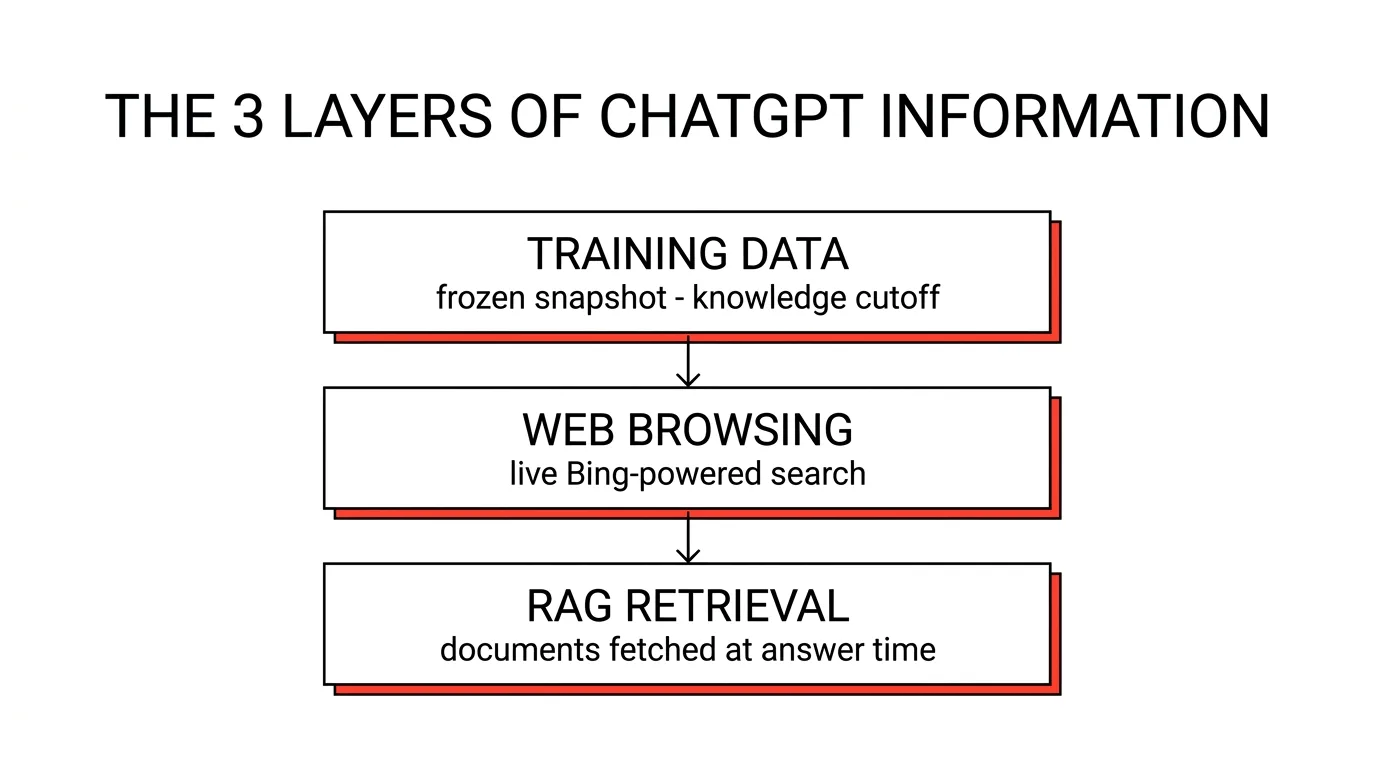 The three layers of ChatGPT information: frozen training data, live Bing-powered web browsing, and RAG retrieval at answer time
Layer 1: Training Data, The Foundation
What Is Training Data?
Every version of ChatGPT starts with a base model that has been trained on a massive dataset of text from across the internet and licensed content. This training process is how the model learns language, facts, reasoning patterns, and world knowledge.
Think of training data as ChatGPT's long-term memory, it's baked into the model's parameters and doesn't require any external lookup. When ChatGPT answers a question about the French Revolution or explains how photosynthesis works, it's drawing on this training data.
What's Included in the Training Data
OpenAI has not published a complete inventory of ChatGPT's training data, but based on their published research, public statements, and independent analysis, the training corpus includes:
| Source Type | Examples | Approximate Scale |
|---|---|---|
| Web crawl data | Common Crawl, publicly accessible websites | Hundreds of billions of words |
| Books | Fiction and non-fiction from digitized collections | Tens of thousands of titles |
| Academic papers | Open-access research repositories | Millions of papers |
| Wikipedia | Full English Wikipedia and many other languages | ~4 billion words (English) |
| Code repositories | GitHub public repositories | Billions of lines of code |
| Forums and Q&A sites | Stack Overflow, Reddit (via licensing deal) | Billions of posts |
| News articles | Major and minor news publications | Extensive but undisclosed |
| Government and legal documents | Public records, court filings, legislation | Varies by jurisdiction |
What's NOT in the Training Data
Equally important is understanding what ChatGPT was not trained on:
- Private databases, proprietary company data, internal wikis, CRM systems
- Paywalled content, articles behind subscription walls (though some leaked into web crawls)
- Personal communications, emails, text messages, private social media posts
- Post-cutoff content, anything published after the training data collection ended
- Your ChatGPT conversations, OpenAI states that conversations are not used to train production models unless users opt in
Knowledge Cutoff Dates
Every GPT model has a knowledge cutoff, the date after which no training data was collected. This is one of the most misunderstood aspects of ChatGPT.
Here is the cutoff history for major models:
| Model | Knowledge Cutoff | Released |
|---|---|---|
| GPT-3.5 | September 2021 | November 2022 |
| GPT-4 | April 2024 | March 2023 (updated) |
| GPT-4o | October 2025 | May 2024 (updated) |
| GPT-4.5 | February 2026 | February 2026 |
| GPT-5 | September 2024 | August 2025 |
Critical nuance: The cutoff date does not mean ChatGPT has complete knowledge of everything up to that date. Training data is a sample, not a census. Many websites, publications, and events are underrepresented or absent entirely, even within the cutoff window.
The concept of tokenization also affects what the model retains, longer, less common content may be represented with less fidelity than frequently occurring text patterns.
Layer 2: Web Browsing, Real-Time Information
How ChatGPT Browses the Web
 ChatGPT's interface: answers come from training data unless the query triggers a live web search
Starting with the "Browse with Bing" feature and expanding significantly since, ChatGPT can now search the live internet in real-time to supplement its training data.
When ChatGPT determines that a query requires current information, or when a user explicitly asks for recent data, the model:
- Formulates search queries, it generates one or more search queries based on the user's question
- Executes searches, using Bing's search API to retrieve results
- Reads web pages, clicking into specific results and reading the page content
- Synthesizes an answer, combining information from multiple pages with its training knowledge
When Does ChatGPT Browse vs. Use Training Data?
ChatGPT does not browse the web for every query. It makes a judgment call based on several factors:
- Temporal signals, questions containing "today," "latest," "2026," or "current" trigger browsing
- Knowledge uncertainty, when the model isn't confident in its training data answer, it may search
- Explicit requests, users can ask ChatGPT to "search for" or "look up" specific information
- Model version, newer models browse more aggressively and reliably than older ones
Important limitation: When ChatGPT browses the web, it functions more like a human reading search results than like a search engine crawling the web. It reads a limited number of pages (typically 3-8 per query), and it may miss relevant sources that don't rank well in Bing.
Implications for Your Content
This is where things get strategic. If ChatGPT browses via Bing, then Bing SEO directly influences ChatGPT's real-time answers. Content that ranks well in Bing is more likely to be found, read, and cited by ChatGPT when it browses.
Key differences between Bing and Google ranking factors to be aware of:
- Bing places more weight on exact-match domains and social signals
- Bing's crawl budget is smaller, so technical SEO (fast load times, clean markup) matters more
- Bing values page authority over domain authority more than Google does
Layer 3: Retrieval-Augmented Generation (RAG)
What Is RAG?
RAG (Retrieval-Augmented Generation) is an architecture where the language model retrieves relevant documents from an external knowledge base before generating its response. Optimising for this retrieval layer is half of LLM SEO. Instead of relying solely on what it memorized during training, the model actively looks up information.
ChatGPT uses RAG in several ways:
- Internal knowledge retrieval, OpenAI maintains curated knowledge bases that the model can query for specific topics
- Custom GPTs with uploaded files, when users create Custom GPTs and upload documents, those documents serve as a RAG knowledge base
- API implementations, developers building on the ChatGPT API often implement RAG with their own document collections
- ChatGPT's memory feature, stored user preferences and conversation context function as a personal RAG system
Why RAG Matters for Content Visibility
RAG is the most controllable path to getting your content into ChatGPT's answers. When someone builds a Custom GPT and uploads your whitepaper, guide, or dataset, ChatGPT will directly reference that content when answering related questions.
This creates an indirect but powerful visibility channel: create content so valuable that people include it in their Custom GPTs and RAG pipelines.
Plugins, Tools, and External Integrations
Beyond training data, browsing, and RAG, ChatGPT can access information through:
Code Interpreter / Advanced Data Analysis
ChatGPT can write and execute Python code, which means it can:
- Analyze uploaded datasets (CSV, Excel, JSON)
- Scrape data from provided URLs
- Process and visualize information dynamically
DALL-E and Image Understanding
ChatGPT can analyze images uploaded by users, extracting text, data from charts, and contextual information. This means information in your images is accessible to ChatGPT when users share screenshots or photos.
Third-Party Plugins and Actions
Custom GPTs can call external APIs, connecting ChatGPT to:
- Databases and knowledge bases
- Real-time data feeds (stock prices, weather, sports scores)
- Proprietary tools and platforms
- Your own API endpoints
How OpenAI Updates Models
Understanding the update cycle helps you plan your content strategy:
Training Runs
OpenAI periodically trains new base models on updated datasets. Each training run:
- Takes months and costs millions of dollars
- Incorporates more recent web data
- May adjust the weighting of different source types
- Results in a new knowledge cutoff date
Fine-Tuning and RLHF
After base training, models are refined through:
- Supervised fine-tuning, human trainers demonstrate desired behaviors
- RLHF (Reinforcement Learning from Human Feedback), human raters compare model outputs and the model learns to prefer higher-rated responses
- Constitutional AI techniques, automated alignment processes
These post-training steps don't add new factual knowledge, but they change how the model presents and prioritizes information.
System Prompt Updates
OpenAI can modify ChatGPT's behavior without retraining the model by updating its system prompt. These updates can:
- Change how the model handles certain query types
- Add or remove capabilities
- Adjust citation behavior and source preferences
How to Get YOUR Content Into ChatGPT's Answers
This is the section most businesses care about. Here are six strategies, ranked by directness and reliability:
Original research and definitive guides get captured by future training runs; the durable play.
ChatGPT browses via Bing, so Bing rankings are the direct path into real-time answers.
Answer-first formatting and schema make your pages the ones RAG systems fetch and quote.
Strategy 1: Become a Primary Source That Training Data Captures
The most durable approach is to create content that will be included in future training runs.
What works:
- Publish original research with unique data points
- Create definitive guides that become reference material in your industry
- Build tools and calculators that generate citable outputs
- Produce content on domains with strong authority and traffic signals
Timeline: 6-18 months before content potentially appears in a new training run. There is no guarantee of inclusion.
Strategy 2: Rank in Bing for Your Target Queries
Since ChatGPT browses via Bing, ranking well in Bing is a direct path to being cited in real-time ChatGPT answers.
What to do:
- Submit your site to Bing Webmaster Tools
- Ensure your content is technically accessible and fast-loading
- Build backlinks from domains that Bing trusts
- Optimize for Bing-specific ranking factors (social signals, exact-match keywords)
- Monitor your Bing rankings for high-value queries
Strategy 3: Structure Content for AI Extraction
Whether ChatGPT encounters your content via training data or browsing, well-structured content is more likely to be retained and cited.
Formatting principles:
- Lead with definitive statements: "X is Y" rather than building up to a conclusion
- Use tables for comparative data, these survive the extraction process well
- Include specific numbers, dates, and proper nouns that the model can confidently attribute
- Write self-contained sections that make sense even when extracted from the page
Strategy 4: Create Content Worth Including in Custom GPTs
Thousands of Custom GPTs are built weekly, and their creators actively search for high-quality reference materials to upload.
Content types that get uploaded to Custom GPTs:
- In-depth industry guides and handbooks
- API documentation and technical references
- Regulatory and compliance frameworks
- Training materials and playbooks
- Datasets in structured formats (CSV, JSON)
Strategy 5: Build an API That Custom GPTs Can Connect To
If you have proprietary data, building an API that Custom GPTs can call puts your information directly into ChatGPT's answers for specific use cases.
Examples:
- A real estate data API that Custom GPTs query for property information
- A legal research API that provides case law summaries
- An industry benchmarking API that returns comparative statistics
- Check our services page for how we help businesses build AI-accessible content infrastructure
Strategy 6: Publish on High-Authority Platforms
Content published on platforms that ChatGPT's training data heavily weights, Wikipedia, Stack Overflow, major news sites, academic repositories, has an outsized influence on the model's knowledge.
What to do:
- Contribute to Wikipedia articles in your area of expertise (follow their guidelines genuinely)
- Answer questions on Stack Overflow, Quora, and Reddit with substantive, expert responses
- Publish guest articles on high-authority industry publications
- Release research on open-access academic platforms
Publisher Partnerships: The Layer You Cannot Opt Into
OpenAI has signed direct content licensing deals with major publishers, including Associated Press, Axel Springer, News Corp, Vox Media, the Financial Times, and Condé Nast. Content from these publishers can flow into ChatGPT through partnership pipelines rather than open-web retrieval, and it tends to surface more often in news and breaking-event queries.
Smaller publishers and independent sites have no way to opt into this layer, and that is the practical takeaway: your strategy competes in the open retrieval layer, where the mechanics in this guide still decide who gets cited. Make sure the OpenAI crawlers can reach you at all; our robots.txt setup guide for AI crawlers covers the exact directives.
What Content ChatGPT Cannot Access
Understanding the boundaries helps you set realistic expectations:
- Content behind authentication, login-required pages are invisible to both training crawlers and the browse feature
- Paywalled articles, while some may have leaked into training data, ChatGPT cannot browse paywalled content
- JavaScript-only rendered content, heavy single-page applications that require JS execution may not be accessible to crawlers
- Robots.txt blocked content, if you block OpenAI's crawlers (GPTBot and ChatGPT-User), your content will be excluded from future training and browsing
- Recently deleted content, once removed from the web, content may persist in training data but won't appear via browsing
- Private social media, posts behind privacy settings on Facebook, Instagram, LinkedIn, etc.
- Encrypted communications, end-to-end encrypted messages on WhatsApp, Signal, etc.
- Most multimedia, audio content in podcasts, dialogue in videos, and text within images are largely inaccessible unless transcribed
Myths vs. Reality
Let us address the most common misconceptions:
Myth: "ChatGPT knows everything on the internet"
Reality: ChatGPT's training data is a large but incomplete sample of publicly available text. Vast amounts of web content, particularly from smaller sites, non-English sources, and niche topics, are underrepresented or absent. The model also cannot access real-time information without explicitly browsing.
Myth: "ChatGPT remembers my previous conversations and uses them to answer other people"
Reality: Standard ChatGPT conversations are not used to train the model (users can opt in to allow this). ChatGPT's "memory" feature stores personal preferences within your account only. Your conversation is not shared with other users.
Myth: "If I block GPTBot, ChatGPT can't mention my brand"
Reality: Blocking GPTBot prevents your content from being included in future training runs. However, content already in the training data remains, and ChatGPT may still encounter your brand via web browsing, user-uploaded documents, or third-party sources that reference you.
Myth: "ChatGPT always gives the same answer to the same question"
Reality: ChatGPT's responses are stochastic, they involve randomness. The same question asked twice may produce different answers with different source emphasis. This is controlled by a "temperature" parameter that introduces variation. When browsing, the results themselves may change over time.
Myth: "Paying for ChatGPT Plus means the model has more information"
Reality: ChatGPT Plus gives access to more capable models (GPT-4, GPT-4o) with more recent knowledge cutoffs and better reasoning. But the fundamental information sources remain the same: training data, browsing, and RAG. The paid tier doesn't unlock a secret database.
Myth: "ChatGPT plagiarizes content verbatim"
Reality: While ChatGPT occasionally reproduces short phrases from its training data, it overwhelmingly paraphrases and synthesizes rather than copying. The model learned patterns and relationships between concepts, not a retrievable copy of every source document. Exact reproduction is a bug, not a feature.
What This Means for Your Visibility Strategy
The fragmented nature of ChatGPT's information sources creates both challenges and opportunities:
The challenge: There is no single optimization lever. You cannot just "rank in ChatGPT" the way you rank in Google. Your content must be strong across multiple dimensions, training data inclusion, Bing rankings, structural extractability, and community adoption.
The opportunity: Most businesses are doing nothing to optimize for ChatGPT visibility. The bar is low. Simply publishing well-structured, authoritative, original content on a technically accessible website puts you ahead of 90% of competitors.
A Practical Action Plan
- Audit your current ChatGPT visibility, ask ChatGPT questions about your industry and see if your brand or content appears
- Check your robots.txt, ensure you haven't blocked GPTBot or ChatGPT-User
- Optimize for Bing, submit to Bing Webmaster Tools and monitor your Bing rankings
- Structure content for extraction, reformat key pages with clear headings, tables, and lead-with-facts writing
- Create original, citable assets, research reports, datasets, and tools that become primary sources
- Monitor and iterate, track ChatGPT's answers for your target queries monthly
The landscape of AI-generated answers is evolving rapidly. The strategies that work today will need continuous refinement as OpenAI updates its models, expands browsing capabilities, and adjusts how information is sourced and presented. Start building your AI visibility foundation now, and adapt as the technology evolves.
For a full evaluation of how your content performs across all major AI search platforms, try our GEO Readiness Checker.
Related: Content Freshness Signals That AI Search Engines Look For covers how to stay citable once you are in the sources.
This post is part of our GEO Optimization guide. Related reading: How to Optimize for Perplexity AI, SEO vs AEO vs GEO, GEO vs SEO vs AEO.

Adel tracks AI citation rates across ChatGPT, Perplexity, Gemini, and AI Overviews. He turns raw visibility data into actionable insights that guide our optimization strategy.
Full Bio →