Why Perplexity AI Matters for Your Visibility Strategy
Perplexity AI has quietly become one of the most consequential search products since Google. With over 100 million monthly queries and a user base that skews heavily toward researchers, professionals, and decision-makers, Perplexity represents a fundamentally different discovery channel than traditional search engines.
Unlike Google, which presents ten blue links and leaves users to click through and evaluate sources themselves, Perplexity synthesizes information from across the web into a single, cited answer. This changes everything about how your content gets discovered, consumed, and attributed.
If your brand doesn't appear in Perplexity's answers, you're invisible to a growing segment of high-intent searchers who have already abandoned traditional search.
This guide breaks down exactly how Perplexity works under the hood, what makes it choose one source over another, and the eight strategies that will maximize your chances of being cited.
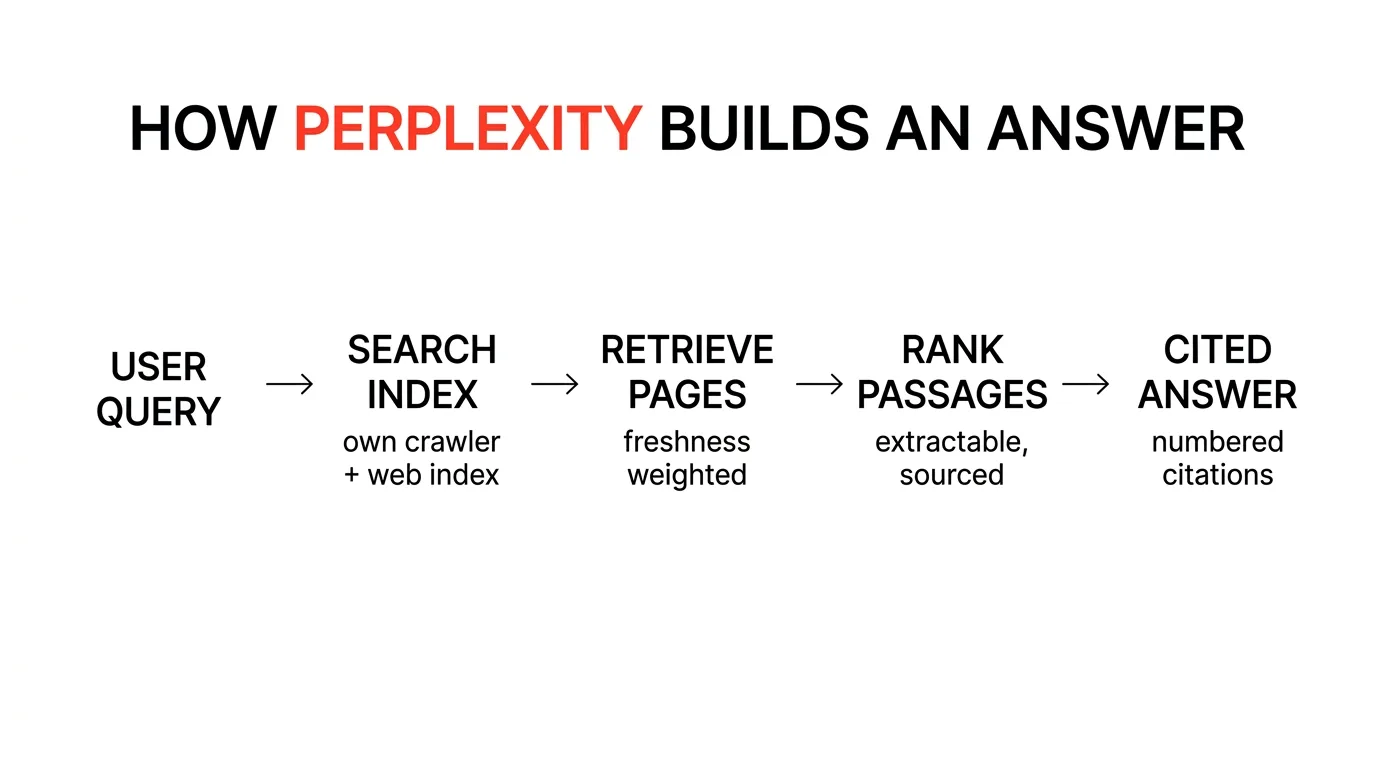 How Perplexity builds an answer: user query, search index, freshness-weighted retrieval, passage ranking, and a cited answer
How Perplexity Actually Works: Search + RAG
To optimize for Perplexity, you first need to understand its architecture. Perplexity is not a chatbot with a static knowledge base. It is a Retrieval-Augmented Generation (RAG) system that combines real-time web search with large language model synthesis.
Here is what happens when a user submits a query:
- Query interpretation, Perplexity parses the user's question and determines what information is needed, often reformulating the query into multiple sub-queries.
- Real-time web retrieval, The system searches the live web, pulling content from dozens of sources. Perplexity uses its own web crawler (PerplexityBot) and also draws on search APIs.
- Source evaluation, Retrieved documents are scored for relevance, authority, recency, and information density.
- Answer synthesis, A large language model (typically a fine-tuned version of models from Anthropic, OpenAI, or Meta) reads the retrieved sources and generates a coherent answer.
- Inline citation, Every factual claim in the response is linked back to its source with numbered citations.
This architecture has a critical implication: your content must be both discoverable by Perplexity's crawler AND high-quality enough to survive the synthesis step. Being indexed is necessary but not sufficient.
How Perplexity Selects and Cites Sources
Perplexity does not cite sources randomly. Through extensive testing and reverse-engineering, several patterns emerge in how it selects which URLs to reference:
| Factor | Weight | What It Means |
|---|---|---|
| Topical relevance | Very High | Content must directly address the query, not tangentially mention it |
| Information density | High | Sources that pack more useful facts per paragraph get preferred |
| Recency | High | For time-sensitive queries, newer content wins decisively |
| Domain authority | Medium-High | Established domains with backlink profiles get a trust boost |
| Structural clarity | Medium | Well-organized content with clear headings is easier for the model to extract from |
| Uniqueness | Medium | Original data, research, or perspectives that other sources lack |
| Technical accessibility | Medium | Fast load times, clean HTML, no aggressive anti-bot measures |
The most important takeaway: Perplexity optimizes for answer quality, not for clicks. It wants sources that make its answers better. Your optimization strategy must align with this incentive.
How Perplexity Differs from ChatGPT and Google
Understanding these differences is essential because the optimization strategies diverge significantly.
Perplexity vs. Google
Google ranks pages. Perplexity cites passages. With Google, you're competing to appear in a list of ten results. With Perplexity, you're competing to have your specific sentences and data points extracted into a synthesized answer.
This means traditional SEO metrics like click-through rate and time-on-page are irrelevant. What matters is whether your content contains citable, specific, factual claims that the model can extract and attribute.
Perplexity vs. ChatGPT
ChatGPT (without browsing) relies on training data with a knowledge cutoff. Perplexity always searches the live web. This means:
- Freshness matters more with Perplexity, you can influence Perplexity's answers by publishing content today
- Citation is guaranteed with Perplexity, ChatGPT rarely tells users where it got information; Perplexity always does
- Traffic potential is real with Perplexity, users click Perplexity's citations at meaningful rates because they want to verify or go deeper
For a deeper understanding of how AI models reference your content, see our guide on how to get cited by AI search engines.
8 Strategies to Optimize for Perplexity AI Search
Strategy 1: Structure Your Content for Extraction
Perplexity's RAG system needs to extract specific passages from your content. Make this easy.
What to do:
- Use descriptive
##and###headings that match how people phrase questions - Lead each section with a direct, factual statement before expanding with context
- Use definition-style formatting: bold the term, follow with a clear explanation
- Keep paragraphs focused, one idea per paragraph, ideally 2-4 sentences
Example of extraction-friendly writing:
Perplexity AI processes over 100 million queries per month as of early 2026, making it the third-largest AI search product by query volume. The platform's user base has grown 340% year-over-year, driven primarily by professional and research use cases.
This paragraph contains two specific, citable facts with clear attribution potential. Compare this to a vague paragraph like "Perplexity is growing really fast and lots of people use it", the model has nothing concrete to cite.
Strategy 2: Prioritize Content Freshness
Perplexity has a strong recency bias for many query types. Its real-time search means it can access content published minutes ago.
What to do:
- Publish timely analysis of industry developments within 24-48 hours
- Update existing content regularly with new data, and include visible "Last updated" dates
- Add a structured
dateModifiedfield in your schema markup - Create "State of X in 2026" style content that signals recency in the title
What to avoid:
- Evergreen content with no date signals, Perplexity may deprioritize it for queries where freshness matters
- Content that references outdated statistics without updating them
- Pages where the only date visible is from 2023 or earlier
Strategy 3: Build Authoritative, Original Sources
Perplexity preferentially cites primary sources over secondary ones. If you're summarizing someone else's research, Perplexity will often go find the original instead.
What to do:
- Conduct and publish original research, surveys, or data analysis
- Create proprietary frameworks, scoring systems, or methodologies, see our methodology for an example
- Interview experts and publish their direct quotes
- Build datasets or calculators that generate unique outputs, like our GEO Readiness Checker
Why this works: When Perplexity encounters a factual claim and traces it back to an original source, that source gets the citation. Being the origin of information is the strongest citation signal you can send.
Strategy 4: Optimize FAQ Content and Direct-Answer Formatting
Perplexity excels at answering specific questions, and it loves content that is already formatted as question-and-answer pairs.
What to do:
- Add FAQ sections to key pages with real questions your audience asks
- Use
###headings formatted as questions:### How does Perplexity select sources? - Provide concise, direct answers in the first sentence after each question heading
- Implement FAQ schema markup (FAQPage JSON-LD) so Perplexity can identify Q&A content programmatically
Pro tip: Study the "Related" questions that Perplexity suggests after answering a query in your niche. These are the follow-up queries users actually ask, build content that answers them.
Strategy 5: Use Citation-Friendly Formatting
Certain content formats are dramatically easier for RAG systems to cite than others.
Formats that get cited frequently:
- Numbered lists with specific items (e.g., "7 strategies for...")
- Comparison tables with clear column headers
- Step-by-step processes with numbered steps
- Statistics presented with source attribution
- Definitions and explanations that begin with the term being defined
Formats that rarely get cited:
- Long narrative prose without structural breaks
- Content buried inside images, infographics, or PDFs
- Interactive widgets where the information only renders via JavaScript
- Content behind login walls or paywalls
Strategy 6: Strengthen Domain Authority Signals
Perplexity's source evaluation includes domain-level trust signals. While this isn't as dominant a factor as in Google's ranking algorithm, it still matters.
What to do:
- Build genuine backlinks from authoritative sites in your industry
- Maintain a consistent publishing cadence, domains that publish regularly signal active expertise
- Ensure your domain has proper
robots.txtand sitemap configuration - Get cited by other authoritative sources, this creates a compounding effect where Perplexity sees your domain referenced across multiple trusted sources
A note on E-E-A-T: While Perplexity doesn't use Google's E-E-A-T framework directly, the underlying signals (expertise, experience, authoritativeness, trustworthiness) still influence whether the model trusts your content enough to cite it.
Strategy 7: Ensure Technical Accessibility for PerplexityBot
If Perplexity's crawler can't access your content, no amount of content optimization matters.
Technical checklist:
- Allow PerplexityBot in robots.txt, check that you haven't blocked it:
User-agent: PerplexityBotshould not be followed byDisallow: / - Serve content as HTML text, not rendered only via client-side JavaScript frameworks. Perplexity's crawler does not execute JavaScript reliably
- Maintain fast server response times, crawlers have timeout thresholds; slow responses mean missed content
- Avoid aggressive CAPTCHAs or bot detection, these block PerplexityBot along with malicious crawlers
- Use clean, semantic HTML, proper
<article>,<h2>,<p>,<table>tags help the crawler understand content structure - Implement an XML sitemap, submit it to help PerplexityBot discover your content efficiently
- Add an llms.txt file, this emerging standard tells AI systems which content to prioritize and how to interpret your site
Strategy 8: Create Content Clusters, Not Isolated Pages
Perplexity often pulls from multiple pages on the same domain when answering complex queries. Having thorough coverage of a topic increases your chances of being cited for various facets of a question.
What to do:
- Build topic clusters with a pillar page and supporting articles
- Interlink related content so the crawler discovers your full topical coverage
- Cover different angles of the same topic: beginner guides, advanced strategies, case studies, data analysis, comparisons
- Create glossary pages for key terms in your field, these are citation magnets for definitional queries
Example cluster for "AI search optimization":
- Pillar: Complete guide to Generative Engine Optimization
- Supporting: How Perplexity selects sources (this post)
- Supporting: Where ChatGPT gets its information
- Supporting: Measuring AI search visibility
- Glossary: AI citation, RAG, tokenization
How to Track Your Perplexity Visibility
Measuring your presence in Perplexity's answers is harder than tracking Google rankings, but it's not impossible.
Manual Monitoring
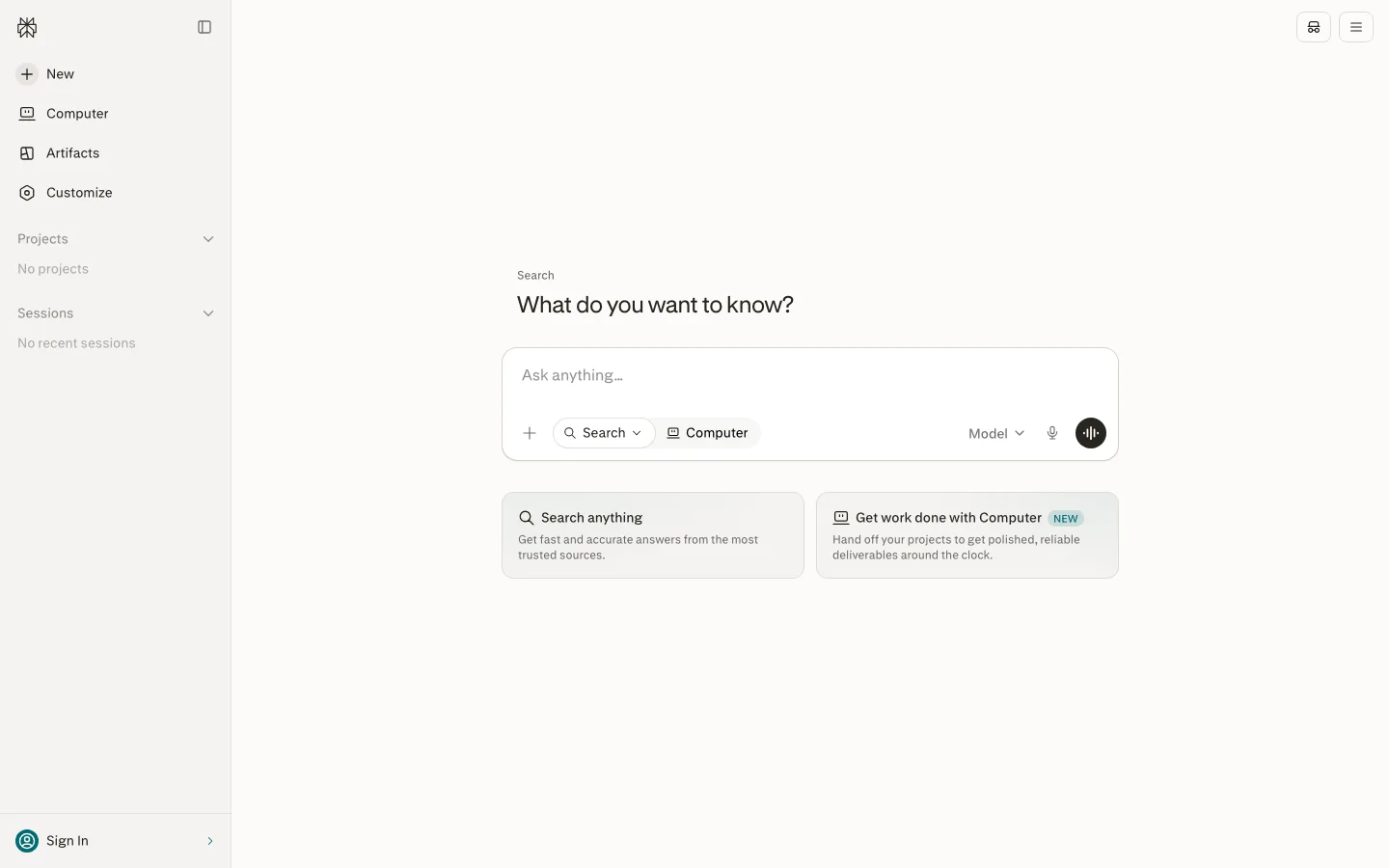 Perplexity's search interface, the place to start manual visibility checks: every answer begins with a live retrieval pass
Run a set of 20-30 target queries through Perplexity weekly and record:
- Whether your domain appears in the citations
- Which specific pages are cited
- What position your citation appears in (citations earlier in the answer get more clicks)
- Whether your content is quoted directly or paraphrased
Server Log Analysis
Look for PerplexityBot in your server access logs. Track:
- Which pages PerplexityBot crawls most frequently
- Crawl frequency trends over time
- Any pages returning errors to the crawler
Referral Traffic
In your analytics platform, filter for traffic from perplexity.ai as a referral source. Monitor:
- Total sessions from Perplexity over time
- Which landing pages receive Perplexity traffic
- User behavior metrics for Perplexity-referred visitors (these users tend to have high engagement because they're arriving with specific intent)
Third-Party GEO Tools
A growing number of tools now track AI search visibility across platforms including Perplexity. Our GEO Readiness Checker evaluates your site's readiness for AI search engines and provides specific recommendations.
Common Mistakes That Kill Your Perplexity Visibility
Avoid these pitfalls that we see brands make repeatedly:
Mistake 1: Blocking AI Crawlers
Some site owners, frustrated by AI companies using their content, block all AI crawlers in robots.txt. While this is within your rights, it's a binary choice, you either participate in AI search or you don't. There is no middle ground where you block the crawler but still appear in answers.
Our recommendation: Allow PerplexityBot specifically. Perplexity provides clear attribution with clickable citations, making it the most publisher-friendly AI search engine. Blocking it removes you from a high-value discovery channel.
Mistake 2: Writing for Word Count, Not Information Density
Long content does not automatically perform better in Perplexity. A 5,000-word article that takes 2,000 words to make its first concrete point will lose to a 1,500-word article that leads with data and specifics.
The fix: Front-load your most important, citable information. Every section should deliver value in its first two sentences.
Mistake 3: Duplicating Content Across Pages
If you have multiple pages making the same claims with slightly different wording, Perplexity may choose none of them, or choose a competitor's single authoritative page instead.
The fix: Consolidate thin content. One in-depth page outperforms five shallow ones.
Mistake 4: Ignoring Structured Data
Schema markup helps Perplexity's system understand what your content is about before the language model even reads it. Sites without structured data are at a disadvantage.
The fix: Implement Article, FAQPage, HowTo, and Organization schema at minimum. Use JSON-LD format.
Mistake 5: Treating Perplexity Like Google
The biggest meta-mistake is applying traditional SEO tactics without adaptation. Keyword density, meta description optimization, internal linking for PageRank, these are Google-specific concepts that don't translate directly.
The fix: Optimize for extractability and citability, not for ranking signals. Ask yourself: "If a language model read this page, could it pull out a specific, accurate fact to cite?"
What's Next: The Future of Perplexity Optimization
Perplexity is evolving rapidly. Several developments to watch:
- Perplexity Spaces, collaborative research environments that may change how sources are discovered and shared
- Revenue sharing, Perplexity has begun testing publisher revenue sharing programs, creating direct financial incentives for being cited
- Multimodal search, image and video content may become citable as Perplexity expands beyond text
- Enterprise adoption, as companies adopt Perplexity for internal research, B2B content optimization becomes even more valuable
The brands that invest in Perplexity optimization now are building a compounding advantage. Every citation builds domain trust, which leads to more citations, which builds more trust. Start with the eight strategies above, measure your results, and iterate.
The opportunity window is open, but it won't stay open forever. As more brands recognize Perplexity's importance, the competition for citations will intensify. Move now.
This post is part of our GEO Optimization guide. Related reading: SEO vs AEO vs GEO, GEO vs SEO vs AEO, What is Generative Engine Optimization.

Adel tracks AI citation rates across ChatGPT, Perplexity, Gemini, and AI Overviews. He turns raw visibility data into actionable insights that guide our optimization strategy.
Full Bio →