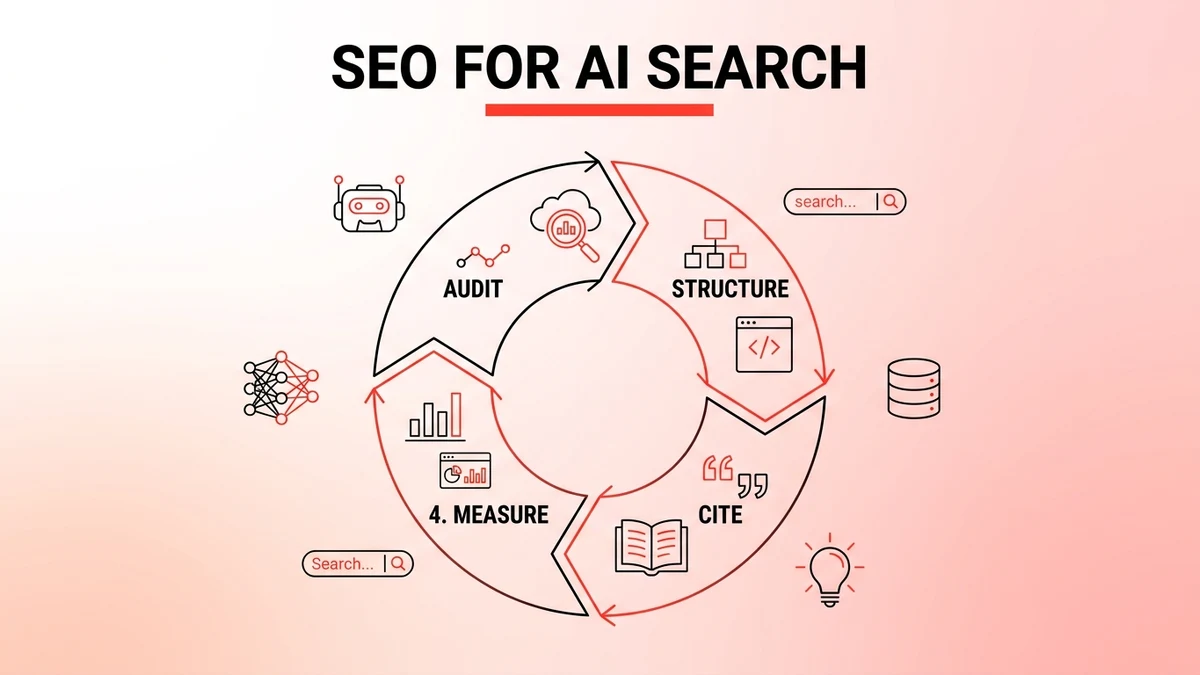
Sites with structured data and FAQ blocks see a 44% increase in AI search citations (Source: BrightEdge, 2026). Pages with author schema are 3x more likely to appear in AI answers. Yet most businesses have never audited their site for AI search readiness. If you are new to the combined discipline, start with our GEO SEO guide, then come back and score your site.
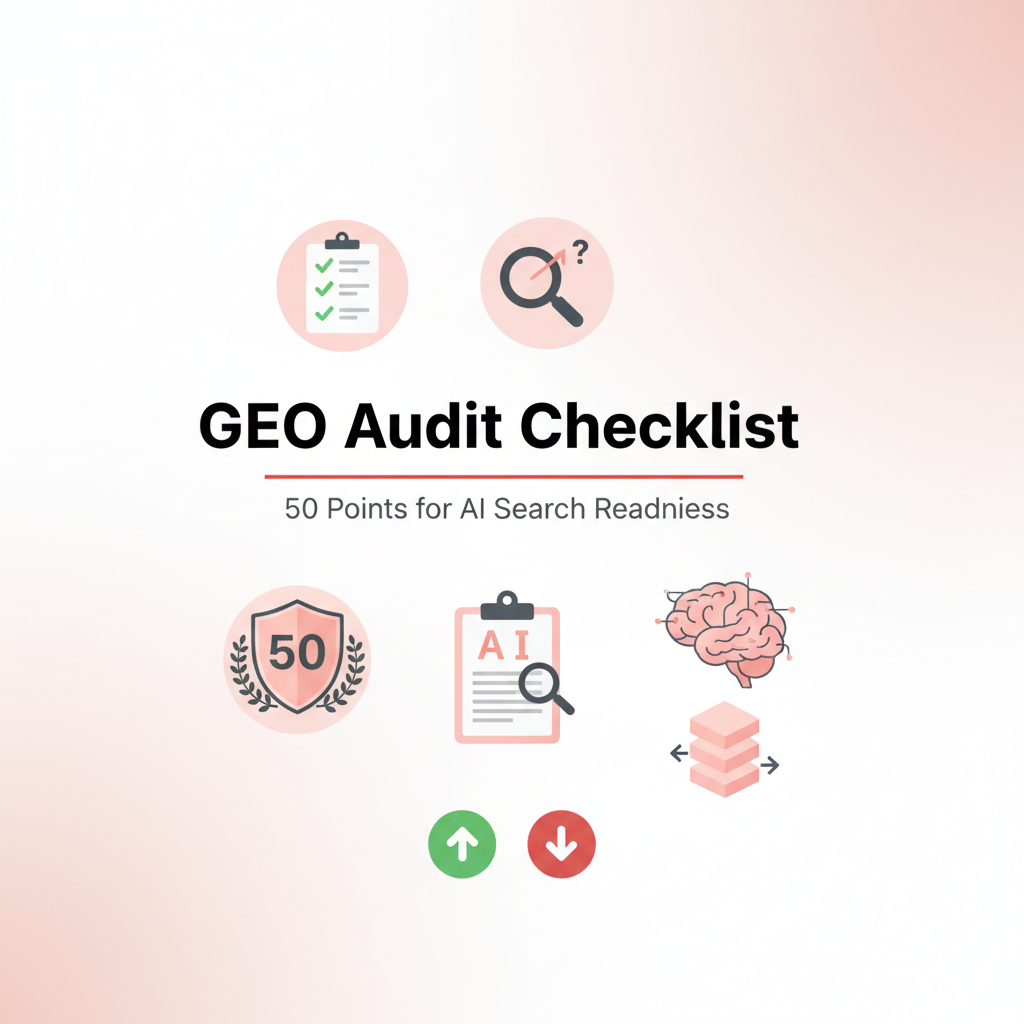
This GEO audit checklist gives you 50 concrete checkpoints across five categories, a scoring rubric to grade your site from A to F, and a clear action plan to close the gaps. Whether you run the audit yourself or use our free GEO readiness checker, you will walk away knowing exactly where your site stands.
Why Does a GEO Audit Matter in 2026?
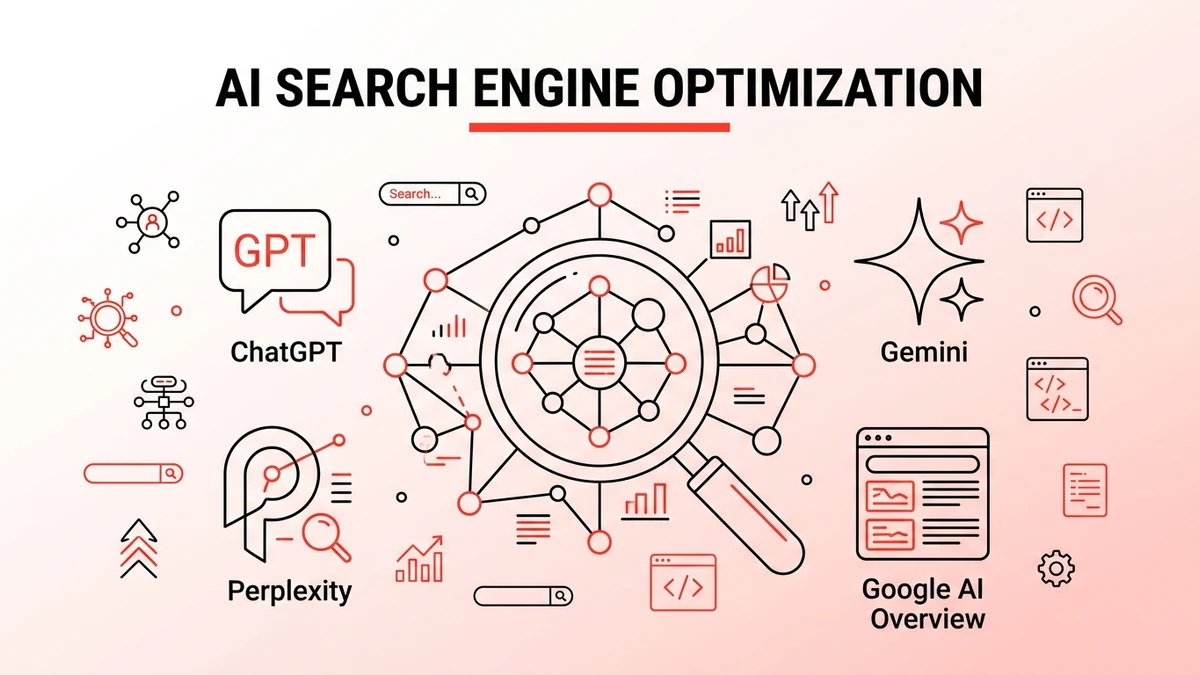
Traditional SEO audits check how Google's crawler sees your site. A GEO audit checks how AI models (ChatGPT, Perplexity, Gemini, Google AI Overviews) interpret, extract, and cite your content. These are fundamentally different processes.
Google ranks pages. AI models cite sources. The signals that earn a citation overlap with SEO, but they are not identical. Content freshness, entity clarity, structured data depth, and answer formatting all carry more weight in AI search than in traditional organic.
Pages updated within 60 days are 1.9x more likely to appear in AI answers (Source: BrightEdge, 2026). Content with citations, statistics, and quotations achieves 30-40% higher visibility in AI responses (Source: Princeton GEO Research). If you are not auditing for these signals, you are optimizing for the wrong scorecard.
How Does the 50-Point GEO Audit Scoring Work?
Each checkpoint in this GEO audit checklist is worth 1 point. Score yourself honestly: 1 if you fully pass, 0 if you don't. Half points are fine for partial implementations.
Add up your total and use this grading scale:
| Grade | Score | What It Means |
|---|---|---|
| A | 40-50 | AI-search ready. You are in the top 5% of sites. Fine-tune and maintain. |
| B | 30-39 | Strong foundation. A few gaps to close before you are fully optimized. |
| C | 20-29 | Average. You have basics covered but are missing key AI-specific signals. |
| D | 10-19 | Below average. Significant work needed across multiple categories. |
| F | 0-9 | Not AI-search ready. Start with the Technical Foundation category first. |
Most sites we audit score between 15 and 25 on their first pass. An honest C grade is a better starting point than a false A.
Category 1: Technical Foundation (10 Points)
Your technical foundation determines whether AI crawlers can even access and understand your site. If these checkpoints fail, nothing else matters.
1. Robots.txt allows AI crawlers
GPTBot, ClaudeBot, PerplexityBot, and Google-Extended should not be blocked in your robots.txt. Currently, 5.89% of all websites block GPTBot (Source: Ahrefs, 2026), and those sites cannot appear in ChatGPT responses at all. Check your robots.txt right now. If you are unsure which crawlers to allow, our robots.txt generator for AI crawlers builds the correct configuration in seconds.
2. XML sitemap is current and submitted
Your sitemap must include all indexable pages, be free of 404s, and reflect recent content additions. AI crawlers rely on sitemaps to discover new and updated content quickly.
3. Core Web Vitals pass
LCP under 2.5 seconds, INP under 200ms, CLS under 0.1. Slow pages get deprioritized by both traditional search and AI retrieval systems. Run your scores through Google PageSpeed Insights.
4. Mobile-first rendering works
AI crawlers render pages as mobile-first. Content hidden behind JavaScript interactions, accordion collapses, or "read more" buttons on mobile may not get indexed by AI systems.
5. HTTPS is enforced site-wide
Every page, image, and resource must load over HTTPS. Mixed content warnings signal trust issues to both search engines and AI retrieval systems.
6. Structured data is implemented
At minimum, you need Organization, Article (for blog content), and BreadcrumbList schema. Sites implementing structured data see that 44% citation increase mentioned earlier. Go deeper with FAQ, HowTo, Product, or LocalBusiness schema where relevant.
7. Canonical URLs are set correctly
Every page should have a self-referencing canonical tag. Duplicate content confuses AI models about which version to cite, splitting your citation equity across multiple URLs.
8. Hreflang tags for multilingual content
If you serve content in multiple languages, hreflang tells AI models which version to cite for which language. Missing hreflang means AI models may cite the wrong language version to users.
9. Page speed under 3 seconds globally
Beyond Core Web Vitals, your total page load time matters. AI crawlers have timeout thresholds. Pages that take longer than 3 seconds to respond risk being skipped entirely.
10. JavaScript content is server-rendered
Client-side-only JavaScript content is invisible to most AI crawlers. Use SSR or SSG for all content you want AI models to discover. Check by viewing your page source (not the rendered DOM) and confirming your key content appears there.
curl -A "GPTBot" https://yoursite.com to see exactly what OpenAI's crawler receives. If your content does not appear in the raw HTML response, AI models cannot cite it.
Category 2: What Does Your Content Quality Score Look Like?
Content quality in a GEO audit is not about word count or keyword density. It is about whether your content is structured for AI extraction and citation.
11. Clear definitions in opening paragraphs
AI models pull definitions from the first 2-3 sentences of a section. If your page targets "what is X," the definition must appear immediately, not after three paragraphs of context.
12. FAQ sections on key pages
65% of pages cited in Google AI Mode use schema markup, and 71% of ChatGPT-cited pages use schema (Source: SE Ranking, 2026). FAQ sections give AI models pre-formatted question-answer pairs to extract directly.
13. Comparison tables for key topics
Nearly 80% of pages cited within ChatGPT include lists to structure key information (Source: SE Ranking, 2026). Tables and lists are the most extractable content formats for AI citation.
14. Original data or research cited
Content with citations, statistics, and quotations achieves 30-40% higher AI visibility. Original research, survey results, or proprietary data gives AI models a reason to cite you over competitors who only summarize others' work.
15. Expert attribution on content
Author bylines with credentials matter. Websites with author schema are 3x more likely to appear in AI answers. Every article should have a named author with a linked bio page.
16. Content updated within 90 days
Pages updated within 2 months earn 5.0 citations on average vs. 3.9 for older pages (Source: SE Ranking, 2026). Set a content refresh calendar and prioritize your highest-traffic pages.
17. Word count matches intent depth
Thin pages (under 500 words) rarely get cited. But AI models do not need 5,000-word essays either. Match your word count to search intent: 800-1,500 for definitions, 1,500-3,000 for guides, 2,000-4,000 for deep analyses.
18. Readability score below grade 9
AI models favor content that is clear and accessible. Run your pages through a readability checker. Hemingway Editor or Flesch-Kincaid scoring should place your content at grade 8 or below for maximum extractability.
19. Internal linking structure is logical
Every key page should link to 3-6 related pages. AI models use internal link patterns to understand topical relationships and content authority within your site.
20. Topical depth across content clusters
Covering a topic from one angle is not enough. AI models assess topical authority by looking at how many related subtopics you cover. A single blog post on "GEO" is weaker than a cluster covering GEO strategy, GEO vs SEO, GEO pricing, and GEO case studies.
Category 3: How Strong Is Your Entity Optimization?
Entity optimization is what separates sites that get cited once from sites that get cited consistently. AI models build entity graphs, and your brand needs a clear node in that graph.
21. Consistent NAP across the web
Name, Address, Phone number must be identical across your website, Google Business Profile, directories, and social profiles. Inconsistency fragments your entity in AI knowledge graphs.
22. Google Business Profile is complete and active
For any business with a physical location, a fully completed Google Business Profile with regular posts, reviews, and photos strengthens your entity signal in Google AI Overviews specifically.
23. Knowledge panel presence
Does your brand trigger a Google Knowledge Panel? If yes, your entity is already recognized. If not, focus on Wikipedia/Wikidata presence, consistent structured data, and press coverage to build entity recognition.
24. Brand mentions across authoritative sources
86% of AI citations come from brand-controlled content such as websites and listings (Source: Yext, 2026). But third-party mentions on news sites, industry publications, and directories validate your entity to AI models.
25. Wikipedia or Wikidata entry
A Wikidata entry (even without a full Wikipedia article) gives AI models a structured entity reference. This is one of the strongest entity signals for citation eligibility.
26. Social profiles are linked and active
LinkedIn, X/Twitter, Facebook, and industry-specific profiles should all link back to your website and be actively maintained. AI models cross-reference social presence when validating entities.
27. Author pages with structured data
Every content author on your site should have a dedicated bio page with Person schema, credentials, expertise areas, and links to their published work. This connects your content to a known, trusted entity.
28. About page with Organization schema
Your About page should include Organization schema with founding date, founders, description, logo, and social links. This is often the first page AI models check when building your entity profile.
29. Schema Person/Organization implemented
Beyond the About page, Organization schema should appear site-wide (in your homepage or layout). Person schema should appear on author bio pages and in Article structured data.
30. Entity disambiguation is clear
If your brand name could refer to multiple things, make the disambiguation obvious. Include your industry, location, and description consistently so AI models assign citations to the right entity.
Category 4: Is Your Content Citation-Ready?
Passing the first three categories means AI models can find you and understand who you are. Citation readiness determines whether they actually quote or reference you in their responses.
31. Answer capsules in opening sentences
Start key sections with a direct, factual answer in 1-2 sentences. AI models extract these "answer capsules" verbatim. "GEO stands for Generative Engine Optimization, the practice of optimizing content for citation by AI search engines." That sentence is citable. A paragraph of background context is not.
32. Direct questions used as H2 headings
Phrase your H2s as questions that match how people prompt AI. "What is GEO?" and "How does GEO differ from SEO?" are directly extractable as question-answer pairs. "Understanding the GEO Landscape" is not.
33. Numbered step-by-step processes
When explaining how to do something, use numbered steps. AI models cite numbered processes at higher rates than narrative explanations because they are structured and unambiguous.
34. Statistics with inline source attribution
Every statistic should include its source inline: "AI search traffic converts at 14.2% vs 2.8% for organic (Source: Semrush, 2026)." AI models are more likely to cite stats that already carry attribution.
35. Quote-ready paragraphs under 40 words
Write at least 3-4 paragraphs per article that are under 40 words and state a complete, citable fact. These are the paragraphs AI models pull directly into their responses.
36. Summary sections at the start of long content
A 2-3 sentence summary at the top of long guides gives AI models an instant extractable overview. Think of it as your "TL;DR" for AI crawlers.
37. TL;DR blocks for complex topics
For technical or complex topics, include a clearly labeled summary. This is different from the introduction. A TL;DR distills 3,000 words into 3 sentences.
38. Definition formatting with bold terms
When defining a term, bold the term itself and follow with "is" or "refers to" plus a clear definition. "Generative Engine Optimization (GEO) is the practice of..." This pattern is the single most extractable format for AI definition queries.
39. List formatting for multi-point answers
When a question has multiple valid answers, use bullet or numbered lists. AI models extract list items individually, increasing your chances of being cited for at least one point.
40. Table formatting for comparison data
Comparison tables are cited at higher rates than prose comparisons. If you are comparing two approaches, tools, or strategies, a table should always accompany the narrative explanation.
| Content Format | AI Citation Rate | Best Use Case |
|---|---|---|
| Tables | High | Comparisons, feature matrices |
| Numbered lists | High | Step-by-step processes, rankings |
| Bullet lists | Medium-High | Multi-point answers, feature lists |
| Short paragraphs (<40 words) | Medium | Definitions, direct answers |
| Long narrative paragraphs | Low | Background context (restructure) |
Category 5: What Authority Signals Does Your GEO Audit Need?
Authority signals tell AI models whether your content deserves to be cited over competitors covering the same topic. These are the hardest checkpoints to earn, but they compound over time.
41. Domain rating above industry average
A strong domain rating (measured via Ahrefs or similar tools) correlates with higher AI citation rates. Domain traffic is the number one predictor of AI Mode citations with a SHAP value of 0.63 (Source: SE Ranking, 2026).
42. Referring domains from authoritative sites
Quality backlinks from news sites, industry publications, and .edu/.gov domains signal authority to AI models just as they do to traditional search engines.
43. Brand mention volume growing
Track how often your brand is mentioned across the web using tools like Google Alerts, Mention, or Brandwatch. Growing mention volume correlates with increased AI citation frequency.
44. Review profiles on key platforms
Google reviews, G2, Trustpilot, Capterra (for SaaS), and industry-specific review platforms all feed into AI models' entity understanding. A business with 200 reviews carries more entity weight than one with 5.
45. Press coverage in recognized publications
Being mentioned or quoted in recognized news outlets, trade publications, or industry media gives AI models high-confidence entity validation. One Forbes mention outweighs dozens of directory listings.
46. Industry directory listings are complete
Crunchbase, LinkedIn Company page, industry-specific directories, and local business directories should all have complete, consistent profiles. Brands are 6.5x more likely to be cited through third-party sources than through their own domains (Source: Yext, 2026).
47. Social proof documented on site
Case studies, client logos, testimonials, and results data on your website give AI models citable proof points. When an AI is asked "which agencies deliver results," documented proof is what gets cited.
48. Published case studies with data
Case studies that include specific metrics (percentage improvements, timeline, methodology) are highly citable. Vague "we helped a client succeed" stories are not.
49. Testimonials with attribution
Named testimonials from real people at real companies carry more weight than anonymous quotes. Include the person's name, title, and company for maximum citation value.
50. Awards, certifications, or partnerships listed
Industry awards, Google Partner status, platform certifications, and technology partnerships all strengthen your entity's authority profile in AI knowledge graphs.
Authority signals are the slowest to build but create the widest moat. A site with strong technical foundations and citation-ready content but weak authority will get cited occasionally. A site with all three will get cited consistently. Start building authority signals now; they compound over 6-12 months.
The Complete 50-Point GEO Audit Checklist Table
Here is the full checklist in one table. Print it, bookmark it, or use our GEO readiness checker tool to score your site automatically.
| # | Checkpoint | Category | Pass? |
|---|---|---|---|
| 1 | Robots.txt allows AI crawlers (GPTBot, ClaudeBot, PerplexityBot) | Technical | |
| 2 | XML sitemap is current and submitted | Technical | |
| 3 | Core Web Vitals pass (LCP <2.5s, INP <200ms, CLS <0.1) | Technical | |
| 4 | Mobile-first rendering works for all content | Technical | |
| 5 | HTTPS enforced site-wide, no mixed content | Technical | |
| 6 | Structured data implemented (Organization, Article, Breadcrumb) | Technical | |
| 7 | Canonical URLs set correctly on all pages | Technical | |
| 8 | Hreflang tags for multilingual content | Technical | |
| 9 | Page speed under 3 seconds globally | Technical | |
| 10 | JavaScript content is server-rendered (SSR/SSG) | Technical | |
| 11 | Clear definitions in opening paragraphs | Content | |
| 12 | FAQ sections on key pages with schema | Content | |
| 13 | Comparison tables for key topics | Content | |
| 14 | Original data or research cited | Content | |
| 15 | Expert attribution (author bylines + credentials) | Content | |
| 16 | Content updated within 90 days | Content | |
| 17 | Word count matches search intent depth | Content | |
| 18 | Readability score below grade 9 | Content | |
| 19 | Internal linking structure (3-6 links per page) | Content | |
| 20 | Topical depth across content clusters | Content | |
| 21 | Consistent NAP across web | Entity | |
| 22 | Google Business Profile complete and active | Entity | |
| 23 | Knowledge panel presence | Entity | |
| 24 | Brand mentions on authoritative sources | Entity | |
| 25 | Wikipedia or Wikidata entry | Entity | |
| 26 | Social profiles linked and active | Entity | |
| 27 | Author pages with Person schema | Entity | |
| 28 | About page with Organization schema | Entity | |
| 29 | Schema Person/Organization site-wide | Entity | |
| 30 | Entity disambiguation is clear | Entity | |
| 31 | Answer capsules in opening sentences | Citation | |
| 32 | Direct questions as H2 headings | Citation | |
| 33 | Numbered step-by-step processes | Citation | |
| 34 | Statistics with inline source attribution | Citation | |
| 35 | Quote-ready paragraphs under 40 words | Citation | |
| 36 | Summary sections at start of long content | Citation | |
| 37 | TL;DR blocks for complex topics | Citation | |
| 38 | Definition formatting with bold terms | Citation | |
| 39 | List formatting for multi-point answers | Citation | |
| 40 | Table formatting for comparison data | Citation | |
| 41 | Domain rating above industry average | Authority | |
| 42 | Referring domains from authoritative sites | Authority | |
| 43 | Brand mention volume growing | Authority | |
| 44 | Review profiles on key platforms | Authority | |
| 45 | Press coverage in recognized publications | Authority | |
| 46 | Industry directory listings complete | Authority | |
| 47 | Social proof documented on site | Authority | |
| 48 | Published case studies with data | Authority | |
| 49 | Testimonials with attribution | Authority | |
| 50 | Awards, certifications, or partnerships | Authority |
How Should You Prioritize Your GEO Audit Fixes?
Not all 50 checkpoints carry equal weight. Here is a prioritization framework based on impact and effort.
Week 1-2: Technical Foundation (checkpoints 1-10) Fix these first. If AI crawlers cannot access your site, nothing else matters. Most technical fixes take hours, not weeks. Start with robots.txt (checkpoint 1) and structured data (checkpoint 6), the two highest-impact technical changes.
Week 3-4: Citation Readiness (checkpoints 31-40) Restructure your top 10 pages for AI extraction. Add answer capsules, convert headings to questions, and format comparison data as tables. These changes are editorial, not technical, and can be done by any content writer.
Month 2: Content Quality (checkpoints 11-20) Build out FAQ sections, add expert attribution, and refresh stale content. Create a content calendar that ensures your top pages are updated at least quarterly.
Month 2-3: Entity Optimization (checkpoints 21-30) Audit your NAP consistency, build out author pages, and improve your About page structured data. Apply for a Wikidata entry if you do not have one.
Ongoing: Authority Signals (checkpoints 41-50) Authority builds over time. Set up a monthly cadence for pursuing press coverage, collecting reviews, publishing case studies, and maintaining directory listings. Our GEO optimization service includes authority building as part of every engagement.
| Priority | Category | Timeframe | Effort | Impact |
|---|---|---|---|---|
| 1 | Technical Foundation | Week 1-2 | Low | Critical |
| 2 | Citation Readiness | Week 3-4 | Medium | High |
| 3 | Content Quality | Month 2 | Medium | High |
| 4 | Entity Optimization | Month 2-3 | Medium | Medium-High |
| 5 | Authority Signals | Ongoing | High | Compounds over time |
What Tools Do You Need to Run a GEO Audit?
You do not need expensive enterprise software to run a GEO audit. Here are the tools that cover each category.
Technical Foundation: Google Search Console (free), Google PageSpeed Insights (free), Screaming Frog (freemium), our robots.txt generator (free). For structured data validation, use Google's Rich Results Test.
Content Quality: Hemingway Editor (free) for readability, Clearscope or Surfer SEO (paid) for topical depth analysis, and your CMS analytics for content freshness tracking.
Entity Optimization: Google your brand name and check for a Knowledge Panel. Use Moz Local or BrightLocal to audit NAP consistency. Check Wikidata for your entity entry.
Citation Readiness: Our AI citation optimizer tool scores your content against the 10 most important citation readiness factors. It is free and gives you a per-page score.
Authority Signals: Ahrefs or Semrush for domain rating and backlink analysis. Google Alerts for brand mention tracking. Your own CRM for case study and testimonial pipeline.
Frequently Asked Questions
What is a GEO audit checklist?
A GEO audit checklist is a structured evaluation of how well your website is optimized for AI search engines like ChatGPT, Perplexity, Gemini, and Google AI Overviews. It covers technical access, content quality, entity optimization, citation readiness, and authority signals. Unlike a traditional SEO audit, a GEO audit specifically measures whether AI models can extract, interpret, and cite your content.
How long does a GEO audit take to complete?
A thorough 50-point GEO audit takes 4-8 hours for an experienced SEO professional. The technical foundation checks (points 1-10) can be completed in under an hour using automated tools. Content and entity audits require manual review of your top 20-30 pages. Our AI visibility audit covers all 50 checkpoints and delivers results within 5 business days.
What is a good GEO audit score?
A score of 40-50 out of 50 (Grade A) means your site is AI-search ready. Most sites score between 15 and 25 on their first audit. A score of 30 or above (Grade B) puts you ahead of the majority of competitors. Any score below 20 means significant gaps exist in your AI search readiness.
How does a GEO audit differ from a traditional SEO audit?
A traditional SEO audit focuses on how Googlebot crawls, indexes, and ranks your pages in blue-link search results. A GEO audit evaluates how AI models access your content (AI crawler permissions), understand your entity (knowledge graph signals), and extract citable information (answer formatting, structured data). The two audits overlap on technical basics but diverge on content structure and entity signals.
How often should you run a GEO audit?
Run a full GEO audit quarterly and a lightweight check (technical foundation + citation readiness) monthly. AI search is evolving rapidly. Pages not updated quarterly are 3x more likely to lose citations (Source: BrightEdge, 2026). Your content SEO strategy should include a recurring GEO audit schedule.
Which GEO audit category should you fix first?
Start with Technical Foundation (points 1-10). If AI crawlers cannot access your pages, no amount of content optimization will help. After that, move to Citation Readiness (points 31-40) because these are editorial changes you can make immediately. Entity and Authority signals take longer to build but compound over time.
Can you automate a GEO audit?
You can automate roughly 60% of the checkpoints. Technical foundation (robots.txt, sitemap, Core Web Vitals, structured data) and some content checks (readability, word count, FAQ presence) are fully automatable. Entity and authority audits still require manual review. Our GEO readiness checker automates the most common checks and gives you an instant score.
Does blocking AI crawlers hurt your GEO audit score?
Yes. Blocking GPTBot, ClaudeBot, or PerplexityBot in your robots.txt immediately zeros out your score for those platforms. You cannot be cited by an AI model whose crawler you have blocked. Currently 5.89% of websites block GPTBot (Source: Ahrefs, 2026), removing themselves entirely from ChatGPT responses.
Sources: BrightEdge, Princeton GEO Research, SE Ranking, Ahrefs, Yext, Superlines AI Search Statistics
This post is part of our GEO Optimization guide. Related reading: Answer Engine Optimization, GEO Pricing Guide 2026, 7 best SEO agencies in Oxford.

Abdelmoghit drives the content engine at AY Rank. He researches keywords, plans content clusters, and produces citation-optimized articles that rank in both Google and AI search engines.
Full Bio →