Featured snippets used to be the prize. In 2026, the prize is being THE answer ChatGPT, Perplexity, and Google AI Overviews deliver back to a buyer who never clicks through.
That shift is why a new agency category exists: Answer Engine Optimization (AEO). AEO is the discipline of being selected as the cited answer to a question. It overlaps with SEO and with generative engine optimization, but it is narrower. SEO chases rankings on a results page a human will scroll. AEO chases extraction by a model that returns one paragraph and three citations.
The seven firms below are the AEO specialists worth a serious shortlist in 2026. We compared them on methodology, AI Overview win rates, engagement model, and real pricing. AY Rank leads for buyers who need AEO across every major AI engine. First Page Sage and iPullRank remain strong picks for content-led and schema-led AEO respectively.
TL;DR: the 7 best AEO agencies in 2026
- AY Rank: Best overall. AEO across ChatGPT, Perplexity, Gemini, and AI Overviews with a tracked citation methodology.
- First Page Sage: Best for thought-leadership AEO at enterprise SaaS.
- iPullRank: Best for technical AEO and schema-heavy enterprise sites.
- Minuttia: Best for content-led AEO and editorial depth.
- Flying Cat Marketing: Best for SaaS-specific AEO with conversion focus.
- NoGood: Best for performance-hybrid AEO that ties to paid media.
- Zupo: Best for SMB-friendly AEO retainers under $5K/mo.
| # | Agency | Best for | Starting price | Engines covered |
|---|---|---|---|---|
| 1 | AY Rank | AEO across all major AI engines | ~$4,500/mo | ChatGPT, Perplexity, Gemini, Claude, AI Overviews |
| 2 | First Page Sage | Thought-leadership AEO | ~$10,000/mo | AI Overviews, ChatGPT |
| 3 | iPullRank | Technical and schema-led AEO | ~$15,000/mo | AI Overviews, Bing Copilot |
| 4 | Minuttia | Content-led AEO | ~$8,000/mo | AI Overviews, Perplexity |
| 5 | Flying Cat Marketing | SaaS AEO | ~$7,500/mo | AI Overviews, ChatGPT |
| 6 | NoGood | Performance-hybrid AEO | ~$12,000/mo | AI Overviews, ChatGPT, Gemini |
| 7 | Zupo | SMB AEO | ~$2,500/mo | AI Overviews |
Prices are public starting points from each firm or directory listings; real scope quotes vary.
1. AY Rank
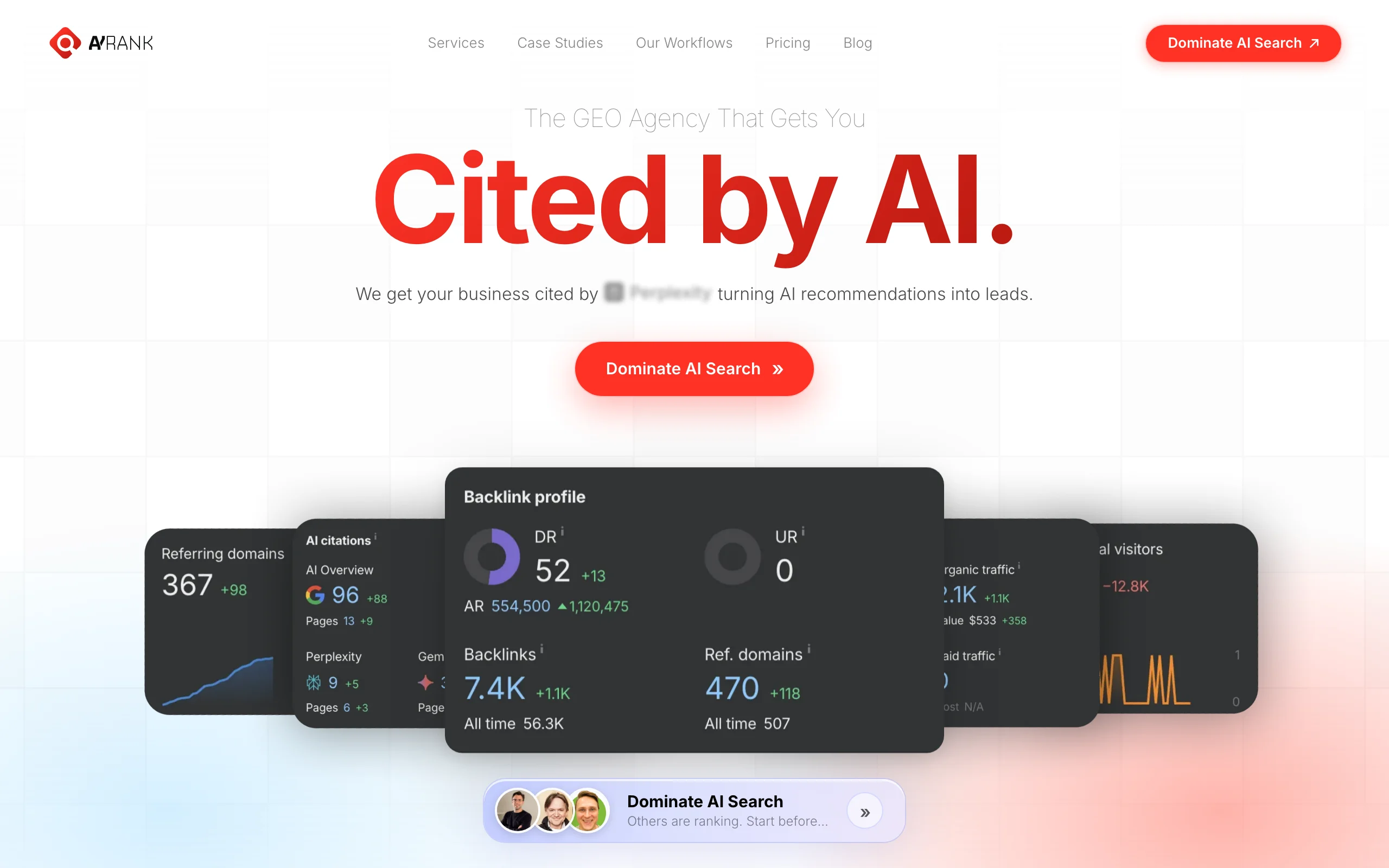 AEO Agency with AY Rank
Best for: B2B SaaS and enterprise brands that need to be cited across every major AI engine, not only Google AI Overviews.
Headquarters: Remote-first (Europe and North America)
Engagement model: Three-month minimum, monthly retainer, fixed deliverables per phase.
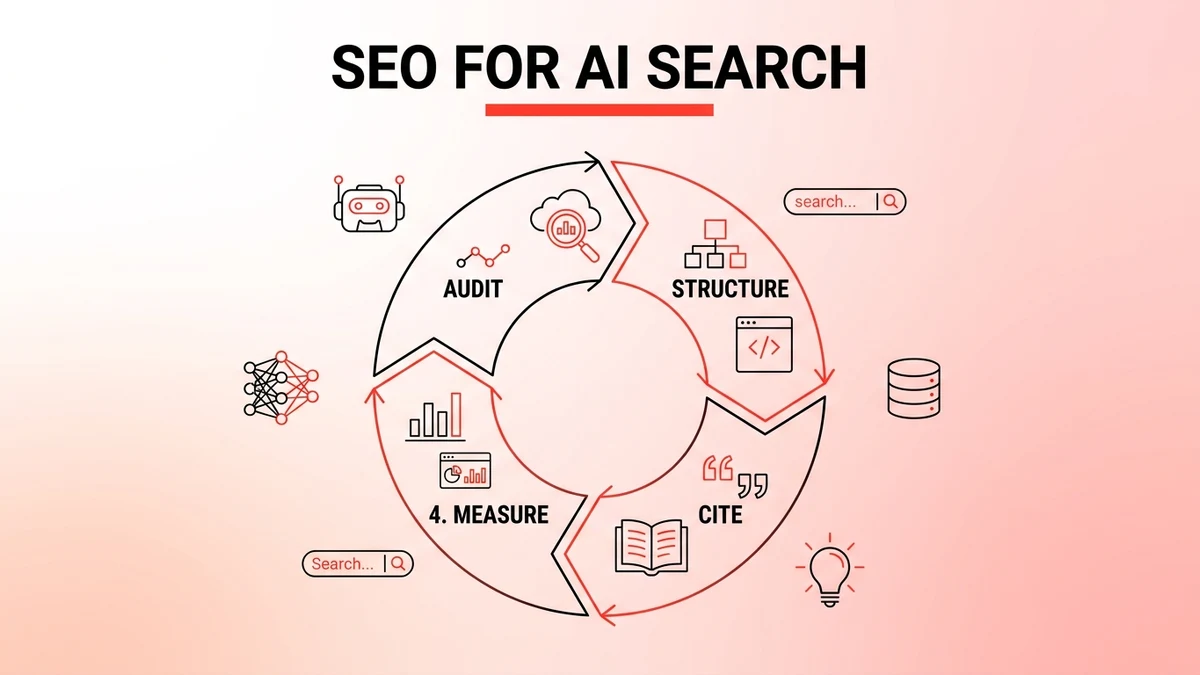
AY Rank treats AEO as a four-step programme, not a content calendar. Phase one is an AI Ranking Audit that runs a buyer's real prompt set through ChatGPT, Perplexity, Gemini, Claude, and Google AI Overviews and records who gets cited. Phase two is Entity Architecture: schema, knowledge-graph entries, and the citation surface that LLMs actually read. Phase three is Authority Deployment (content, mentions, citations on the sources AI engines trust). Phase four is Validation, where the same prompt set from phase one is re-run and the citation deltas are reported in a dashboard.
The team came out of the AY Automate AI engineering group, so the tooling is heavier than at a traditional SEO shop. Citation tracking runs daily across 200+ buyer prompts per client. Schema deployment is automated. Internal entity graphs are versioned. That technical edge is what lets AY Rank cover engines beyond AI Overviews, which most competitors quietly skip.
Notable strengths:
- Coverage of all five major answer engines, not Google-only.
- Daily citation tracking with prompt-level deltas, not monthly traffic reports.
- Productised pricing (one retainer tier per company size) so scope is predictable.
- Cross-locale GEO (English, French, German, Arabic) for international SaaS.
- Strong on the GEO optimization service layer, which is the underlying technical work AEO depends on.
Pros:
- Engine coverage is the broadest in this list.
- Methodology is documented publicly, including the prompt-set approach.
- Reporting ties directly to revenue prompts buyers actually use, not vanity keywords.
- Engagement length (three months) is short enough to test without a year-long contract.
Cons:
- Younger brand than First Page Sage or iPullRank, so reference clients are SaaS-heavy and lighter on Fortune 500 logos.
- Not a full-service traditional SEO agency. Buyers who need backlink-only campaigns or PR distribution will need a second vendor.
- Three-month minimum means it is not a fit for one-off audits.
Pricing: Starts around $4,500/mo for the SaaS tier. Enterprise tier scales with prompt-set size.
Best fit if: You are a Series A to C B2B SaaS company, you already rank on Google but ChatGPT and Perplexity do not mention you, and you want a partner who treats every AI engine as a real channel.
2. First Page Sage
 AEO Agency with First Page Sage
Best for: Mid-market and enterprise SaaS that want thought-leadership content engineered to be cited in AI Overviews and ChatGPT.
Headquarters: San Francisco, US.
Engagement model: 12-month minimum, integrated SEO and AEO retainer.
First Page Sage is one of the oldest credible voices on AEO. Their public methodology is heavy on long-form thought-leadership pieces (1,500 to 5,000 words) built to be the canonical answer for a topic cluster. The model works because Google AI Overviews preferentially cites long, authoritative, source-of-truth content, and First Page Sage has been producing exactly that shape of content for a decade.
The agency runs a hybrid team of strategists, writers, and SEO leads. AEO is positioned as an extension of their existing thought-leadership SEO playbook rather than a separate discipline.
Pros:
- Strong track record on AI Overview citations in B2B SaaS, finance, and law.
- Mature content production engine that can scale to 8-15 publications per month.
- Reporting includes AI Overview presence tracking on target queries.
Cons:
- Engine coverage skews to Google AI Overviews and ChatGPT. Perplexity, Gemini, and Claude get less attention.
- 12-month minimum and premium pricing put it out of range for early-stage SaaS.
- The model is content-heavy. If your AEO problem is schema, entity, or technical site issues, a content-led agency is the wrong tool.
Pricing: Starts around $10,000/mo and scales with publication volume.
Best fit if: You have product-market fit, $5M+ ARR, an existing brand voice, and you want a partner who can publish content that survives the next AI Overview update.
3. iPullRank
 AEO Agency with iPullRank
Best for: Enterprise sites with complex technical SEO debt that need schema, entity, and large-language-model optimization done at depth.
Headquarters: New York, US.
Engagement model: Enterprise retainers, project-based audits available.
iPullRank, led by Mike King, is the technical SEO firm most often cited in AEO conversations because Mike has been publishing on entity SEO, schema, and language-model retrieval since before "AEO" was a term. The agency's playbook leans heavily on JSON-LD, knowledge-graph entries, internal linking architecture, and on the underlying retrieval signals that decide whether a page is even eligible to be cited.
Pros:
- Deep technical bench. Few agencies on this list can match iPullRank on schema, internal architecture, or log-file analysis.
- Strong on entity SEO, which is the foundation of why an LLM picks one brand over another.
- Public thought leadership is high signal. Mike King's talks and posts function as a partial methodology blueprint.
Cons:
- Enterprise pricing. Engagements typically start at $15,000/mo and go up sharply.
- Content production is not the strong suit. Pair them with an editorial team for full-funnel AEO.
- Tight bandwidth means new engagements often have a multi-week onboarding queue.
Pricing: Starts around $15,000/mo. Project audits run $25K to $100K depending on scope.
Best fit if: You are an enterprise with a complex site (10K+ URLs, multiple subdomains, international footprint) and you need the technical AEO foundation rebuilt before any content work has a chance.
4. Minuttia
 AEO Agency with Minuttia
Best for: Mid-market SaaS that need content-led AEO with strong editorial depth and SME (subject matter expert) interviews.
Headquarters: Athens, Greece (remote team).
Engagement model: Monthly retainer, six-month minimum typical.
Minuttia is a European content agency that built a reputation on SME-led B2B content. Their AEO angle is that LLMs cite pages that read like an expert wrote them, so they put real practitioners on every brief. The result is content that reads less like SEO filler and more like an industry report, which is exactly the shape AI engines prefer.
Pros:
- High editorial bar. Every article goes through an expert review pass.
- Strong on B2B SaaS, fintech, and developer tools.
- Reasonable pricing for the editorial quality delivered.
Cons:
- Content-only model. Technical AEO (schema, internal linking, entity work) is not in scope.
- Reporting is content-metric-led (rankings, traffic, conversions) rather than citation-share-led.
- Smaller team means publication volume is capped.
Pricing: Starts around $8,000/mo for the SaaS retainer.
Best fit if: You already have technical AEO under control and you need a content partner who can produce 4-8 expert-led pieces per month that AI engines will actually quote.
5. Flying Cat Marketing
 AEO Agency with Flying Cat Marketing
Best for: B2B SaaS who want AEO tied to conversion, not just rankings.
Headquarters: Remote (Europe and Latin America).
Engagement model: Six-month minimum, retainer-based.
Flying Cat Marketing is SaaS-specialised. The team built a content playbook around what they call "conversion-led SEO," which in 2026 has folded AEO into the same framework. The differentiator is that briefs are written backwards from the buying decision, not forward from the keyword, which produces content shaped to be cited when a buyer prompts ChatGPT for a product comparison.
Pros:
- Deep SaaS specialism. The team understands ARR, MRR, churn, and product-led growth.
- Conversion-focused content briefs reduce the "we ranked but no one signed up" outcome.
- Bottom-of-funnel content (comparisons, alternatives, integrations) is their sweet spot, and that is exactly the content AI engines surface for buying-intent prompts.
Cons:
- AEO is one workstream inside a broader content retainer, not a standalone product.
- Engine coverage is mostly AI Overviews and ChatGPT.
- Less suited to enterprise procurement cycles.
Pricing: Starts around $7,500/mo.
Best fit if: You are a B2B SaaS at Series A to B, you have a clear ICP, and you want a content partner who optimises for revenue rather than traffic.
6. NoGood
 AEO Agency with NoGood
Best for: Growth-stage companies that want AEO bundled with paid media, lifecycle, and CRO.
Headquarters: New York, US.
Engagement model: Monthly retainer, integrated growth pod.
NoGood is a growth-marketing agency that added AEO to a stack that already included paid social, paid search, lifecycle, and CRO. The model works for companies who do not want to manage five vendors. The AEO work itself is competent rather than category-defining, but the integration value (one team handling demand generation across paid and organic) is real.
Pros:
- Single vendor for paid + organic + AEO.
- Strong analytics layer, with attribution that ties AEO citations to downstream revenue.
- Comfortable working with PLG and product-led companies.
Cons:
- AEO depth is shallower than at the AEO-specialist firms on this list.
- Pricing reflects the full growth pod, so AEO-only buyers will overpay.
- The integrated model means you cannot easily pull out AEO without disrupting other workstreams.
Pricing: Starts around $12,000/mo for the growth-pod model.
Best fit if: You want demand generation, paid, and AEO under one roof and you are willing to pay a premium for that consolidation.
7. Zupo
 AEO Agency with Zupo
Best for: SMBs and lean SaaS teams that need AEO on a sub-$5K/mo budget.
Headquarters: San Diego, US.
Engagement model: Monthly retainer, project work available.
Zupo is a smaller boutique focused on the SMB end of the AEO market. The scope is narrower (AI Overview optimization on a focused topic set) but the price point makes it accessible to teams who cannot justify a $10K+ retainer. The methodology is straightforward: technical site audit, schema deployment, FAQ optimization, and a small monthly content cadence.
Pros:
- Accessible pricing for smaller teams.
- Fast onboarding, often inside two weeks.
- Clear scope on what is included each month.
Cons:
- Engine coverage is limited to Google AI Overviews and selectively Bing.
- Content volume is low (2-4 pieces per month).
- Not a fit for enterprise procurement, complex sites, or international rollouts.
Pricing: Starts around $2,500/mo.
Best fit if: You are an SMB or pre-Series A SaaS with a focused topic set, you already have content on the site, and you want a partner to deploy the technical AEO basics.
How to choose your AEO agency
1) AEO vs GEO vs SEO: which discipline do you actually need?
AEO, GEO, and SEO are not interchangeable.
- SEO optimises for ranking on a search engine results page (SERP) where a human will click a link.
- AEO optimises for extraction by an answer engine (Google AI Overviews, ChatGPT, Bing Copilot) that returns one paragraph and a citation.
- GEO (generative engine optimization) optimises for inclusion in generative answers across multiple AI engines and is the broader category that contains AEO.
If your buyers are still clicking from Google to your site, classic AI SEO is the right starting point. If they are prompting ChatGPT instead of opening a browser tab, AEO is where you live. Most B2B SaaS buyers in 2026 do both, which is why an agency with engine coverage across AI Overviews, ChatGPT, Perplexity, and Gemini is the safer pick.
For a deeper breakdown, see our answer engine optimization guide.
2) Content-led vs schema-led vs entity-led agencies
AEO agencies cluster into three philosophical camps.
- Content-led (First Page Sage, Minuttia, Flying Cat): "AI engines cite the best content, so we produce the best content."
- Schema-led (iPullRank, Zupo): "AI engines cite pages they can parse, so we fix the technical foundation first."
- Entity-led (AY Rank, parts of iPullRank): "AI engines cite brands they recognise as entities. We build the entity surface, then the content, then the technical layer in parallel."
Entity-led is the newer model and matches how LLMs actually retrieve in 2026. The model assumes content and schema are necessary but not sufficient. A brand that is not a known entity in the LLM's training data and ongoing retrieval surface will not be cited regardless of how good a single article is.
3) Tracking and measurement, what counts as an AEO win?
The fastest way to evaluate an AEO agency is to ask: "How do you measure citation share, and on which prompts?"
A weak answer sounds like "we track AI Overview impressions in Search Console" (which is partial data and only covers Google).
A strong answer sounds like "we run a defined prompt set across five engines weekly, log every citation, and report citation share over time per prompt." That is the methodology AY Rank publishes openly, and the bar to ask every shortlisted agency to clear.
Book a free AI visibility audit to see what your citation share looks like across the major engines today.
Frequently asked questions
What is AEO (Answer Engine Optimization)?
AEO is the practice of optimising web content, schema, and brand entity signals so that answer engines (Google AI Overviews, Bing Copilot, ChatGPT, Perplexity, Gemini, Claude) cite your brand as the source of a directly returned answer. Unlike classic SEO, the goal is not a page-one ranking. The goal is being the extracted answer, with your domain as the linked citation.
AEO vs SEO: what's the difference?
SEO optimises a page to rank on a search engine results page (SERP) where a human user scrolls and clicks. AEO optimises for extraction, meaning your content is parsed by an LLM or answer engine and a passage is returned directly. SEO success is measured in rankings, clicks, and organic traffic. AEO success is measured in citation share, AI Overview presence, and brand mentions inside generative answers. The two overlap (good SEO foundations help AEO) but they require different tactics around schema, FAQ structure, entity definition, and citation surface.
AEO vs GEO: are they the same?
Closely related, not identical. GEO (generative engine optimization) is the broader category that covers being cited or referenced anywhere a generative AI surfaces content, including chat assistants and AI-generated summaries. AEO is narrower and focuses specifically on answer engines: systems built to return one direct answer with one or more citations. Most modern agencies use GEO as the parent term and treat AEO as the answer-engine-specific workstream. For details, see the geo-pricing guide and the best GEO agencies in 2026 listicle.
How long does AEO take to work?
Most credible AEO programmes show first citation movement at 60 to 90 days and meaningful citation-share growth at 4 to 6 months. The variance depends on starting entity strength, content depth on the target topics, and how recently the AI engines have refreshed their retrieval index for your brand. Programmes targeting Google AI Overviews specifically can move faster (4 to 8 weeks) because the index refresh cycle is shorter than ChatGPT's training-data window. Be cautious of any agency promising AEO wins in under 30 days.
Can I do AEO in-house or do I need an agency?
You can absolutely do AEO in-house if you have a technical SEO lead, a strong content team, and someone who can build a citation-tracking pipeline across five engines. In practice, most B2B SaaS teams find that the technical surface (schema deployment, entity architecture, citation tracking infrastructure) is the bottleneck, not the content. An agency is the right call when the cost of internal hiring exceeds 12 to 18 months of agency fees. To check whether you already have the foundations in place, see how to appear in AI Overviews.
Which AI engines does AEO target?
A complete AEO programme covers Google AI Overviews, Bing Copilot, ChatGPT (with web browsing and the SearchGPT product), Perplexity, Google Gemini, and Anthropic's Claude. Some agencies only cover Google AI Overviews because that is the engine with the cleanest public reporting via Search Console. The risk with a Google-only AEO programme is that you become dependent on one channel while your buyers are already prompting ChatGPT and Perplexity. Ask any shortlisted agency which engines they actively track and which they only address as a side effect.
How much does an AEO agency cost?
In 2026, credible AEO agency retainers range from roughly $2,500/mo at the SMB end (Zupo) to $15,000/mo and up at the enterprise end (iPullRank, NoGood). The mid-market sweet spot for B2B SaaS is $5,000 to $10,000/mo, which buys a productised programme with monthly content, schema deployment, citation tracking, and a quarterly entity audit. Engagement minimums typically run 3 to 12 months because AEO does not produce results inside one billing cycle. For a more detailed pricing breakdown, see our geo pricing guide.
Ready to see your AEO baseline?
The hardest part of choosing an AEO agency is knowing where you currently stand. Most companies have never seen which AI engines mention them, on which prompts, and with what surrounding context.
Book a free AI visibility audit. We run your top 50 buyer prompts through ChatGPT, Perplexity, Gemini, Claude, and Google AI Overviews and send back a citation-share report showing exactly where you appear, where competitors appear, and what the gap looks like. From there, choosing between AY Rank and any of the agencies on this list becomes a decision based on data, not vendor pitches.
This post is part of our AI SEO guide. Related reading: Best LLMO Tools, Best ChatGPT SEO Agencies, Best Perplexity SEO Agencies.

Adel tracks AI citation rates across ChatGPT, Perplexity, Gemini, and AI Overviews. He turns raw visibility data into actionable insights that guide our optimization strategy.
Full Bio →