Perplexity answers questions with a short list of cited sources, and buyers trust those citations the way they used to trust page one of Google. If your brand is not one of the links Perplexity shows, you are absent at the exact moment someone is comparing options. Tracking that visibility is now its own discipline, separate from classic rank tracking, and a small set of tools does it well.
This guide compares the six best Perplexity SEO tracking tools in 2026, with pricing, coverage of the other AI engines, and a decision framework to pick the right one for your team.
TL;DR: for most marketing teams, Otterly.AI is the best Perplexity SEO tracking tool, with a $29 entry tier and clean daily monitoring; LLMrefs is the pick when you need Perplexity plus every other major AI platform in one dashboard, and the free AY Rank AI Visibility Checker tells you in minutes whether Perplexity can crawl and cite your site at all, the right first check before paying for tracking.
Best Perplexity SEO tracking tools: a brief overview
- Otterly.AI: Best overall for marketing teams: monitors your brand across Perplexity, ChatGPT, and Google AI Overviews with daily runs, sentiment, and drop alerts.
- LLMrefs: Best multi-platform depth: Perplexity tracking inside a six-plus platform dashboard with competitor share of voice and white-label reporting.
- Peec AI: Best AI search metrics for in-house teams: visibility, position, and sentiment scores per prompt, trended over time.
- Profound: Best enterprise platform: answer engine insights, prompt volume data, and agent analytics for large brands.
- AIclicks: Best for traffic attribution: connects Perplexity citations to GA4 sessions so you can show what the visibility is worth.
- AY Rank AI Visibility Checker: Best free first step: an instant audit of whether AI crawlers, including PerplexityBot, can access and understand your site, with a GEO readiness score.
How we evaluated these Perplexity SEO tracking tools
We built and ordered this list against six criteria, checked against each tool's own site, its live pricing page, and its public feature documentation:
- Perplexity coverage specifically, not AI search in general: does the tool run against Perplexity as a first-class platform, or bolt it on as one of many engines with thin depth
- Query and prompt scheduling: automated, repeatable runs rather than a one-off manual check, since Perplexity's answers vary between runs on the same prompt
- Citation-level detail: whether the tool shows the exact cited sentence and source URL, not only a yes/no mention
- Pricing transparency: a published starting price or a working free trial, checked against the live pricing page rather than taken from an old sales deck
- Breadth beyond Perplexity: how many other AI platforms (ChatGPT, Gemini, Claude, Copilot, Google AI Overviews) the same subscription covers, since most buyers end up tracking more than one engine
- Verifiable public evidence: a real pricing page or documented feature set we could check directly, not marketing copy alone
Tools that fail the first two criteria, no genuine Perplexity-specific tracking, or only manual checks, do not make this list regardless of brand size.
| Tool name | Key strength | Pricing | Platforms |
|---|---|---|---|
| Otterly.AI | Marketer-friendly daily monitoring with sentiment and alerts | From ~$29/month; free trial | Perplexity, ChatGPT, Google AI Overviews |
| LLMrefs | Deepest multi-platform coverage and competitor benchmarking | From ~$79/month | Perplexity, ChatGPT, Claude, Gemini, Copilot, Grok, more |
| Peec AI | Visibility, position, and sentiment metrics per prompt | From €85/month; free trial | Perplexity, ChatGPT, Gemini, AI Overviews, Copilot |
| Profound | Enterprise answer-engine insights and prompt volume data | Custom; demo-led | Perplexity, ChatGPT, Gemini, Claude |
| AIclicks | Ties AI citations to GA4 traffic and conversions | From ~$59/month | Perplexity, ChatGPT, Gemini, more |
| AY Rank AI Visibility Checker | Free AI-readiness audit: crawler access, llms.txt, schema | Free | Readiness checks for PerplexityBot, GPTBot, ClaudeBot, Google-Extended |
How Perplexity tracking works
Perplexity SEO tracking tools all run the same loop: you define the buyer prompts that matter, the tool runs them against Perplexity on a schedule, parses each answer for brand mentions and source links, and turns the results into a citation rate you can trend and benchmark against competitors.
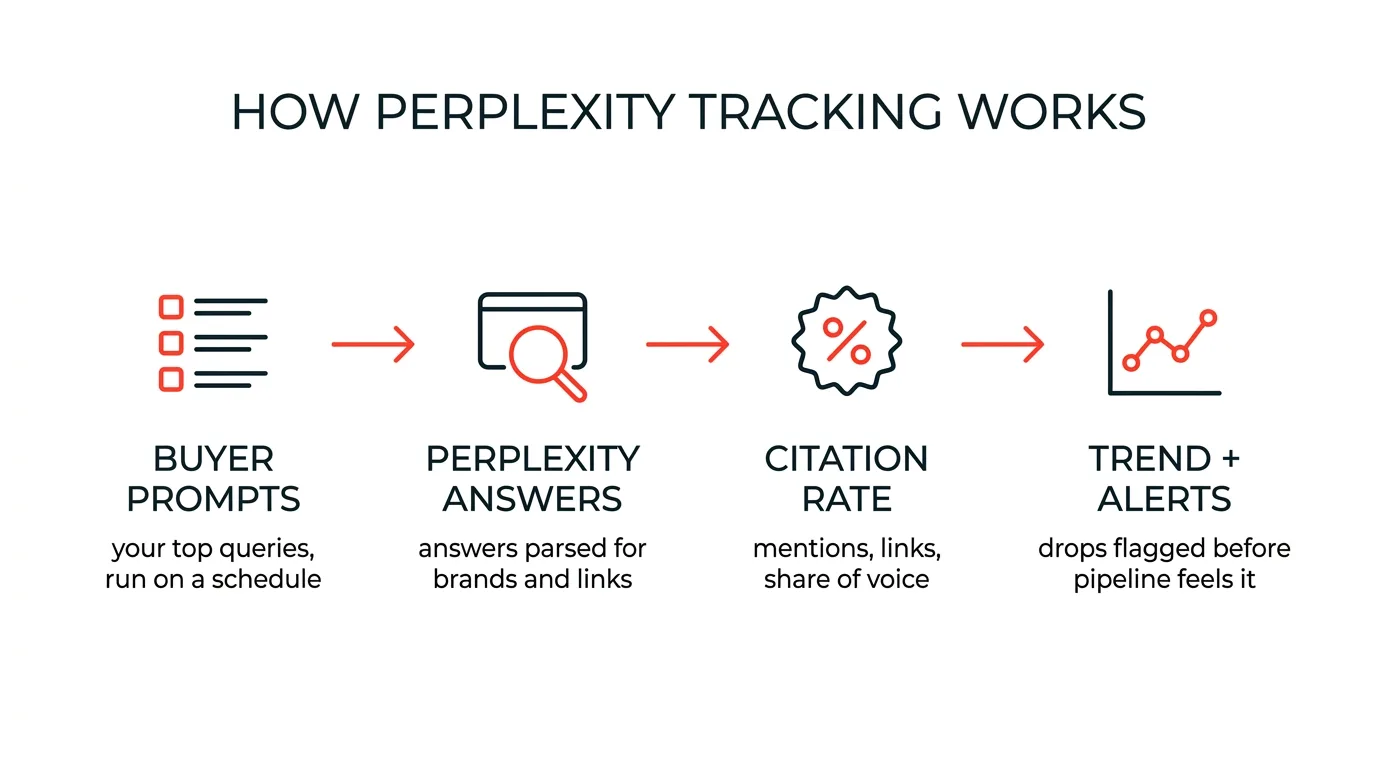 How Perplexity tracking works: buyer prompts run on a schedule, answers parsed for brands and links, citation rate measured, trends and drops flagged
Two things make this different from classic rank tracking. First, answers are probabilistic: the same prompt can produce different citations on different runs, so good tools query repeatedly and average the results. Second, Perplexity shows clickable source links in every answer, which means citations there drive measurable referral traffic, not just brand exposure. That link behaviour is why Perplexity is usually the first platform teams start tracking.
1. Otterly.AI, best overall Perplexity SEO tracking tool for marketing teams
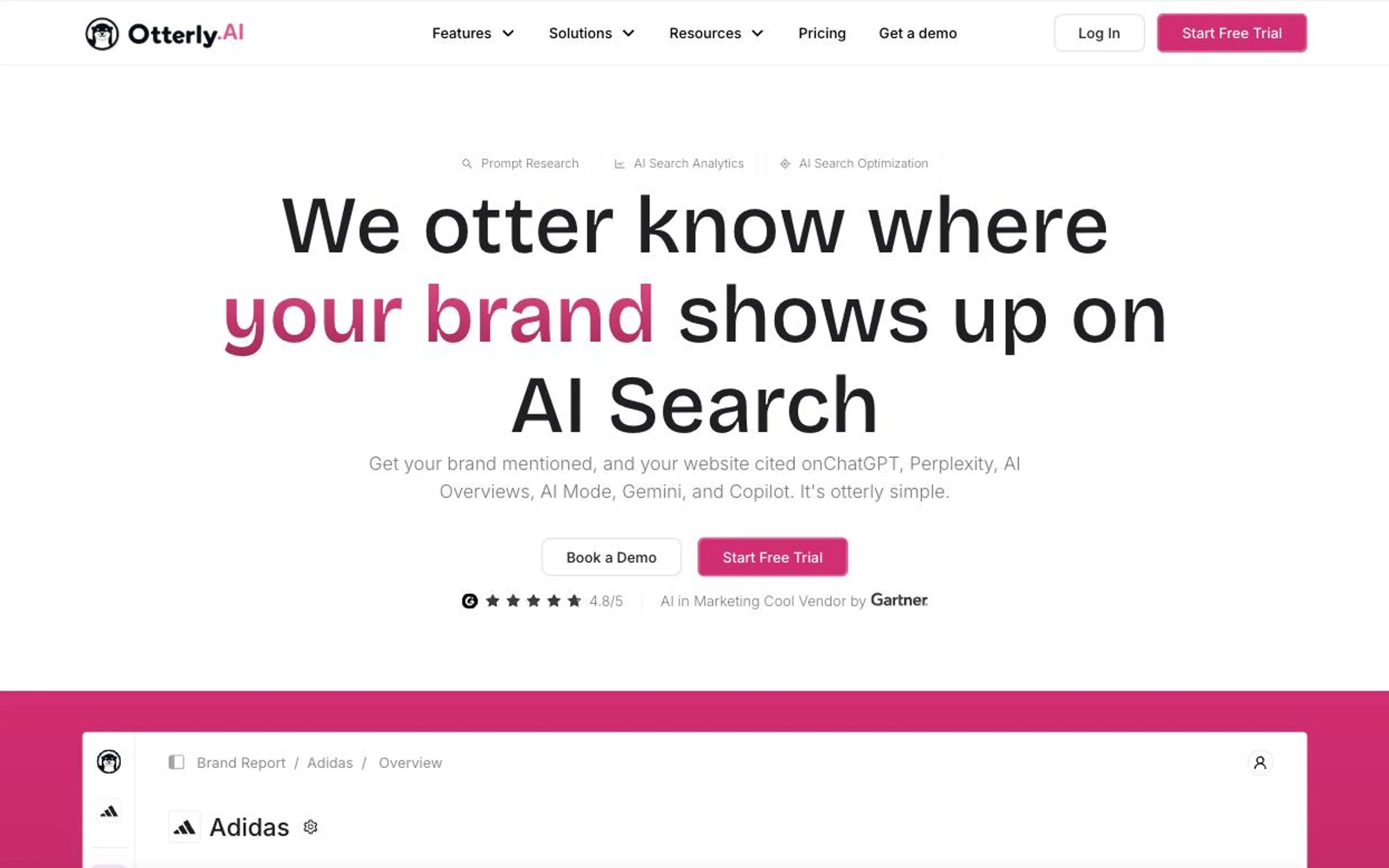
Otterly.AI is an AI search monitoring tool that tracks how your brand appears across Perplexity, ChatGPT, and Google AI Overviews. Onboarding takes minutes: you enter your brand, competitors, and a list of topics or prompts, and Otterly begins monitoring with daily or weekly runs and email digest reports.
 Perplexity SEO Tracking with Otterly.AI
Key features
- Brand and competitor monitoring across Perplexity, ChatGPT, and Google AI Overviews
- Automated daily or weekly query runs with email digests
- Sentiment classification per citation (positive, neutral, negative)
- Alerts when your citation rate drops
- CSV export for reporting
Best for
- Marketing teams that want Perplexity monitoring running this week, without a technical setup
- Brand and comms teams that care about how Perplexity frames the brand, not just whether it appears
Pricing
- Free trial rather than a permanent free tier
- Paid plans from approximately $29 per month
Pros
- The easiest tool in this list to get value from on day one
- Sentiment and drop alerts catch negative framing and displacement early
Cons
- Narrower platform coverage than LLMrefs; no Claude or Gemini tracking
- Query customisation is less granular than power users may want
2. LLMrefs, best Perplexity tracking inside a multi-platform dashboard
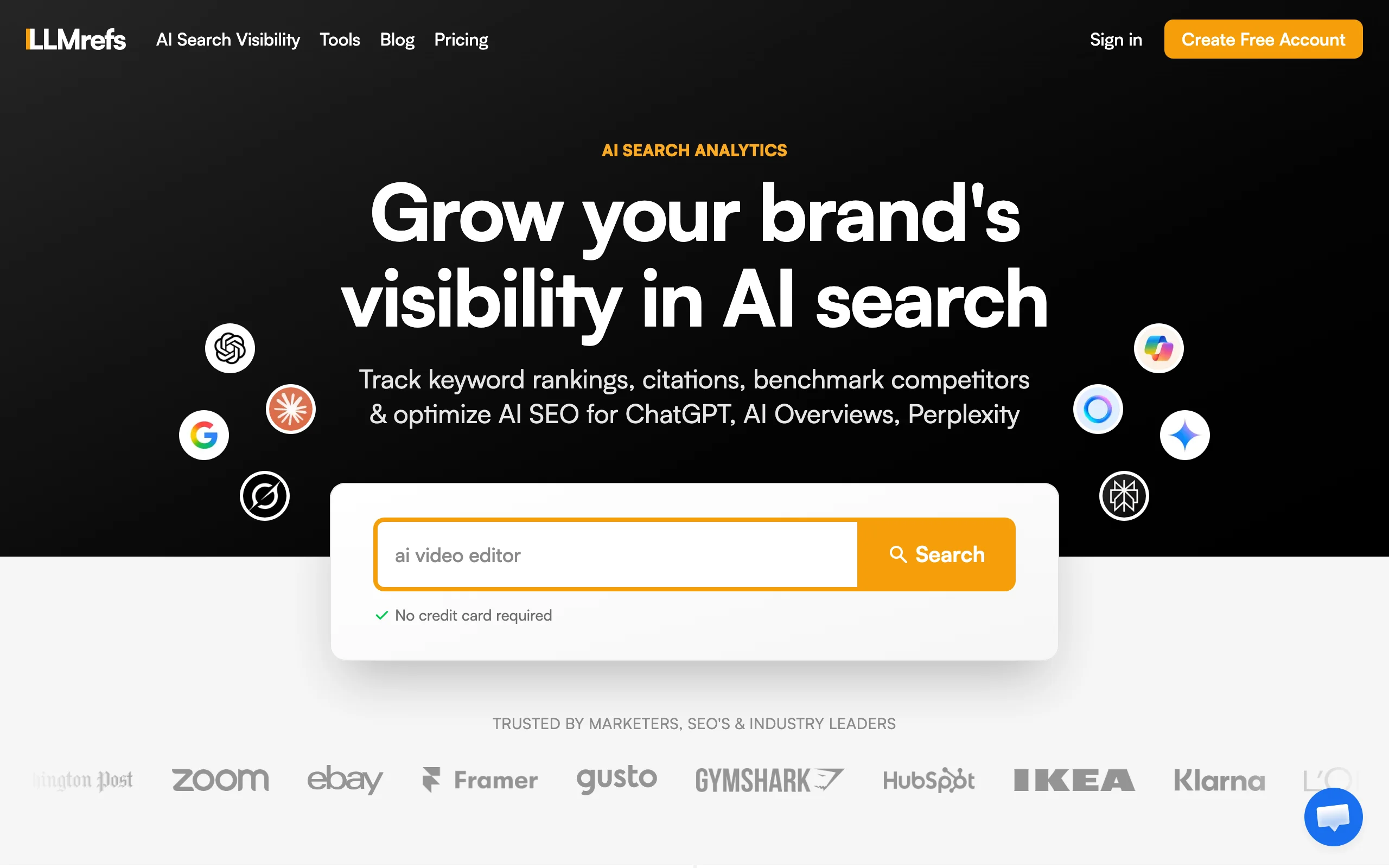
LLMrefs is a generative AI search analytics platform that tracks brand citations across six-plus platforms, including Perplexity, ChatGPT, Claude, Gemini, and Copilot, from one dashboard. It is the breadth pick: if Perplexity is one of several AI surfaces you need to cover, LLMrefs saves you from running three separate trackers.
 Perplexity SEO Tracking with LLMrefs
Key features
- Multi-platform tracking (six-plus AI engines) in a single dashboard
- Automated query scheduling on your keyword list
- Competitor share-of-voice benchmarking, side by side
- Citation context extraction showing the exact sentence that mentioned you
- Source URL tracking to identify which pages earn your Perplexity citations
- White-label reporting for agencies
Best for
- Agencies reporting AI visibility across clients and platforms
- Brands that need to know where competitors displace them, per platform
Pricing
- Tiered subscription from approximately $79 per month (limited-time pricing at the time of writing)
- Custom enterprise pricing at the top end
Pros
- The most thorough coverage available if Perplexity is only part of your AI search picture
- Per-URL citation tracking makes domain-level reporting straightforward
Cons
- Priced for agencies and funded teams rather than solo practitioners
- Query volume on lower tiers can be restrictive for large prompt sets
3. Peec AI, best AI search metrics for in-house marketing teams
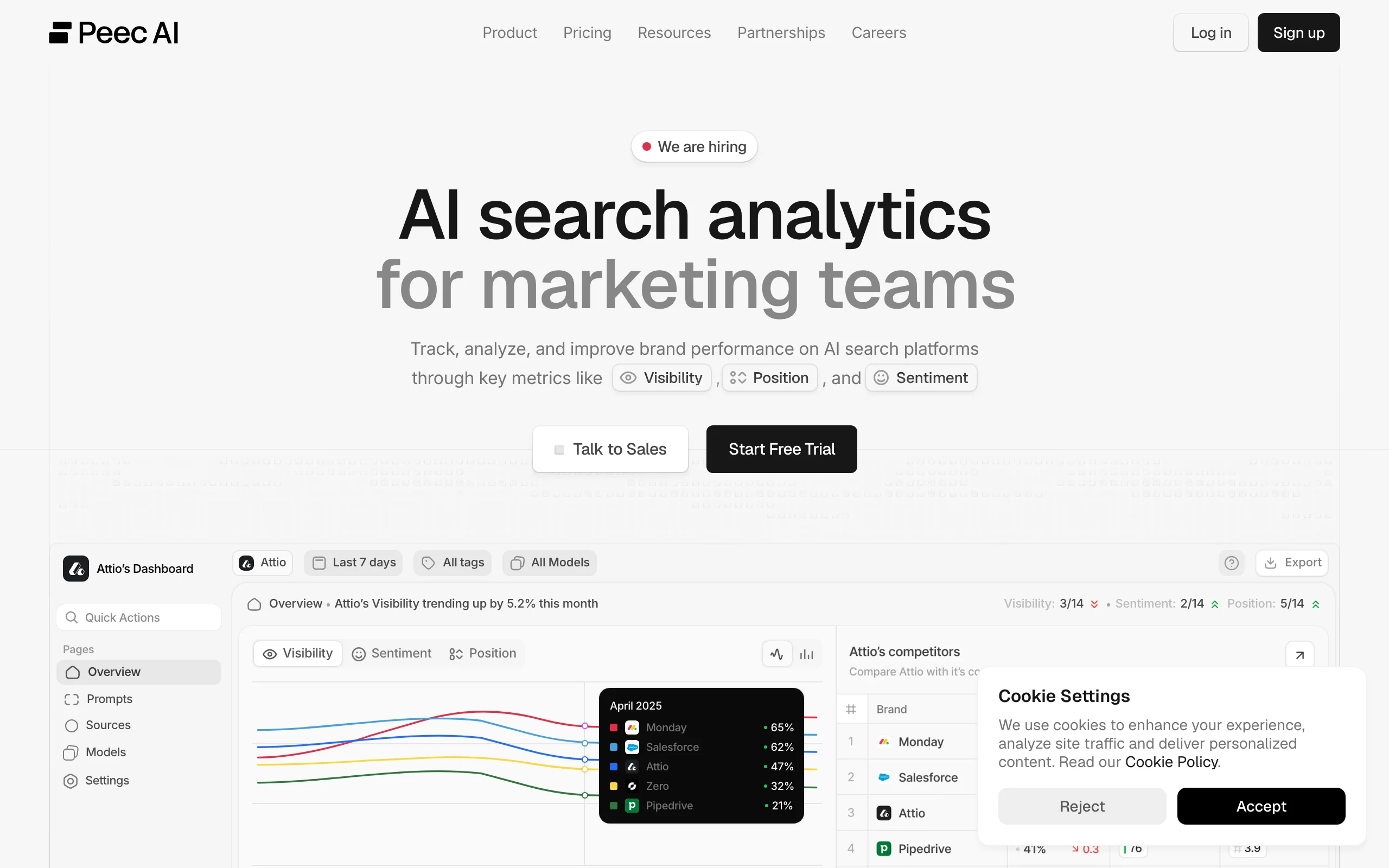
Peec AI is an AI search analytics platform built for marketing teams and SEO agencies, tracking brand performance on Perplexity, ChatGPT, Gemini, Google AI Overviews, and Copilot through three core metrics: visibility (share of chats where your brand appears), position (where you rank inside the answer), and sentiment (how the AI frames you). Prompts can be tagged, organised, and tracked across countries.
 Perplexity SEO Tracking with Peec AI
Key features
- Visibility, position, and sentiment scores per prompt, trended over time
- Competitor visibility comparison on the same prompt set
- Prompt tagging and per-country tracking
- Source analysis showing where AI answers pull from
- Export for reporting
Best for
- In-house teams that want a small set of clear metrics rather than raw answer logs
- Brands running structured monthly reporting on AI visibility against named competitors
Pricing
- Plans from €85 per month, scaling to €205 and €425 tiers
- Free trial available
Pros
- The visibility, position, and sentiment triad maps directly onto how executives ask about AI search
- Trusted by a large base of brands and agencies, with an agency partner programme
Cons
- No Grok or Meta AI coverage listed at the time of writing, unlike LLMrefs
- Euro-denominated tiers sit above Otterly's entry price for small teams
4. Profound, best enterprise Perplexity and answer-engine platform
Profound is an enterprise AI search platform that covers answer engine insights, prompt volume data, and agent analytics, with tracking across Perplexity, ChatGPT, Gemini, and Claude. It positions itself as a full-stack platform for AI search marketing rather than a point tracker: alongside citation monitoring it shows what people actually ask AI engines and how AI crawlers interpret your site.
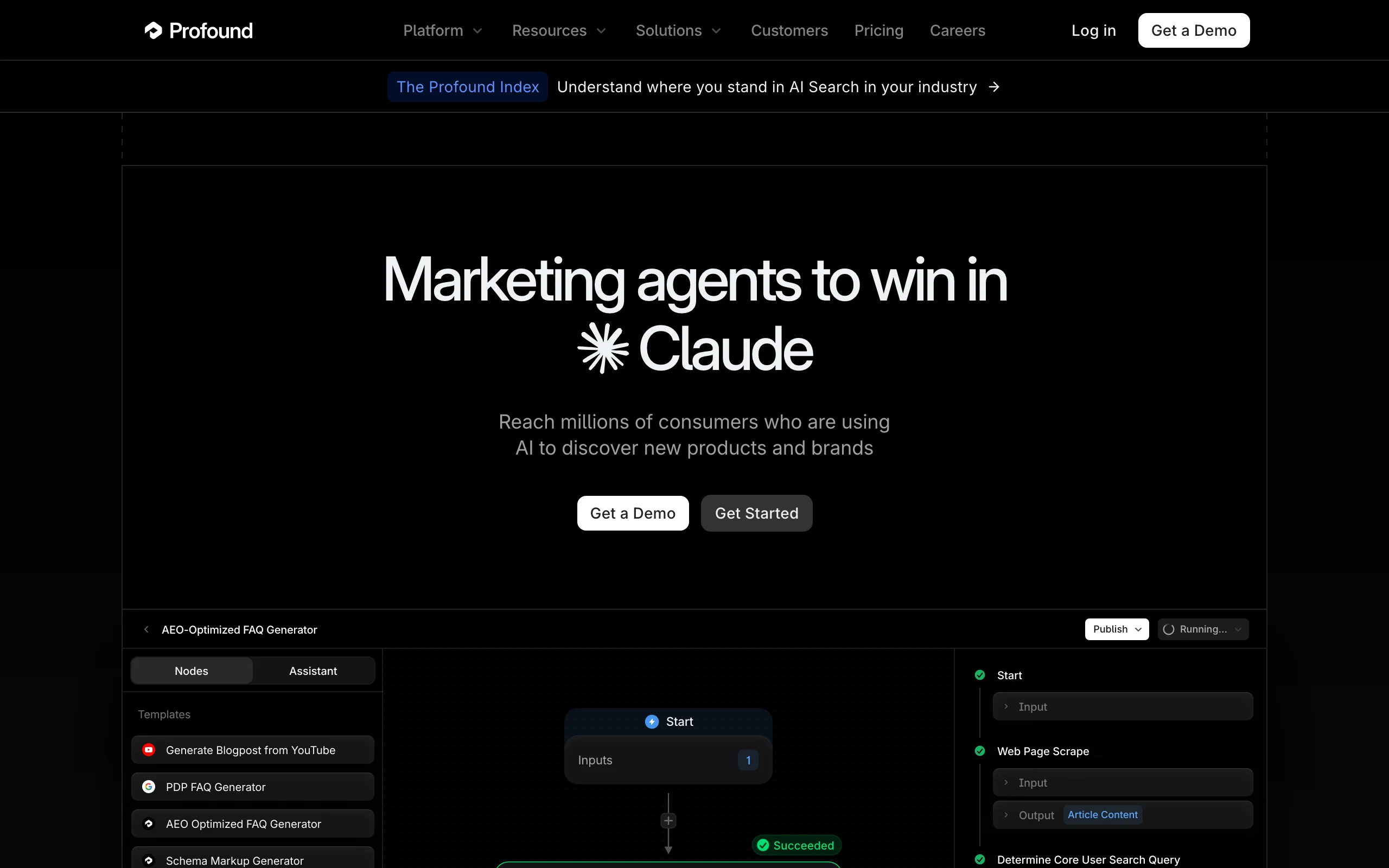 Perplexity SEO Tracking with Profound
Key features
- Answer engine insights showing how AI represents your brand per conversation
- Prompt volume data: what millions of people ask AI, matched to your category
- Agent analytics tracking how ChatGPT, Gemini, Claude, and Perplexity crawl your site
- Brand sentiment and source citation reporting
- Free AEO report as an entry point
Best for
- Enterprise brands with dedicated AI search budget and multiple stakeholders
- Teams that want demand data (prompt volumes) alongside visibility tracking
Pricing
- Custom, demo-led; no public price list
- Free AEO report available before committing
Pros
- Prompt volume data answers the question trackers cannot: which AI queries are worth winning
- Crawl-level agent analytics is rare and useful for technical AI SEO work
Cons
- No public pricing; procurement takes longer than the self-serve tools here
- More platform than most small teams need for Perplexity tracking alone
5. AIclicks, best for tying Perplexity citations to traffic
AIclicks is an AI search visibility tool that connects citation tracking to analytics. Most trackers stop at whether you were mentioned; AIclicks correlates citations with GA4 sessions to estimate the traffic and conversions your AI visibility produces. Because Perplexity shows clickable source links, its citations are the most measurable of any AI platform, which makes this pairing genuinely useful.
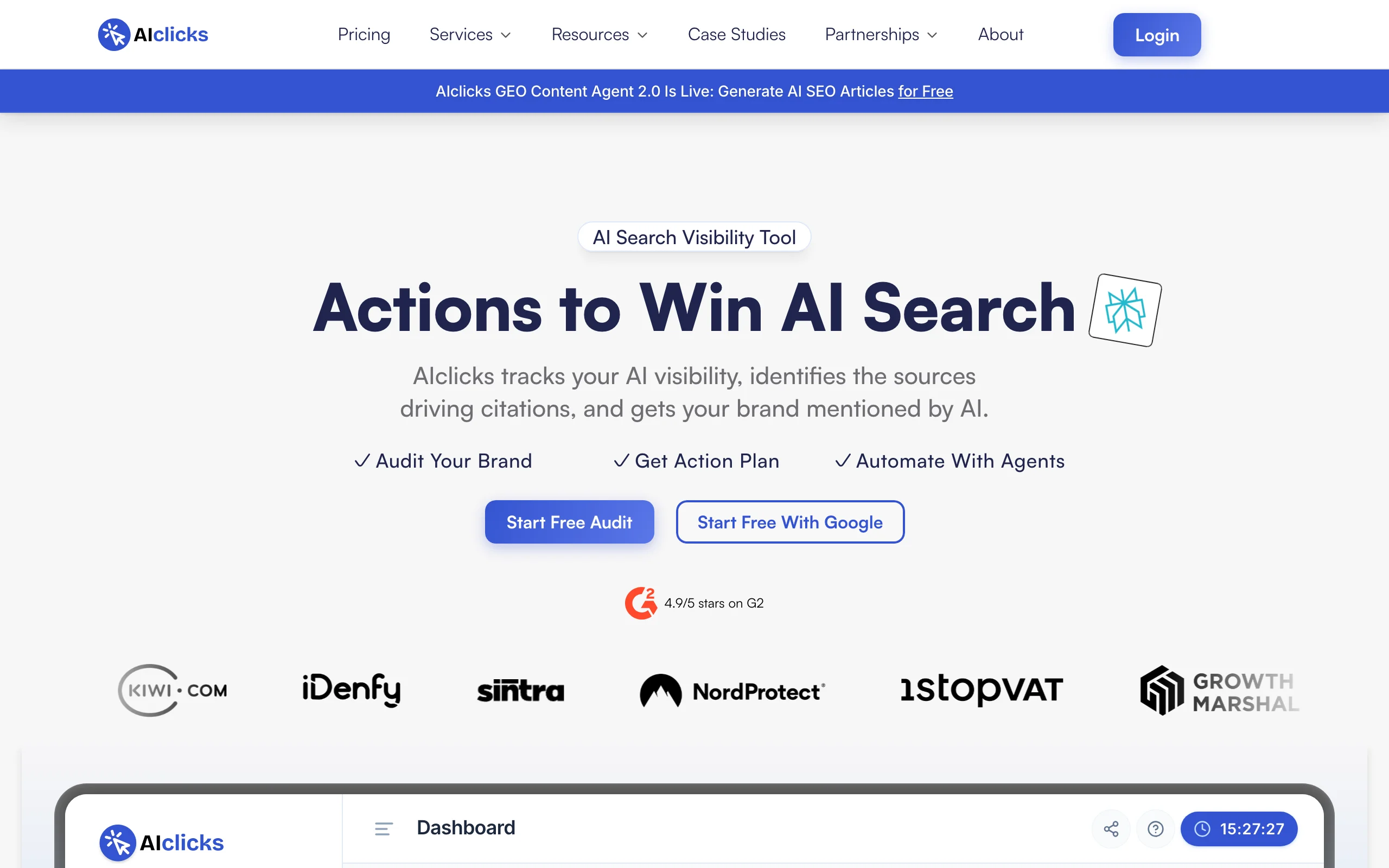 Perplexity SEO Tracking with AIclicks
Key features
- Citation tracking across Perplexity, ChatGPT, Gemini, and other major platforms
- Traffic attribution modelling for AI-sourced sessions via GA4 integration
- Conversion path analysis for AI-driven visits
- Keyword-level citation reporting with intent classification
- ROI dashboard translating citations into estimated revenue impact
Best for
- Performance marketers who need to justify AI search spend to a CFO or head of growth
- Teams already instrumented in GA4 who want AI visibility in the same frame
Pricing
- From approximately $59 per month
- Higher tiers unlock deeper analytics integrations
Pros
- The closest thing to a revenue-attributable Perplexity visibility report currently available
- Intent classification helps you prioritise commercial prompts over informational ones
Cons
- AI platforms do not consistently pass referrer data, so attribution involves estimation; understand the caveats before presenting numbers to executives
6. AY Rank AI Visibility Checker, best free Perplexity readiness check
The AY Rank AI Visibility Checker is a free audit tool that checks whether your site is set up to be cited by AI engines in the first place. It is not a tracker: instead of running queries, it audits the foundations that decide whether Perplexity can crawl and quote you, including robots.txt access for PerplexityBot, GPTBot, ClaudeBot, and Google-Extended, HTTPS, llms.txt presence, and your structured data, then returns a GEO readiness score. Every tracking tool in this list measures how often Perplexity cites you; this one tells you whether it even can.
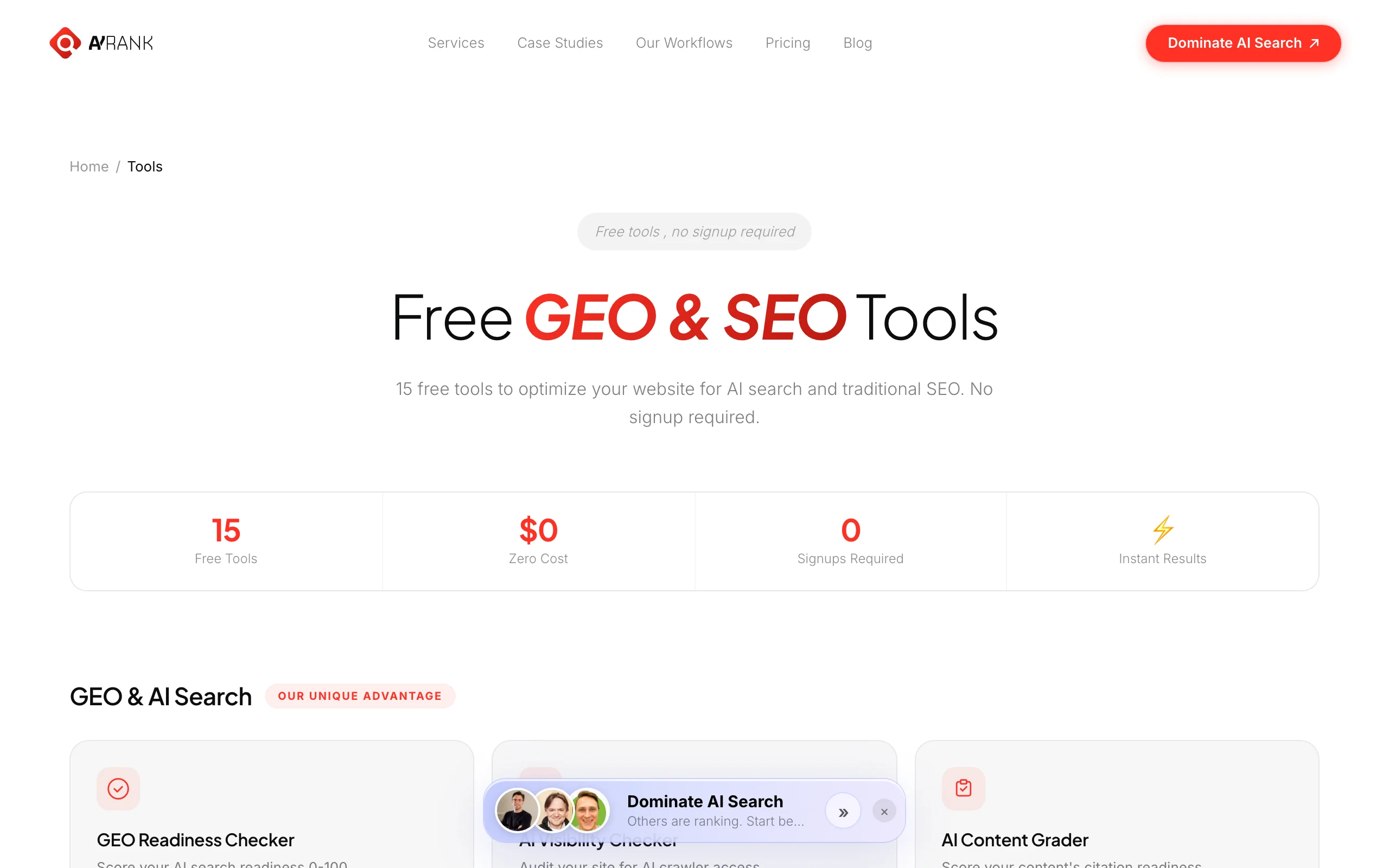 AY Rank free AI readiness tools: crawler access, schema, and llms.txt checks for Perplexity visibility
Key features
- AI crawler access checks: robots.txt directives for PerplexityBot, GPTBot, ClaudeBot, and Google-Extended
- HTTPS and llms.txt checks
- Structured data audit (Organization, Article, FAQ, breadcrumb, website schema)
- A GEO readiness score with per-check pass, warning, and fail detail
- Companion Entity Analyzer that checks how clearly AI models can recognise your brand as an entity
Best for
- Brands about to invest in Perplexity tracking who should first confirm crawlers can reach the site
- Fixing blocked-crawler and missing-schema basics before paying to measure citations
Pricing
- Free
Pros
- Catches the failure mode no tracker can fix: if PerplexityBot is blocked, your citation rate is zero no matter what you publish
- Turns the vague "why are we not cited?" question into a concrete pass/fail fix list
Cons
- It audits readiness, not results: it does not run Perplexity queries or report citation rates, so pair it with one of the trackers above
Key takeaways
- Otterly.AI is best for marketing teams that want Perplexity monitoring live this week without an engineer, at the lowest entry price in this list ($29/month).
- LLMrefs is best when Perplexity is one of several AI platforms you track, with six-plus engines and per-URL citation data in one subscription.
- Peec AI is best for in-house teams that want three clean metrics, visibility, position, and sentiment, rather than raw answer logs.
- AIclicks is best for performance marketers who need to tie Perplexity citations to GA4 traffic and defend the spend to finance.
- Run the free AY Rank AI Visibility Checker before any paid tracker: a blocked PerplexityBot makes every number the trackers above report read zero.
How to choose the best Perplexity SEO tracking tool
1) Perplexity only, or every AI platform?
If Perplexity is your first and main AI surface, Otterly.AI covers you without paying for platforms you do not track. If your buyers also research in ChatGPT, Claude, and Copilot, LLMrefs consolidates everything, and Profound adds demand data on top for enterprise budgets.
2) Do you need to prove revenue, or just visibility?
Visibility metrics satisfy a marketing team; finance wants traffic and pipeline. If the tracking data has to survive a budget review, AIclicks is the only tool here that attempts citation-to-conversion attribution. For everyone else, citation rate and share of voice trended over time is enough to run the programme.
3) What does total cost look like at your scale?
Sticker prices converge around $29 to $85 per month, but query volume is the real variable: large prompt sets push you into higher tiers everywhere. A sensible sequence is to run the free AY Rank readiness check first (a blocked crawler makes any tracking spend pointless), pilot your top 20 buyer prompts on Otterly's free trial and $29 entry tier for four weeks, and only then commit to the tier that fits your real query volume.
If you have picked your tracking tool but want a partner to actually move the citations it measures, entity architecture, authority deployment, and ongoing citation work across ChatGPT, Perplexity, Gemini, and AI Overviews, that is what AY Rank does. We help B2B brands go from invisible to consistently cited in AI answers. Book a free AI ranking audit to see where your brand currently shows up.
FAQ
What is the best Perplexity SEO tracking tool? Otterly.AI is the best Perplexity SEO tracking tool for most marketing teams in 2026: it monitors Perplexity, ChatGPT, and Google AI Overviews with daily runs, sentiment classification, and drop alerts from roughly $29 per month, with a free trial to start. Teams that need wider platform coverage should look at LLMrefs; enterprise teams at Profound.
What is the best Perplexity SEO tracking software for small teams? For small teams, Otterly.AI is the best Perplexity tracking software: its free trial gets you monitoring on day one and the $29 entry tier adds scheduled runs and alerts. Before subscribing, run the free AY Rank AI Visibility Checker once to confirm PerplexityBot can actually crawl your site. Both are built to be run by a marketer, not an engineer.
Is a Perplexity SEO tracker the same as a Perplexity SEO tracking tool? Yes. "Tracker," "tracking tool," "tracking software," and "monitoring tool" all describe the same category: software that runs your prompts against Perplexity on a schedule and reports how often you're cited. Otterly.AI, LLMrefs, Peec AI, Profound, and AIclicks are trackers in this sense regardless of which term their own marketing uses.
What's the difference between a Perplexity SEO checker and a Perplexity SEO tracker? In practice, not much. A "checker," like the free AY Rank AI Visibility Checker, runs once and tells you whether Perplexity can crawl and cite your site at all. A "tracker" runs continuously and reports your citation rate over time. Most teams need both: a checker first, to fix any crawler or schema blockers, then a tracker to measure the ongoing result.
What are the best Perplexity SEO analysis tools beyond tracking? For analysis on top of tracking, Peec AI breaks performance into visibility, position, and sentiment per prompt; LLMrefs shows the exact cited sentence and the source URL that earned it; and Profound adds prompt volume data so you can see which Perplexity queries are worth winning before you optimise for them.
Can I track Perplexity rankings like classic rank tracking? Not exactly. Perplexity produces a generated answer with cited sources rather than a fixed list of ten results, and the same prompt can cite different sources on different runs. Tracking tools handle this by running prompts repeatedly and reporting a citation rate (how often you appear) instead of a single position, alongside where in the answer you appear.
How do I monitor my website's performance in Perplexity AI? Define 20 to 50 buyer prompts that matter to your business, run them through a tracking tool on a weekly schedule, and watch three numbers: citation rate, share of voice against competitors, and which of your URLs get cited. Otterly.AI's free trial is the quickest way to see your first real numbers; a paid plan automates the schedule and the trend line. Check first that PerplexityBot is not blocked in your robots.txt, or every number will read zero.
How do I find Perplexity keyword opportunities? Look for prompts where competitors are cited and you are not: that gap list is your content roadmap. Profound's prompt volume data shows which AI queries have real demand, and LLMrefs' competitor benchmarking shows who currently owns them. Then structure content to be citable and measure whether your citation rate moves.
Can I track Perplexity citations for free? Only during a trial. Otterly.AI and most paid trackers now offer time-limited free trials rather than permanent free tiers, so trial windows are the practical way to monitor Perplexity citations without paying. The free AY Rank AI Visibility Checker is a complement rather than a tracker: it audits whether PerplexityBot can crawl your site and whether your schema and llms.txt are in place, which is the groundwork citations depend on. Ongoing monitoring with alerts needs a paid plan.
Does being cited in Perplexity actually drive traffic? Yes, more reliably than most AI platforms. Perplexity shows clickable source links in every answer, so citations there produce measurable referral sessions. That is also why attribution-focused tools like AIclicks work best on Perplexity data. Once you are tracking citations, the next step is improving them: our guide to AI citation tracking tools covers the measurement discipline in depth, and how to optimise for Perplexity covers the content side. For the strategy layer above both, see LLM SEO. For the wider stack across every AI platform, see the best AI search monitoring tools.
This post is part of our GEO Optimization guide. Related reading: GEO SEO, AY Rank vs Trailblazer Marketing, GEO for SaaS.

Adel tracks AI citation rates across ChatGPT, Perplexity, Gemini, and AI Overviews. He turns raw visibility data into actionable insights that guide our optimization strategy.
Full Bio →