As of August 2026, every new Claude model embeds an invisible watermark in all generated text, worldwide. The mark proves that text was processed by Claude, not who wrote it, it survives copy-paste, and it changes nothing about how Google ranks or AI engines cite your content: quality signals, not provenance marks, still decide that. Here is what Anthropic actually announced, the nuance most coverage is missing, and what it means for teams that use AI in their content workflow.
Published 12 August 2026. This story is developing; facts below are cited to their sources by date.
What Anthropic announced
On 10 and 11 August 2026, Anthropic confirmed that every Claude model launched on or after 2 August 2026 embeds an invisible statistical watermark in generated text, and marks generated images and files, applied globally rather than only in the EU (SiliconANGLE, 11 Aug 2026; Fortune, 11 Aug 2026; Quartz, 11 Aug 2026).
The regulatory trigger is Article 50(2) of the EU AI Act, which became enforceable for new systems on 2 August 2026 and requires AI-generated content to be machine-detectable. Anthropic also signed the EU's Code of Practice on Transparency of AI-Generated Content (the full labelling rules are broken down in our EU AI Act Article 50 guide), and chose to apply the marking worldwide rather than maintain separate EU and non-EU behaviour (Search Engine Journal; Euronews, 11 Aug 2026).
Three practical details matter for content teams:
- The marks are designed to survive copy-paste, and Anthropic says they do not change the meaning or readability of the text (Interesting Engineering). One early analysis describes them as "almost impossible to remove" (PhoneArena, Aug 2026).
- Older Claude models get watermarking too, before 2 December 2026, the end of the EU grace period for pre-existing systems (Northeast Times, 11 Aug 2026).
- The watermark is statistical and invisible: there is nothing to see in the text, and no public detector has been announced alongside it.
The nuance most coverage misses: processing is not authorship
The most important detail for anyone who writes with AI assistance is buried under the headlines: the watermark proves that text passed through Claude, not that Claude wrote it (TechTimes, 11 Aug 2026).
If you draft an article yourself and ask Claude to tighten the grammar, the output can carry the mark. If you paste your own writing into Claude for a summary and keep the summary, that summary carries the mark (Notebookcheck, Aug 2026).
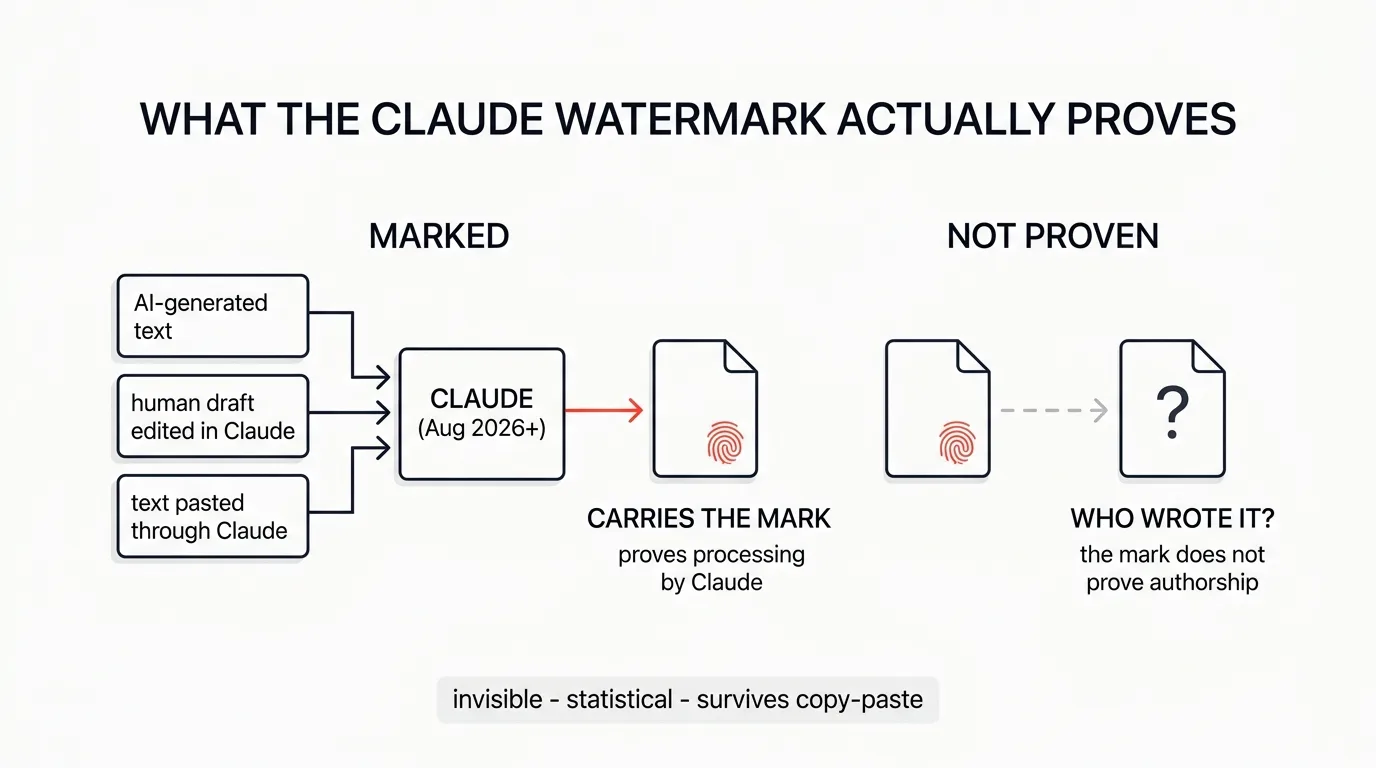 What the Claude watermark actually proves: AI-generated text, human drafts edited in Claude, and text pasted through Claude all carry the mark, which proves processing, not authorship
That cuts both ways:
- A marked document is not proof that a machine wrote it. Human-led work that touched Claude at any stage can be marked.
- An unmarked document is not proof that a human wrote it. Older outputs, other models, and text that never touched a marking system carry nothing.
Any policy, academic, editorial, or procurement process that treats the mark as an authorship test will misfire in both directions. That distinction, not the watermark itself, is the story.
Does the watermark affect Google rankings or AI citations?
Nothing in Anthropic's announcement changes how search engines rank content, and Google's own position has been consistent: it evaluates content quality, not production method. What Google's May 2026 spam-policy update did add is explicit coverage of manipulating AI Overviews and AI Mode, which is a behaviour rule, not an AI-detection rule. The full policy picture is in our guide to whether Google penalises AI content. Google's stance remains quality-based, not provenance-based.
The same logic applies to AI citations. ChatGPT, Perplexity, and Google AI Overviews select sources on authority, structure, and usefulness. There is no evidence that any engine reads provenance watermarks as a ranking or citation signal today.
So the honest answer to "will my AI-assisted content lose rankings because of the watermark?" is: not because of the watermark. Thin, generic, unedited AI output was already the risk before August 2026, and carefully edited, genuinely useful content with real expertise behind it was already the safe path. The watermark changes the detectability of processing, not the economics of quality.
Can AI detectors detect Claude now?
Mostly asked as: did Claude just become detectable? The precise answer has three parts.
- The watermark is not a public detector. Anthropic announced marking, not a tool that anyone can point at text to get a verdict. Whether and how verification is exposed, and to whom, matters enormously and is not yet public.
- Commercial AI detectors are a different technology. Tools that guess whether text is AI-written use statistical style analysis, which is probabilistic and produces false positives. Their accuracy against Claude did not change on 2 August; they still guess. How detectors work, and why they misfire, is covered in our detectors and false positives guide.
- Even perfect watermark detection would only prove processing. As above, a positive result on a human-drafted, Claude-edited article says the article touched Claude. It cannot say a machine authored it.
The detection market is moving fast around this news: Pangram raised $9M for AI-content detection this week (TechCrunch), Substack shipped an AI detector on 10 August, and ZeroGPT expanded to video on 11 August. Expect louder claims; the processing-versus-authorship limit applies to all of them.
What about watermark removers and "humanizer" tools?
Search demand for evasion is real, and a wave of tools will now claim to strip the Claude mark. Two facts before anyone spends money:
- Anthropic designed the mark to survive copy-paste and rewording pressure, and early technical coverage calls it close to irremovable (Interesting Engineering; PhoneArena). Claims of reliable removal are unverified marketing until someone demonstrates otherwise.
- Evasion solves the wrong problem. Google does not penalise content for being AI-assisted; it penalises content for being bad, and it now explicitly polices manipulation of AI answer surfaces. Paying a tool to hide legitimate work adds risk and cost to protect against a penalty that does not exist, while doing nothing for the quality signals that actually decide rankings and citations.
If your content cannot stand with its provenance visible, the fix is the content, not the fingerprint. That fix is a voice discipline, not an evasion tool: see our AI content humanization workflow for how we do it.
What content teams should do instead
The durable playbook after this announcement is the one that worked before it:
- Keep humans leading, with AI assisting. Direction, expertise, verification, and final judgement stay human; drafting and restructuring help is fine. Assume anything that touches an AI tool may be marked as processed, and be comfortable with that.
- Build E-E-A-T signals that no watermark can grant or remove. Named authors with real credentials, first-hand experience, cited data, and editorial standards. Our guide to E-E-A-T for AI search covers the implementation.
- Compete to be cited, not to hide. AI engines quote sources that are structured, factual, and current. Answer-first structure, FAQ coverage, schema, and content freshness signals move citation share; provenance marks do not. The combined discipline is GEO SEO: classic rankings and AI citations run as one programme.
- Prepare for provenance questions, not provenance penalties. Clients, editors, and regulators may ask how you use AI. A one-paragraph workflow disclosure you can send anyone beats an evasion strategy you have to hope nobody tests.
The brands that win AI search are the ones AI engines can verify and quote confidently. That was true before 2 August 2026, and the watermark makes it more true, not less. If you want to know where your brand stands in AI answers today, book a free AI ranking audit.
FAQ
Does Claude watermark all of its output now? Every Claude model launched on or after 2 August 2026 embeds an invisible statistical watermark in generated text and marks generated images and files, applied globally. Older Claude models are scheduled to get watermarking before 2 December 2026, the end of the EU AI Act grace period for pre-existing systems.
Does the Claude watermark prove content was written by AI? No. It proves the text was processed by Claude. Human-written text that passes through Claude, for editing, summarising, or reformatting, can carry the mark, and text from other models or older systems carries nothing. Treating the mark as an authorship test misfires in both directions.
Will watermarked content rank worse on Google? There is no evidence of that. Google evaluates quality, not production method, and its May 2026 spam-policy update targets manipulation of AI Overviews, not the use of AI assistance. The ranking risk lives in thin, unedited output, exactly where it lived before the watermark existed.
Can you remove the Claude watermark? Anthropic designed it to survive copy-paste, and early technical analysis describes it as close to impossible to remove. Tools will claim otherwise; those claims are unverified. More usefully: removal solves nothing, because no search engine or AI platform penalises the mark in the first place.
Is the watermark only for EU users? No. The EU AI Act's Article 50(2) triggered it, but Anthropic applies the marking globally rather than running separate EU and non-EU behaviour.
Should we stop using Claude for content work? Not on this evidence. The watermark changes what is provable about your workflow, not what performs. Teams that keep humans leading, verify claims, and build citable structure keep winning under exactly the same rules as before August 2026.
This post is part of our GEO Optimization guide. Related reading: Does Google Penalize AI Content? The 2026, 7 Best SEO Companies in the UK, 7 Best AI Search Monitoring Tools.

Walid founded AY Rank to help businesses dominate AI search. He leads the GEO methodology and oversees client strategy across 50+ cities in Europe, Middle East, and North Africa.
Full Bio →