Article 50 of the EU AI Act is the transparency rule that, since 2 August 2026, requires AI providers to mark all synthetic text, audio, images, and video so they are machine-readable and detectable as AI-generated, and requires companies deploying AI to label deepfakes and disclose AI-generated public-interest text. Fines reach EUR 15 million or 3% of worldwide turnover. For most content teams the practical exposure is smaller than the headlines suggest, because text published under human editorial responsibility is exempt from the deployer disclosure duty. Here is what the article actually says, who must do what, the two dates that matter, and how it connects to the Claude watermark that began appearing in AI output this month.
What Article 50 actually requires
Article 50 sits in the EU AI Act's transparency chapter and applies to specific AI uses, not only to high-risk systems. Its obligations split by role (full article text):
| Paragraph | Who | Obligation |
|---|---|---|
| 50(1) | Providers | Tell users they are interacting with an AI system, unless it is obvious |
| 50(2) | Providers | Mark all synthetic audio, image, video, and text output in a machine-readable format, detectable as artificially generated |
| 50(3) | Deployers | Inform people exposed to emotion recognition or biometric categorisation systems |
| 50(4) | Deployers | Label deepfake image, audio, and video; disclose AI-generated text published to inform the public on matters of public interest |
A provider is the company that builds the AI system (OpenAI, Anthropic, Google). A deployer is any organisation using one under its own authority, which includes a business publishing AI-assisted content.
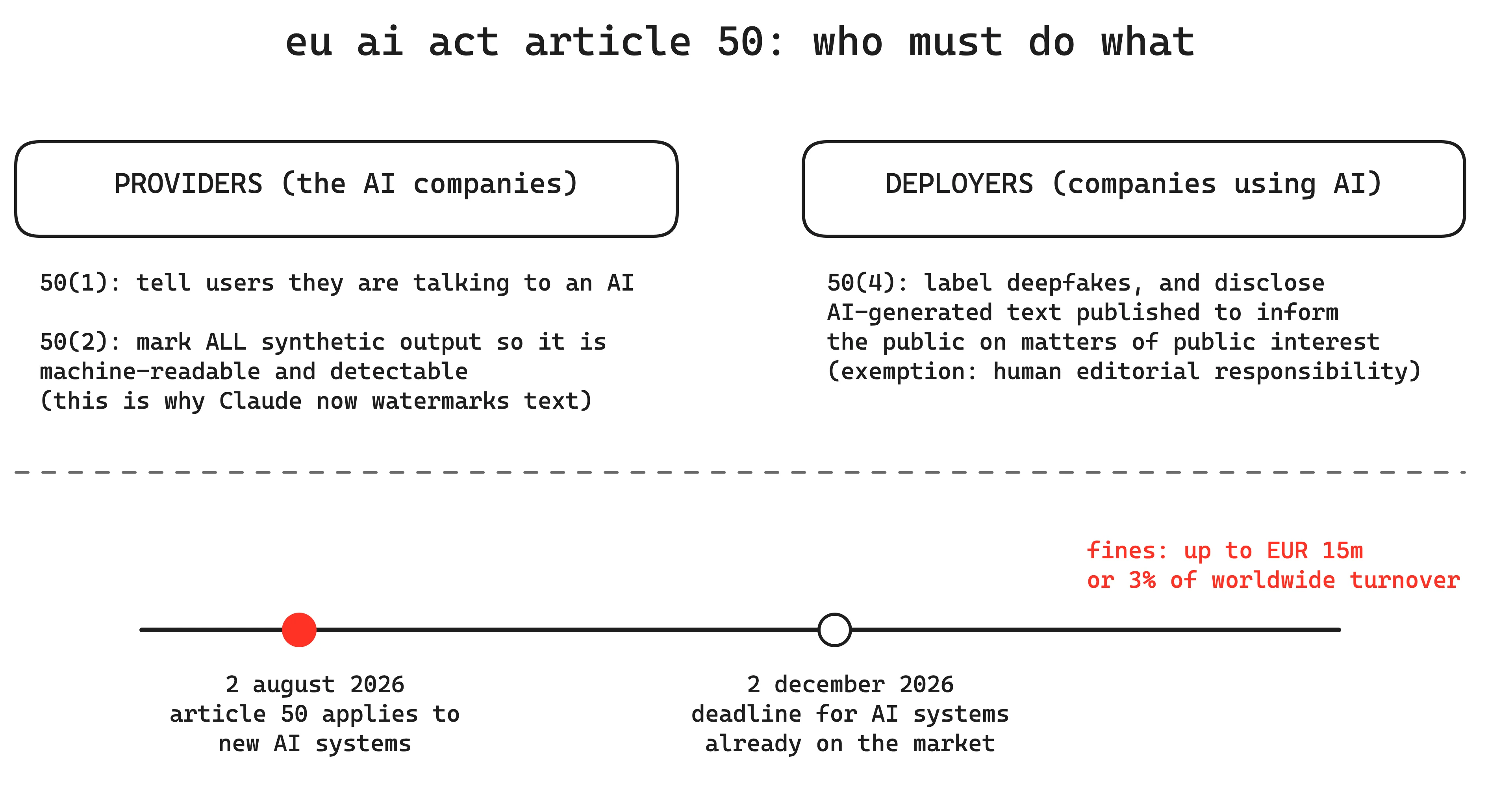 EU AI Act Article 50 obligations: providers must disclose chatbots and mark all synthetic output machine-readably; deployers must label deepfakes and disclose AI-generated public-interest text; enforcement from 2 August 2026 with fines up to EUR 15 million or 3% of turnover
The two dates that matter
- 2 August 2026: Article 50 became enforceable for AI systems placed on the market from this date (European Commission FAQ).
- 2 December 2026: under the AI Omnibus provisional agreement of May 2026, generative AI systems already on the market before 2 August have until this date to meet the machine-readable marking requirement of Article 50(2).
This second date is why watermarking is arriving in waves rather than all at once: new models are marked now, older models are being retrofitted before December.
Why your AI tools started watermarking
Article 50(2) is the reason Anthropic began embedding an invisible watermark in all output from new Claude models on 2 August 2026, applied globally rather than only in the EU. Our guide to the Claude watermark covers what that mark does and does not prove; the short version is that it proves text was processed by Claude, not that Claude authored it. Expect equivalent moves from other providers as the December deadline approaches, because the marking duty in 50(2) falls on them, not on you.
The law asks providers for solutions that are "effective, interoperable, robust and reliable" only as far as technically feasible, which is an honest acknowledgement that text watermarking is harder than image watermarking. The Commission is backing this with draft guidelines and a Code of Practice on marking and labelling of AI-generated content (Commission guidelines page).
The exemption that matters for content teams
The deployer duty in 50(4) to disclose AI-generated text applies to text "published with the purpose of informing the public on matters of public interest", and it carries a decisive carve-out: the disclosure duty does not apply where the content has undergone human review or editorial control and a natural or legal person holds editorial responsibility for its publication.
Read plainly: a marketing blog, a product page, or a category guide that a named human edits and takes responsibility for is not caught by the deployer labelling duty, even if AI drafted parts of it. The obligation targets ungoverned mass publication, synthetic news without an accountable editor, and deepfakes. This mirrors how Google treats AI content: the governing question in both regimes is human accountability, not tool usage.
Two boundaries to respect:
- Deepfake-style image, audio, and video must be labelled by the deployer regardless of editorial review, outside narrow artistic and satirical allowances.
- The provider-side mark from 50(2) is embedded whether or not your text qualifies for the editorial exemption. Assume provenance is detectable; the exemption only removes your duty to add a visible label.
Penalties
Non-compliance with Article 50 falls in the AI Act's middle penalty tier: administrative fines up to EUR 15 million or 3% of total worldwide annual turnover, whichever is higher, under Article 99 (penalty text). The steepest tier, EUR 35 million or 7%, is reserved for prohibited practices, not transparency failures.
What content teams should do now
- Map your role. Using ChatGPT or Claude in your workflow makes you a deployer at most. The heavy engineering duties in 50(1) and 50(2) belong to the AI companies.
- Put a name on everything. Named authors and documented editorial review are now a legal safe harbour in the EU, on top of being the E-E-A-T signal that search and AI engines reward. Our E-E-A-T for AI search guide covers the implementation.
- Label synthetic media honestly. If you publish AI-generated images, audio, or video that could pass for real, label them. This duty does not depend on the editorial exemption.
- Do not buy watermark evasion. Provenance marks carry no ranking penalty, and the marking duty sits with providers. Paying to strip marks buys legal and quality risk to escape a penalty that does not exist in any search engine. If what you actually want is AI drafts in your own voice, that is a content humanization workflow, not a watermark remover.
- Write down your AI workflow. A one-paragraph disclosure of how your team uses AI, who reviews output, and who holds editorial responsibility answers regulators, clients, and platforms with one document.
This guide describes the regulation for orientation; it is not legal advice. For compliance decisions about your specific situation, consult counsel.
FAQ
What is Article 50 of the EU AI Act? Article 50 is the EU AI Act's transparency rule, enforceable since 2 August 2026. It requires AI providers to disclose chatbots and to mark all synthetic audio, image, video, and text output in a machine-readable, detectable format, and requires deployers to label deepfakes and disclose AI-generated text published to inform the public on matters of public interest.
Does the EU AI Act require labelling of AI-generated content? Yes, in two layers. Providers must embed machine-readable marks in all synthetic output under Article 50(2), which is why Claude now watermarks its text. Deployers must add a visible disclosure only for deepfakes and for AI-generated public-interest text, and the text duty is waived where a human holds editorial responsibility for the publication.
Does Article 50 apply to blog posts written with AI? Generally not at the visible-label level. AI-assisted articles that undergo human review with a person holding editorial responsibility are exempt from the deployer disclosure duty in Article 50(4). The provider-side machine-readable mark may still be present in the text, because that obligation belongs to the AI company and does not depend on your editorial process.
What are the penalties for violating Article 50? Up to EUR 15 million or 3% of total worldwide annual turnover, whichever is higher, under Article 99 of the AI Act. This is the Act's middle penalty tier; the EUR 35 million and 7% ceiling applies to prohibited AI practices, not transparency violations.
When do the AI content labelling rules take effect? Article 50 has applied to new AI systems since 2 August 2026. Generative AI systems already on the market before that date have until 2 December 2026 to comply with the machine-readable marking requirement, under the May 2026 AI Omnibus provisional agreement.
Does Article 50 apply outside the EU? The obligation binds systems placed on the EU market, but in practice its effects are global: Anthropic chose to watermark all Claude output worldwide rather than maintain separate EU and non-EU behaviour, and other providers face the same engineering economics before the December deadline.

Walid founded AY Rank to help businesses dominate AI search. He leads the GEO methodology and oversees client strategy across 50+ cities in Europe, Middle East, and North Africa.
Full Bio →