No, Google does not penalise content for being AI-generated or AI-assisted. Its published position is that it rewards quality regardless of production method, and its spam policies target behaviour: thin mass-produced pages, scaled content abuse, and, since May 2026, manipulation of AI Overviews and AI Mode. The question that actually decides your rankings is not "did AI touch this?" but "would this page survive a quality rater reading it closely?"
What Google's policy actually says
Google's stance has been public since early 2023: its systems reward "high-quality content, however it is produced", and using AI does not violate its guidelines when the content is helpful and original (Google Search Central, Feb 2023). The behaviour it names as spam is different: scaled content abuse, producing masses of pages that add no value, whatever tool made them (Google's spam policies).
Two updates since then sharpened the picture without changing the principle:
- The March 2024 core and spam updates went after scaled, low-value content aggressively, and sites leaning on unedited mass generation lost visibility. The penalty attached to the thin pages, not to the tools.
- In May 2026, Google's spam policies were extended to explicitly cover manipulation of AI Overviews and AI Mode (reported by The Verge, PPC Land, and Gizmodo, May 2026). That is a behaviour rule about gaming AI answer surfaces, and notably it is still not an AI-detection rule.
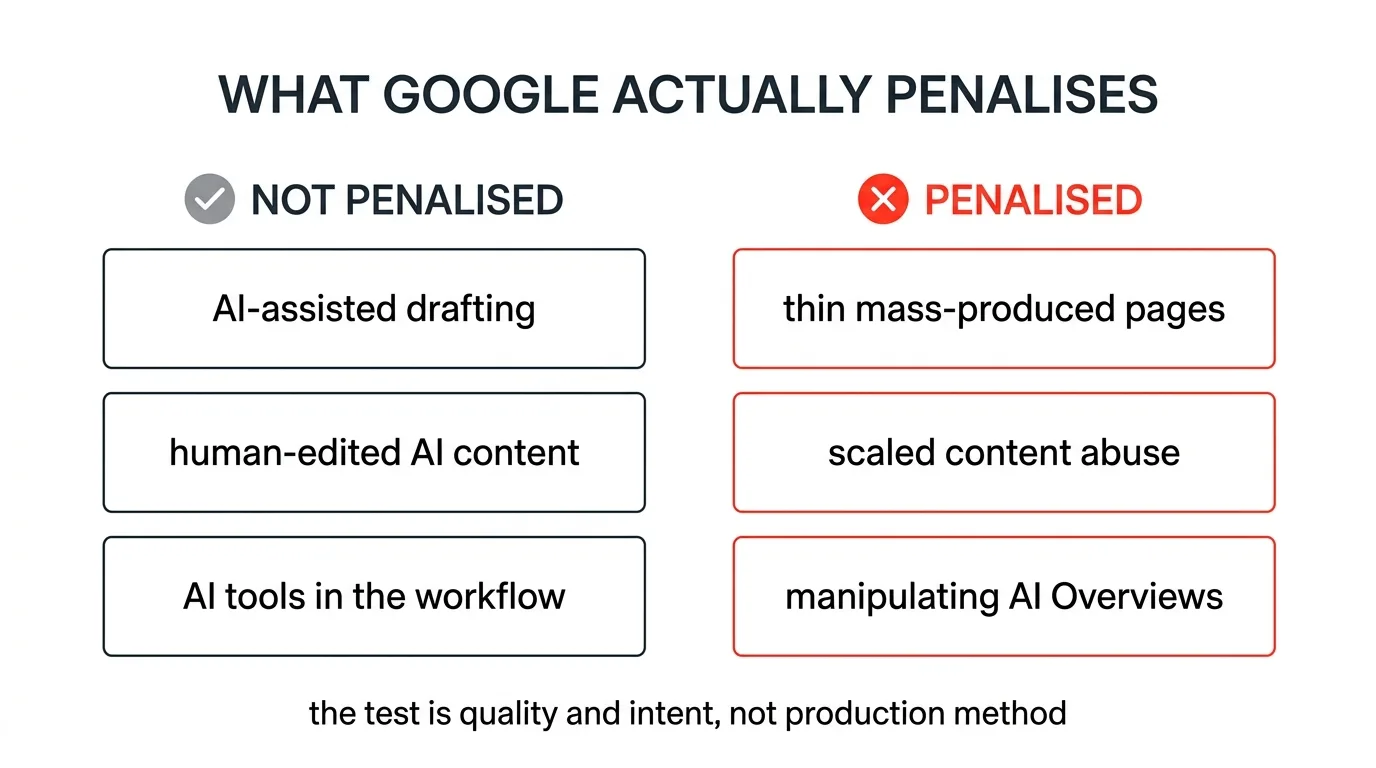 What Google actually penalises: AI-assisted drafting and human-edited AI content are fine; thin mass-produced pages, scaled content abuse, and manipulating AI Overviews are not
Can Google even tell content is AI-written?
Google has never claimed a reliable AI detector, and provenance marks do not change its ranking rules. Anthropic's August 2026 move to watermark all Claude output made provenance detectable in a new way, but the mark proves processing, not authorship, and no search engine has announced treating it as a ranking signal. Our guide to the Claude watermark covers exactly what it does and does not prove.
What Google demonstrably can detect is the footprint of low-quality scaled content: templated sameness, no original information, no evidence of experience. That is a quality judgement, and it catches lazy human content just as reliably as lazy AI content.
What actually gets AI-assisted sites in trouble
Across the public cases and Google's own statements, the failure pattern is consistent:
- Volume without value. Hundreds of pages that restate what already ranks, adding no experience, data, or perspective.
- No human accountability. No named authors, no credentials, no editorial standards, nothing a reader (or a quality system) can trust. This is the E-E-A-T layer, and it is where AI-assisted sites most often fall short; our E-E-A-T for AI search guide covers the fixes.
- Publishing the first draft. Unedited model output tends to be generic, occasionally wrong, and structurally samey, all quality problems in their own right.
- Gaming answer surfaces. Since May 2026, attempting to manipulate AI Overviews or AI Mode is named spam behaviour. Optimising honestly to be cited is fine; manipulation schemes are not.
The playbook that survives every update
Use AI where it is strong, drafting, restructuring, coverage, and keep humans where trust is built: direction, verification, experience, and final judgement. Publish under named authors with real credentials. Add information that does not already exist in the top results. Keep pages current, because content freshness signals feed both classic rankings and AI citations. Running both channels as one programme is what GEO SEO means in practice. If your content would embarrass you with a byline and a fact-checker, fix that before worrying about detection. Our content humanization workflow shows how we rewrite AI drafts to a named brand voice at scale.
If you want to know how your AI-assisted content is actually performing in search and AI answers, book a free AI ranking audit.
FAQ
Does Google penalize AI content for SEO? No. Google's published position is that it rewards helpful, high-quality content regardless of how it is produced. Its penalties target behaviour: scaled content abuse, thin mass-produced pages, and, since May 2026, manipulation of AI Overviews and AI Mode. AI-assisted content with real editing, expertise, and originality is not a policy violation.
Can Google detect AI-generated content? Google has never claimed a reliable AI detector, and it does not need one: its systems evaluate quality, and low-value scaled content has a detectable footprint whoever produced it. Provenance watermarks like Claude's prove that text was processed by a model, not who authored it, and no engine treats them as a ranking signal.
Will AI content hurt my rankings in 2026? Unedited, mass-produced AI content carries real risk, exactly the pattern the 2024 spam updates hit. Human-led content that uses AI in the workflow, with named authors, verification, and original value, competes on the same terms as anything else. The risk lives in the quality bar, not the tool.
Is it against Google's guidelines to use ChatGPT or Claude for content? No. Using AI tools is explicitly acceptable under Google's guidance when the result is helpful and original. What violates the guidelines is producing content primarily to manipulate rankings, at scale, without value, and, since May 2026, schemes aimed at manipulating AI answer surfaces.
This post is part of our GEO Optimization guide. Related reading: 7 Best SEO Companies in the UK, 7 Best AI Search Monitoring Tools, 6 Best Perplexity SEO Tracking Tools.

Oussama leads technical and on-page SEO at AY Rank. He specializes in structured data engineering, crawl optimization, and building the entity architecture that makes AI models cite our clients.
Full Bio →