AI content detectors guess from writing style and get it wrong in both directions; watermarks like Claude's prove processing but not authorship; and "humanizer" tools sell evasion against penalties that do not exist. What actually protects your content in 2026 is none of the three: it is quality, named expertise, and being worth citing. Here is how each technology really works, where false positives come from, and the honest playbook.
How AI detectors actually work
Commercial detectors do not read a hidden signature. They analyse statistical properties of style, how predictable the word choices are, how uniform the sentence rhythms run, and compare them with patterns typical of model output. That makes every verdict probabilistic: a likelihood estimate dressed as a yes or no.
The structural problem is that plenty of human writing shares those properties. Clear, conventional, well-edited prose, the exact style taught in schools and demanded by corporate style guides, reads "AI-like" to a statistical model. That is why false positives are not a bug being polished away; they are inherent to the method. The most telling data point remains OpenAI's own attempt: it launched an AI-text classifier in 2023 and retired it within six months, citing its low rate of accuracy (OpenAI, July 2023). The company with the most insight into its own model's output could not make detection reliable enough to keep.
The market is nonetheless accelerating: Pangram raised $9M for AI-content detection this week (TechCrunch, Aug 2026), Substack shipped a built-in detector on 10 August, and ZeroGPT expanded into video on 11 August. More detectors will not change the mathematics of probabilistic classification; treat any single verdict as a hint, never as proof, especially in education and hiring contexts where a false accusation carries real human cost.
Watermarks are a different technology entirely
A watermark is embedded at generation time by the model provider, which makes it deterministic where detectors are statistical. Since 2 August 2026, every new Claude model embeds an invisible watermark in all output, globally, under the EU AI Act's Article 50(2) (Search Engine Journal; Euronews, 11 Aug 2026).
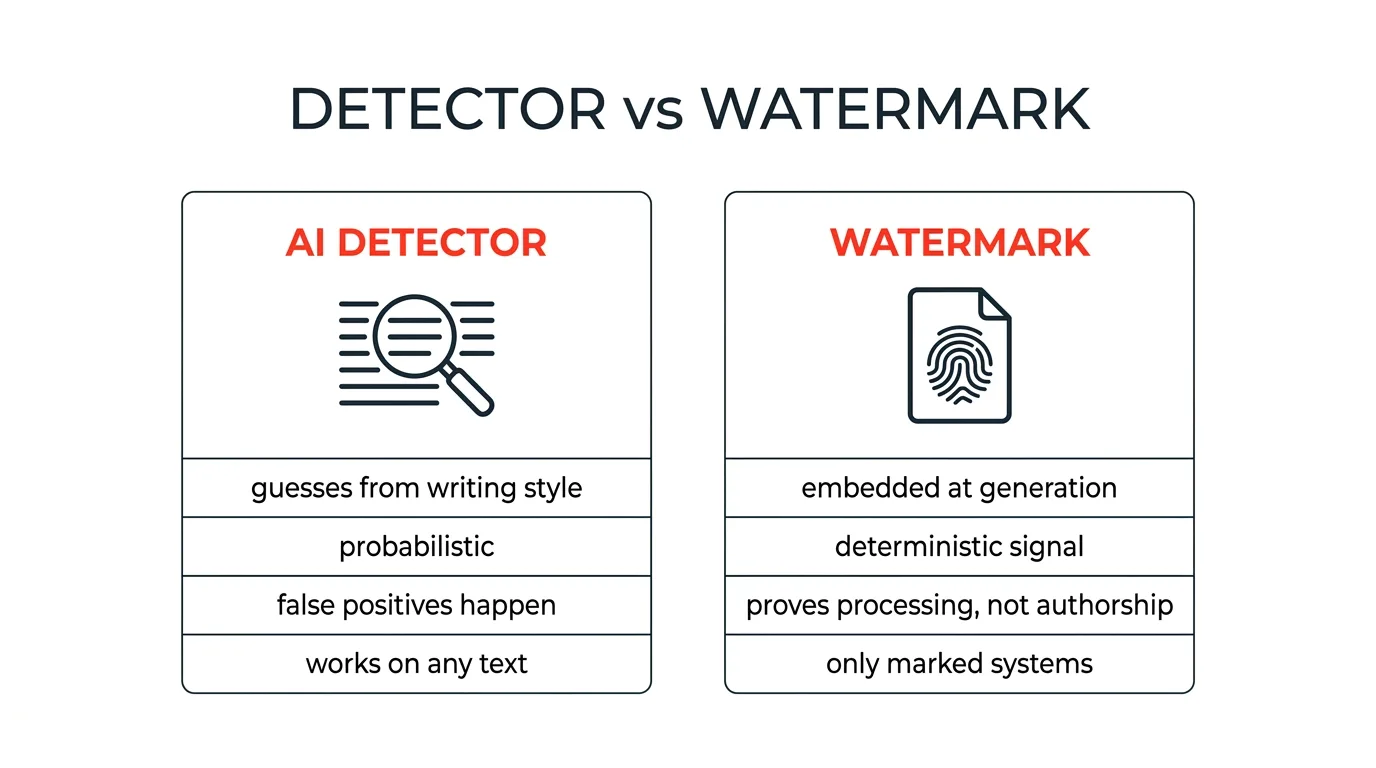 Detector versus watermark: detectors guess from writing style and produce false positives; watermarks are embedded at generation, prove processing rather than authorship, and exist only in marked systems
The catch, covered in depth in our Claude watermark guide: the mark proves text passed through Claude, not that Claude wrote it (TechTimes, 11 Aug 2026). A human article edited in Claude carries the mark; an unmarked text proves nothing about human authorship either. Watermarks fix the detector's false-positive problem and replace it with an interpretation problem.
SynthID vs C2PA vs the Claude watermark
The three provenance systems people conflate, side by side:
| SynthID (Google DeepMind) | C2PA / Content Credentials | Claude watermark (Anthropic) | |
|---|---|---|---|
| What it is | Invisible watermark embedded in AI-generated media and text from Google models | Open metadata standard attaching signed provenance records to files | Invisible statistical watermark in all new Claude output since Aug 2026 |
| Where it lives | Inside the generated content | In attached, cryptographically signed metadata | Inside the generated text |
| Survives copy-paste | Designed to | No: stripping metadata removes it | Designed to (Interesting Engineering) |
| What it proves | Output came from a Google model | The recorded capture and edit history of a file | Text was processed by Claude, not who authored it |
| Ecosystem | Google models and tools | Cross-industry: TikTok joined the C2PA steering committee in July 2026; Canon ships compliant news cameras | Claude models; legacy models marked before 2 Dec 2026 |
Three systems, three scopes, and none of them is an authorship test. Anyone treating any of them as "AI detection" is over-reading what the technology asserts.
What "humanizer" tools actually do
Humanizers rewrite text to defeat statistical detectors, and against detectors they sometimes succeed, at the cost of degrading the writing. The honest version of this discipline optimises for voice quality rather than evasion: that is what our content humanization workflow does. Against generation-time watermarks their claims are unverified: Anthropic designed the Claude mark to survive copy-paste and rewording pressure, and early technical coverage calls it close to irremovable (PhoneArena, Aug 2026).
The deeper problem is the premise. Google does not penalise AI-assisted content; it penalises bad content and manipulation behaviour, as our guide to Google's actual policy documents from Google's own statements. Paying to obscure a workflow that no ranking system punishes is spending money to add risk.
The playbook that makes all three irrelevant
- Never rely on a detector verdict alone, in either direction, for any decision that affects a person or a publication.
- Assume provenance will be visible and build content that stands anyway: named authors, verified claims, first-hand experience. The E-E-A-T guide covers implementation.
- Compete on citability, not concealment. AI engines cite structured, factual, current sources; that is a quality contest no watermark affects. The discipline behind winning it is LLM SEO.
If you want to see how your content performs where it matters, in rankings and AI answers, book a free AI ranking audit.
FAQ
How common are AI detector false positives? There is no reliable universal rate: vendors publish their own numbers under their own test conditions, and independent testing keeps finding both false positives and missed detections. The structural cause is that detectors judge style statistically, and clear, conventional human prose shares the statistical profile of model output. Any workflow that punishes people on a single detector verdict is built on a method its own biggest practitioner abandoned for low accuracy.
Are AI content detectors reliable? As a hint, sometimes; as proof, no. They are probabilistic classifiers with error in both directions, which is why OpenAI retired its own classifier in 2023. Watermarks are more reliable about what they assert, but they assert less: processing by a specific system, not authorship.
Can you make AI content undetectable? Against style-based detectors, rewriting can lower scores, at a quality cost. Against generation-time watermarks like Claude's, removal claims are unverified and the mark is designed to survive editing. The more useful question is why: no search engine penalises AI assistance, so evasion buys risk without buying protection.
How do invisible AI watermarks work? The model subtly biases its own generation choices in a pattern that is statistically detectable to a verifier holding the key, while remaining invisible to readers and stable through copy-paste. Because the pattern is embedded at generation, it exists only in output from marked systems, which is why an unmarked text proves nothing.
Can you remove an AI watermark from text? Anthropic designed the Claude watermark to survive copy-paste and rewording, and early analysis describes it as close to impossible to remove. Tools will claim otherwise; treat those claims as unverified marketing. Removal also solves nothing: the mark carries no ranking or citation penalty to escape.
This post is part of our AI SEO guide. Related reading: LLM SEO, AI Visibility Monitoring, How to Rank in ChatGPT.

Walid founded AY Rank to help businesses dominate AI search. He leads the GEO methodology and oversees client strategy across 50+ cities in Europe, Middle East, and North Africa.
Full Bio →