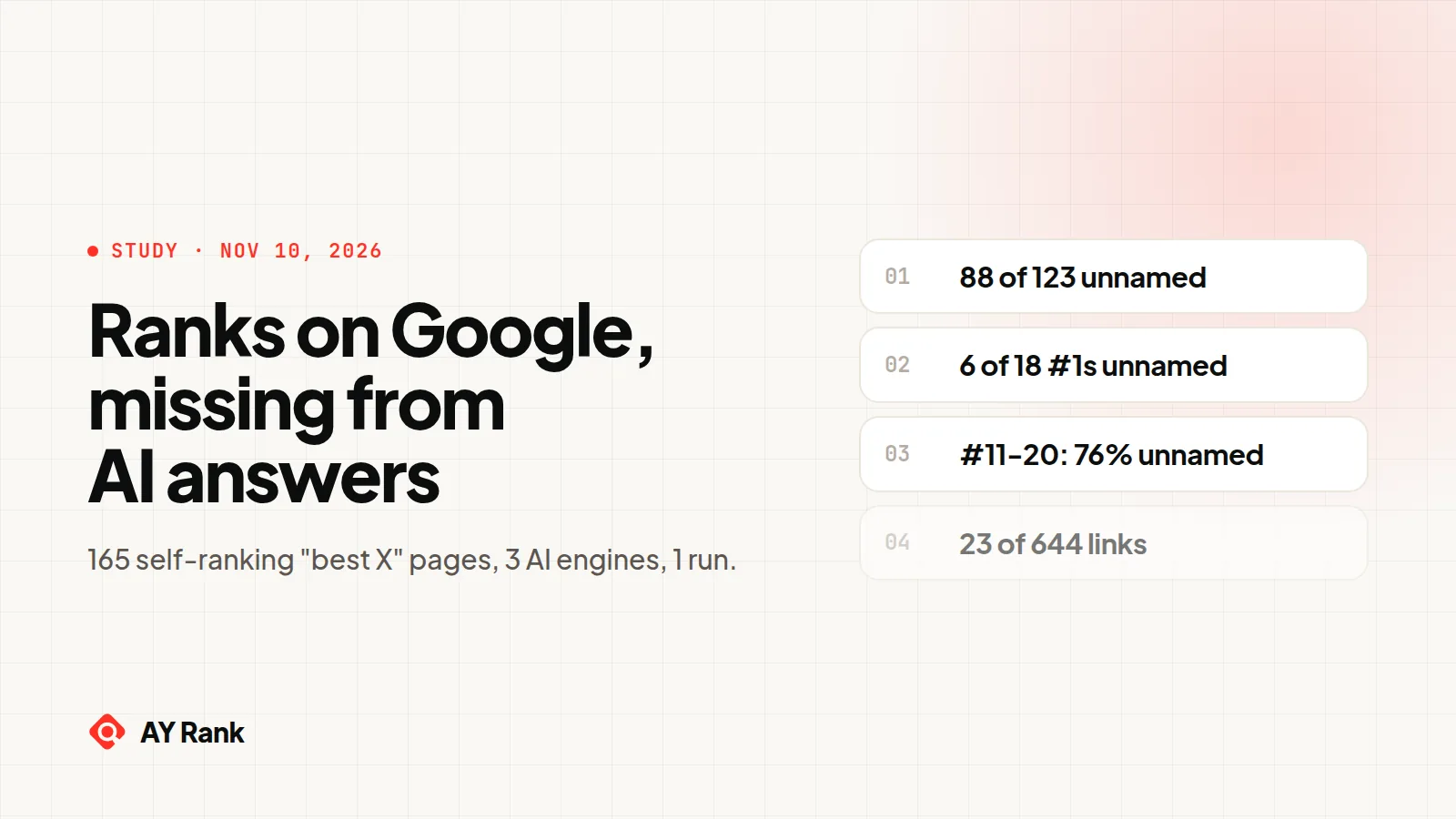
88 companies rank their own "best X" page on Google. On that question, AI answers left them out.
We read 165 "best X" pages that rank in Google's US top 20 and list their own product, then asked ChatGPT, Gemini and Google AI Mode the same question. 88 of 123 companies went unnamed on at least one question. Method, data and limits.
Run a free check on app.ayrank.com→No sign-up. See if ChatGPT names your brand.Client result: Wearview went from $0 to $36K MRR in 8 months.
Walid founded AY Rank to help businesses dominate AI search. He leads the GEO methodology and oversees client strategy across 50+ cities in Europe, Middle East, and North Africa.
On November 10, 2026 we read 165 "best X" pages in Google's US top 20 where the publisher lists its own product. 149 of them put it at #1. Then we asked ChatGPT, Gemini and Google AI Mode the same question.
For 107 of those pages, from 88 companies, none of the three answers named the publisher. A second ChatGPT run checked every one of them.
Pages higher on Google went unnamed less often: 33% at #1 against 76% at #11 to #20. Still, 6 of the 18 publishers at #1 went unnamed.
The answers held 644 links. 23 of them pointed at one of the 165 pages.
Our earlier piece, 1 in 10 AI citations come from self-promotional listicles, covered Peec AI's finding that vendor-written "best X" lists earn a real share of AI citations. This study looks at the other side of that number: companies whose own "best X" page ranks on Google, but who are missing from the AI answer to the same question.
We took 32 "best X" questions about B2B software and services and read every page in Google's US top 20 for each. We kept the 165 pages where the publisher puts its own product in its own numbered list. 123 companies publish them. Then we asked ChatGPT, Gemini and Google AI Mode each question once.
88 of the 123 companies had at least one question where all three engines answered without naming them, even though their own page ranked on Google for that exact question.
What did the study find?
88 of 123
Companies not named by any of the 3 engines
On at least one question where their own page ranks in Google's top 20
107 of 165
Self-ranking pages whose publisher went unnamed
65% of pages, 0 of 3 engines, confirmed on a second ChatGPT run
23 of 644
Links in the answers that pointed at one of the 165 pages
3.6% of all links across 96 answers
The 88 split into two groups. 75 companies were not named on any page they had. 13 were missing on one question but named on another. Another 21 companies had no fully unnamed page but at least one page named by only one engine (for 2 of them, only the ChatGPT recheck named them). 14 were named by two or three engines on every page they had.
The engines differed. Across the 165 pages, ChatGPT named the publisher 32 times, Gemini 39 times and Google AI Mode 25 times.
On 7 of the 32 questions, no engine named any of the self-ranking publishers, even on the ChatGPT recheck.
How did we run the study?
Here is the full method, so you can repeat it or argue with it.
Questions. 32 "best X" searches for B2B software and services. 8 came from sales, SEO and AI search categories we already track. We added 24 more across sales, marketing, AI and developer tools, and operations software. The full list is in the table further down.
Google results. The top 20 organic results in the US (pages 1 and 2) for each search, pulled through Serper on November 10, 2026. Forum results were skipped.
What counts as self-ranking. We read every remaining page over plain HTTP. A page counts when the publisher's own product appears as an entry in the page's numbered list, such as a heading that reads "1. Product". Pages where the brand only shows up in the navigation or a call to action were dropped. That left 165 pages. 149 put the publisher at #1.
The prompt. One prompt per question, in the form "What are the best X?", for example "What are the best cold email software?". Asked once per engine, with no follow-up and no custom instructions.
The engines. ChatGPT (collected through Bright Data, US), Gemini (through SearchAPI) and Google AI Mode (through DataForSEO, US, English). All on November 10, 2026.
Named and linked. A company counts as named when its brand name appears in the answer text, with URLs stripped out first. Short or common names got custom matching rules ("Make" only counts as the product). A company counts as linked when the answer links any page on its domain.
The recheck. For every question where a publisher went unnamed by all three engines, we asked ChatGPT again through a second provider (SearchAPI). That run named 2 companies, and we moved both from "not named" to "named once".
Authority. Ahrefs Domain Rating (DR) for every publisher domain.
Does ranking higher on Google get you named?
Position helps, but it is no guarantee. Pages at Google #1 had the lowest unnamed share. Pages on Google's second page had the highest.
Publishers no AI engine named, by Google position
Share of self-ranking pages where ChatGPT, Gemini and Google AI Mode all left the publisher out.
Google #16 of 18 pages
33%
Google #2 to #35 of 13 pages
38%
Google #4 to #1034 of 50 pages
68%
Google #11 to #2062 of 82 pages
76%
Source: AY Rank study of 165 self-ranking "best X" pages, Google US top 20, answers from ChatGPT, Gemini and Google AI Mode, run November 10, 2026. 2 pages that fell outside the top 20 on the day are left out of this chart.
The top 3 is not a pass. 11 of the 31 pages in positions 1 to 3 had a publisher that none of the three engines named. Of the 88 companies, 39 had an unnamed page on Google's first page.
Does domain authority change the result?
In this sample, it lines up about as strongly as Google position does. Publishers under DR 70 went unnamed on almost 9 in 10 pages. At DR 80 and above, it was under half.
Publishers no AI engine named, by Domain Rating
Share of self-ranking pages where ChatGPT, Gemini and Google AI Mode all left the publisher out. Ahrefs DR of the publisher's domain.
DR under 5018 of 21 pages
86%
DR 50 to 6926 of 30 pages
87%
DR 70 to 7938 of 59 pages
64%
DR 80 and above25 of 55 pages
45%
Source: AY Rank study of 165 self-ranking "best X" pages, run November 10, 2026. Domain Rating from Ahrefs.
On pages whose publisher was named by two or three engines, the median DR was 81. On pages whose publisher no engine named, it was 72.
We don't read DR as the cause. Our reading is that DR roughly tracks how much of the web already writes about a company, and that is closer to what the engines draw on. Our piece on domain authority and AI citations covers larger studies where DR did not predict which URLs get cited. Those studies measured cited pages. This one measures whether a brand gets named in the answer, on 165 pages, so treat it as a pattern in one sample.
Does the category matter?
Barely. The unnamed share sits between 63% and 68% in every category we grouped the 32 questions into.
Sales and outbound software had the most self-ranking pages by far: 62 pages from 9 questions. "Best LinkedIn automation tools" alone had 15, and 11 of those publishers went unnamed.
Category
Questions
Self-ranking pages
Publisher not named
Share
Sales and outbound
9
62
39
63%
SEO and AI search
6
35
23
66%
AI and developer tools
6
28
18
64%
Marketing and content
6
21
14
67%
Operations and other
5
19
13
68%
Which brands did the AI engines name instead?
The same few brands came up again and again. Apollo.io was among the most-named brands on 7 of the 32 questions. Semrush was on 5. Ahrefs, ZoomInfo and Lusha were on 3 each.
The table lists, for each question, the five brands named most often across the three answers.
Sprout Social, Hootsuite, Buffer, Metricool, Later
Best knowledge base software
5
3
Notion, Guru, Document360, Confluence, Slite
Some winners publish their own lists too. 17 of the 160 most-named slots went to a brand that also had a self-ranking page in that question's Google top 20. Every one of those 17 was named by at least two engines. So the winners have lists as well. In this data, the list is not what separates them from the companies that went unnamed.
What did the AI engines link to?
The 96 answers (32 questions, 3 engines) contained 644 links. 7 answers had none. Each engine linked very different things.
Engine
Links
What stood out
ChatGPT
356
204 went to a site's homepage. No Reddit or YouTube links
Google AI Mode
218
56 YouTube links and 18 Reddit links. 16 of 32 answers linked Reddit, and 16 linked YouTube
Gemini
70
Mostly list articles: 64 of 70 URLs contain "best", "top", "tools" or "alternatives"
Across all three engines, zapier.com was the most-linked site after YouTube, with 20 links. 18 of them went to Zapier's blog, mostly its "best X" roundups.
Only 23 links, 3.6% of the total, pointed at one of the 165 self-ranking pages. They came from 21 of the 96 answers.
The ChatGPT result fits what we wrote about Reddit's drop in ChatGPT citations in August. Google AI Mode still links Reddit and YouTube heavily for these questions.
One more detail stands out. On 9 pages, an engine linked the publisher's site (6 times the self-ranking page itself), but no engine named the publisher. Our reading is that the engine used the page as a source and named other products instead.
Why doesn't a page that ranks on Google get you into AI answers?
Here is our reading of the data. It is one run, so these are patterns, not laws.
Your page is one source among hundreds. For these 32 questions, the answers held 644 links, and only 23 pointed at the self-ranking pages. Ranking on Google gets your page into the pool. It does not make your page the answer.
The engines keep naming the same well-known brands. Apollo.io came up on 7 different questions. The links lean on third-party roundups (Zapier's blog), Reddit, YouTube and homepages. A company that only appears at the top of its own list has one vote in that pool.
Position and authority line up with being named, but they don't decide it. The unnamed share falls from 76% on Google's second page to 33% at #1, and from 86% to 45% as DR rises. A third of the publishers at Google #1 were still left out.
Being linked is not being named. On 9 pages an engine linked the publisher's site, and no engine named the publisher.
Key takeaway
A "best X" page that ranks on Google puts your page in the pool AI engines read from. In this study that was rarely enough. 23 of 644 links pointed at these pages, and 88 of 123 publishers went unnamed on at least one question.
What you can do with this:
Ask the engines your buyers' questions yourself. Use their exact words, ask more than once, and write down who gets named and which pages get linked. Our AI visibility monitoring guide covers how to set that up.
Get onto the lists the answers link to. In this data that meant third-party roundups for all three engines, plus Reddit and YouTube for Google AI Mode. This is slow work: outreach, reviews, being useful in the threads. Our GEO optimization and link building services cover this work.
Keep your own list useful. As our piece on self-promotional listicles argues, an honest comparison with real competitors still has a place. Just don't count on it alone to get you named.
If you sell to local or ecommerce buyers, claim your business in ChatGPT. OpenAI says claiming "doesn't guarantee increased visibility", but it lets you manage your business information in ChatGPT. Our guide on how to list your business on ChatGPT has the steps.
What are the limits of this study?
One run per engine, on one day. AI answers change from run to run. A company that went unnamed on November 10 could be named the next time.
One wording per question. Other phrasings, such as "top X for startups", may get different answers.
No Perplexity. One of our routes to Perplexity was disabled by the provider on the day, and the other refused the call because our account had no balance. Google AI Mode is the third engine instead.
Location. Google results, ChatGPT and Google AI Mode were set to the US. Gemini was queried without a location setting.
Ads unknown. Our Google data has organic results only. We don't know which of these companies also run search ads on these questions.
Name matching. We match brands by name and checked short names by hand, but a missed or false match is possible.
"Best LLM tracking tools". All three engines read it as LLM observability (Langfuse, LangSmith), while the self-ranking pages sell brand tracking in AI answers. Its 4 pages count as unnamed, but that gap is about how the engines read the words.
Correlation only. Google position and DR line up with being named. This study does not show that either one causes it.
Sample. 32 questions, 165 pages, B2B software and services. It is not a random sample of the web.
FAQ
Does ranking #1 on Google mean AI engines will name you?
No. Of the 18 self-ranking pages at Google #1 in our study, 6 had a publisher that ChatGPT, Gemini and Google AI Mode all left out of their answer to the same question on November 10, 2026. Higher positions lined up with being named more often: the unnamed share was 76% at positions 11 to 20 and 33% at #1.
Do AI engines cite "best X" lists that rank their own product first?
Sometimes, but rarely in this study. 23 of the 644 links in the answers pointed at one of the 165 self-ranking pages. Peec AI's much larger study, covered in our self-promotional listicles piece, found about 1 in 10 AI citations come from such lists. Being cited and being named are not the same thing.
Why would an AI engine read my page but not name my product?
In 9 cases in our data, an engine linked the publisher's site (6 times the self-ranking page itself), but none of the three engines named the publisher. Our reading is that the engine used the page as a source and kept the entries that other sources also name. We can't see inside the engines, so treat that as an inference.
Which sources do AI engines use for "best X" questions?
It depends on the engine. In our run, 204 of ChatGPT's 356 links went to a site's homepage, and none went to Reddit or YouTube. Google AI Mode linked YouTube 56 times and Reddit 18 times. Across all three, zapier.com got 20 links, mostly to its "best X" roundups.
How can I check whether AI engines name my company?
Ask ChatGPT, Gemini, Google AI Mode and Perplexity the questions your buyers ask, in their words, on more than one day. Record who gets named and which pages get linked. Our AI visibility monitoring guide walks through it. To run those checks on a schedule, our comparisons of AI citation monitoring tools and AI Mode SEO analysis tools list what each tool covers and costs.
Why wasn't Perplexity part of the study?
On November 10, 2026, one of our routes to Perplexity was disabled by the provider and the other refused the call because our account had no balance. We used Google AI Mode as the third engine instead, and every "3 engines" in this post means ChatGPT, Gemini and Google AI Mode.
Data: AY Rank study, run November 10, 2026. Google US top 20 via Serper. Answers via Bright Data (ChatGPT), SearchAPI (Gemini and the second ChatGPT run) and DataForSEO (Google AI Mode). Domain Rating from Ahrefs. Quote on claiming from OpenAI Help Center, Setting up your business on ChatGPT.