AI training vs AI grounding: Bing's new controls, Google's 2027 plan, and why Dec 15 only matters for NoArchive or NoCache sites
From February 1, 2027, Bing reads AI training and AI grounding as separate settings. Google announced a plan for 2027 with no syntax yet. Every date, who must act, and the exact lines from Bing's post.
Abdelmoghit drives the content engine at AY Rank. He researches keywords, plans content clusters, and produces citation-optimized articles that rank in both Google and AI search engines.
Training changes what future AI models learn. Grounding uses your page to inform an AI answer. From February 1, 2027, Bing reads separate settings, grounding per page only. Only NoArchive or NoCache sites face a deadline: March 1, 2027. Google has published no syntax.
AI training and AI grounding are now two separate settings at Bing. On October 30, 2026, Google and Microsoft both published posts about AI controls for websites. Google announced a plan. Bing shipped syntax, a deadline and a grounding control. This page puts both posts side by side, quotes them, and tells you who needs to do what and when. If your site has never used NoArchive or NoCache, the short version is that nothing changes for you unless you want it to.
What is the difference between AI training and AI grounding?
Bing's post defines both terms. Google's post only talks about training.
AI Training "covers using an asset to modify the learned parameters of a generative AI model." In plain words, your page helps build a future model.
AI Grounding "covers using content as input to help inform AI-generated responses." Your page is read when an answer is written, and can be cited with a link.
Bing adds one line that matters for SEO teams: "Indexing and ranking pages in traditional search results is not grounding." So neither setting changes your eligibility for Bing's blue links. Bing says it directly: "These usage preferences do not change eligibility for traditional Bing search results, subject to normal crawl and indexing requirements."
What did Google change?
Google changed nothing yet. It announced a plan. The post, by John Mueller on October 30, 2026, says Google will support "a shared AI training control in robots.txt" based on work from the IETF AIPREF working group.
Here is what the post says, and what it leaves out.
Google's October 30, 2026 post: what it says
Question
What Google says
What is coming?
A shared "policy token" in robots.txt to "set broad preferences across participating AI providers"
When?
"We aim to support this new control along with other AI providers in 2027"
What if I opt out with the shared token?
If "Google-Extended is not explicitly specified, Google plans to interpret that as if the publisher had disallowed Google-Extended"
Does Google-Extended still work?
Yes. "Existing company-specific controls will continue to function alongside this new joint signal"
Grounding
"Websites that specifically allow Google-Extended are eligible to appear in responses and receive clicks via grounding in Gemini Apps"
Syntax for the shared token
Not given
A separate grounding control
Not given
Source: Google Search Central Blog, Supporting a shared AI training control for websites, October 30, 2026, read November 11, 2026. Quotes are Google's words.
Google has not published syntax yet. Google's post names no token, no robots.txt lines and no date beyond "2027". It does not say how to stay eligible for grounding in Gemini Apps while opting out of training. Until Google publishes more, Google-Extended in robots.txt, which Google calls "the AI training control we've offered since 2023", is the Google control to use. Any article that hands you a "Google" line for the shared token is guessing.
Bing's post links an IETF Internet-Draft that defines the token __usage_ai-training. Google's post does not name that draft or that token. It may end up the same. Google has not said so.
What did Bing change?
Bing shipped two separate settings and a transition plan. The post, by Krishna Madhavan of Microsoft Bing, says the new preferences "will replace existing Microsoft preferences NoArchive and NoCache for training and grounding."
Bing's AI Training and AI Grounding preferences
AI Training
AI Grounding
Where you set it
robots.txt (site or path), or a single page
A single page only. "There is no site-wide robots.txt grounding preference"
Values
Allow, Disallow
Allow, DisallowExtended, Disallow
Default
Allow
Allow
Page syntax
<meta name="Bingbot" content="ai-training:disallow"> or the X-Robots-Tag header
<meta name="Bingbot" content="ai-grounding:disallow"> or the X-Robots-Tag header
Priority
"The new AI Training preference set at a page level overrides the robots.txt setting"
Page level only
Temporary Bing Webmaster Tools setting
None
Yesfrom December 15, 2026, only for NoArchive or NoCache sites
Yes stated on its own siteSource: Bing Search Blog, Your content, your choice: clearer preferences for training and grounding, October 30, 2026, read November 11, 2026.
DisallowExtended is the new middle option. Bing says it "limits grounding use to Microsoft-operated experiences such as AI Mode, AI Overview, Copilot, and Microsoft 365, and excludes grounding services Microsoft provides to third parties, such as Web IQ and grounding through API access in Foundry."
Bing is blunt about the cost: "If you select DisallowExtended or Disallow for grounding, you will see reduced brand visibility in AI experiences." It also says "Neither choice guarantees inclusion, traffic, or payment."
To check whether your grounding choice changes anything, look at Bing's own data. The AI Performance report in Bing Webmaster Tools counts how often Copilot and Bing's AI summaries cite your pages, and shows a sample of the grounding queries behind those citations. For citation counts in ChatGPT, Perplexity and Gemini you need a third-party tool, compared in our guide to AI citation monitoring tools.
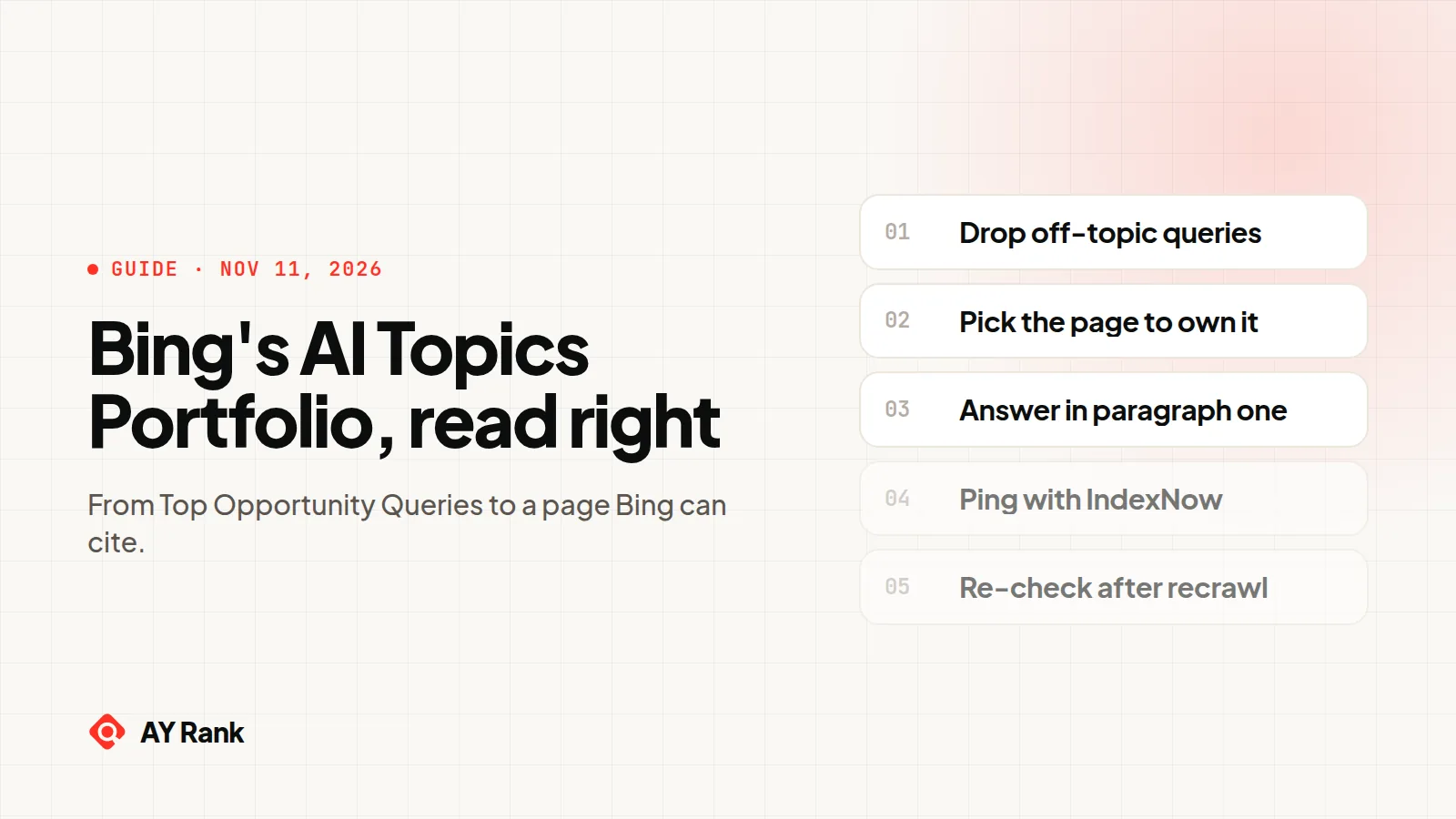
Since October 13, 2026, that report also has a Topics Portfolio tab (beta) that lists queries where other sites are cited and yours is not. Before you write a page for one of them, check the page isn't opted out of grounding. Our guide to turning Bing's Topics Portfolio gaps into pages has the full checklist.
When does each change take effect?
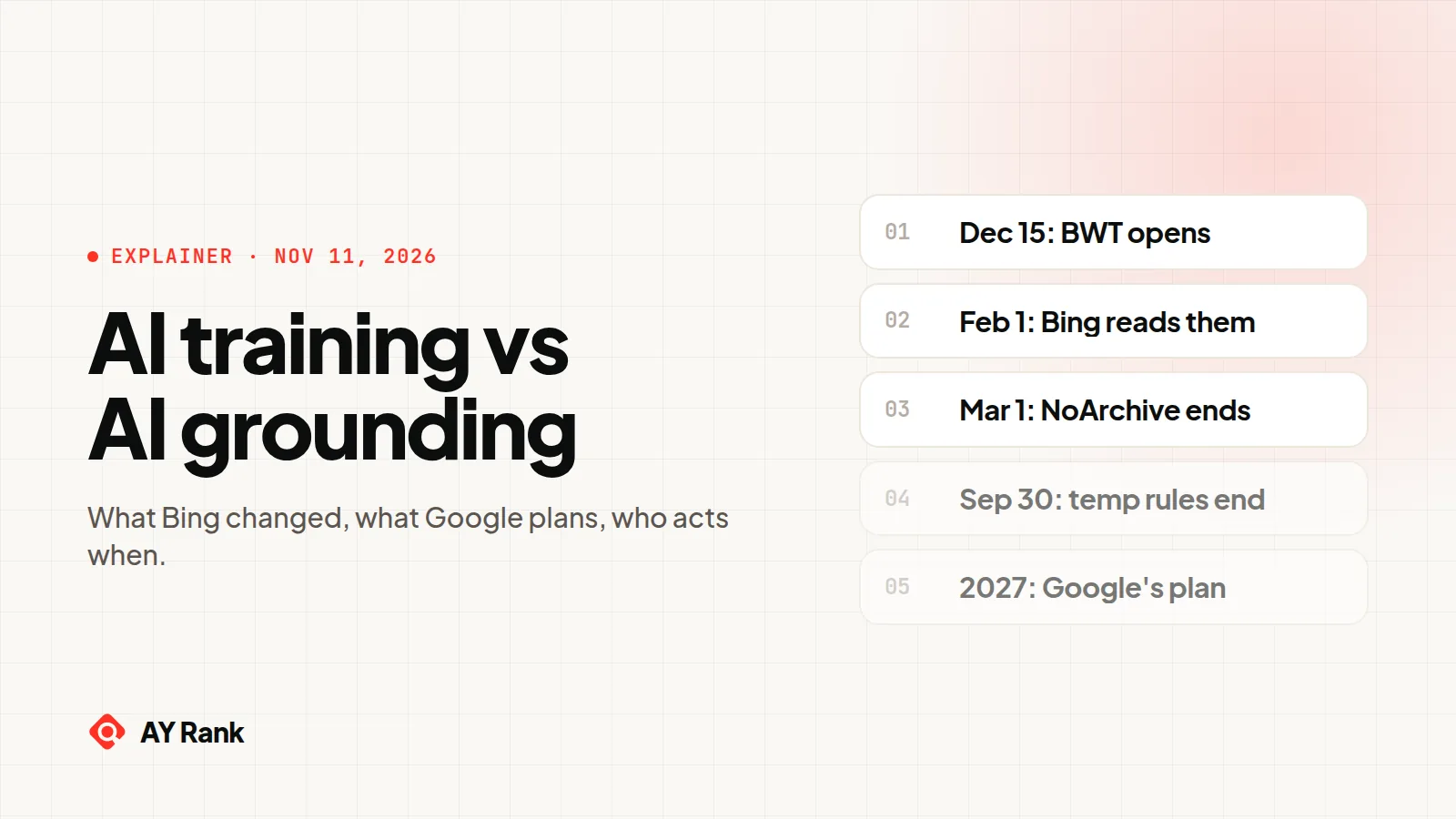
Here is every date in the two posts. Three of them apply only to sites that use NoArchive or NoCache today.
AI training and grounding timeline
Date
What happens
Who it affects
Source
October 30, 2026
Google announces its plan. Bing announces AI Training and AI Grounding
Nobody has to act
Google, Bing
December 15, 2026
Temporary grounding transition preferences open in Bing Webmaster Tools
Only sites using NoArchive or NoCache as of that date. "All other sites need no transition action"
Bing
February 1, 2027
"Microsoft starts honoring AI Training and AI Grounding preferences as pages are crawled"
Any site that publishes the new preferences
Bing
March 1, 2027
After this date, "NoArchive and NoCache will no longer be read as a preference for training or grounding"
Sites using NoArchive or NoCache
Bing
September 30, 2027
Temporary Bing Webmaster Tools grounding preferences expire, or earlier, "until Microsoft recrawls the page and discovers its new AI Grounding preference"
Sites that used the temporary setting
Bing
2027, no date given
Google aims to support the shared training control "along with other AI providers"
Everyone, once Google publishes details
Google
Sources: Bing Search Blog and Google Search Central Blog, both October 30, 2026, read November 11, 2026.
Who needs to do what, and by when?
Most sites need to do nothing. Find your row.
Who needs to do what
Your site today
Bing AI Training
Bing AI Grounding
Google
No NoArchive or NoCache, defaults are fine
Nothing. Default is Allow
Nothing. Default is Allow
Nothing
No NoArchive or NoCache, you want to opt out of training
Add a __usage_ai-training group to robots.txt, or a page meta tag or header. Bing honors it as it crawls from February 1, 2027
Nothing, unless you also want to limit grounding
Google-Extended in robots.txt works today. Google aims to support the shared control in 2027
You want to limit grounding on some pages
No change needed
Add ai-grounding:disallow or ai-grounding:disallowextended to each page. There is no robots.txt option
No grounding control in Google's post
You use NoArchive or NoCache today
Publish your training preference in robots.txt or on pages before March 1, 2027. There is no temporary training setting
If you want to keep limiting grounding: from December 15, 2026, record a temporary grounding preference in Bing Webmaster Tools, and publish page-level grounding preferences. Both before March 1, 2027
Google-Extended works today
Built from the Bing and Google posts of October 30, 2026. Both Bing preferences default to Allow.
One trap for NoArchive sites. Bing says "If we detect new AI Training or AI Grounding preferences on a site, we will disregard any NoArchive and NoCache preferences that may remain on that site." So if you add only a training line and forget grounding, your old NoArchive limit stops working for grounding too. Our reading: grounding then falls back to Allow, unless a temporary Bing Webmaster Tools preference covers the page.
If you use NoArchive or NoCache and skip the Bing Webmaster Tools step, Bing says your pages "default to Allow for grounding until Microsoft recrawls them and discovers your new AI Grounding preference." Bing asks for the temporary setting "because we may not retrieve your new preferences until we recrawl your site; an activity that may not take place between February and March 1."
What exactly do I paste?
These examples are copied word for word from Bing's post. Change nothing but the path.
AI Training for the whole site or a path (robots.txt)
# Allow is default. No action needed to allow ai training

# Disallow ai training for whole site
User-Agent: __usage_ai-training
Disallow: /

# Disallow ai training at a path-level
User-Agent: __usage_ai-training
Disallow: /example-path/
Bing's optional explicit Allow, also word for word:
# Allow is default. No action needed to allow ai training. To specify explicity use
User-Agent: __usage_ai-training
Allow: /
For the middle option, Bing's post says: "Use ai-grounding:disallowextended for the other grounding preferences." That gives content="ai-grounding:disallowextended" in the same meta tag, or Bingbot: ai-grounding:disallowextended in the header.
User-agent: * does not count. The IETF draft that Bing links says "wildcard groups (i.e., User-Agent: *) MUST NOT be interpreted as matching the policy token." A Disallow: / under User-agent: * blocks crawling. It does not express an AI training preference. You need a group that names __usage_ai-training.
Our robots.txt generator builds the crawler rules. It does not write the __usage_ai-training group yet, so paste that group in by hand. Check what a page actually says with our free AI training and grounding checker. It reads the robots.txt, meta tags and X-Robots-Tag header and shows the result for each setting. If you have set up AI crawler rules before, our robots.txt setup guide for AI crawlers covers GPTBot, ClaudeBot and the rest.
Does blocking a crawler do the same thing?
No. These preferences govern use, not crawl access. Bing says "These settings govern use of content, not crawl access. An Allow setting does not override a robots.txt rule blocking Bingbot from crawling." The IETF draft says the same about the token: "This policy token is not a directive for crawling behavior."
robots.txt is a request that crawlers choose to follow, not a lock. We cover what that means for AI crawlers in why blocking GPTBot in robots.txt often doesn't work. The same habit helps here: check what each line says for the exact path, not what you meant it to say.
Two more limits from Bing's post:
"Publishing a setting is not the same as activating it. Microsoft must crawl the page to discover the setting."
IndexNow "can signal that a page has changed and increase the chance of a recrawl, but it does not guarantee a recrawl date."
Can AI crawlers reach your site?
Run the free AI Visibility Checker for crawler access and page structure. It does not read the new Bing training or grounding tags. For those, book a call and we will read your robots.txt, meta tags and headers with you.
That is a business call. Bing names a visibility cost only for grounding. On training, its one line on the upside is "Allowing training can help improve future generative models." Blocking grounding costs you visibility. Bing calls grounding the path that brings "relevant sources and web publishers' expertise into the response," with "links and citations providing a path to the original content."
Our view: if you want to be cited in AI answers, leave grounding on. Decide training on its own terms. That is the split Bing's own example shows: "you can set AI Training to Disallow and AI Grounding to Allow to keep content eligible to inform generated responses without allowing it to train generative models."
If you sell on being found in AI search, grounding is the setting to protect. A technical SEO audit is the place to check that your crawl rules, meta tags and headers say what you mean, page by page. If you would rather walk through it with us, book a call.
FAQ
What is the difference between AI training and AI grounding?
Training uses your content to change what a future AI model learns. Grounding uses your page as input when an AI answer is created, with "links and citations providing a path to the original content." Bing lets you set the two separately, and both default to Allow.
Do I need to do anything before December 15, 2026?
No. December 15 is when Bing Webmaster Tools opens a temporary grounding setting, and only for sites using NoArchive or NoCache. Their deadline is March 1, 2027. Bing says "All other sites need no transition action."
Can I block AI grounding in robots.txt?
No. Bing says "There is no site-wide robots.txt grounding preference." You set grounding page by page, with <meta name="Bingbot" content="ai-grounding:disallow"> or the X-Robots-Tag header.
Does Google support __usage_ai-training today?
Google has not said so. Its October 30, 2026 post announces a plan to support a shared AI training control in 2027 and gives no syntax. Google-Extended remains Google's working training control in robots.txt.
Will blocking AI training hurt my Bing rankings?
Bing says no. Its post says these preferences "do not change eligibility for traditional Bing search results, subject to normal crawl and indexing requirements." Blocking Bingbot from crawling is a different rule, and that one does affect search.
What does DisallowExtended mean?
It is a Bing grounding value that limits grounding to Microsoft's own AI experiences, such as Copilot, AI Overview, AI Mode and Microsoft 365. It excludes grounding services Microsoft provides to third parties, such as Web IQ and the grounding API in Foundry. Bing adds that no choice guarantees inclusion.
Does User-agent: * with Disallow: / opt me out of AI training?
No. The IETF draft linked from Bing's post says wildcard groups "MUST NOT be interpreted as matching the policy token." That rule blocks crawling for every bot, which is a much bigger change. Use a User-Agent: __usage_ai-training group instead.