Generative engine optimization is not a 48-hour switch. The honest answer to how long does GEO take is 4 to 24 weeks, with the curve shaped by which engine you target, how clean your technical foundation is, and how aggressively you publish entity-rich content.
Perplexity can cite a new page inside two weeks. Gemini often takes a full quarter before share-of-voice budges. ChatGPT sits in the middle, gated by retrieval model refresh cycles that Anthropic and OpenAI control, not you.
This guide breaks down the real GEO results timeline by engine, by stage, and by buyer scenario. If you are budgeting a programme internally or pitching one to a CFO, these are the numbers to anchor on.
What is a realistic GEO timeline?
GEO timelines vary by engine because each one rebuilds its retrieval index on a different schedule. Perplexity refreshes near real-time. ChatGPT pulls from a mix of pre-trained weights and live search calls. Gemini blends Google Search ranking with its own knowledge graph. Google AI Overviews are pinned almost entirely to classic Google ranking, which means GEO inherits SEO's 3 to 6 month lag.
Here is the consolidated range across our GEO agency programme engagements:
| Engine | First citation | Share-of-voice shift | Full ranking impact |
|---|---|---|---|
| Perplexity | 2 to 4 weeks | 4 to 6 weeks | 6 to 10 weeks |
| ChatGPT | 4 to 8 weeks | 6 to 10 weeks | 8 to 12 weeks |
| Google AI Overviews | 4 to 8 weeks | 6 to 10 weeks | 8 to 12 weeks |
| Gemini | 6 to 10 weeks | 10 to 14 weeks | 12 to 16 weeks |
The fastest wins come from Perplexity because its retrieval pipeline crawls and indexes fresh URLs on a near-continuous loop. The slowest come from Gemini, which leans on Google's deeper indexing layer and adds a second pass through its own factuality filters before quoting a source.
How long does GEO take in ChatGPT?
ChatGPT typically starts citing optimized pages between 4 and 12 weeks after a clean launch. The first citations usually appear in the 4 to 8 week window for niche, low-competition queries, then expand to broader prompts by week 10 to 12.
The lag has three causes. First, ChatGPT's browsing tool needs to actually retrieve your page during a live query, which depends on Bing index coverage. Second, OpenAI's training data refreshes happen on a quarterly to semi-annual cadence, so genuinely new pages only enter the parametric memory after a model update. Third, ChatGPT's response model ranks sources by perceived authority signals (third-party mentions, structured data, brand entity strength), which take weeks to accumulate.
For a deeper tactical walk-through, see our guide on how to rank in ChatGPT.
ChatGPT week-by-week milestones
- Weeks 1 to 2: Bing crawls and indexes new URLs. Verify in Bing Webmaster Tools.
- Weeks 3 to 4: First retrieval citations on long-tail prompts (5+ word queries).
- Weeks 5 to 8: Citations expand to mid-tail prompts. Brand mentions start appearing without the URL.
- Weeks 9 to 12: Share of voice stabilizes. Page becomes a recurring source for category-level prompts.
- Beyond week 12: Parametric memory begins to include the brand on the next model refresh, reducing dependence on live retrieval.
How long does GEO take in Perplexity?
Perplexity is the fastest engine to influence, with first citations often inside 2 to 6 weeks. Two factors compress the timeline: Perplexity uses a near real-time index, and its ranking algorithm weights source freshness heavily.
If you publish a definition-first page with clean schema markup on a Monday, Perplexity can cite it by the following Monday on niche prompts. By week 4 to 6, share of voice for category queries starts to shift. Full ranking impact (top-3 source on broad prompts) usually lands by week 10.
We cover the tactical playbook in detail in how to optimize for Perplexity.
Perplexity week-by-week milestones
- Week 1: URL crawled within 24 to 72 hours of publication.
- Weeks 2 to 4: First citations on long-tail and definition prompts.
- Weeks 4 to 6: Share of voice shifts on category prompts.
- Weeks 6 to 10: Stable top-3 source positioning on target queries.
Callout: Why Perplexity wins on speed
Perplexity does not wait for a model retraining cycle. Every answer is generated live against its current index. A page published today can be quoted in an answer tomorrow if the relevance signals are strong.
How long does GEO take in Gemini?
Gemini takes the longest, with realistic timelines of 8 to 16 weeks for visible share-of-voice change. Two systems gate Gemini citations: Google's classic search ranking and Gemini's own factuality and grounding layer.
For a query like "best GEO agency for SaaS," Gemini first runs a search call (which inherits Google's 3 to 6 month ranking lag), then filters the top results through its grounding layer to pick which sources to quote. A new page has to win on both layers, which doubles the time-to-impact.
The upside: once a page ranks well in Gemini, it tends to stay there. Gemini's citations are stickier than Perplexity's because the grounding layer rewards consistency and depth, not freshness alone.
Gemini week-by-week milestones
- Weeks 1 to 4: Google indexes the page. Initial classic ranking forms.
- Weeks 4 to 8: First Gemini citations on long-tail prompts.
- Weeks 8 to 12: Grounding layer begins rewarding the source on mid-tail prompts.
- Weeks 12 to 16: Share-of-voice shift on broad category prompts.
- Beyond week 16: Stable inclusion across multiple query variants.
How long does GEO take in Google AI Overviews?
AI Overviews follow a 4 to 12 week timeline, tightly correlated with classic Google ranking. If your page ranks in the top 10 organic results, it has roughly a 40 to 60 percent chance of being cited in an AI Overview for that query. If it sits on page 2 or beyond, AI Overview citations are rare.
This means GEO for AI Overviews is, in practice, traditional SEO plus structured-data enrichment. The keyword-level lag of 3 to 6 months from classic SEO applies, with a 2 to 4 week additional layer for AI Overviews to start picking up the page after it enters the top 10.
AI Overviews week-by-week milestones
- Weeks 1 to 4: Page enters Google's index, initial ranking established.
- Weeks 4 to 8: Page climbs into top 20. Occasional AI Overview citations on long-tail queries.
- Weeks 8 to 12: If top 10, AI Overview citations stabilize on mid-tail and category prompts.
What slows GEO down?
GEO programmes that miss timeline expectations usually share a handful of root causes. The five most common, in order of frequency:
- Technical debt: Pages blocked from AI crawlers, missing JSON-LD, broken canonical chains, slow render times. A clean robots.txt and a deployed llms.txt fix most of this in week one.
- Weak entity coverage: The brand has no Wikipedia entry, no consistent NAP across the web, and inconsistent descriptions. Engines cannot build a clean entity profile, so citations skew toward competitors with cleaner signals.
- Low domain authority: New domains under 6 months old often need 8 to 12 weeks longer than the ranges in this guide. The fix is third-party citation density, not more on-page content.
- Thin content: Posts under 1,500 words with no original data, no FAQ schema, and no comparison tables rarely get cited. AI engines extract structured Q&A pairs preferentially.
- No tracking: Without a baseline, you cannot tell whether GEO is working or you are just impatient. Use a tool like our AI visibility checker to set a baseline in week one.
What speeds GEO up?
The inverse list is just as useful. Five factors compress GEO timelines significantly:
- Existing Google rankings: A site that already ranks top 10 for the target keyword cluster will see AI Overview and Gemini citations 4 to 6 weeks faster than a cold-start site.
- Third-party citation density: Brands mentioned across 50+ trusted sites (review platforms, industry directories, press) build entity strength faster.
- Fresh content cadence: 2 to 4 published pages per week, each with FAQ schema and original data, accelerates Perplexity citations specifically.
- Structured data depth: FAQPage, HowTo, Article, Product, and Organization schemas combined are 2 to 3x more effective than Article alone.
- Clean technical foundation: A pre-launch audit fixing crawl issues, llms.txt, robots.txt, and canonicals saves 2 to 4 weeks of debugging mid-programme.
What are the stage-by-stage GEO milestones?
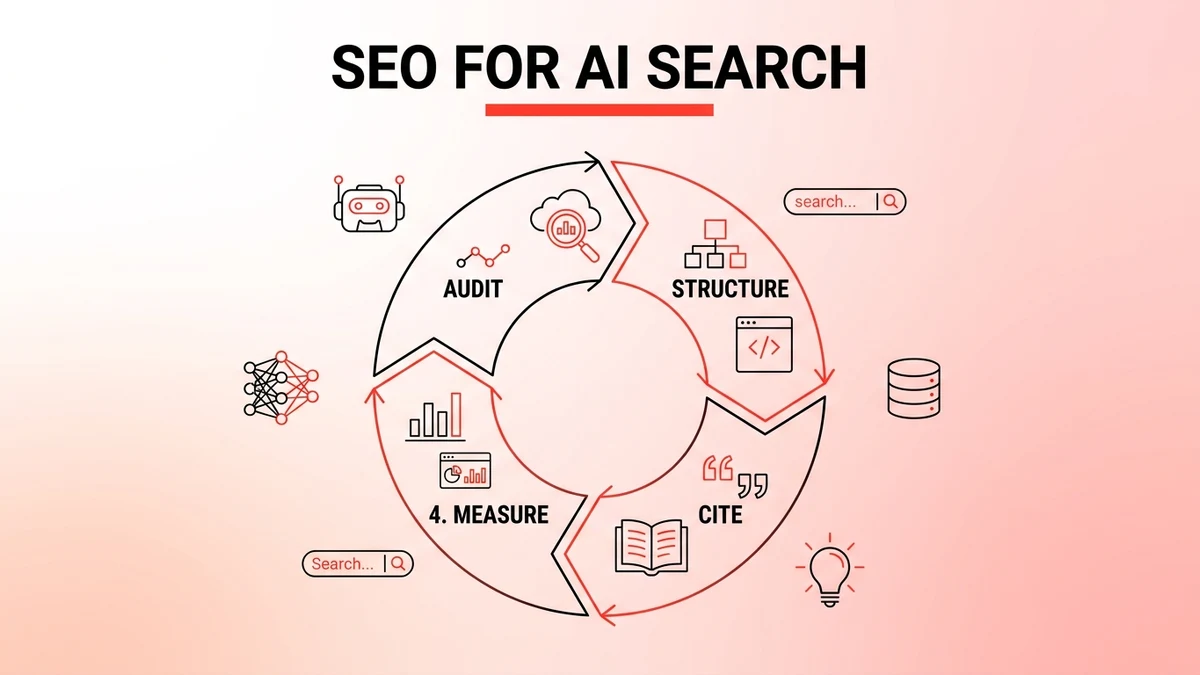
The AY Rank programme runs in four stages. Each maps to a phase of the timeline.
Stage 1: AI ranking audit (weeks 0 to 2)
Baseline measurement of current AI citations across ChatGPT, Perplexity, Gemini, and Google AI Overviews. Technical audit of crawl status, schema markup, llms.txt, and entity coverage. This is also the week to budget. Our GEO pricing guide covers what to expect financially.
Stage 2: Entity architecture (weeks 2 to 6)
Fix technical foundation. Deploy schema markup across all key pages. Build entity coverage (Wikipedia, Wikidata, consistent brand descriptions across third-party properties). Publish a core cluster of 8 to 15 pages with FAQ schema. First Perplexity citations typically land in this window.
Stage 3: Authority deployment (weeks 6 to 14)
Distribute brand mentions across high-authority third-party properties. Publish supporting content (definition guides, comparisons, data studies). ChatGPT and AI Overview citations stabilize. Share of voice begins to shift on mid-tail prompts.
Stage 4: Validation and results (weeks 14 to 24+)
Gemini share-of-voice shift completes. Citations stabilize across all four engines. Programme moves into a maintenance cadence (1 to 2 new pages per week, monthly entity refresh, quarterly schema audits).
The full programme is detailed at our GEO agency programme page, or you can book a free AI visibility audit for a concrete timeline tied to your domain.
How do you set expectations with stakeholders?
The biggest failure mode is not a slow GEO programme. It is a fast GEO programme that the CFO thinks is slow because nobody set the timeline upfront. Three rules:
- Quote the 4 to 24 week range, not a single number. Anyone promising 30-day GEO results is either lying or working a Perplexity-only scope.
- Track leading indicators, not lagging ones. Citation count is the lagging metric. The leading metric is structured data coverage, entity completeness, and indexed page count.
- Calibrate against your starting position. A site already ranking on Google needs 8 to 14 weeks. A brand-new domain often needs 16 to 24 weeks for the same outcomes.
For a board-ready model, our GEO ROI calculator takes your current traffic, AOV, and target engines and outputs a payback timeline tied to citation gains.
How does the AY Rank GEO programme compare to a typical agency?
Most agencies bundle GEO into a generic content retainer, which dilutes the timeline. Here is how AY Rank structures the work differently.
| Dimension | Typical agency | AY Rank GEO programme |
|---|---|---|
| First citation target | "Eventually" | Week 4 (Perplexity) |
| Engines tracked | ChatGPT only | ChatGPT, Perplexity, Gemini, AI Overviews |
| Technical foundation | Optional add-on | Stage 1 deliverable |
| Entity work | Not included | Stage 2 deliverable |
| Reporting cadence | Monthly | Weekly leading indicators, monthly share-of-voice |
| Client cap per category | Unlimited | One client per category per market |
If your current SEO or content agency cannot answer "where are we cited in ChatGPT today and how is that trending week-over-week," you are paying for content, not GEO.
FAQ
How long does GEO take to show results?
GEO typically shows first results in 2 to 8 weeks depending on the engine. Perplexity is fastest (2 to 6 weeks), ChatGPT and Google AI Overviews land in the 4 to 12 week range, and Gemini takes 8 to 16 weeks for visible share-of-voice change. Full programme impact across all four engines typically lands between weeks 14 and 24.
Why does Perplexity show results faster than ChatGPT?
Perplexity uses a near real-time index and generates every answer live against current sources, so a page can be cited within days of publication. ChatGPT relies on a mix of pre-trained model weights (which refresh quarterly) and live retrieval calls through Bing, which adds latency. The result is a 2 to 4 week head start for Perplexity citations in most programmes.
Can I see GEO results in 30 days?
Yes, but only on Perplexity and only for niche long-tail queries. Promising 30-day results across ChatGPT, Gemini, and AI Overviews is not realistic given how those engines refresh their indexes and rerank sources. A realistic 30-day milestone is: technical foundation deployed, first 8 to 15 pages live, first Perplexity citations on long-tail prompts.
Why hasn't my GEO programme delivered after 6 months?
The three most common causes are technical debt blocking AI crawlers, weak entity coverage (no Wikipedia, inconsistent brand descriptions), and thin content that lacks the structured Q&A pairs AI engines extract. Run a baseline check with a tool like our AI visibility checker to identify which is the bottleneck.
Is GEO faster than traditional SEO?
On Perplexity, yes (2 to 6 weeks versus 3 to 6 months for classic Google ranking). On ChatGPT, roughly comparable (4 to 12 weeks). On Google AI Overviews, GEO inherits SEO's timeline because AI Overviews are pinned to classic ranking. The honest framing: GEO is faster on the engines that index in real time, slower on the engines tied to Google's ranking pipeline.
What happens after 12 months of GEO?
After month 12, well-executed programmes shift from acquisition mode to defensive mode. Citation positions stabilize, the brand enters parametric memory on the next ChatGPT model refresh, and maintenance shifts to entity freshness, new content for emerging query patterns, and quarterly schema audits. The marginal cost per citation typically drops 40 to 60 percent compared to months 1 to 6. For a fuller breakdown of the category, see what is generative engine optimization.
Sources: AY Rank programme calibration data across 40+ B2B SaaS engagements, 2024 to 2026. Perplexity index refresh documentation. Google Search Central documentation on AI features.
This post is part of our GEO Optimization guide. Related reading: AY Rank vs Directive Consulting, AY Rank vs First Page Sage, Topical Authority for AI Search.

Oussama leads technical and on-page SEO at AY Rank. He specializes in structured data engineering, crawl optimization, and building the entity architecture that makes AI models cite our clients.
Full Bio →