About the Author

Oussama Alami
Head of SEO
Oussama leads technical and on-page SEO at AY Rank. He specializes in structured data engineering, crawl optimization, and building the entity architecture that makes AI models cite our clients.
Full Bio →Google released the November 2026 core update on November 10. What Google has posted so far, a first-7-days Search Console checklist from Google's own docs, and one site's early numbers.
 Client result: Wearview went from $0 to $36K MRR in 8 months.
Oussama leads technical and on-page SEO at AY Rank. He specializes in structured data engineering, crawl optimization, and building the entity architecture that makes AI models cite our clients.
Full Bio →Google confirmed the November 2026 core update on its Search Status Dashboard on November 10, 2026. The entry is three lines long. It says the update is out, that it applies everywhere, and that the rollout "may take up to 2 weeks to complete." That is all Google has said about this update so far.
So this guide sticks to Google's own pages. You get the dated rollout status, what Google's core updates documentation says about changes like this one, and a Search Console checklist for your first 7 days, with the report names and compare steps exactly as Google describes them. At the end we show our own site's numbers, one site, a few hours into the rollout.
Yes. The status entry shows no end date yet.
| Question | What Google says | Source |
|---|---|---|
| Name | "November 2026 core update" | Status entry |
| When did it start? | "Incident began at 2026-11-10 10:06 (all times are US/Pacific)". Announced at 10:07 PST, which is 18:07 UTC | Status entry |
| Where does it apply? | "applies globally and to all languages" | Status entry |
| How long will it take? | "The rollout may take up to 2 weeks to complete." | Status entry |
| When will it end? | Not posted yet | Status entry |
| How long did 2026's other core updates take? | May 2026: 11 days, 21 hours. March 2026: 12 days, 4 hours | Ranking history |
| What changed? | Not stated by Google | |
| Which sites are affected? | Not stated by Google |
If the rollout takes the full 2 weeks, it would end around November 24. That date is our arithmetic, not Google's. Watch the status entry for a line like the one Google posted at the end of its September 2026 spam update: "The rollout was complete as of October 8, 2026." To get that line without checking by hand, Google's status dashboard help page says "you can subscribe to our RSS feed."
Nothing specific. The status entry links to Google's general page, Google Search's core updates and your website. That page describes every core update, not this one.
Here is what it says:
Google explains it with a list of 20 favorite restaurants written in 2019. New places open, old favorites move up or down, and "restaurants that move down aren't necessarily "bad"; there are just other restaurants that make your top 20."
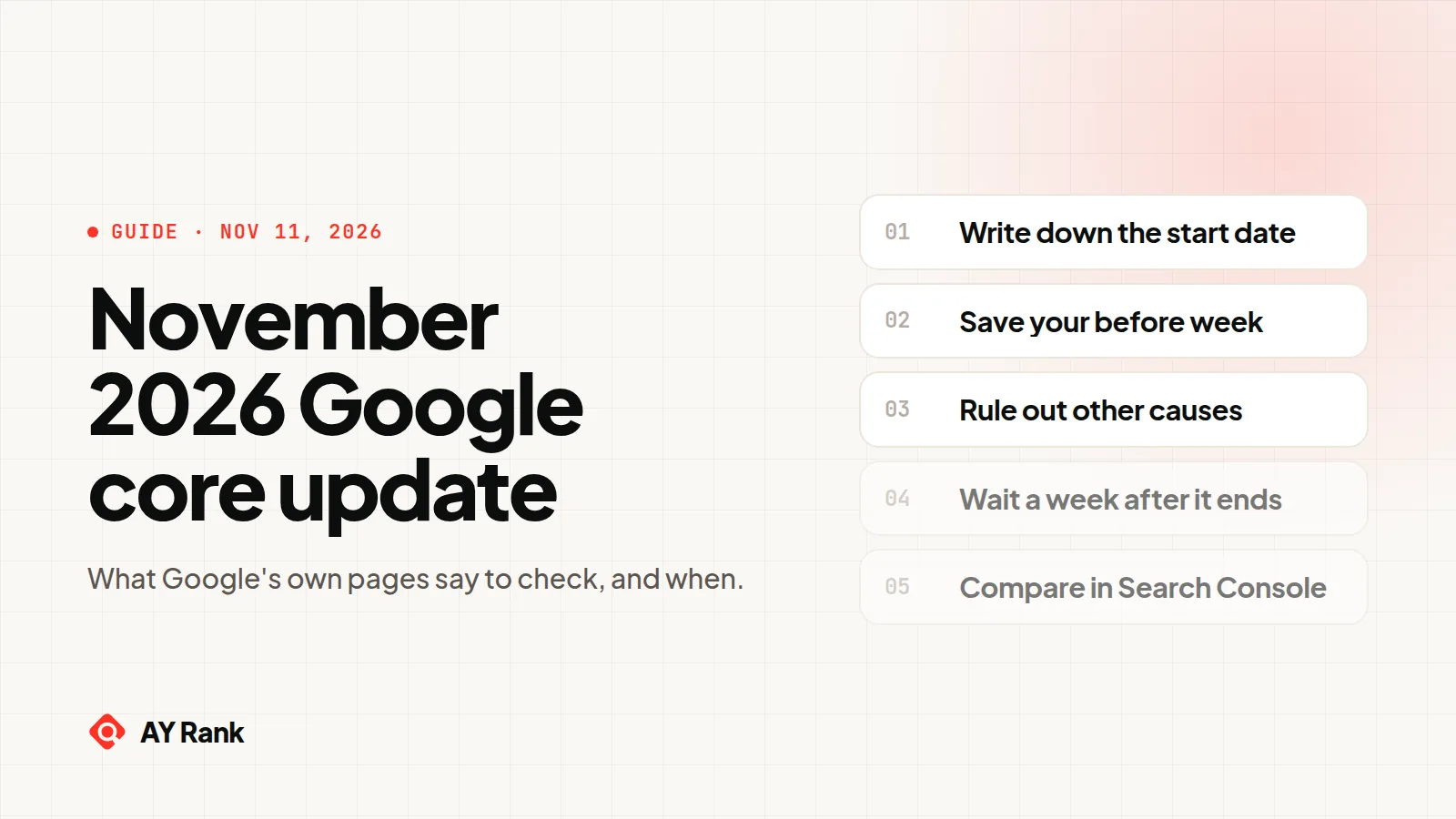
Mostly you set up the comparison you will need later, and rule out problems that have nothing to do with the update. Google's core updates page and its guide to debugging drops in Google Search traffic give the steps. We put them in order for the first week.
| When | What to do | Where in Search Console | Google's words |
|---|---|---|---|
| Day 1 | Write down the start: November 10, 2026, 10:06 Pacific | Status dashboard, not Search Console | "take note of the start and end date of the core update" (core updates) |
| Day 1 | Save your "before" week: November 3 to 9 | Performance report, Date filter, Compare tab | "comparing this week with a week before the core update started rolling out" (core updates) |
| Days 1 to 7 | Rule out technical problems | Crawl stats report, Page indexing report | "find if there's a corresponding spike in issues detected" (traffic drops) |
| Days 1 to 7 | Rule out security and spam problems | Security Issues report, Manual Actions report | "check the Manual Actions report" (traffic drops) |
| Days 1 to 7 | Rule out a reporting glitch | Search Console Data Anomalies page | "The drop might be related to a change in the data processing or a logging error" (traffic drops) |
| Days 1 to 7 | Check seasonality |
Open the Performance report for search results. Choose the Date filter at the top of the chart, select the Compare tab, and set your two ranges. Google's comparison help says that once you compare two values, "the results table will display a Difference column."
For now, export the week before the update, November 3 to 9, 2026. That is the "before" side of Google's recommended comparison. Search Console keeps this data, so the export is only there to make the later comparison quick.
A drop this week is not proof of a core update hit. Google's traffic drops guide lists other causes with their own reports: technical issues (Crawl stats, Page indexing), security issues, manual actions, seasonality, and site moves. If one of those reports shows a spike in the same days, fix that first. It is the one thing you can act on now.
Also watch the 24-hour view. Google's Performance report help says its data points "include preliminary data." Early numbers move.
Google suggests checking whether a drop "happened in Web Search, Google Images, Video mode, or the News tab." Use the Search type filter at the top of the chart. A drop in one type and not the others tells you more than the total does.
Only after the rollout ends, plus a full week. Google's core updates page gives the order:
So if Google posts an end date of November 24, your first fair look is around December 1. You would compare the week after the end with November 3 to 9. Both dates in that example are ours. Use the real end date when Google posts it.
When you do compare, Google splits drops into two kinds:
| You see | Google's example | What Google says to do |
|---|---|---|
| Small drop in position | Position 2 to 4 | "There's no need to take drastic action (in fact, we recommend avoiding making changes to content that's already performing well)." |
| Large drop in position | Position 4 to 29 | "Do a deeper assessment" with the self-assessment questions, looking at "your site as a whole" |
Google's traffic drops guide adds one more pattern. "If your impressions remain the same but your clicks drop, you might not be generating the best page title and snippet that you could," or "perhaps other sites had a more appealing rich result."
To find which pages moved, Google says to "Review the Pages table below the chart" and "Select Clicks Difference to order it based on pages that lost the most traffic." Click Average position above the chart to see rank, not just clicks.
| Date filter, Last 16 months |
| "make sure it's not a drop that happens every year" (traffic drops) |
| Days 1 to 7 | Split by search type | Search type filter: Web, Image, Video, News | "Analyze different search types separately" (core updates) |
|---|
Google never says "don't touch your site." It does say to confirm the rollout has finished and wait a week before you analyze, and its core updates page lists changes to avoid:
Our reading: if you rewrite pages during the rollout, you can't tell what moved them. Keep shipping planned work, and leave pages that already rank alone until you have the after-week numbers. Google also says "Small fluctuations in position can happen at any time (including moving back up in position, without you needing to do anything)."
Fixes from the rule-out step are different. A noindex tag by mistake, a server error spike or a manual action are not core update effects. Fix those now.
This is one site, early in the rollout, so it is not evidence about the update. We pulled ayrank.com's Search Console data (domain property) on November 10, 2026 at 23:27 UTC and compared the last 7 full days with the 7 before them. Both weeks end before the release.
| Metric | Oct 27 to Nov 2 | Nov 3 to Nov 9 | Change |
|---|---|---|---|
| Clicks | 146 | 126 | -13.7% |
| Impressions | 61,242 | 60,153 | -1.8% |
| CTR | 0.24% | 0.21% | -0.03 points |
| Average position | 32.3 | 32.4 | About the same |
A 13.7% click drop in the week the update landed would be easy to blame on it. It can't be the cause here. Every day in that week came before the release. Our daily clicks went 38, 29, 16, 18, then 5 on November 7 and 6 on November 8. The week before had days of 9 and 10 clicks too (October 30 and 31), so swings like this are normal for a site our size.
November 10 itself was incomplete when we pulled it: 2 clicks and 3,797 impressions so far. That is not enough to read anything into.
The biggest single loss was our free backlink sites list, over the same two weeks: clicks fell from 86 to 49 (-43%), impressions from 2,809 to 2,489 (-11%), and average position stayed at about 12. The page did not lose rank. Clicks fell faster than impressions, which is close to the pattern Google's guide links to the title and snippet, or to a better rich result on another site. We are not editing that page until the rollout ends.
What the table is good for: November 3 to 9 is our saved "before" week. When Google posts the end date, we will compare the week after it with November 3 to 9, as Google recommends, and update this section.
Google's core updates page does not mention AI Overviews or AI Mode, so any effect there is not stated by Google. If your buyers also ask ChatGPT, Gemini or Perplexity, a core update tells you nothing about those answers. Check them separately. That is the work our GEO optimization service does. For Google's own AI answers, our post on the AI Overviews report in Search Console shows where to look.
Google's last ranking update before this one was the September 2026 spam update. We covered the one before it, the August 2026 spam update, the same way, from Google's own pages.
Yes. Google released the November 2026 core update on November 10, 2026 at 10:07 PST. As of November 10, 2026, 23:28 UTC, its status entry showed no end date, so it is still rolling out.
Google says "The rollout may take up to 2 weeks to complete." It has not posted an end date. On the same dashboard, the May 2026 core update took 11 days, 21 hours and the March 2026 core update took 12 days, 4 hours.
Google has not said. The status entry links to its general core updates page, which describes "broad changes to our search algorithms and systems" that "don't target specific sites or individual web pages."
Maybe not. Google's traffic drops guide lists technical issues, security issues, manual actions, seasonality and reporting glitches as other causes, most with their own Search Console report. For seasonality it points to Google Trends and the Last 16 months view. Our own clicks fell 13.7% in the last full week before the update, so a drop can have nothing to do with it.
Google recommends confirming the rollout has finished and "waiting at least a full week" before analyzing your site in Search Console. For small drops it recommends "avoiding making changes to content that's already performing well." Our advice: fix technical problems now, and hold content changes until you have the after-week numbers.
Google says to self-assess your site as a whole if you see a large, lasting drop, and warns there is "no guarantee" changes will help. Effects "could take several months," and if nothing has changed after a few months, that "could mean waiting until the next core update."
Not stated by Google. Neither the status entry nor the core updates page mentions AI Overviews or AI Mode.
Sources: Google Search Status Dashboard, November 2026 core update, Ranking history, Google Search Central, Google Search's core updates and your website, Google Search Central, Debugging drops in Google Search traffic, Google Search Central, Using the Google Search Status Dashboard, Google Search Central, Creating helpful, reliable, people-first content, Search Console Help, Performance report, Search Console Help, Advanced filtering and comparison. All read November 10, 2026.