Google finished rolling out its Search Console generative AI performance report to every website worldwide on August 31, 2026. The report shows how many times your pages appeared inside AI Overviews, AI Mode, and the generative AI features in Discover, broken down by page, country, date, and device. It does not show clicks. It does not show which queries triggered the impressions. Google built that limitation into the report on purpose, and it changes how you have to read the numbers.
Alongside the report, Google shipped a property-level opt-out: a toggle in Search Console Settings that pulls a site's links and content out of AI Overviews, AI Mode, and Discover's AI features, both as a cited link and as material the models can draw from when generating an answer. It doesn't touch normal Search rankings, and it's a separate control from Google-Extended, which governs AI model training.
Here's what most coverage of this launch skipped: the report gives you a number with no denominator and no context, and the opt-out is a real decision with real trade-offs, not a checkbox anyone should flip reflexively.
What does the new Search Console AI report actually show?
It shows impression counts, meaning how many times a page from your site appeared inside an AI Overview, inside AI Mode, or inside one of Discover's generative AI features, whether or not your brand was named in the generated text and whether or not anyone clicked through. You can filter and break those impressions down by page, by country, by date, and by device, but the breakdown stops at Search; Discover doesn't get the device split.
What's missing matters more than what's there. There's no click data and no query data, which means you can see that a page got pulled into an AI surface a few hundred times last week, but not which questions triggered it and not whether a single person acted on what they read. Google's own explanation, per its engineers Hillel Maoz and Moshe Samet, is that AI-generated answers synthesize multiple sources into one response, so attributing a click or a specific query to any one source doesn't map cleanly onto how the old ten-blue-links report worked. Whether that's the full story or a convenient way to withhold competitively useful data, the practical result is the same: this report tells you where you're getting pulled in, not why or whether it worked.
How did we get from a UK test to a global rollout?
Google announced the report on June 3, 2026, as a limited test in the UK. Through July it expanded to more countries outside the UK, and by August 31, 2026, it was live for every property in Search Console worldwide, alongside the opt-out control. Four months from announcement to global availability is fast for a Search Console feature, and the timeline isn't a coincidence.
Why is a UK regulator driving a Google product feature?
Because it's mandated, not volunteered. The UK's Competition and Markets Authority (CMA), acting under the Digital Markets, Competition and Consumers Act 2024, designated Google as having Strategic Market Status in search and ordered it to give publishers both visibility into how their content performs in AI features and a real way to opt out of them.
The compliance calendar runs well past this rollout:
That anti-retaliation clause is worth sitting with. Regulators clearly anticipated the obvious worry, that opting out of AI Overviews might quietly cost you ranking elsewhere, and moved to close it off explicitly.
What does the opt-out actually exclude, and what does it leave alone?
The property-level toggle in Search Console Settings removes your site as a link and as source material from AI Overviews, AI Mode, and Discover's generative AI features. Two things it does not touch: your ranking in regular Search results, and whether your content trains Google's models, which is governed separately by the Google-Extended crawler control.
| Control | What it excludes | What it does NOT affect |
|---|---|---|
| New AI features opt-out (Search Console Settings) | Links and content in AI Overviews, AI Mode, Discover's AI features | Regular Search rankings |
| Google-Extended | Use of content to train Gemini and future models | AI Overviews, AI Mode, current model outputs |
| noindex | All indexing, including regular Search | Nothing indexed anywhere |
Three separate levers, three separate decisions. Conflating them is the fastest way to opt out of the wrong thing.
How do you read impressions data that has no clicks and no queries attached to it?
Treat it as a discovery signal, not a performance metric. A page showing up 4,000 times in AI Overview impressions over 28 days tells you Google's models consider that page relevant grounding material for whatever cluster of questions it's answering. It does not tell you whether that exposure moved a single person toward buying anything.
The useful move is triangulation, not staring at the AI report in isolation:
- Cross-reference against your existing Search Console query report. If a page's AI impressions are climbing while its regular-Search clicks are flat or falling, that's your Seer-style CTR compression showing up in your own data, not just the industry-wide stat.
- Watch trend direction over weeks, not single-day counts. A single day's number is noisy; a sustained four-week climb or drop on a specific page is the signal worth acting on.
- Ask the AI platforms directly whether they recognize your brand, since the Search Console report can't tell you that. Prompt ChatGPT, Perplexity, and Gemini with the questions your buyers actually ask and see if your brand shows up in the answer. Our AI Visibility Checker covers the other half of that problem: it checks whether your site is technically structured for AI crawlers to find and cite in the first place, meaning crawler access in robots.txt, structured data, and content structure, rather than pull your content anonymously into a summary with no attribution.
- Segment by page type. A definitional or how-to page picking up AI impressions is doing its job; that's exactly the content AI Overviews are built to summarize. A bottom-funnel pricing or comparison page picking up heavy AI impressions with falling clicks is a different problem, and the one worth reading in the next section.
Should you opt your site out of AI Overviews and AI Mode?
For most sites, no. Seer Interactive's research on AI Overview queries found organic CTR fell from 1.76% to 0.61%, a 61% drop, when an AI Overview appeared on a search result page. That sounds like a case for opting out. It isn't, because the same research found brands that got cited inside the AI Overview saw 35% higher organic CTR and 91% higher paid CTR than brands that weren't cited. Opting out doesn't protect you from that CTR compression; it just guarantees you're never the cited brand that captures the upside. You still lose the click-through rate hit from AI Overviews appearing on the query. You just lose it as an invisible non-participant instead of as a visible, cited source.
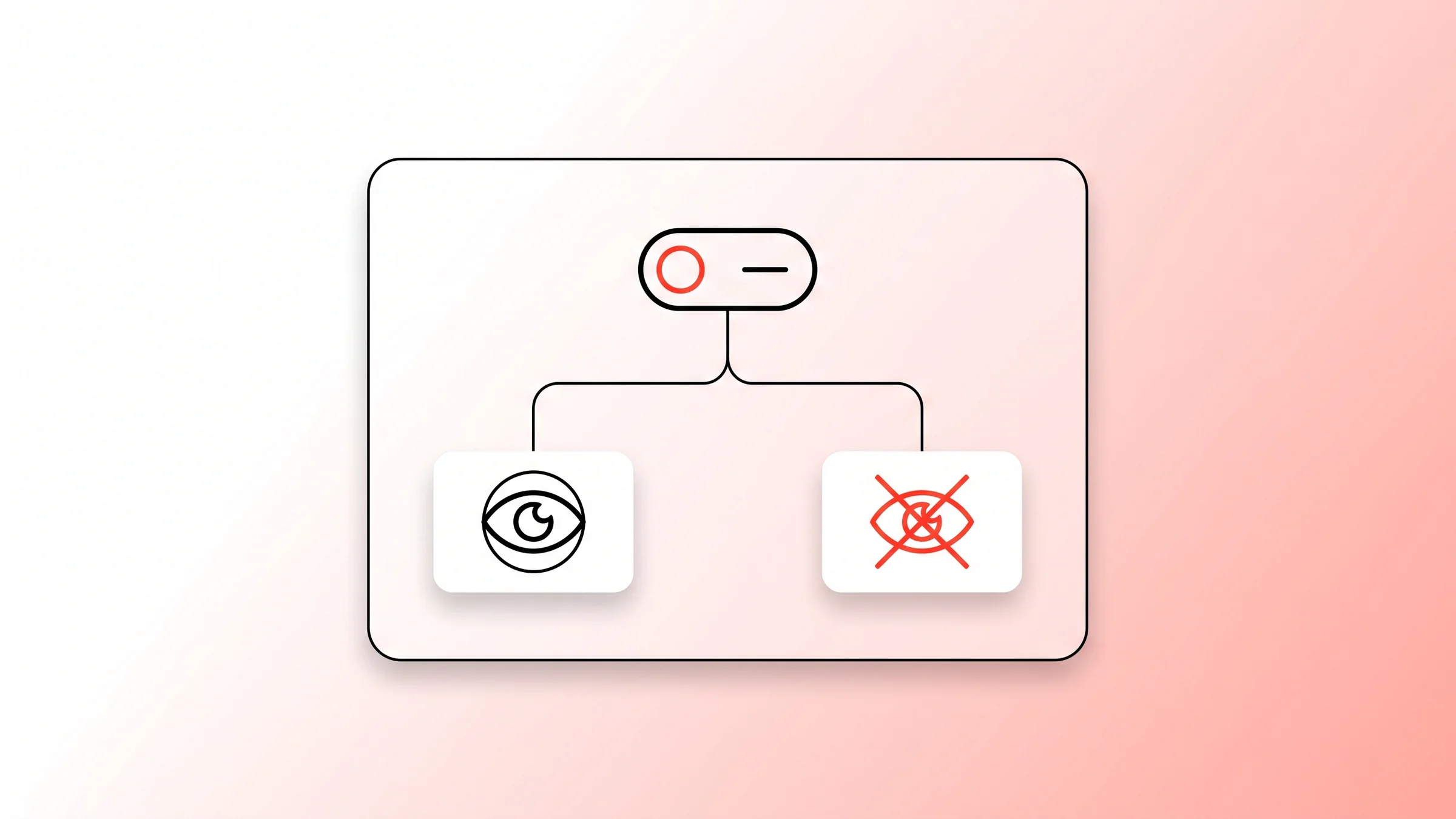 A simple decision-tree diagram branching from an AI-visibility toggle into one path showing an eye icon for staying visible and another showing a blocked eye icon for opting out
- Your value is in the depth of the page, not just the answer AI Overviews can lift from it: case studies, tools, pricing, comparisons people still need to visit the page for
- Being cited by name carries brand-recognition value even without a click
- You're already losing the CTR from AI Overviews appearing on the query whether or not you opt out, so staying in at least gives you a shot at the citation-lift numbers
- A page's entire commercial value is the click itself: ad-supported content, a paywalled resource, or a page where the summary genuinely substitutes for the visit
- You've measured that AI impressions on a page are climbing while direct traffic and brand-name mentions in AI answers both stay flat, meaning you're feeding the summary without gaining citation value
- Competitive or legal reasons specific to your content that have nothing to do with SEO performance
The AI report tells you where you're showing up, not why or whether it worked, so pair it with your existing query data and a name-citation check before drawing conclusions. And the opt-out isn't a shield against the CTR drop AI Overviews cause across the board; it's a way to guarantee you're never the cited brand capturing the 35% to 91% CTR lift that goes to sites that stay visible. Most sites should stay in.
What should you actually do with this report this week?
Pull the report for your top-trafficked pages and check whether AI impressions are concentrated on definitional or how-to content, which is expected and generally fine, or on pages where the click itself is the point, like pricing or comparison pages, which is worth investigating further. Our GEO optimization services build around exactly this kind of page-by-page read, restructuring the pages that need to earn the click rather than assuming every page should optimize the same way for AI extraction. If you're auditing a client site rather than your own, our AI visibility audit folds this report into the same review as your regular Search Console data instead of treating it as a separate, disconnected number.
Leave the opt-out toggle off unless you've already identified a specific page where the summary substitutes for the visit. Flipping it site-wide on a hunch, before page-level granularity ships in March 2027, trades away citation-lift upside you can't get back once page-level control exists and you'd rather have used it more precisely.
Frequently asked questions
What is Google Search Console's generative AI performance report?
It's a report, rolled out worldwide by August 31, 2026, that shows how many times a site's pages appeared inside AI Overviews, AI Mode, and Discover's generative AI features, broken down by page, country, date, and device for Search. It does not include click or query data.
Does the Search Console AI report show which queries triggered my impressions?
No. Google explicitly omits query-level data from this report, along with click data, because AI-generated answers typically synthesize several sources into one response, which doesn't map cleanly onto a single query-to-source attribution.
What does the new AI features opt-out control actually do?
It's a property-level setting in Search Console Settings that excludes your site's links and content from AI Overviews, AI Mode, and Discover's AI features, both as a cited source and as grounding material. It does not affect your regular Search rankings and is separate from Google-Extended, which governs AI model training.
Should I opt my site out of AI Overviews?
For most sites, no. Seer Interactive found brands cited inside AI Overviews get 35% higher organic CTR and 91% higher paid CTR than uncited brands, and opting out doesn't undo the CTR drop AI Overviews cause on a query, it just removes any chance of capturing that citation upside. Opting out makes more sense for specific pages whose entire value is the click itself, once page-level opt-out ships in March 2027.
Why did the UK's CMA get involved in a Google product feature?
The CMA designated Google as holding Strategic Market Status in search under the Digital Markets, Competition and Consumers Act 2024, and ordered it to give publishers visibility into AI feature performance plus a genuine opt-out, with a compliance timeline running from a December 2026 domain-wide toggle through page-level granularity in March 2027 and a regime that runs until October 10, 2030.
Can Google penalize my rankings if I opt out of AI Overviews?
No. The CMA's order includes an explicit anti-retaliation clause preventing Google from penalizing a publisher's regular Search ranking because they opted a site or page out of AI features.
How is this different from the Google-Extended control?
Google-Extended governs whether your content can be used to train future Gemini models. The new AI features opt-out is separate and controls whether your content and links appear inside current AI Overviews, AI Mode, and Discover's AI features. You can use either control independently of the other.
Will page-level opt-out replace the current site-wide toggle?
Not replace it, add to it. The CMA's timeline requires Google to add page-level granularity by March 3, 2027, on top of the domain-wide toggle that's already live, giving publishers the option to exclude individual pages instead of an entire property.
Sources: Google Search Console AI Reports Rolled Out Worldwide (Search Engine Journal), Google gives every site AI search reports, minus the clicks and queries (ppc.land)
This post is part of our AI SEO guide. Related reading: Domain Authority Doesn't Predict AI, Reddit's ChatGPT Citations Fell 86% in August, Is ChatGPT a Search Engine? The EU Just Said.

Adel tracks AI citation rates across ChatGPT, Perplexity, Gemini, and AI Overviews. He turns raw visibility data into actionable insights that guide our optimization strategy.
Full Bio →