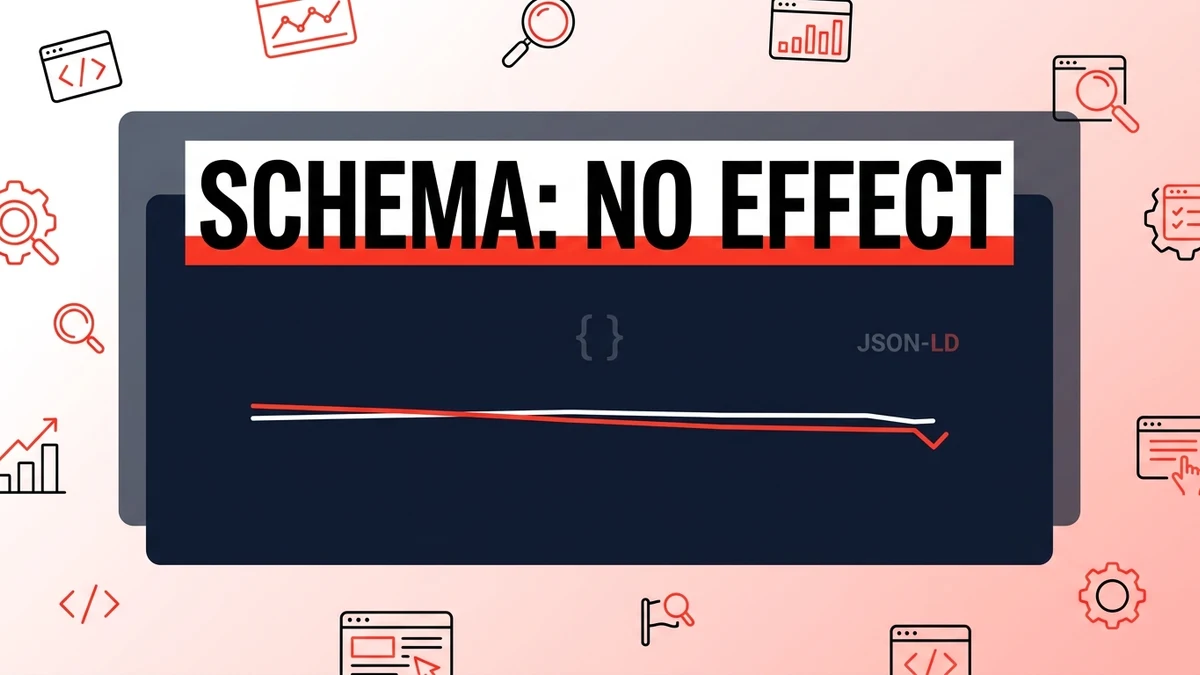
A controlled experiment tracking 1,885 pages that added JSON-LD schema found close to zero effect on AI citations. Not a small positive bump, not a modest win, close to zero on two of three platforms tested, and a small decline on the third. That result runs directly against a stat that's been repeated across the GEO industry, including in two of our own posts, that AI-cited pages carry schema markup at roughly three times the rate of uncited pages. Both numbers are real. Only one of them tells you what happens if you add schema to your own page.
What did Ahrefs actually test?
Ahrefs ran two separate studies, and the difference between them is the entire point of this post. The first was observational: across 6 million URLs, pages cited by AI systems were almost three times more likely to carry JSON-LD schema than pages that weren't cited. That's the number that's been circulating in GEO advice for the better part of a year, including in our own schema markup guide and structured data engineering guide, both originally framed as evidence that schema drives citations.
The second study, published May 11, 2026 by Louise Linehan and Xibeijia Guan (reviewed by Ryan Law), was built to answer a different question: if a page adds schema, does its citation rate actually change afterward? That's a causal question, and it needs a causal design, not a snapshot correlation. Ahrefs tracked 1,885 pages that added JSON-LD between August 2025 and March 2026, matched each one against similar control pages on different domains that didn't add schema in that window, and measured citation counts on Google AI Overviews, Google AI Mode, and ChatGPT before and after the change. Four separate statistical tests, including a matched difference-in-differences model, all pointed the same direction.
What actually happened after pages added schema?
| Platform | Effect on citations | Verdict |
|---|---|---|
| Google AI Overviews | -4.6% | Small but statistically significant decline |
| Google AI Mode | +2.4% | Statistically indistinguishable from zero |
| ChatGPT | +2.2% | Statistically indistinguishable from zero |
On two of three platforms, adding schema produced a result no different from noise. On the third, treated pages lost about 4.6% of their citation volume relative to matched controls, roughly 12 fewer daily citations per page on average in a sample where most pages were getting hundreds. That's real, and the odds of seeing a gap that size by chance are about 1 in 2,500. It is not, however, evidence that schema actively hurts a page: both the treated pages and the control group were already declining before schema went on, likely from a Google update or content going stale, and the treated pages simply fell a little faster. Reading that as "schema tanks your AI Overview visibility" overstates a small, noisy negative sitting next to two flat results.
Why did we get this wrong in our own content?
We ran the 4.7x correlation stat from our own site audits in two flagship posts and framed it as evidence schema drives AI visibility. It doesn't, or at least the controlled test found no reliable evidence that it does on pages already doing reasonably well elsewhere. We've added a correction to both the schema markup for GEO guide and the structured data engineering guide linking back to this study, because the honest move when new controlled evidence contradicts something you published is to say so, not to quietly stop repeating the old number. This post exists because the causal-evidence question deserves its own treatment rather than a caveat buried in two implementation guides.
If not schema, then what actually drives AI citations?
The confound analysis points at the answer: whatever schema-adding sites were doing besides adding schema. A few things stand out as genuinely testable, unlike schema's causal effect, which this study closes the door on for sites with a solid technical baseline.
- Content structure that answers the question directly. Pages that state a clear answer near the top, in plain language a model can lift without inference, get cited more consistently than pages that bury the answer in paragraph four.
- Source diversity and earned media. Being mentioned, linked, and discussed across independent sites gives AI systems more corroborating evidence that your page is a real source, not just a well-marked-up one.
- Crawlability. A page a crawler can't reliably fetch or parse doesn't get cited no matter how complete its JSON-LD is. Confirm the basics before layering on structured data.
- Content freshness and maintenance. Sites that update pages regularly are the same sites this study found already over-indexing on schema; the maintenance habit is plausibly doing more work than the markup it produces.
None of this means schema is worthless. It still earns its place for rich results, entity disambiguation, and giving a model an unambiguous, low-effort read of what a page is. What the data doesn't support is treating schema as a citation lever you can pull on its own. And for sites without that reasonably solid foundation already in place, the study is honestly silent, not proof either way, since every page in the sample was already established enough to be tracked for citations in the first place.
A controlled test of 1,885 pages found close to zero causal effect from adding JSON-LD schema on Google AI Mode and ChatGPT citations, and a small, likely-confounded decline on Google AI Overviews. The widely cited 3x correlation between schema and AI citation is real, but the study's own confound analysis suggests the rest of a site's SEO investment, not the markup itself, is doing the actual work. Treat schema as technical hygiene, not a citation strategy on its own.
Frequently asked questions
Does adding schema markup increase AI citations?
A controlled Ahrefs study of 1,885 pages that added JSON-LD schema found no reliable increase in citations on Google AI Mode (+2.4%) or ChatGPT (+2.2%), both statistically indistinguishable from zero, and a small statistically significant decline on Google AI Overviews (-4.6%).
Why do so many AI-cited pages have schema markup if it doesn't help?
Ahrefs found 53% of AI-cited pages carry JSON-LD schema, about three times the rate of uncited pages, across 6 million URLs. The controlled follow-up study attributes this to confounding: sites that add schema also tend to invest more in content quality, technical SEO, and link building, and those factors are more likely the actual drivers of citation.
Does this mean I should remove schema markup from my site?
No. The study found a small decline on Google AI Overviews specifically, but both treated and control pages were already declining before schema was added, so the drop likely reflects a pre-existing trend rather than schema causing harm. Schema still has value for rich results, entity disambiguation, and giving AI systems an unambiguous read of a page's content.
Is this study reliable?
Ahrefs ran four separate statistical tests, including a matched difference-in-differences design comparing 1,885 treated pages against 4,000 control pages with similar baseline citation levels, and all four pointed the same direction. That's a stronger design than the single correlational pass most "schema boosts AI citations" advice, including our own prior claims, was built on.
What should I focus on instead of schema for AI citations?
Content structure that states a direct answer near the top of the page, source diversity and earned media that corroborate your content elsewhere, reliable crawlability, and consistent content maintenance. The study's confound analysis suggests these are more likely to be driving the citation gap between schema-carrying and non-schema pages than the markup itself.
Does this study apply to sites with weak technical SEO?
The study doesn't say either way. Every page in the sample was established enough to be tracked for AI citations before the test began, so whether schema matters more for a site with a weaker foundational setup is genuinely untested, not disproven.
Sources: We Tracked 1,885 Pages Adding Schema. AI Citations Barely Moved. (Ahrefs, May 11, 2026)
This post is part of our Technical SEO guide. Related reading: Cloudflare's AI Crawler Rules Change September 15, Free SEO Audit Template for 2026, Schema Markup for GEO.

Oussama leads technical and on-page SEO at AY Rank. He specializes in structured data engineering, crawl optimization, and building the entity architecture that makes AI models cite our clients.
Full Bio →