What has not been published yet about Claude Fable 5.2?
As of 2026-11-09, 21:30 UTC, we could not find a primary source for any of the items below. If you see a confident number for one of them, check where it came from.
- An independent test of the "up to 30% faster" claim. The 30% figure, measured against Fable 5.1 and Mythos 5.1, is Anthropic's own. We have not seen a like-for-like third-party speed comparison yet.
- Independent numbers for Mythos 5.2. It is only open to verified organizations, so outside benchmarks will be slow to appear.
- How Claude ranks or picks sources in web search. Anthropic documents how the web search tool works and how citations look. It does not publish ranking factors. More on that below.
- Whether the Claude apps use exactly the same search setup as the API tool. The developer docs describe the API tool. We found no Anthropic page that says the consumer apps behave the same way.
- Real search volume for "claude fable 5.2". Keyword tools lag by weeks for brand-new terms.
Should you use Claude Fable 5.2 or Opus 5.5?
Anthropic's own advice is to start with Opus 5.5. The models overview says: "If you're unsure which model to use, start with Claude Opus 5.5 for most workloads. Use Claude Fable 5.2 for demanding reasoning and long-horizon agentic work, or when your evals on Claude Opus 5.5 at higher effort still fall short."
The last row is easy to miss. Cache reads cost $0.20 per million tokens on both models, according to the pricing page. If most of your input is a cached prompt, the input-side gap between the two models shrinks.
Anthropic also describes two team roles for Fable 5.2. As an "Advisor," Haiku, Sonnet or Opus models consult it on hard problems. As an "Orchestrator," it hands simpler tasks down to smaller models.
Key takeaway
Claude Fable 5.2 costs 2x Opus 5.5 per token. Anthropic's own data shows it can come within 0.2 points of Opus 5.5's best FrontierCode score at high effort for about half the cost per task. Test both on your own tasks before you switch.
What does Claude Fable 5.2 mean for AI search visibility?
When Claude Fable 5.2 runs with Anthropic's web search tool, it searches the web and cites the pages it uses. For a brand, the question is whether your page is one of the citations.
Below is what Anthropic documents about that process, all from the web search tool docs unless noted. None of it is specific to Fable 5.2. It applies to Claude models with the tool switched on.
When does Claude decide to search?
The docs say Claude searches when a request depends on information that is "current, changing, or outside its training data." The examples Anthropic lists include recent news, current prices, and "information about specific organizations, people, or products that might have changed."
We read that list as covering most buying questions. "Which GEO agency should I hire" or "what does tool X cost" both depend on products and prices. Claude Fable 5.2's knowledge cutoff is June 2026, so anything your company shipped after that mostly reaches the answer through search.
Claude answers without searching for stable facts, math, coding concepts and creative writing. Developers can also nudge it to search more or less through the system prompt.
What does a Claude citation contain?
Citations are always on for web search. Each one carries the source URL, the page title, and cited_text, which is "up to 150 characters of the cited content." Anthropic also tells developers who show API output to end users that "citations must be included to the original source."
Our inference from that field limit, not Anthropic guidance: the sentence that answers the question should make sense on its own in about 150 characters. A claim that only works with the paragraph around it quotes badly.
What happens to search results before Claude reads them?
With the web_search_20260209 tool version and later, "Claude can write and run code that filters the search results before they reach the context window." Anthropic calls this dynamic filtering. It is available on Claude 4.6 and later models, which includes Claude Fable 5.2, on the Claude API and most platforms.
So a page can come back in the raw results and still be filtered out before the model reads it. Anthropic does not document what the filter looks for, beyond keeping "only relevant information."
What can developers and site owners control?
Developers building on Claude can limit sources with allowed_domains or blocked_domains, and localize results with user_location. A Claude-powered app in your market may only search a short list of domains. You can't see that list from outside.
Site owners control crawler access. Anthropic runs three bots, described in its crawler help article:
You can block ClaudeBot for training and still allow Claude-SearchBot and Claude-User. Check your robots.txt before you assume Claude can read your site. Our free robots.txt generator handles ClaudeBot and other AI training crawlers. Add the Claude-SearchBot and Claude-User lines by hand.
What is not documented?
Anthropic does not say which search index the web search tool queries, how results are ranked, or what makes Claude prefer one source over another. Any article that lists "Claude ranking factors" as fact is guessing. We cover what the docs do say, in more depth, in our guide on how to get cited by Claude.
Does Claude Fable 5.2 search better than older models?
On one measure, yes. On WANDR, Perplexity's benchmark for large data-collection tasks, Anthropic reports 82.1% for Fable 5.2 against 72.3% for Opus 5.5 and 68.7% for Fable 5.1. The score says nothing about which websites it trusts or cites, so don't read a source-selection change into it.
Does Claude cite your brand when buyers ask?
We check what Claude, ChatGPT, Perplexity and Gemini say about your category and who they cite, then show you where you are missing.
Get your free AI visibility audit
What should you do this week?
- Check
robots.txt for Claude-SearchBot and Claude-User. Blocking them may reduce your visibility in Claude's search results, by Anthropic's own account.
- Put a self-contained answer sentence near the top of each key page. Keep it under about 150 characters so a citation can quote it whole.
- Publish current prices, product names and dates on your own pages. Those are the topics Anthropic says trigger a search.
- Ask Claude the questions your buyers ask, with web search on, and record which domains it cites. Repeat monthly.
If you want a team to run this across Claude, ChatGPT, Perplexity and Gemini, that is what our GEO service does.
Frequently asked questions
What is Claude Fable 5.2?
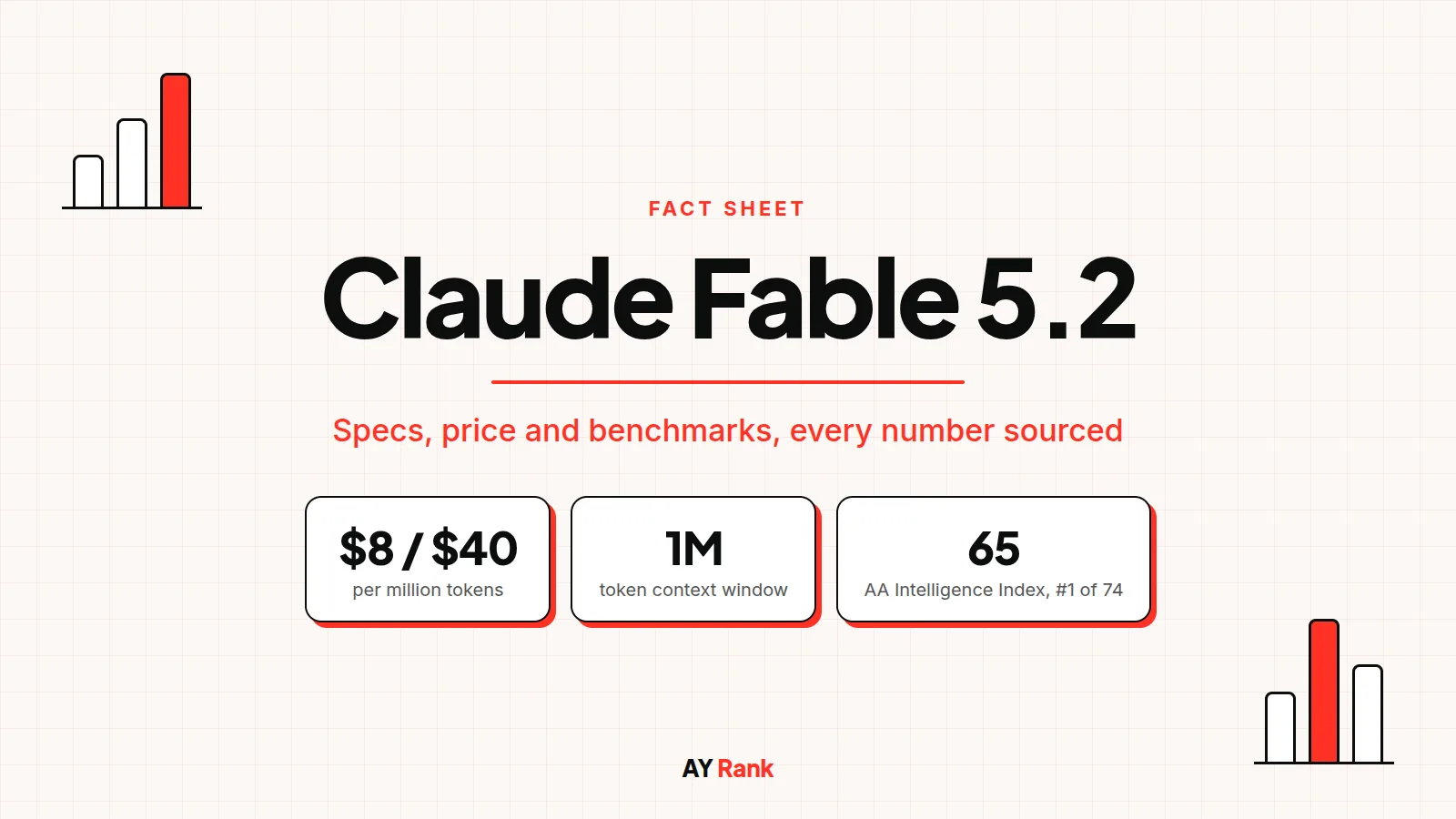
Claude Fable 5.2 is an Anthropic model for demanding reasoning and long-horizon agentic work, released on November 9, 2026. It costs $8 per million input tokens and $40 per million output tokens, has a 1M-token context window and 128K max output, and its API ID is claude-fable-5-2.
When was Claude Fable 5.2 released?
Claude Fable 5.2 was released on November 9, 2026. Anthropic's @claudeai launch post went out at 18:57 UTC that day, and the announcement, docs and pricing pages went live with it.
How much does Claude Fable 5.2 cost?
Claude Fable 5.2 costs $8 per million input tokens and $40 per million output tokens on the Claude API. That is 20% below Fable 5.1's $10 and $50. Fast mode costs $16 and $80, and the Batch API halves the standard price. Our pricing breakdown has worked examples.
Is Claude Fable 5.2 better than Opus 5.5?
Claude Fable 5.2 beats Opus 5.5 on most rows of Anthropic's benchmark table, but not all. Opus 5.5 is ahead on the AA-Briefcase Elo line, 1800 to 1785. Anthropic still recommends starting with Opus 5.5 for most workloads and moving up to Fable 5.2 when your evals fall short.
Can I use Claude Fable 5.2 for free?
Not through the launch offers, which don't cover the Free plan. Anthropic's launch offer gives Pro plans and standard Team seats all Fable models until November 16, 2026, at 11:59 pm PT, capped at 50% of weekly usage limits. Max, Ultra and premium Team seats get one to three Fable limit resets instead.
What is the difference between Claude Fable 5.2 and Claude Mythos 5.2?
They are the same underlying model with different safeguards. Fable 5.2 blocks high-risk cybersecurity and most research biology tasks and is open to everyone. Mythos 5.2 is for organizations accepted into Anthropic's Cyber or Life Sciences Verification Programs. Both cost $8 and $40 per million tokens.
Does Claude Fable 5.2 change how Claude cites websites?
Anthropic has not documented any change to how sources get picked for Fable 5.2. When Claude uses the web search tool, it decides when to search, can filter results with code on newer tool versions, and each citation carries the URL, title and up to 150 characters of cited text. Anthropic does not publish ranking factors. Our AI Visibility Report tests where Claude and other AI assistants cite your brand.
Facts checked 2026-11-09. Sources: Anthropic, Introducing Claude Fable 5.2 and Claude Mythos 5.2, Claude Platform models overview, Claude Fable 5.2 model page, Claude Platform pricing, Web search tool docs, Claude Fable 5.2 launch offers, Anthropic crawler help article, Artificial Analysis, Claude Fable 5.2, @claudeai launch post