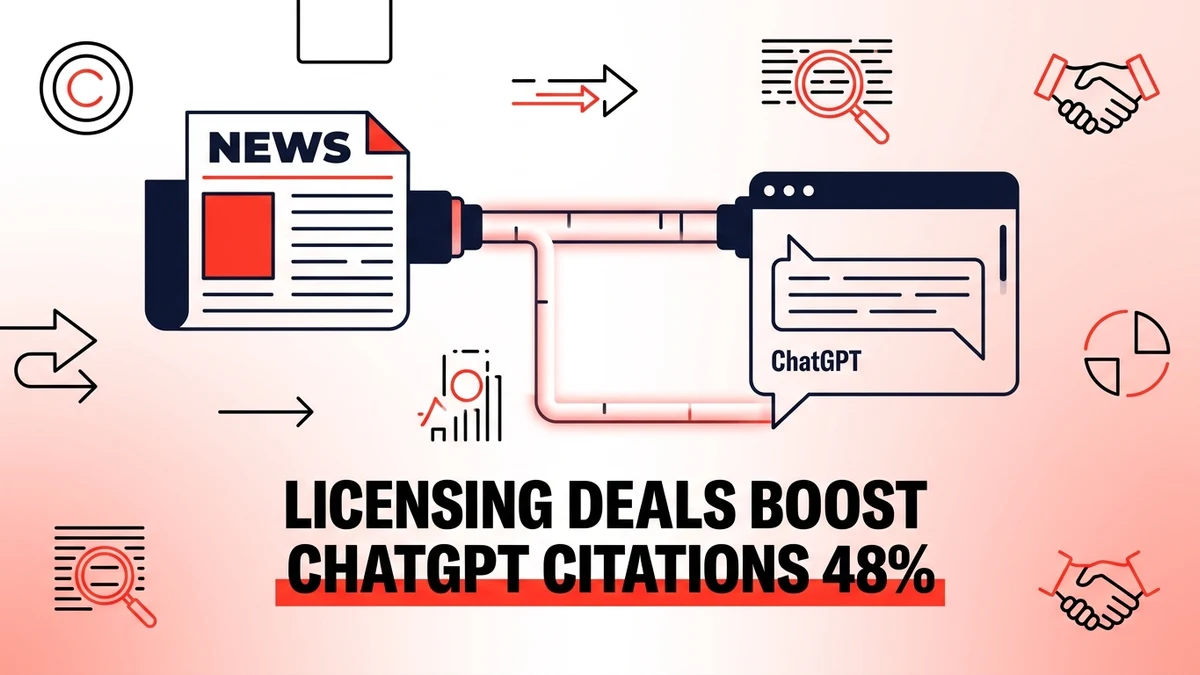
Publishers with an OpenAI content-licensing deal earn 48% more citations per page on ChatGPT than unlicensed publishers, according to a joint study by Press Ranger and OtterlyAI published August 20, 2026. Sign an exclusive OpenAI deal, no other AI company, and the premium jumps to 112%. That sounds like a straightforward "pay to get cited more" story. It isn't. The same study found the effect is specific to OpenAI: Google's licensed publishers were actually cited slightly less often on Google AI Overviews than unlicensed competitors, and Perplexity's licensed publishers landed at parity with unlicensed ones. A licensing deal doesn't buy AI visibility in general. It buys ChatGPT visibility, and concentrates a publisher's citation volume onto one platform in the process.
What did the Press Ranger and OtterlyAI study actually measure?
The study joined two datasets that hadn't been paired before. OtterlyAI supplied the citation side: 129.3 million citations across more than 20 million cited URLs, tracked across seven AI platforms, ChatGPT, Google AI Overviews, Google AI Mode, Perplexity, Microsoft Copilot, Gemini, and Claude, during June 2026. Press Ranger supplied the deal side: its AI-Publisher Licensing Research database, 91 confirmed agreements between AI companies and news publishers, mapped to 314 publisher domains, each record backed by a public source through July 28, 2026.
Matching the two let the researchers ask a question publishers and PR teams had argued over for three years without a real number attached: does signing a licensing deal with an AI company actually change how often that publisher's pages get cited? On ChatGPT specifically, the answer is yes. Licensed publishers' pages averaged 10.2 citations each; unlicensed publishers' pages averaged 6.9. Across all seven platforms combined, the same OpenAI-licensed cohort's premium narrows to 46% (10.7 versus 7.3 citations per page), which is the first hint that the effect isn't spread evenly.
Does a licensing deal help on every AI platform, or just ChatGPT?
Just ChatGPT, and this is the part of the study worth sitting with before anyone treats a licensing deal as a general AI-visibility play.
| Licensor | Effect on home platform | Effect size |
|---|---|---|
| OpenAI | Clear positive lift on ChatGPT | +48% overall, +112% for exclusive-only deals |
| Slight negative effect on Google AI Overviews | Licensed publishers cited slightly less than unlicensed | |
| Perplexity | No meaningful effect on Perplexity | Roughly at parity with unlicensed publishers |
OpenAI was the only licensor whose deals produced a clear home-platform citation advantage. Google-licensed publishers were cited at a slightly lower rate on Google AI Overviews than comparable unlicensed publishers, the opposite of what a "pay to get cited" theory would predict. Perplexity's licensed publishers sat at roughly the same citation rate as unlicensed ones, no meaningful lift either way.
Thomas Peham, CEO of OtterlyAI, put the finding plainly: "A licensing deal does one clear thing: it tilts your citations toward ChatGPT. It does not guarantee you show up everywhere, and it is not the only way to win. For most brands, the smarter move is to earn coverage in the vertical publishers AI already trusts."
Is a licensing deal actually the best move for most publishers?
Probably not, and the study's own numbers point that direction. News citations are a small slice of what AI platforms cite at all, 7.2% of all citations in the dataset. Within that slice, five media groups, Future plc, Forbes, People Inc., Condé Nast, and Hearst, capture 69% of all citations that go to licensed publishers. Licensing access is concentrated at the top of the market by scale, which matters for who this is realistically relevant to: publishers operating at that scale, not most businesses weighing their next content move.
Meanwhile, across 16 US industries the study examined, niche and trade outlets, most of them unlicensed, carried the majority of news citations in 15 of them, collecting 213% more AI citations than mainstream media. Steve Beyatte, Founder of Press Ranger, framed it as the real story: "For three years, publishers and PR teams have argued about whether these licensing deals actually change what AI reads, and nobody had a number. Now we do. The bigger surprise is not that OpenAI's deals pay off on ChatGPT, it is that the largest opening for PR teams sits with the trade and niche outlets nobody licensed. Those are the sources answer engines quote most in 15 of the 16 industries we looked at, and they are still wide open."
The most-cited news domains in the dataset include unlicensed outlets like NerdWallet, Healthline, and Bankrate, and the content types that draw citations most, best-of lists, buying guides, and product reviews, make up 46.9% of licensed publishers' citations too. That's a format finding as much as a licensing one: AI platforms cite service journalism, licensed or not.
An OpenAI licensing deal produces a real, measurable ChatGPT citation lift (48%, or 112% if exclusive), but it's a platform-specific effect, not a general AI-visibility strategy, and it concentrates 57.9% of citation volume onto one platform. Google and Perplexity licensing deals show no comparable lift on their own platforms. For most publishers, especially outside the handful of media groups that dominate licensed-publisher citations, earning coverage in the niche and trade outlets AI already trusts is the more available, and per this study's own industry breakdown, more consistently effective, path.
Frequently asked questions
Do AI content-licensing deals increase citations on ChatGPT?
Yes. Publishers with an OpenAI licensing deal averaged 10.2 citations per page on ChatGPT in June 2026, versus 6.9 for unlicensed publishers, a 48% increase, according to the Press Ranger and OtterlyAI study.
Does an exclusive OpenAI deal help more than a non-exclusive one?
Yes, substantially. Publishers who signed exclusively with OpenAI, with no licensing deals with any other AI company, earned 112% more citations per page on ChatGPT than unlicensed publishers, more than double the effect of a non-exclusive deal.
Do Google and Perplexity licensing deals produce the same citation boost?
No. Google-licensed publishers were cited slightly less often on Google AI Overviews than unlicensed competitors, and Perplexity's licensed publishers were roughly at parity with unlicensed ones. The home-platform lift only showed up for OpenAI.
What's the downside of an exclusive OpenAI licensing deal?
It concentrates citation exposure. OpenAI-licensed publishers now draw 57.9% of their total AI citation volume from ChatGPT alone, a much heavier concentration than unlicensed publishers, who spread more evenly across ChatGPT and Perplexity. That's a bet on one platform's continued dominance.
Is a licensing deal realistic for most publishers or brands?
Not at the scale this study measured. Five media groups, Future plc, Forbes, People Inc., Condé Nast, and Hearst, capture 69% of all AI citations that go to licensed publishers, and the 91 confirmed deals in the dataset skew toward large-scale publishers rather than small or mid-size ones.
What should smaller publishers or brands do instead of pursuing a licensing deal?
Target the niche and trade outlets AI platforms already cite heavily. The study found unlicensed niche and trade outlets carried the majority of news citations in 15 of 16 US industries examined, collecting 213% more AI citations than mainstream media, and that format, best-of lists, buying guides, and product reviews, draws citations regardless of licensing status.
Source: Press Ranger and OtterlyAI Release Study Showing Publishers With OpenAI Deals Earn 48% More AI Citations on ChatGPT (GlobeNewswire, August 20, 2026)
This post is part of our AI SEO guide. Related reading: The 50 Websites AI Search Actually Cites, ChatGPT Product Feed Requirements, Bing Webmaster Tools AI Performance Report.
Oussama leads technical and on-page SEO at AY Rank. He specializes in structured data engineering, crawl optimization, and building the entity architecture that makes AI models cite our clients.
Full Bio →