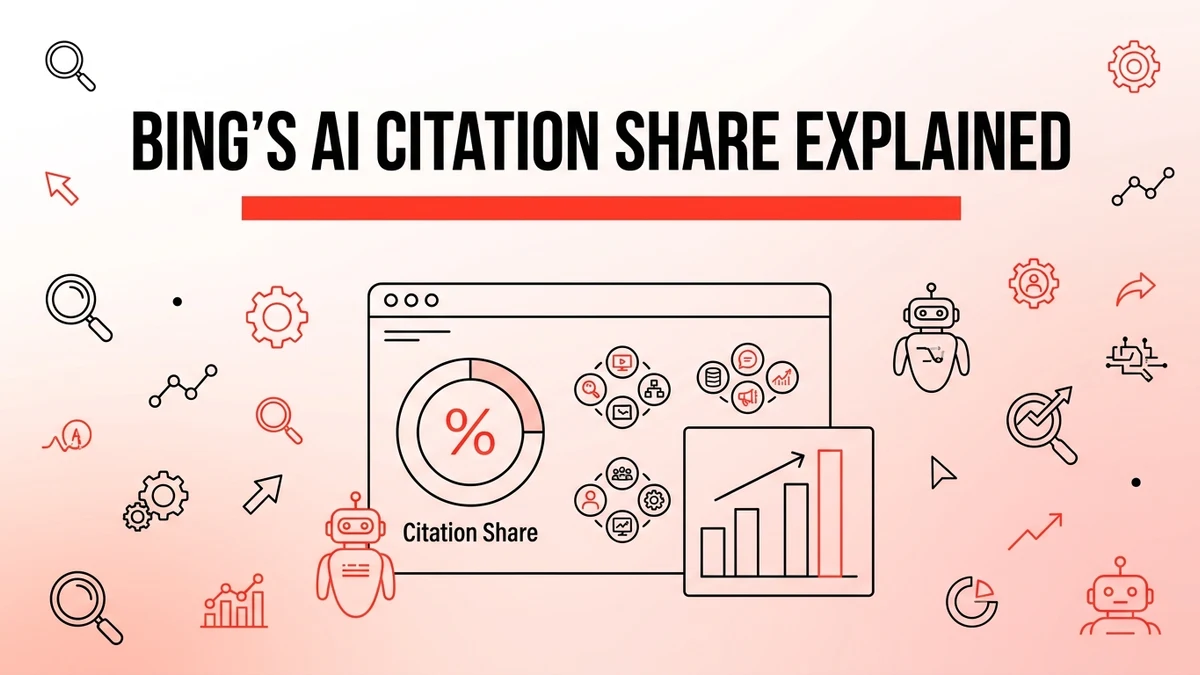
Microsoft expanded Bing Webmaster Tools' AI Performance report on June 16, 2026, adding four features: Intents, Topics, Citation Share, and Compare. The original report, launched February 10, 2026, only told you where your content got cited inside Copilot and Bing's AI answers. The expansion answers a different question: why that content surfaced, which subject areas it's winning in, and how its standing changes over time relative to everyone else answering the same query.
That's a meaningfully different report from Google's. Search Console's AI Overviews feature, which finished its global rollout on August 31, 2026, shows impression counts and nothing else, no clicks, no queries, no relative standing. Bing's tool shows you the actual grounding queries, the intent behind them, and now a percentage that tells you how much of the citation pie you're getting on a specific query compared to every other site cited for it.
What is the Bing Webmaster Tools AI Performance report?
It's a reporting dashboard inside Bing Webmaster Tools that shows how a site's content is being used and cited inside AI-generated answers across Microsoft Copilot, Bing, and select partner AI experiences. Microsoft shipped it on February 10, 2026, calling it out as the first time a major AI search provider gave site owners direct visibility into their own citation performance rather than leaving that as a black box.
The original version tracked two metrics: Total Citations, the total number of times your content was cited as a source in AI-generated answers over a given period, and Average Cited Pages, the average number of unique pages from your site cited per day over that same period. The dashboard also surfaced grounding queries, the search phrases Copilot generates internally when it decides it needs to pull in web content to answer something, distinct from what the user actually typed, plus a page-level citation view showing which specific URLs got cited. Useful on their own, but limited: you'd see that you got cited, and roughly how often, without much sense of why, or how you stacked up against anyone else answering the same query.
What changed in the June 2026 update?
Microsoft added four capabilities in global preview: Intents, Topics, Citation Share, and Compare. In its own framing, the original report answered "where is my content being cited?" The expansion is built to answer "why does content surface, which subject areas gain visibility, and how do citation patterns evolve?" Here's what each one does.
| Metric | Added | What it shows |
|---|---|---|
| Total Citations | Feb 2026 | The total number of citations displayed as sources in AI-generated answers during the selected time frame |
| Average Cited Pages | Feb 2026 | The average number of unique pages from your site displayed as sources in AI-generated answers per day over the selected time range |
| Intents | Jun 2026 | Classifies grounding queries into categories: Informational, Commercial, Navigational, Learn and Solve, Research, Creation, Local, and more |
| Topics | Jun 2026 | Groups related grounding queries into thematic clusters, e.g. "solar panels," "solar energy efficiency," and "residential solar installation" rolling up under Solar Energy |
| Citation Share | Jun 2026 | The percentage of citations attributed to your site out of all citations shown across all sites for that same grounding query |
| Compare | Jun 2026 | Overlays a prior time period on the current view, standard 30-day windows or custom date ranges, to observe citation trends over time |
Why do Intents and Topics matter more than another keyword list?
Because grounding queries on their own don't tell you much about context. Intents solves that by sorting queries into categories, so an e-commerce site might find it's showing up heavily in commercial or comparison-shopping contexts, while a publisher with how-to content sees itself concentrated in Learn and Solve or Research. That's a signal about what kind of content is actually earning citations, not just which keywords are attached to them.
Topics does something similar at a broader level. Instead of reading grounding-query data one keyword at a time, you see it grouped into subject clusters the way Microsoft's systems already reason about content, by theme rather than isolated phrase. Microsoft's own example: queries about solar panels, solar energy efficiency, and residential solar installation collapsing into one Solar Energy topic. If you write across a subject area, this is the view that tells you where you actually have authority versus where your coverage is thin.
Microsoft is upfront that both features are still maturing. The classification runs on evolving AI/ML models, and labels can be broad, especially in specialized or niche domains, during the preview phase.
What is Citation Share and what does it actually tell you?
Citation Share is the percentage of citations attributed to your site out of every citation shown for that specific grounding query, across every site cited. If a query pulls in citations from six sites total and your content accounts for two of them, your Citation Share on that query is roughly 33%. It's a relative measure of visibility for one query, not a raw citation count, and not anything close to search rank.
How does Compare help you read that trend?
Compare overlays a previous reporting period directly onto the current view; the standard options are current 30 days against the prior 30 days, plus custom date ranges. On its own, a Citation Share number or an impressions count is a snapshot. Overlaid against the prior period, you can see whether a content update, a seasonal shift, or a broader change in how AI systems ground their answers moved your numbers in either direction. Microsoft's own caveat applies here too: citation activity shifts for reasons that have nothing to do with your content, including model updates and changes elsewhere on the web, so a dip isn't automatically something you broke.
How does this compare to Google Search Console's AI Overviews report?
Google's report, which we covered when it finished its global rollout on August 31, 2026, shows impression counts for pages appearing inside AI Overviews, AI Mode, and Discover's generative features. That's it. No click data, no query data, no way to see which search triggered the impression, by design, according to Google's own stated reasoning that a single click or query doesn't map cleanly onto answers synthesized from multiple sources.
Bing's report goes further on every axis that matters for actually doing something with the data. It shows you the grounding queries themselves, sorted by intent and rolled up into topics, plus a relative visibility metric neither Google's report nor most third-party AI rank trackers offer. If you've been treating "check your AI citation status" as one generic task covered by whichever tool you already have open, this is the one that actually answers a more specific question: which named queries are you winning on, and by how much relative to everyone else answering that same query.
Worth checking even if you don't think of your site as "a Bing property." Copilot's citation surface draws on the same underlying data this report exposes, and Copilot usage isn't small.
Bing's AI Performance report now answers a question Google's Search Console AI report doesn't: which specific queries you're winning on, sorted by intent and topic, with a real trend line via Citation Share. It's genuinely useful for tracking your own performance over time. It is not competitive intelligence, since Microsoft explicitly withholds which other domains are splitting the rest of that citation percentage with you, so don't use it to try to out-guess a specific competitor.
FAQ
What is a grounding query in Bing's AI Performance report?
A grounding query is the internal search phrase Microsoft Copilot generates when it determines it needs to retrieve web content to answer a user's question. It's distinct from what the user actually typed, and it's the unit Bing's AI Performance report uses to attribute citations.
What is Citation Share in Bing Webmaster Tools?
Citation Share is the percentage of citations attributed to your site out of all citations shown across all sites for a specific grounding query. It shows relative visibility on that query, not a raw citation count, and Microsoft has said explicitly that it does not expose competitor domains, traffic share, or content quality scores.
When did Bing launch the AI Performance report?
Microsoft launched the AI Performance report inside Bing Webmaster Tools on February 10, 2026, tracking Total Citations and Average Cited Pages. It expanded the report on June 16, 2026, adding Intents, Topics, Citation Share, and Compare.
How is Bing's AI Performance report different from Google Search Console's AI Overviews report?
Google's report, live globally since August 31, 2026, shows impression counts only, with no click or query data attached. Bing's report shows the actual grounding queries, classifies them by intent, groups them into topics, and adds Citation Share, a relative visibility percentage Google's report doesn't offer.
Do I need to care about this if my site isn't optimized for Bing?
Yes, because Copilot's citation surface draws on the same grounding-query data this report exposes. A site doesn't need to think of itself as "a Bing property" to show up in, or benefit from tracking, Copilot's AI-generated answers.
Is Citation Share a ranking or competitive score?
No. Microsoft designed it as an observational metric for tracking your own citation trend on a given query over time. It deliberately withholds competitor domains and doesn't calculate traffic share or a quality score, so it isn't built for competitive benchmarking.
Are Intents and Topics fully accurate right now?
Not perfectly. Both run on AI/ML classification systems that are still maturing during the preview phase, and Microsoft has said labels can be broad for specialized or niche subject areas. Precision is expected to improve as the models see more real-world usage.
Sources: Microsoft Bing Blog, June 16, 2026, AY Rank: Google Search Console's AI Overviews Report, Explained, AY Rank: How to Rank in ChatGPT
This post is part of our AI SEO guide. Related reading: Google Search Console's AI Overviews Report,, Domain Authority Doesn't Predict AI, Reddit's ChatGPT Citations Fell 86% in August.

Walid founded AY Rank to help businesses dominate AI search. He leads the GEO methodology and oversees client strategy across 50+ cities in Europe, Middle East, and North Africa.
Full Bio →