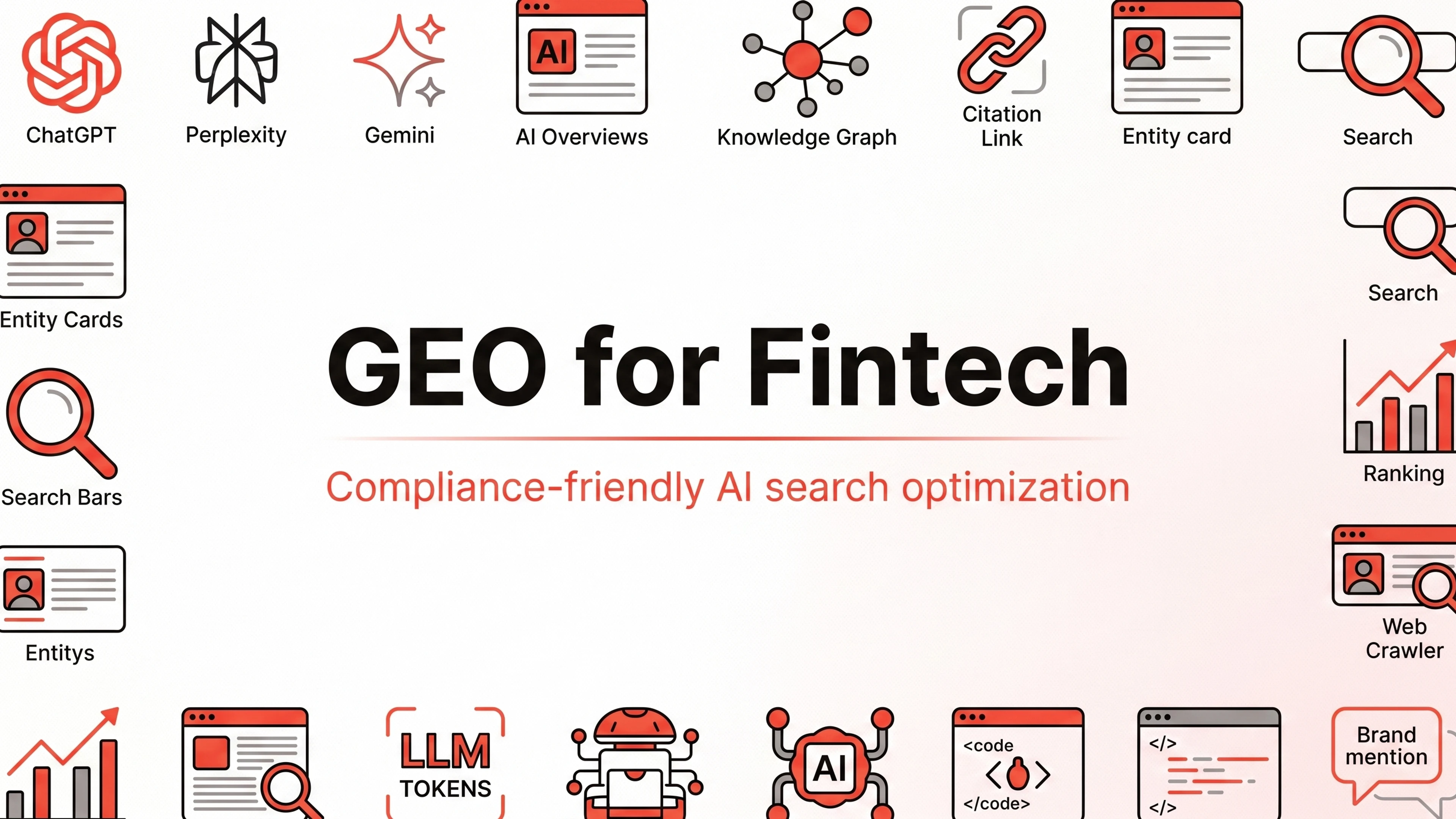
The Fintech GEO Paradox
Fintech companies are some of the most searched-for entities in AI engines. When someone asks Perplexity "what is the best business account for a UK startup," or asks ChatGPT "which neobank offers the highest interest rate on cash savings," the answer has direct financial consequences for the person asking, and for the brands being recommended.
This creates a paradox. Fintech is simultaneously one of the highest-stakes verticals for Generative Engine Optimization (GEO) and one of the most constrained. Financial content must be accurate. It must carry appropriate disclaimers. It cannot make misleading performance claims. And it must comply with FCA, SEC, MAS, or whichever regulatory framework governs your market.
The good news: the constraints of financial compliance and the requirements of GEO are more aligned than they first appear. Compliant financial content tends to be specific, factual, well-sourced, and regularly updated, precisely the qualities that AI engines reward with citations.
This guide shows you how to build GEO authority in fintech without compromising your compliance posture, and how to appear in AI-generated answers across ChatGPT, Perplexity, Google Gemini, and beyond.
Part 1: Financial Entity Optimization
In the language of knowledge graphs and AI systems, a financial entity is a uniquely identifiable financial product, company, or concept with a defined set of verifiable attributes. Your neobank, lending product, payment tool, or investment platform needs to exist as a well-defined entity in the world models of major AI systems.
Building Your Financial Entity
Step 1: Define your core entity attributes. Every financial product has a set of canonical facts that buyers need to know. For a business bank account: monthly fee, interest rate (if any), FX fees, supported countries, regulatory authorisation, deposit protection scheme. For a lending product: APR range, minimum/maximum loan size, repayment terms, eligibility criteria, FCA authorisation number.
These facts should be stated explicitly, consistently, and prominently on your product pages, not buried in terms and conditions. AI engines extract structured factual claims from the top of pages, not the bottom.
Step 2: Use FinancialProduct schema. Schema.org includes financial product types that are directly relevant to fintech:
{
  "@context": "https://schema.org",
  "@type": "FinancialProduct",
  "name": "YourProduct Business Account",
  "description": "FCA-authorised business current account for UK SMEs. No monthly fees, 1% cashback on eligible card spend, real-time payment notifications, and multi-currency support in 30+ currencies.",
  "url": "https://yourproduct.com/business-account",
  "provider": {
    "@type": "FinancialService",
    "name": "YourProduct",
    "legalName": "YourProduct Financial Ltd",
    "leiCode": "YOUR_LEI_CODE"
  },
  "feesAndCommissionsSpecification": "No monthly fee. 0.5% FX fee on non-GBP transactions. ATM withdrawals: first £200/month free, then 2%.",
  "annualPercentageRate": {
    "@type": "QuantitativeValue",
    "value": "0",
    "unitText": "ANN"
  },
  "regulatoryCompliance": "Authorised and regulated by the Financial Conduct Authority (FCA). FCA registration number: 123456."
}
Step 3: Establish regulatory credential signals. AI engines that surface financial products need to trust that the product is legitimate and regulated. Include your regulatory authorisation number, deposit protection scheme membership (FSCS, FDIC, etc.), and a link to your regulator's public register on every product page. These signals disambiguate regulated entities from unregulated alternatives.
Step 4: Wikidata and knowledge graph presence. Major fintech brands, Revolut, Wise, Monzo, Starling, all have detailed Wikidata entries that contribute to their entity strength in AI systems. If your company does not have a Wikidata entry, create one. If it does, ensure all fields are accurate and current: founding date, headquarters, key executives, regulatory status, countries of operation.
Part 2: Regulatory Compliance in AI Content
The tension between marketing language and regulatory requirements is real in fintech. "Our interest rate is the best on the market" is not a compliant claim in most jurisdictions. "We offer 4.5% AER on instant-access cash savings, current as of [date], subject to change" is both compliant and GEO-optimised.
Compliance-First Content Principles
State facts, not superlatives. Compliant financial content naturally avoids the promotional language that AI engines are trained to discount. When you say "4.5% AER, correct as of May 2026, subject to change" you are making a verifiable, specific claim, exactly what AI engines extract for structured answers. When you say "the best savings rate available," you are making an unverifiable claim that AI systems treat as noise.
Disclaimers as GEO assets. Regulatory disclaimers, the "capital at risk," "your home may be repossessed," "past performance is not indicative of future results" class of statements, signal to AI systems that your content is produced by a regulated, accountable entity. Include them clearly and prominently, not as hidden fine print.
Update cadence and date stamping. Financial information changes constantly. Interest rates shift. Fees are revised. Products are discontinued. AI engines weight recency heavily, and outdated financial information is a compliance liability as well as a GEO liability. Every page containing specific product data should display a "Last updated" date and be part of a regular review cycle (quarterly at minimum, monthly for rate-sensitive products).
Separate editorial from promotional. Create a clear content architecture that distinguishes editorial/informational content (guides, comparisons, explainers) from promotional content (product pages, sign-up flows). Editorial content should be authoritative and balanced; promotional content should be compliant and factual. Both can generate GEO citations, but they serve different query types.
Part 3: Trust Signals for Financial Services
Trust is the currency of financial services, and AI engines have been specifically calibrated, particularly after Google's E-E-A-T (Experience, Expertise, Authoritativeness, Trustworthiness) guidelines, to weight trust signals heavily for financial content (YMYL: Your Money or Your Life queries).
Trust Signal Architecture
Author credentials. Every piece of financial content should have a named author with verifiable credentials. Not "the YourProduct team", a named individual with a title, a photo, and a link to their professional profile. "Written by Sarah Chen, Chartered Financial Analyst (CFA) and former product manager at Barclays" carries far more trust weight than anonymous content.
Editorial review process. Publish a clear editorial policy explaining how your financial content is produced, reviewed, and updated. AI systems trained on YMYL guidelines are calibrated to recognise and reward content from entities with explicit editorial standards.
Regulatory accreditation display. FCA authorisation badges, FSCS protection logos, and regulator register links should appear on every product page, not just the footer. These are not just legal requirements; they are trust signals that AI engines use to evaluate financial entity credibility.
Independent validation. Third-party coverage in authoritative financial publications, Financial Times, Bloomberg, Forbes Finance, Moneyfacts, Boring Money, is a powerful entity trust signal. AI engines weight citations from authoritative financial publications above almost everything else. A GEO-focused PR strategy should specifically target these outlets.
Customer review integration. For retail-facing fintech products, verified customer reviews on Trustpilot, Google, and the App Store contribute to entity trust. Monzo's 35,000+ Trustpilot reviews are not just marketing, they are entity authority signals that contribute to its dominance in AI-generated answers about UK digital banking.
Part 4: FAQ Schema for Product Comparisons
Financial product comparison queries are among the most frequent AI search queries: "What is the difference between Wise and Revolut?" "Which business account has the lowest FX fees?" "Is Monzo FSCS protected?" These are queries where FAQ schema on your product pages drives direct citations.
Building GEO-Optimised Financial FAQs
Target the comparison queries your prospects are asking. Use Google Search Console, tools like AlsoAsked, and manual AI query research to identify the specific comparison and clarification questions buyers have about your product category. Build FAQ content that directly answers these questions.
Structure FAQs for AI extraction. Each FAQ entry should:
- State the question exactly as a buyer would ask it
- Answer in the first sentence (not buried after a preamble)
- Be specific and verifiable (include numbers, regulatory references, dates where relevant)
- Be 50–150 words, long enough to be informative, short enough to be extracted as a direct answer
Example: GEO-optimised financial FAQ entry
Question: Is YourProduct FSCS protected?
Answer: Yes. YourProduct is authorised and regulated by the Financial Conduct Authority (FCA reference number: 123456). Customer deposits are protected up to £85,000 per person under the Financial Services Compensation Scheme (FSCS). This protection applies to electronic money held in your YourProduct account. For business accounts, FSCS protection applies to sole traders and partnerships; limited companies are not covered by FSCS.
This answer is specific, regulatory-referenced, covers the nuances (business vs personal), and is exactly what an AI engine needs to generate an accurate, trustworthy answer to a query about FSCS protection.
Implement FAQPage schema. Mark up your FAQ sections with FAQPage schema to give AI crawlers explicit structural signals:
{
  "@context": "https://schema.org",
  "@type": "FAQPage",
  "mainEntity": [{
    "@type": "Question",
    "name": "Is YourProduct FSCS protected?",
    "acceptedAnswer": {
      "@type": "Answer",
      "text": "Yes. YourProduct is FCA-authorised (reference: 123456). Deposits are FSCS protected up to £85,000 per person."
    }
  }]
}
Part 5: Multi-Platform Citation Strategy
Different AI engines have different content preferences, training data emphases, and answer generation patterns. A fintech GEO strategy needs to be multi-platform by design.
Platform-Specific Fintech GEO
ChatGPT (OpenAI) ChatGPT's financial knowledge comes primarily from training data cutoffs supplemented by web browsing (for ChatGPT with web search). For fintech brands, the key levers are: Wikipedia/Wikidata presence, coverage in major financial publications indexed by OpenAI's training crawlers, and structured product pages that browsing mode can access.
ChatGPT is conservative about specific financial advice, which means it tends to cite established, regulated entities over newcomers. Building entity authority through regulatory signal and third-party coverage is the primary lever.
Perplexity AI Perplexity is a real-time web retrieval engine, it crawls the web and synthesises answers, so your current website content matters directly. Perplexity prioritises sources that are:
- Crawlable (no JavaScript blocking, no login walls)
- Authoritative (high-trust domain)
- Fresh (recently updated)
- Specific (precise facts and numbers)
For fintech, Perplexity is where product comparison pages, fee tables, and rate pages have the most direct impact. A page that clearly states "YourProduct charges 0.5% on non-GBP transactions with no monthly cap, vs Competitor A at 1.0% capped at £50/month" will be cited in comparison queries.
Google Gemini Gemini synthesises answers from Google's index, with heavy weighting toward E-E-A-T signals, structured data, and Google's Knowledge Graph. For fintech, this means:
- FinancialProduct and Organization schema are directly useful
- Google Business Profile completeness matters
- Coverage in Google News-indexed financial publications drives entity trust
- FAQ schema appears directly in AI Overviews panels
Claude (Anthropic) Claude prioritises accuracy and tends to be cautious about specific financial product recommendations. Building citation authority with Claude requires the same foundations as other platforms, well-structured, accurate, compliant content, but Claude is particularly attentive to source credibility. Coverage in academic and research-grade publications, regulator-published content, and established financial journalism carries significant weight.
Multi-Platform Content Distribution Strategy
| Content Type | ChatGPT | Perplexity | Gemini | Claude |
|---|---|---|---|---|
| Wikipedia/Wikidata entity | High | Medium | High | High |
| Product pages with schema | Medium | High | High | Medium |
| Major financial press coverage | High | Medium | High | High |
| FAQ schema on product pages | Medium | High | High | Medium |
| Regulatory register entry | Medium | Low | High | High |
| Comparison/alternative pages | Medium | High | Medium | Medium |
| Original research/data | High | Medium | High | High |
Invest across all channels, but prioritise Perplexity for real-time product content and ChatGPT/Claude for entity authority building through third-party coverage.
Part 6: Content Architecture for Fintech GEO
The most effective fintech GEO content architectures combine three types of pages: product pages, comparison pages, and educational hub pages.
Product Pages
Every product you offer should have a dedicated, in-depth product page that functions as its canonical entity home. The page should include:
- Canonical product description (60–100 words, used consistently across all channels)
- Complete feature and fee table (structured as HTML table)
- Regulatory credentials (FCA number, FSCS status, etc.)
- Eligibility criteria
- FAQPage schema (10+ questions)
- FinancialProduct schema
- Customer reviews with AggregateRating schema
- "Last updated" date
Comparison Pages
For every major competitor, build a structured comparison page. These pages serve two functions: they capture "X vs Y" queries, and they demonstrate that your brand is aware of the competitive landscape and confident enough to address it directly.
Comparison pages in fintech must be factual and defensible. "YourProduct charges 0% FX fees; Competitor B charges 1.5%" is factual and citable. "YourProduct is better than Competitor B" is not.
Educational Hub Pages
Educational content, "How to choose a business bank account," "What is open banking," "How does FSCS protection work", builds topical authority in your product category without the compliance complexity of product claims. These pages attract high-volume informational queries, and being cited as an authority source for educational content increases your entity credibility for product recommendation queries.
The architecture of a fintech content hub should resemble a spoke-and-wheel: educational hub pages link to relevant product pages; product pages link back to relevant educational content. This cluster architecture builds topical authority that compounds over time.
Measuring Fintech GEO Performance
| Metric | Target | Measurement |
|---|---|---|
| AI citation frequency | Baseline → +50% in 6 months | Manual query sampling, Profound |
| Schema validation rate | 95%+ | Google Search Console |
| Wikipedia/Wikidata completeness | 100% fields populated | Manual audit |
| Financial press coverage | 2 new placements/month | Media monitoring |
| FAQ impressions (GSC) | Growing MoM | Google Search Console |
| Trustpilot review volume | +20 verified reviews/month | Trustpilot dashboard |
| Direct/dark traffic share | Growing as % of total | GA4 |
90-Day Fintech GEO Roadmap
Month 1: Entity and Technical Foundation
- Implement FinancialProduct + Organization schema on all product pages
- Add FAQPage schema to top 10 product and comparison pages
- Create or update Wikidata entry with all key entity attributes
- Audit and fix all schema validation errors (Google Rich Results Test)
- Verify AI crawler access (GPTBot, PerplexityBot, ClaudeBot in robots.txt and server logs)
Month 2: Content and Compliance Alignment
- Build or upgrade comparison pages for top 5 competitors (factual, table-driven)
- Write 10 educational hub pages targeting high-volume informational queries
- Add named author profiles with credentials to all financial content
- Publish editorial policy page
- Launch targeted PR campaign: 4 pitches to tier-1 financial publications
Month 3: Authority Amplification
- Commission or publish original research with proprietary data (survey, transaction analysis)
- Expand FAQ content to all product pages (10+ questions each)
- Build complete customer review acquisition flow (post-signup, post-milestone)
- Set up GEO monitoring dashboard and establish 90-day baselines
- Identify and act on citation gaps (queries where competitors are cited but you are not)
Fintech GEO is not a sprint. The compliance requirements, the trust signals, and the entity authority needed to get consistently recommended by AI engines take time to build. But the brands that invest in this infrastructure now will find it compounding year over year, while those who wait will be competing against entrenched entity authority that is exponentially harder to displace.
For a fintech GEO audit covering entity health, schema implementation, and compliance-safe content strategy, get in touch with our team, or explore our published case studies to see what GEO looks like in practice for regulated financial services businesses.
This post is part of our Technical SEO guide. Related reading: GEO for E-commerce, Zero-Click Search Optimization, robots.txt for AI Crawlers.

Oussama leads technical and on-page SEO at AY Rank. He specializes in structured data engineering, crawl optimization, and building the entity architecture that makes AI models cite our clients.
Full Bio →