A ChatGPT visibility audit answers one question: when your buyers ask ChatGPT about your category, are you in the answer? This guide is the full method: define category prompts, run them cleanly, score citation presence, log competitors, and turn the gaps into a 90-day fix list.
You rank #1 on Google. You also do not exist inside ChatGPT. OpenAI officially confirmed 1 billion weekly active users on August 6, 2026, up from 900 million in February 2026. A meaningful share of those users ask ChatGPT product, vendor, and category questions, and many of those answers never name you. A ChatGPT visibility audit is the diagnostic step that tells you how often the model cites you, who it cites instead, and which fixes will move the needle in 30 to 60 days.
This guide walks you through a complete DIY audit in 10 steps. By the end you will have a prompt set, a citation scorecard, a competitor map, and a prioritized fix list. The same framework powers our paid audits, so if you want to validate the methodology before hiring AY Rank or any other vendor, work through it yourself first.
Why does a ChatGPT visibility audit matter in 2026?
Buyer research now happens inside chat. A 2026 Bain survey found that 38% of B2B buyers consult an AI chatbot at least once in a purchase cycle, and 17% start there. If ChatGPT recommends three vendors and you are not one of them, you lose the shortlist before a single SDR has a chance to write you in.
Traditional SEO audits do not measure this. They measure rankings, crawl health, and backlinks. A ChatGPT SEO audit measures something different: whether the model selects your brand as a citable source for the prompts your buyers actually type. Those are two separate diagnostics, and treating them as one is why most agencies still cannot tell you your AI citation rate.
Step 1: How do you define your category prompts?
Start with the prompts a buyer would actually type. Forget keywords. ChatGPT users speak in sentences, not in 2-word search queries, and the citation set the model returns depends heavily on how the question is framed.
For each audit, build a list of 25 to 40 prompts split across five intent buckets:
- Category discovery: "What are the best [category] tools for [ICP]?"
- Comparison: "How does [your brand] compare to [competitor]?"
- Use case: "What is the best [tool type] for [specific job to be done]?"
- Pricing: "How much does [category] software cost in 2026?"
- Implementation: "How do I set up [category] for a [size] company?"
Write the prompts as a buyer would, with full context. "Best CDP for a Series B SaaS doing $20M ARR with a Snowflake warehouse" beats "best CDP" by a wide margin, because it forces the model to retrieve niche sources rather than the top three Gartner names.
Step 2: How do you run prompts in ChatGPT without contamination?
Use a clean session. ChatGPT personalizes responses based on memory, conversation history, and your account. If you query from your logged-in account, the model may surface your own domain because it remembers you work there. That is a false positive.
The protocol:
- Open ChatGPT in an incognito or private window, logged out.
- Run each prompt in a fresh chat, never in a continuing thread.
- Use the default model with web browsing enabled. That is the configuration most of your buyers use.
- Save each response to a doc with the prompt, the date, and the full citation list.
- Run the same prompt 3 times across different days. AI responses vary, and a single run is not a sample.
If you also care about Perplexity, Gemini, Claude, and Google AI Overviews, repeat the protocol on each. Cross-platform variance is real, and a brand that gets cited in ChatGPT may be invisible in Gemini.
Step 3: How do you score citation presence?
For each prompt response, score your brand on three dimensions:
| Score | Citation type | What it means |
|---|---|---|
| 3 | Named recommendation | Brand mentioned in the body of the answer as a recommended option |
| 2 | Cited source | Brand domain appears in the source list at the bottom but not in the answer body |
| 1 | Mentioned in passing | Brand named once without a recommendation context |
| 0 | Absent | No mention, no citation, no link |
A healthy ChatGPT visibility check produces an aggregate score between 0 and 3 across all 25 to 40 prompts. Under 1.0 means you are functionally invisible. Between 1.0 and 2.0 means you are inconsistently cited. Above 2.0 means the model treats you as a category authority.
Most B2B SaaS brands we audit score between 0.3 and 0.9 on first measurement. That is the baseline. Move it to 1.8 in 90 days and you will see pipeline movement.
Step 4: How do you log competitor citations?
For each response, list every competing brand the model cites. Build a frequency table:
| Competitor | Citations across 30 prompts | Share of voice |
|---|---|---|
| Competitor A | 22 | 73% |
| Competitor B | 18 | 60% |
| Competitor C | 11 | 37% |
| Your brand | 4 | 13% |
| Competitor D | 3 | 10% |
Share of voice is the percentage of prompts where the brand appears at all (any score above 0). This is the single most useful number to track over time because it isolates discoverability from quality of placement.
Then ask the harder question: why is Competitor A cited so often? Open the source URLs the model used. Usually you will find one of three reasons: they have a strong listicle that the model loves to extract, they have a Wikipedia entry, or they have dense FAQ schema on a category-defining page. Steal the structural lesson, not the content.
Step 5: How do you check entity coverage?
ChatGPT does not retrieve documents the way Google does. It builds an entity graph of the world and surfaces brands tied to the entities in the prompt. If the model does not associate your brand with the right category, product, ICP, and adjacent concepts, you will not get cited even when you have great content.
Run this prompt set to probe your entity coverage:
- "What does [your brand] do?"
- "What category does [your brand] belong to?"
- "Who are [your brand]'s main competitors?"
- "What kind of customers use [your brand]?"
- "Who founded [your brand] and when?"
If the model hesitates, gives a wrong category, names the wrong founders, or confuses you with another company with a similar name, you have an entity problem. Fix the entity coverage before you optimize anything else. Our entity coverage analyzer gives you a fast read on which entity facts are missing or wrong.
Step 6: How do you audit schema markup for AI?
AI models extract structured data at roughly 3x the rate of unstructured prose. Your schema audit needs to cover four types:
- Organization schema on your homepage, with
sameAslinks to your LinkedIn, Crunchbase, Wikipedia, and G2 profiles. - Product or SoftwareApplication schema on every product page.
- FAQPage schema on category and pricing pages, with 5 to 10 real buyer questions.
- Article schema on every blog post, with an
authorlinked to a real person entity.
Use Google's Rich Results Test and Schema.org validator to check syntax. Then check coverage: are 100% of your money pages emitting all four where relevant? Most sites we audit have schema on well under half of their pages, and the schema they do have references stale info.
For a full structured-data review tied to your AI visibility, our paid SEO audit service checks 150+ technical signals including schema completeness, entity linkage, and crawlability for AI bots.
Step 7: How do you check your llms.txt and robots.txt?
Two files. Both matter.
- robots.txt: confirm you are not blocking
GPTBot,OAI-SearchBot,PerplexityBot,Google-Extended, orClaudeBot. Many sites accidentally block these because a security plugin or a CDN default flagged them as scrapers. If you block them, you are blocking your own citations. - llms.txt: an emerging file at
/llms.txtthat gives AI crawlers a curated map of your most citable pages. Treat it like a sitemap for LLMs. It is not yet a ranking factor, but it is a low-cost, high-signal addition that several AI vendors have started consuming.
AY Rank has free generators for both, and our AI visibility checker verifies your robots.txt and llms.txt as part of a 60-second self-serve scan.
Step 8: How do you identify content gaps?
A content gap is any prompt where a competitor is cited and you are not, where the cited content is something you could plausibly produce. Walk through your prompt log and tag each gap with:
- The prompt that triggered it
- The competitor cited
- The URL the model used
- The format (listicle, definition page, pricing guide, comparison)
- The dominant entity in the cited page
Group gaps by format. If 40% of your gaps are competitor listicles ("Top 10 [category] tools"), your fix is to publish your own listicles with clear, citable structure. If 30% are comparison pages ("[Brand A] vs [Brand B]"), your fix is a comparison hub.
Our GEO audit checklist walks through the same gap-mapping process at the page level, with screenshots of the kind of structure ChatGPT extracts most reliably.
Step 9: How do you prioritize the fix list?
Not every gap is worth fixing. Rank them by impact x effort:
- Fix entity coverage on your homepage and About page
- Add Organization and Product schema where missing
- Unblock AI crawlers in robots.txt
- Publish or update your top 3 missing comparison pages
- Build new pillar content for low-volume long-tail prompts
- Pursue brand mentions on third-party sites the model already cites
- Translate top-cited pages into other languages
- Acquire backlinks from Wikipedia, G2, Capterra, and category lists
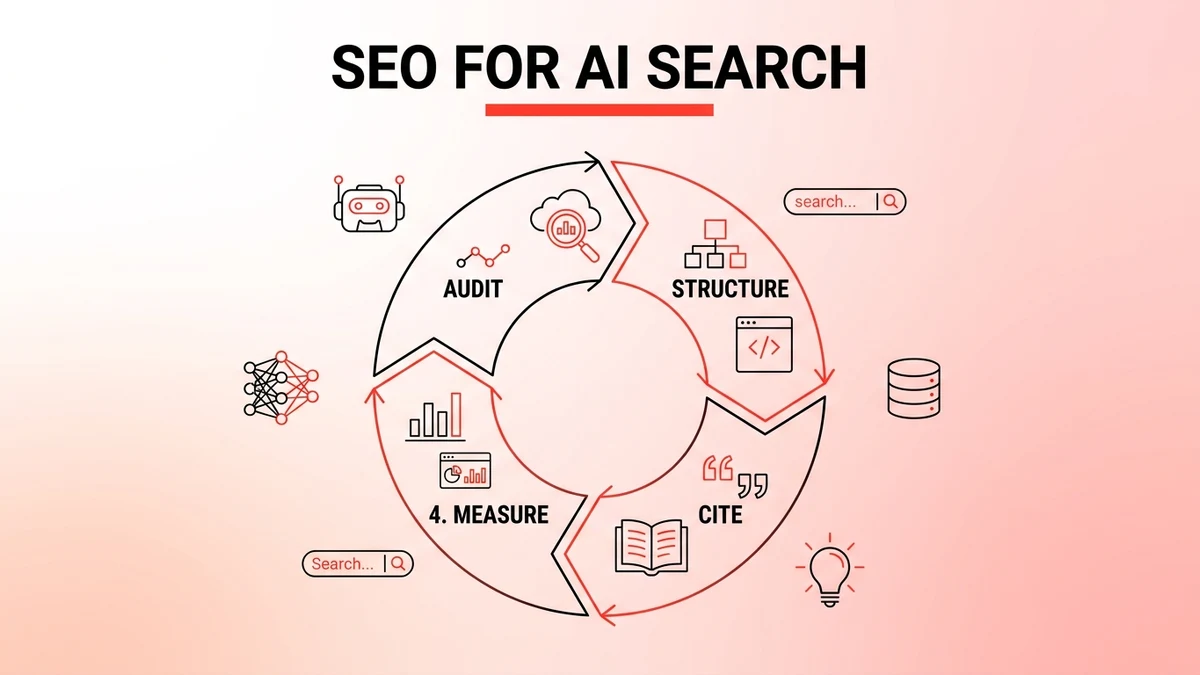
Aim for 5 to 8 high-priority fixes in the first 30 days, then re-run the audit. The re-audit is the part most teams skip. Without it you cannot tell whether your work moved the score or whether the model just had a good day.
Step 10: How do you re-audit and report?
Run the same prompt set, same protocol, every 30 days for the first 90 days, then every 60 days afterward. Track:
- Aggregate citation score (0 to 3)
- Share of voice vs. top 5 competitors
- Number of named recommendations (score 3 placements)
- Entity correctness across the five entity prompts
- Any new competitors entering the cited set
Put it in a single dashboard your CMO can read in 30 seconds. The metric leadership cares about is not "are we doing GEO." It is "are we cited more this quarter than last." If the answer is yes, keep going. If the answer is no, re-prioritize and re-test.
A ChatGPT visibility audit is a measurable, repeatable diagnostic. Define 25 to 40 buyer prompts, run them in a clean session three times each, score citations on a 0 to 3 scale, and re-test every 30 days. The teams that win in AI search are not the ones with the most content. They are the ones who measure their citation rate and act on it.
FAQ
What is a ChatGPT visibility audit?
A ChatGPT visibility audit is a structured diagnostic that measures how often, how, and in what context ChatGPT cites your brand in response to buyer-intent prompts. It scores your citation rate, maps competitor share of voice, audits your entity coverage, and identifies the technical and content fixes that will move your visibility score over time.
How long does a DIY ChatGPT audit take?
A thorough DIY audit takes a focused marketer 6 to 10 hours spread over a week. Two hours to build the prompt set, three to four hours to run prompts in a clean session three times each, two hours to score and tally competitor citations, and the rest to write up the gap list. Repeating the audit at the 30-day mark takes about half that time.
How is a ChatGPT SEO audit different from a normal SEO audit?
A normal SEO audit measures rankings, crawl health, backlinks, and on-page signals tied to Google's blue-link results. A ChatGPT SEO audit measures whether the model selects your brand as a citable source for buyer prompts, your entity coverage, your structured data completeness, and your share of voice against competitors inside chat responses. They are complementary, not interchangeable.
How do I audit ChatGPT citations for a specific competitor?
Run 15 to 25 prompts that a buyer comparing you and the competitor would type, with both brands named, in a clean ChatGPT session. Log every citation the model produces, score each by context (recommendation, source, mention), and look for the URLs the model used to support its claims. Those URLs are the pages you need to outrank in the model's retrieval set.
Can I use a tool instead of running prompts manually?
Yes, partially. Tools like our free AI visibility checker automate the citation scan across ChatGPT, Perplexity, and Gemini for a small prompt set and flag obvious technical issues. For a full audit with custom prompts, competitor mapping, and a prioritized fix list, manual work or a paid audit is still the higher-fidelity path.
How often should I run a ChatGPT brand audit?
Every 30 days for the first 90 days, then every 60 days afterward. AI models update their retrieval indexes on different cadences, and competitor activity can shift your share of voice in weeks. Quarterly is the minimum cadence to catch regressions before they cost you pipeline.
What does it cost to fix the gaps a ChatGPT audit finds?
It depends on the gap. Entity fixes and schema additions usually cost a developer two to five days of work. Publishing or updating five citable pages typically runs 4 to 8 weeks of content production. A managed GEO programme that runs the audit, fixes, and re-tests on your behalf typically prices between $4,000 and $15,000 per month depending on company size and category competitiveness.
Sources: Bain B2B Buyer Survey 2026, Semrush AI Search Study 2026, Schema.org Documentation, OpenAI Browsing Documentation
This post is part of our AI SEO guide. Related reading: Why Isn't My Business Cited by AI? Mentions vs. Citations, How AI Chooses Which Brands to Recommend, 5 best ecommerce SEO agencies.

Adel tracks AI citation rates across ChatGPT, Perplexity, Gemini, and AI Overviews. He turns raw visibility data into actionable insights that guide our optimization strategy.
Full Bio →