Why Schema Markup Matters More Than Ever in 2026
Schema markup has always been the unsung hero of technical SEO. But in 2026, it has become something more fundamental: the language that AI search engines use to understand and cite your content.
When ChatGPT, Perplexity, Google AI Overviews, or Claude surfaces an answer about your brand, your products, or your expertise, it is almost always working from two inputs: the raw text of your content, and the structured data signals embedded in your pages. Pages with clean, accurate schema markup are parsed faster, understood more precisely, and cited more reliably by AI engines than unstructured pages with identical prose.
This is not a theoretical claim. Google's Search Quality Rater Guidelines explicitly recognize structured data as a signal of E-E-A-T (Experience, Expertise, Authoritativeness, Trustworthiness). Perplexity's crawler weights pages that declare their content type explicitly. And AI Overviews have been shown in multiple studies to pull disproportionately from pages with FAQPage and HowTo schema.
The practical problem is that writing JSON-LD by hand is tedious, error-prone, and unfamiliar territory for most content and marketing teams. That's where schema markup generators come in. The right tool eliminates the friction, produces valid JSON-LD in seconds, and lets you focus on the content rather than the syntax.
In this guide, we compared every major schema markup generator available in 2026, free and paid, browser-based and plugin-based, and ranked them on output quality, ease of use, AI-readiness, and whether they actually generate valid markup. We'll start with the four tools AY Rank built specifically for GEO (Generative Engine Optimization) workflows, then cover the broader landscape.
The 4 AY Rank Schema Generators (Free, No Signup Required)
AY Rank built four dedicated schema generators as part of our free GEO toolkit. Each tool is purpose-built for a specific schema type, produces clean JSON-LD output, and requires zero account creation. You copy, paste, and deploy in under two minutes.
1. General Schema Generator
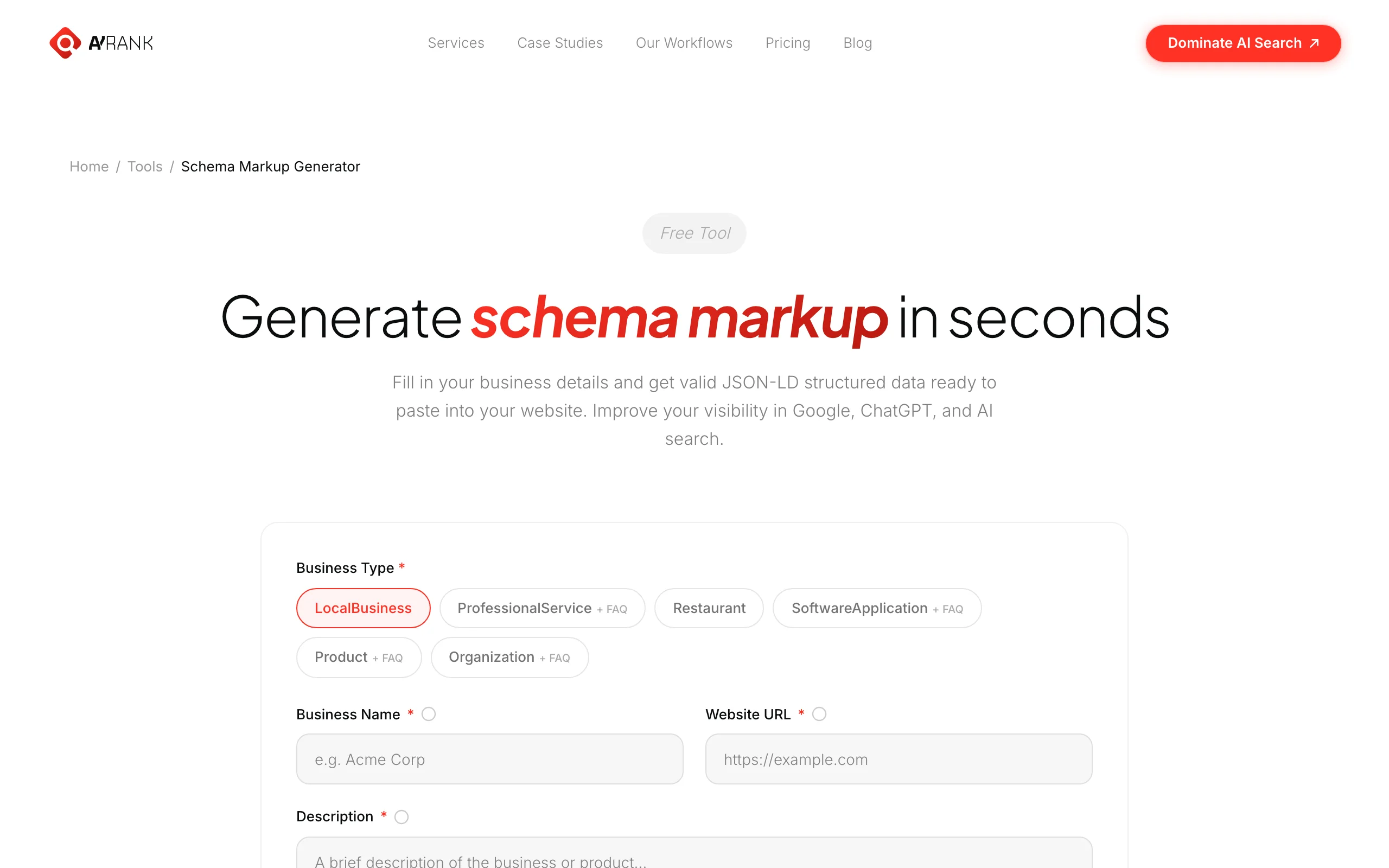 Schema Markup Generator: General Schema Generator
Tool: AY Rank Schema Generator
The General Schema Generator is the starting point for any page that needs structured data. It covers the most widely-used schema types: Organization, WebPage, WebSite, Product, LocalBusiness, Service, Person, and Event.
The interface is form-based: you select your schema type from a dropdown, fill in the relevant fields (name, URL, description, logo, contact information, price range, and so on), and the tool renders a validated JSON-LD block in real time. There is no need to memorize property names or cross-reference the Schema.org vocabulary.
What makes it AI-ready: The tool enforces the properties that AI engines weight most heavily. For Organization schema, it includes sameAs (social profile links) and contactPoint, which help AI systems establish entity disambiguation, the process of confirming that the organization mentioned in a query is the same one described on your page. For LocalBusiness, it includes areaServed and hasMap, which Perplexity and Google both use to surface local results.
Best for: Agencies, in-house SEO teams, and developers who need to generate schema for multiple page types quickly without writing JSON-LD from scratch.
2. FAQ Schema Generator
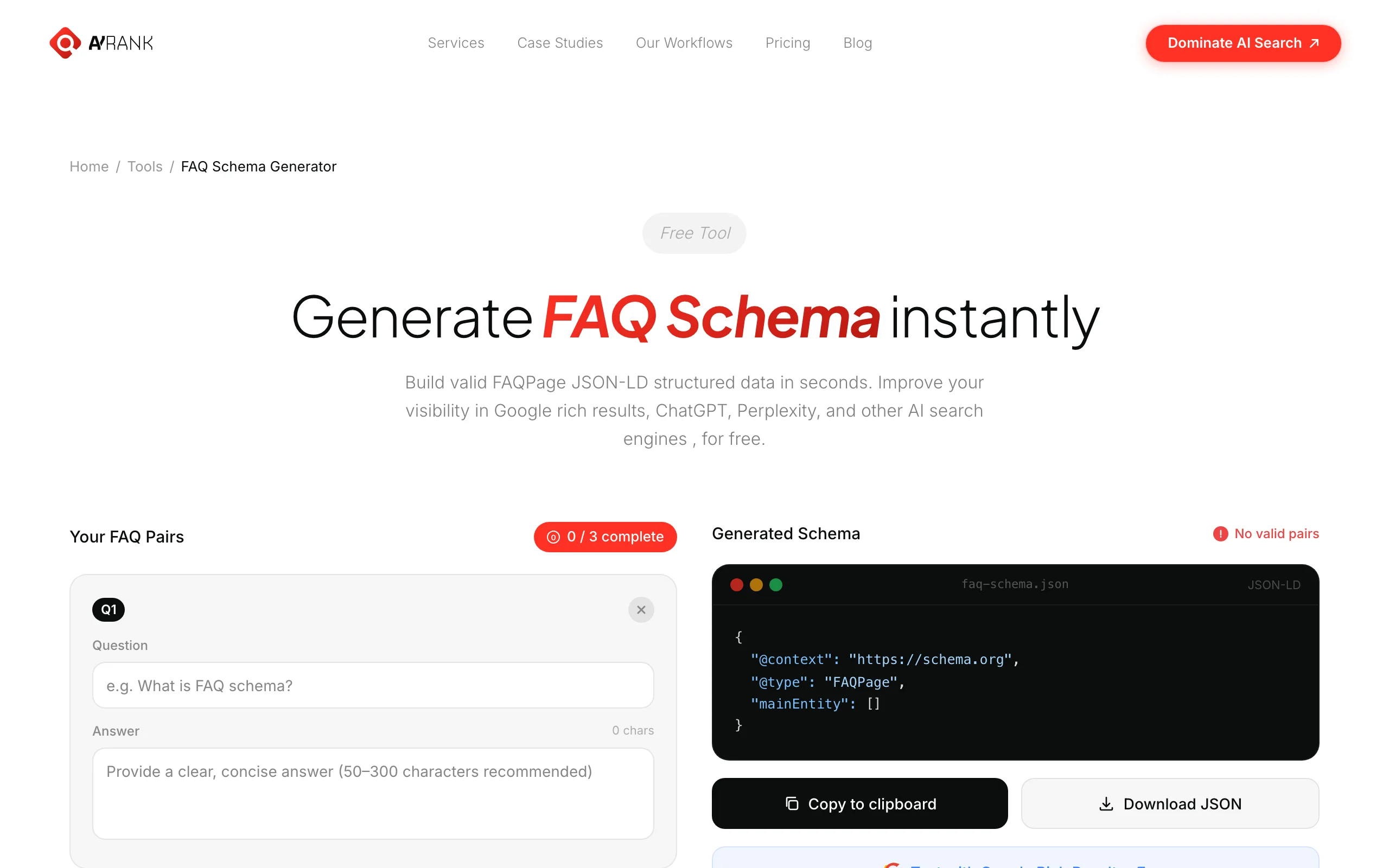 Schema Markup Generator: FAQ Schema Generator
Tool: AY Rank FAQ Schema Generator
FAQPage schema is arguably the single highest-ROI schema type for AI search visibility in 2026. Here is why: every AI answer engine, Google AI Overviews, ChatGPT with browsing, Perplexity, Bing Copilot, is in the business of answering questions. When you mark up your FAQ content with FAQPage and Question/Answer schema, you are handing these engines a pre-structured question-answer dataset that requires zero inference to extract.
The AY Rank FAQ Schema Generator takes a frictionless approach. You enter your questions and answers into a form (up to as many pairs as you need), and the tool outputs a complete FAQPage JSON-LD block with proper nesting. It validates the output against Google's FAQ structured data requirements so you don't deploy invalid markup.
What makes it AI-ready: The tool outputs markup that matches the exact structure Google's Natural Language API and Perplexity's extraction pipeline look for. Each acceptedAnswer is wrapped correctly, and the tool reminds you to keep answers under 300 words, the threshold at which AI engines begin to truncate or paraphrase rather than cite directly.
Best for: Blog posts, service pages, product pages, and any page where you have already written FAQ content and want to add structured data without touching code.
3. Article Schema Generator
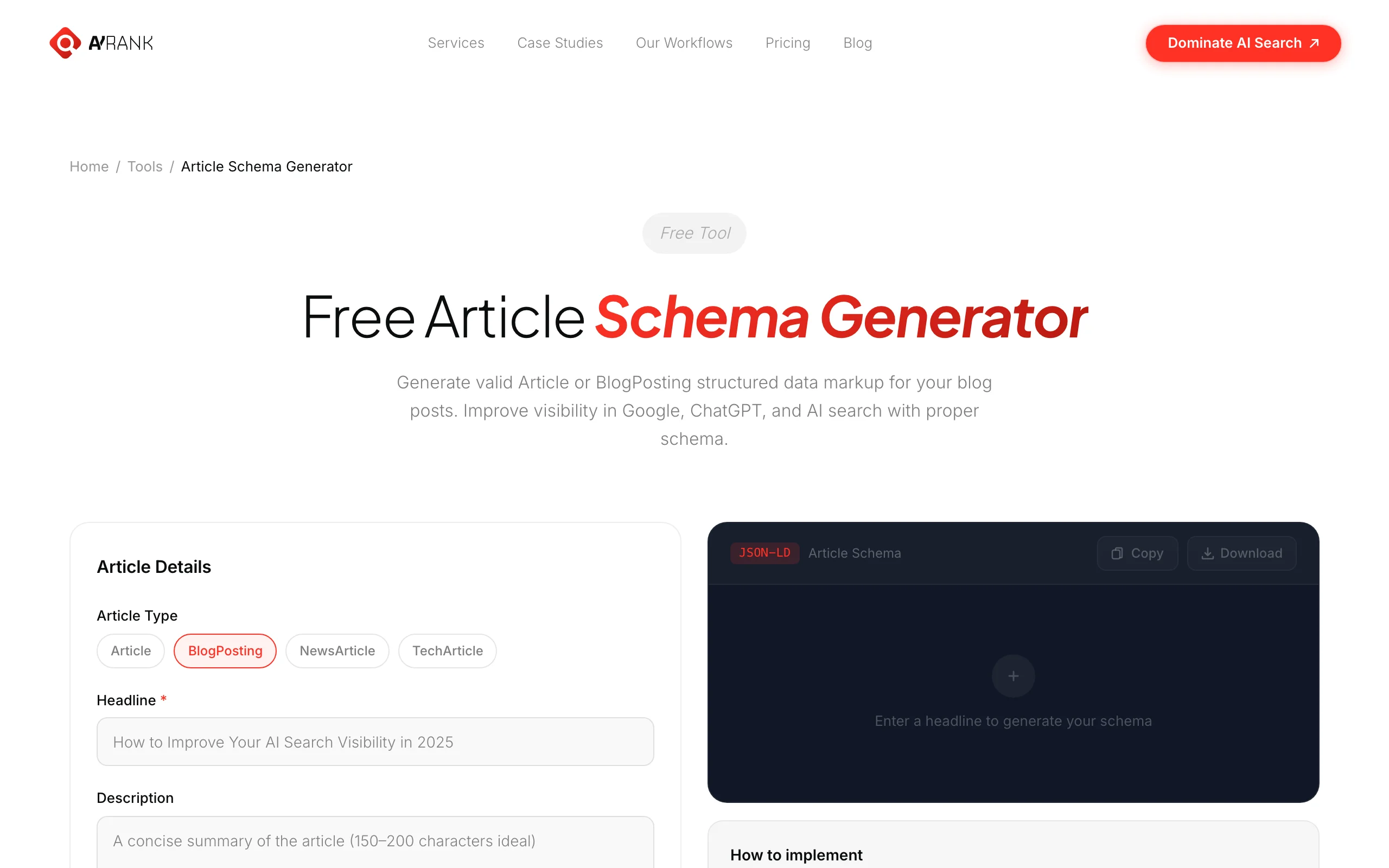 Schema Markup Generator: Article Schema Generator
Tool: AY Rank Article Schema Generator
Article schema (Article, NewsArticle, BlogPosting) tells search engines and AI systems what your content is, who wrote it, when it was published, and when it was last updated. In the context of AI search, this matters for two reasons.
First, recency signals. Perplexity and Google AI Overviews weight recently updated content more heavily for time-sensitive queries. If your page doesn't declare a dateModified property, AI engines fall back to crawl date estimates, which are often stale. Declaring it explicitly keeps you competitive.
Second, authorship and E-E-A-T. The author property in Article schema, when combined with a Person entity that includes sameAs links to LinkedIn and other authority profiles, helps AI systems assign expertise scores to your content. This is how AI engines decide whether to cite a generic blog post or a recognized expert's analysis of the same topic.
The AY Rank Article Schema Generator collects headline, description, author name and URL, organization, publication date, modified date, and featured image, all the properties that matter, and outputs a clean BlogPosting JSON-LD block. It includes a mainEntityOfPage reference to the canonical URL, which is the correct pattern for blog content.
Best for: Blog posts, thought leadership articles, news pages, and any long-form content where author authority and recency are competitive factors.
4. HowTo Schema Generator
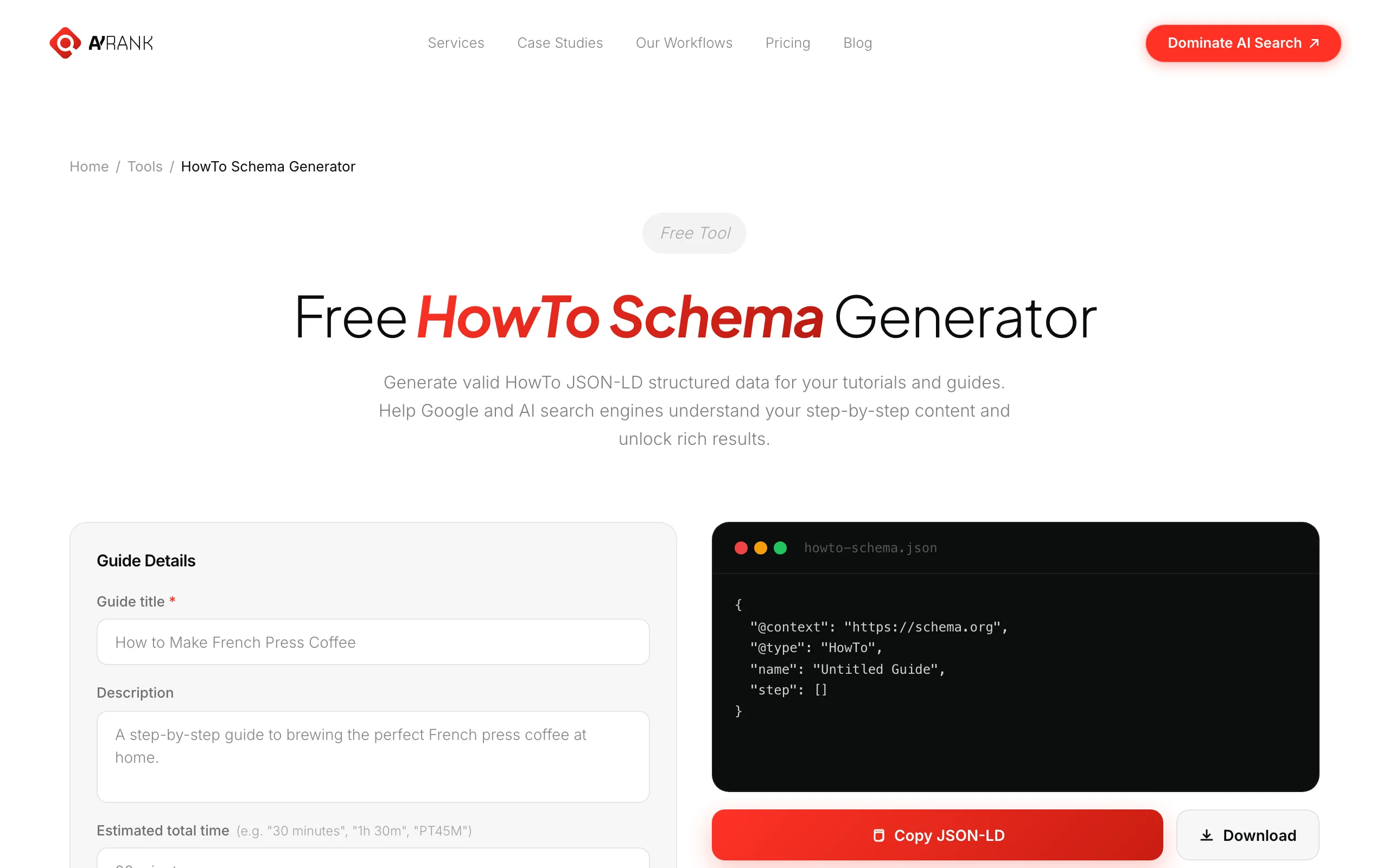 Schema Markup Generator: HowTo Schema Generator
Tool: AY Rank HowTo Schema Generator
HowTo schema is the most structured of the four schema types, and the most directly actionable for AI search. When someone asks Perplexity "how do I do X" or asks ChatGPT for step-by-step instructions, AI engines preferentially extract content that is already organized as a sequence of steps with clear inputs and outputs.
The AY Rank HowTo Schema Generator lets you define a title, description, total time, estimated cost, and an unlimited sequence of named steps, each with its own name, text, and optional image. The output is a complete HowTo JSON-LD block that satisfies Google's rich result requirements and is optimized for AI extraction.
What makes it AI-ready: HowTo schema gives AI engines a numbered list they can surface directly in answers without paraphrasing. This is why pages with HowTo schema consistently appear in Google AI Overviews for procedural queries. The tool also lets you specify supply and tool properties, which are required for rich results on DIY and technical content.
Best for: Tutorials, guides, recipes, process documentation, and any content that walks users through a sequence of steps.
Quick Comparison: All Four AY Rank Tools
| Tool | Schema Type | Key Properties | AI Optimization | Signup Required |
|---|---|---|---|---|
| Schema Generator | Organization, Product, LocalBusiness, Service, WebPage, Person, Event | sameAs, contactPoint, areaServed, priceRange | Entity disambiguation, local signals | No |
| FAQ Schema Generator | FAQPage | Question, acceptedAnswer | Direct Q&A extraction by AI engines | No |
| Article Schema Generator | Article, BlogPosting, NewsArticle | author, datePublished, dateModified, mainEntityOfPage | Recency signals, E-E-A-T authorship | No |
| HowTo Schema Generator | HowTo | step, supply, tool, totalTime | Step-by-step AI extraction | No |
All four tools are permanently free, require no account, and output valid JSON-LD that passes Google's Rich Results Test.
Other Schema Markup Generators Worth Knowing
Beyond the AY Rank toolkit, several other tools are widely used in the SEO industry. Here is an honest assessment of each.
Google Structured Data Markup Helper
URL: https://www.google.com/webmasters/markup-helper/
Google's own tool takes a visual approach: you paste your page URL or HTML, Google renders the page, and you highlight elements (article title, author, date, etc.) and tag them. The tool then generates the JSON-LD or Microdata markup based on your tagging.
Strengths: It is authoritative, you are generating markup in the format Google explicitly recognizes. The visual tagging interface is intuitive for non-technical users. It supports Article, Review, Local Business, Restaurant, Event, Movie, Product, Software Application, TV Episode, and Book schema types.
Weaknesses: The tool is dated and supports a limited subset of schema types. It does not support FAQPage, HowTo, or many of the schema types most relevant to AI search in 2026. It also does not validate your output or warn you about missing recommended properties.
Verdict: Useful for traditional SEO schema on standard page types, but limited for GEO workflows. Use it as a starting point for Article and Product schema if you prefer Google's interface, but supplement with dedicated tools for FAQ and HowTo.
Schema.org Generator (schema.org/docs/gs.html)
URL: https://schema.org
The Schema.org website itself is not a generator in the traditional sense, but it is the authoritative reference for every schema type, property, and expected value. For advanced users who want to implement schema types not covered by any generator, SoftwareApplication, MedicalCondition, FinancialProduct, Dataset, the Schema.org documentation is the primary source.
Strengths: Covers every schema type in the vocabulary (over 800 types and 1,400 properties). Includes examples, expected data types, and notes on which properties are recommended versus required. Essential for any schema implementation beyond standard types.
Weaknesses: It is documentation, not a generator. You will need to write the JSON-LD yourself, which requires technical familiarity with JSON syntax and the schema vocabulary.
Verdict: Not a replacement for a generator tool, but essential as a reference when you need to implement custom or advanced schema. Bookmark it.
Merkle Schema Markup Generator
URL: https://technicalseo.com/tools/schema-markup-generator/ (hosted on TechnicalSEO.com)
The Merkle Schema Markup Generator is one of the most full-featured free schema generators available and has been an industry staple for years. It supports a wide range of schema types including Article, Breadcrumb, Event, FAQ, HowTo, Job Posting, Local Business, Organization, Person, Product, Recipe, Review, Sitelinks Searchbox, Video Object, and more.
Strengths: Type coverage is excellent. The form-based interface is clean and organized, with clear field labels. Output is valid JSON-LD. The tool supports nested schema (for example, Review nested inside Product) which most simpler tools do not.
Weaknesses: The tool does not validate output against Google's current rich result requirements. Some property recommendations are slightly dated. There is no real-time preview of the structured data as you fill in fields.
Verdict: One of the best all-around free generators for SEO teams that need broad type coverage. Particularly good for JobPosting, Recipe, and VideoObject schema that AY Rank's tools do not focus on.
TechnicalSEO.com Schema Markup Generator
TechnicalSEO.com (Merkle's technical SEO resource) offers several schema-related tools beyond the primary generator, including a structured data validator and a schema type explorer. The broader toolset is useful for teams doing systematic schema audits.
Strengths: The site's schema documentation and type explorer are genuinely useful for understanding which schema types apply to which content. The tools are maintained by a reputable SEO consultancy with deep technical credibility.
Weaknesses: Some tools on the site are showing their age and have not kept pace with the AI search developments of 2025-2026. The FAQ and HowTo generators, in particular, lack the AI-specific property recommendations that newer tools include.
Verdict: Strong for reference and auditing use cases. For generation, the Merkle generator (above) is the more polished offering from the same stable.
Hall Analysis JSON-LD Generator
URL: https://hallanalysis.com/json-ld-generator/
The Hall Analysis generator is a long-standing free tool focused specifically on JSON-LD output (no Microdata or RDFa). It covers Organization, Person, Local Business, Breadcrumb, and a handful of other types.
Strengths: Clean, simple interface with no bloat. Outputs pure JSON-LD, which is Google's preferred format. Good for quick generation of Organization and LocalBusiness schema.
Weaknesses: Limited schema type coverage, it does not support FAQPage, HowTo, Article, Product, or Event. Not actively developed; last significant update was several years ago. Does not reflect current Schema.org vocabulary or Google's current recommended properties.
Verdict: Functional for basic Organization and LocalBusiness schema, but too limited for modern GEO or SEO workflows. Use the AY Rank General Schema Generator for the same types with better AI-oriented properties.
RankMath Schema Generator (WordPress)
URL: https://rankmath.com
RankMath is a WordPress SEO plugin with an integrated schema generator. Unlike browser-based tools, RankMath's schema module operates inside the WordPress editor and applies schema directly to pages and posts without any copy-paste workflow.
Strengths: Tightly integrated with WordPress's content model, RankMath can auto-populate schema properties (title, author, publication date, featured image) from the page data without manual entry. Supports a wide range of schema types. The Pro version includes a schema builder with conditional display rules (for example, apply HowTo schema only to posts in a specific category).
Weaknesses: WordPress-only. The free tier's schema capabilities are solid but the most powerful features (custom schema per post type, schema templates, schema variables) require the paid Pro plan ($59/year). Output is not always as clean as hand-crafted JSON-LD; the plugin sometimes includes unnecessary properties that add noise.
Verdict: The best option for WordPress sites that want automated schema without any manual generation workflow. For non-WordPress sites, browser-based tools are more practical.
Yoast SEO Schema (WordPress)
URL: https://yoast.com
Yoast SEO, the other dominant WordPress SEO plugin, takes a different approach to schema. Rather than offering a form-based generator, Yoast automatically generates a schema graph for every page, a connected web of structured data that links your Organization, WebSite, WebPage, and content-level schema into a single coherent knowledge graph declaration.
Strengths: The knowledge graph approach is architecturally correct and increasingly important for AI search. By declaring isPartOf relationships between schema entities, Yoast helps AI engines understand how your content relates to your brand, your website, and your broader entity graph. This is sophisticated compared to most generators' page-level output.
Weaknesses: Less flexible than RankMath for custom schema types. The schema output is generated automatically, which means less control over individual property values. For users who want to customize FAQ or HowTo schema on specific pages, the Yoast interface is less intuitive than RankMath's.
Verdict: Excellent for establishing a strong site-wide schema foundation on WordPress. Pair it with a dedicated FAQ or HowTo generator for content-level schema on high-priority pages.
Full Comparison Table: All Schema Generators
| Tool | Free | Schema Types | JSON-LD Output | AI Optimized | Platform | Signup |
|---|---|---|---|---|---|---|
| AY Rank Schema Generator | Yes | Org, Product, LocalBusiness, Service, WebPage, Person, Event | Yes | Yes | Browser | No |
| AY Rank FAQ Schema Generator | Yes | FAQPage | Yes | Yes | Browser | No |
| AY Rank Article Schema Generator | Yes | Article, BlogPosting, NewsArticle | Yes | Yes | Browser | No |
| AY Rank HowTo Schema Generator | Yes | HowTo | Yes | Yes | Browser | No |
| Google Structured Data Markup Helper | Yes | Article, Product, Event, LocalBusiness, Review, Movie, Book + more | Yes (also Microdata) | No | Browser | No |
| Merkle / TechnicalSEO.com | Yes | 15+ types incl. FAQ, HowTo, Recipe, JobPosting | Yes | Partial | Browser | No |
| Hall Analysis | Yes | Org, LocalBusiness, Person, Breadcrumb | Yes | No | Browser | No |
| RankMath | Freemium | 20+ types | Yes | Partial | WordPress | No (plugin) |
| Yoast SEO | Freemium | Automatic graph + content types | Yes | Partial | WordPress | No (plugin) |
| Schema.org Documentation | Free | 800+ types | Reference only | N/A | Web | No |
How AI Search Engines Actually Use Schema Markup
Understanding the mechanics here will change how you prioritize your schema implementation.
Extraction vs. Inference
Every AI search engine, whether it is Perplexity's RAG pipeline, Google's AI Overviews, or Bing Copilot, operates in two modes when reading your content: extraction and inference.
Extraction is cheap and reliable. The model reads structured data (JSON-LD, microdata, or RDFa) and directly extracts values from declared properties. If you have "name": "AY Rank" in your Organization schema, the model extracts "AY Rank" as the organization name without any ambiguity.
Inference is expensive and unreliable. The model reads your prose and infers what it means. "AY Rank is a GEO agency based in London" might be correctly interpreted, might be partially extracted, or might be confused with another entity if the model's training data includes similarly named organizations.
Schema markup converts AI inference problems into AI extraction problems. This is why pages with detailed, accurate schema markup consistently outperform otherwise-identical pages in AI search citations.
The FAQ Schema Advantage
FAQPage schema is particularly valuable because it maps directly onto how AI engines generate answers. When a user asks a question, the AI engine is pattern-matching their query against the questions in its retrieved context. A page with FAQPage schema containing "name": "What is GEO optimization?" and a well-formed acceptedAnswer gives the engine a pre-matched question-answer pair it can surface directly.
This is why, in multiple independent studies of Google AI Overviews composition, pages with FAQPage schema are cited at 2-4x the rate of pages without it, even when the prose content is comparable.
The HowTo Schema Advantage
HowTo schema provides AI engines with a numbered, ordered sequence of steps, exactly the format users expect for procedural answers. When someone asks "how do I add schema markup to my website," an AI engine that retrieves a page with HowTo schema can output a formatted, numbered list with step names and descriptions, attributed to your page.
Pages without HowTo schema require the AI to infer step boundaries, step names, and step order from prose, an inference task that often produces lower-quality outputs and lower citation confidence.
Entity Disambiguation and sameAs
One of the most underused schema features for AI visibility is the sameAs property. When you include sameAs links in your Organization or Person schema pointing to your Wikidata entity, LinkedIn profile, Crunchbase page, and other authoritative sources, you are helping AI engines confirm that the entity on your page is the same as the entity they know from their training data and other indexed sources.
Without sameAs, an AI engine that encounters "AY Rank" in your content has to infer whether this is the same "AY Rank" it has seen mentioned elsewhere. With sameAs, that disambiguation is explicit and reliable. This directly affects whether AI engines cite you confidently or hedge with vague attributions.
How to Implement Schema Markup: A Step-by-Step Guide
Step 1: Audit your current schema coverage
Before generating new schema, understand what you already have. Use Google Search Console's Enhancements section to see which schema types Google has detected on your site and whether there are validation errors. You can also run individual URLs through Google's Rich Results Test (search.google.com/test/rich-results).
Step 2: Prioritize by page type and AI opportunity
Not all pages benefit equally from schema. Prioritize in this order for AI search impact:
- FAQ pages and blog posts with FAQ sections, implement FAQPage schema immediately
- Tutorial and how-to content, implement HowTo schema
- Homepage and about page, implement Organization schema with sameAs
- Blog posts and articles, implement Article/BlogPosting schema with author entity
- Service and product pages, implement Service or Product schema
Step 3: Generate the JSON-LD
Use the appropriate AY Rank generator for your schema type:
- General types (Organization, Product, Service, LocalBusiness): Schema Generator
- FAQ sections: FAQ Schema Generator
- Blog posts and articles: Article Schema Generator
- Tutorial and how-to pages: HowTo Schema Generator
Step 4: Validate before deploying
Paste your generated JSON-LD into Google's Rich Results Test. Fix any errors (typically missing required properties) before deploying. Warnings about recommended properties are worth addressing but are not blocking.
Step 5: Deploy in the <head> as a <script type="application/ld+json">
JSON-LD goes in the document <head>. In Next.js, use a <Script> component with strategy="beforeInteractive" or place it directly in the page component's <head>. In WordPress, RankMath or Yoast handle injection automatically. In other CMSes, most SEO plugins provide a custom code field for per-page JSON-LD.
Step 6: Monitor in Google Search Console
After deploying, monitor the Enhancements section in Search Console for errors or warnings on the new schema types. Allow 1-2 weeks for Google to recrawl and process the structured data.
Common Schema Markup Mistakes to Avoid
1. Marking up content that is not on the page
Schema must accurately reflect visible page content. If your FAQPage schema includes questions that do not appear in the page's visible HTML, Google will penalize the page for structured data spam. Every schema property value must correspond to something a user can see.
2. Using outdated Microdata instead of JSON-LD Microdata and RDFa were earlier methods of embedding structured data in HTML. Google still supports them, but JSON-LD is the recommended format. JSON-LD is easier to maintain, does not require modifying existing HTML, and is what all modern generators output.
3. Missing the dateModified property on articles
This is the single most common omission in Article schema. Without dateModified, AI engines cannot confirm your content is current and may deprioritize it for time-sensitive queries. Always declare both datePublished and dateModified.
4. Generic author values
Setting "author": {"@type": "Organization", "name": "Company Blog"} is far weaker than declaring a specific Person entity with their name, URL, and sameAs links. The latter contributes to E-E-A-T signals; the former does nothing.
5. Omitting sameAs on Organization and Person entities
As discussed above, sameAs is the mechanism for entity disambiguation. A schema implementation without sameAs is significantly less valuable for AI search citation than one with it.
Frequently Asked Questions About Schema Markup Generators
What is the best free schema markup generator in 2026?
For AI search optimization, the AY Rank suite of four tools (General Schema Generator, FAQ Schema Generator, Article Schema Generator, HowTo Schema Generator) offers the most widest free coverage with no signup required. For breadth of schema types including Recipe and JobPosting, the Merkle generator at TechnicalSEO.com is the strongest free browser-based option.
Do I need to use a schema generator or can I write JSON-LD manually?
You can write JSON-LD manually if you are comfortable with JSON syntax and the Schema.org vocabulary. For teams generating schema across dozens or hundreds of pages, generators dramatically reduce time and error rates. The AY Rank tools validate output automatically, catching errors that manual JSON-LD writing often misses.
Does schema markup directly improve Google rankings?
Schema markup is not a direct ranking factor in Google's core algorithm. However, it enables rich results (FAQ dropdowns, HowTo steps, Product ratings) which significantly improve click-through rates, and CTR does influence ranking signals. More importantly for 2026, schema is a major factor in AI search citation rates, which is increasingly where organic traffic comes from.
How many schema types should I implement on a single page?
You can implement multiple schema types on a single page using either an array of JSON-LD objects or a graph (@graph). A blog post might reasonably include BlogPosting + BreadcrumbList + FAQPage if the post includes FAQ content. Avoid implementing types that do not accurately describe the page, schema spam is a manual action risk.
Will schema markup help my content appear in AI Overviews?
Yes. Multiple independent analyses of Google AI Overview source composition have found that pages with FAQPage, HowTo, and Article schema are cited at higher rates than unstructured pages with equivalent content quality. Schema markup is not sufficient on its own, content quality, topical authority, and crawlability all matter, but it is one of the highest-impact technical factors for AI search visibility.
What is the difference between JSON-LD and Microdata?
Both are methods for embedding structured data in web pages. JSON-LD is a standalone <script> block in the page head. Microdata is embedded as HTML attributes throughout the page body. Google recommends JSON-LD because it is cleaner, easier to maintain, and does not require modifying existing HTML structure. All modern schema generators output JSON-LD.
The Bottom Line
Schema markup generators have never been more important than they are in 2026. As AI search engines replace or supplement traditional blue-link results for a growing share of queries, the structured data signals on your pages are becoming the primary mechanism by which AI systems read, understand, and cite your content.
The four AY Rank tools, Schema Generator, FAQ Schema Generator, Article Schema Generator, and HowTo Schema Generator, cover the schema types with the highest AI search impact, produce validated JSON-LD output, and require no signup or payment. Start there.
For schema types beyond those four (Recipe, JobPosting, VideoObject, Event), the Merkle generator at TechnicalSEO.com fills the gap. For WordPress sites, RankMath's Pro plan or Yoast's knowledge graph implementation provides the tightest integration with your content workflow.
Whatever toolset you choose, the most important thing is to actually implement schema, validated, accurate, and covering your highest-traffic pages, rather than treating it as a future optimization. In AI search, the pages that declare their content structure explicitly will consistently outperform pages that rely on prose alone.
This post is part of our Technical SEO guide. Related reading: Best GEO Agency for E-commerce, GEO for SaaS, The State of AI Search.

Walid founded AY Rank to help businesses dominate AI search. He leads the GEO methodology and oversees client strategy across 50+ cities in Europe, Middle East, and North Africa.
Full Bio →