Microsoft Advertising published an official guide in January 2026, titled "From Discovery to Influence: A Guide to AEO and GEO," aimed at helping retailers compete for visibility inside AI search, AI assistants, and AI browsers. It is one of the first framework documents on this topic to come from a major platform rather than an SEO agency or a tool vendor, and it comes with a specific, checkable list of what it wants from a product catalog.
That is worth taking seriously on its own, but the microsoft aeo geo guide is also a useful test case for a confusion that has been building all year: Microsoft's own coverage is not even consistent on what AEO stands for in this guide. Some summaries call it "answer engine optimization." Others call it "answer/agentic engine optimization." This piece covers what the guide actually recommends, and why the acronym itself is part of the story.
What is agentic engine optimization, according to Microsoft's guide?
Microsoft's framework splits AI visibility into two disciplines rather than one. AEO, which Microsoft's own materials describe as "answer/agentic engine optimization," focuses on making content and product data easy for AI assistants and agents (Copilot, and by extension any agent reading structured data) to retrieve, interpret, and present as a direct answer or action. GEO, generative engine optimization, focuses on making content discoverable and persuasive inside generative AI systems, the layer that wins the actual recommendation once an agent has found you.
That "answer/agentic" hybrid naming is the part worth flagging directly: AY Rank's own answer engine optimization guide uses the more established, narrower definition of AEO, optimizing content to be extracted as a direct answer. Microsoft's version folds in agentic behavior, an AI system acting on data rather than just answering with it, under the same acronym. Both usages are defensible. Neither is wrong. But a reader moving between Microsoft's guide and the rest of the industry's content should not assume "AEO" means the exact same thing in both places.
How does agentic engine optimization differ from generative engine optimization?
The practical difference, stripped of acronym debate, is what happens after an AI system finds your product. AEO in Microsoft's framing is about retrieval and action: can an agent parse your data cleanly enough to summarize it or transact against it. GEO is about persuasion once retrieved: does your content give the generative system a reason to recommend you over a competitor with equally clean data.
| Layer | AEO (Microsoft's framing) | GEO |
|---|---|---|
| Core question | Can an agent find, parse, and act on this data? | Does the AI system trust and recommend this brand? |
| Primary inputs | Structured schema, product feeds, real-time sync | Content clarity, third-party validation, authority signals |
| Failure mode | Agent cannot parse the data, brand is invisible | Agent parses the data but recommends a competitor instead |
| Who owns it internally | Data/engineering, ecommerce ops | Marketing, content |
| Microsoft's guide covers | Yes, in detail (schema, feeds) | Yes, more briefly (trust signals, authority) |
Both layers matter, and Microsoft's own guide treats them as sequential rather than competing: get found (AEO), then get chosen (GEO). That two-stage framing is closer to how ai shopping agents actually behave in practice than either discipline covered in isolation.
What does Microsoft's guide actually require from a product catalog?
The technical core of the guide is a schema and data-sync checklist, not a content strategy document. It names six schema.org types as the baseline for a retail catalog to be agent-readable: Product, Offer, AggregateRating, Review, ItemList, and FAQ. That list overlaps heavily with what a solid technical SEO program already requires, which is Microsoft's own point: AEO and GEO are built on the same crawl and structured-data foundations as classic SEO, not a replacement discipline requiring an entirely new stack.
The guide's sharper requirement is on three data layers that all have to agree: crawled data (what a search engine's crawler sees), product feeds and APIs (what a shopping agent or assistant queries directly), and live on-site data (what a human visitor or an agent double-checking a claim actually finds). Microsoft's guidance is explicit that these three layers drifting out of sync, a feed price that does not match the live page, is a trust failure an AI system will penalize the same way a human shopper would after being shown a stale price.
Most mid-sized retailers already have at least one of these layers drifting without realizing it. A product feed that updates nightly while the live site reflects a flash sale in real time is a common, unremarkable gap under classic SEO, since a human shopper who lands on the live page simply sees the correct price. An agent that queries the feed directly, transacts on it, and never loads the live page has no such correction step. The guide's implicit argument is that feed-to-page parity, previously a minor operational nuisance, becomes a hard requirement the moment agents start transacting without a human double-check in the loop.
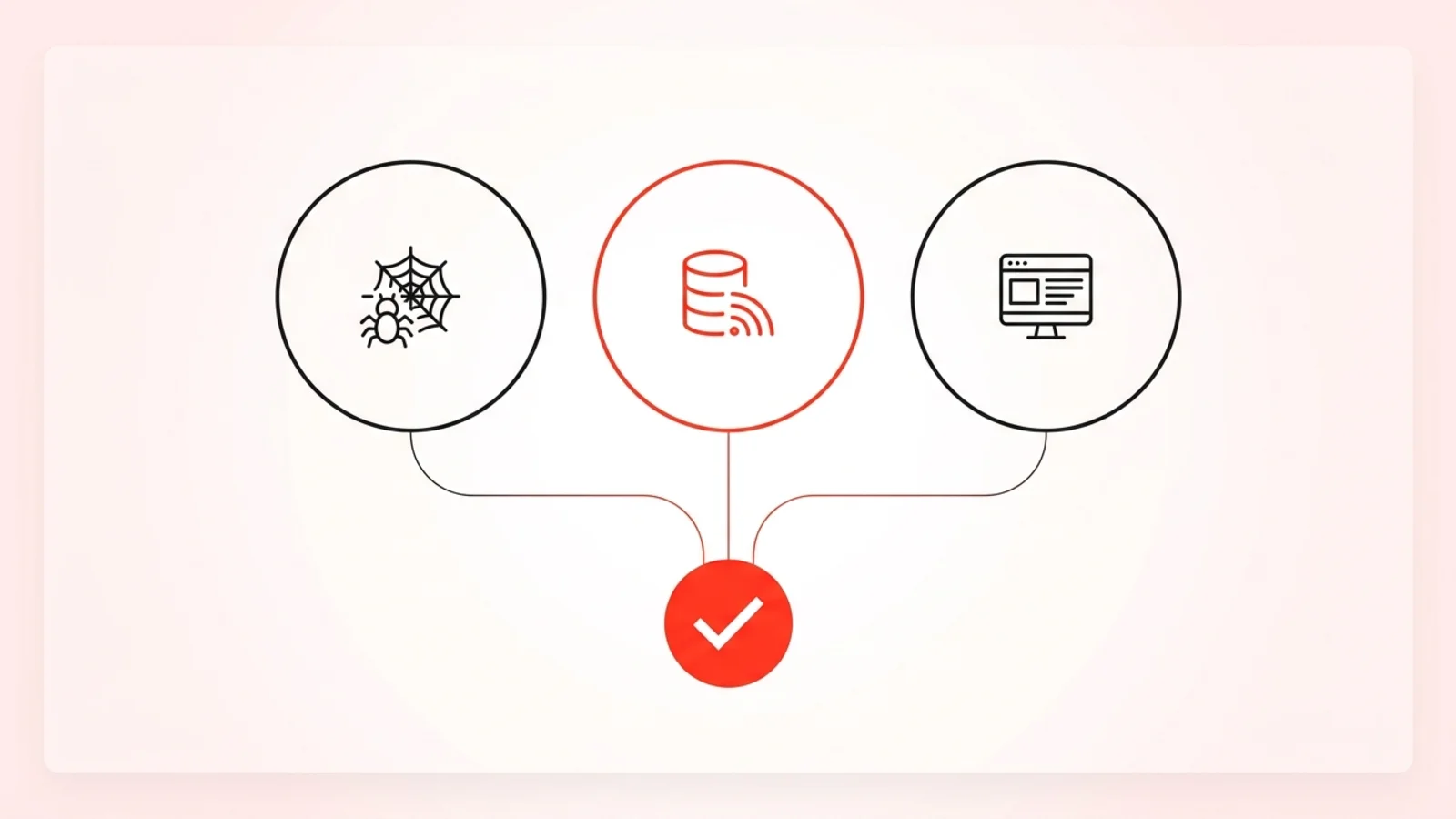 Three overlapping data-source icons converging into one checkmark, representing a feed, a crawler, and a live page that all have to agree
Microsoft's guide treats data consistency, not content volume, as the make-or-break signal for AEO. A perfectly written product description behind a stale price feed fails the same way an empty page would.
Is this the same advice as standard GEO for e-commerce, or something new?
Mostly the same, with one addition worth taking seriously. The schema and structured-data groundwork Microsoft recommends matches what our own GEO for e-commerce guide already covers in depth: complete product schema, review strategy, and crawl architecture for large catalogs. Where Microsoft's guide adds something genuinely new is the emphasis on real-time synchronization across all three data layers as an explicit, named requirement, rather than an implicit best practice.
Should businesses treat Microsoft's guide as the definitive AEO/GEO standard?
Treat it as one credible, well-researched framework from a major platform, not as an industry-wide standard, since no single vendor sets the rules for how every AI answer engine or shopping agent evaluates a brand. It is genuinely useful for its schema checklist and its data-layer framing, both of which are actionable regardless of which acronym definition a reader prefers.
- Names a concrete, checkable schema list rather than vague "structure your data" advice
- Explicitly frames data-layer consistency as a trust signal, not just a technical nicety
- Sequences AEO before GEO in a way that matches how agentic commerce actually behaves
- The AEO acronym is used inconsistently even in Microsoft's own surrounding materials
- The guide's checklist is retail-specific; B2B SaaS and service businesses need a different set of priorities
- Microsoft has an obvious interest in retailers treating Copilot and Bing as first-class citation targets
Frequently asked questions
What is Microsoft's AEO and GEO guide?
Microsoft's AEO and GEO guide is an official document from Microsoft Advertising, published in January 2026 and titled "From Discovery to Influence: A Guide to AEO and GEO," that gives retailers a practical framework and schema checklist for AI search, AI assistants, and AI shopping agents.
What is agentic engine optimization?
Agentic engine optimization, per Microsoft's usage of the term, is the practice of making content and product data easy for AI agents and assistants to retrieve, interpret, and act on directly, distinct from the narrower, more established definition of answer engine optimization used elsewhere in the industry, which focuses specifically on content being extracted as a direct answer.
How does agentic engine optimization differ from generative engine optimization?
Agentic engine optimization (AEO, in Microsoft's framing) focuses on whether an AI agent can find, parse, and act on your data, while generative engine optimization (GEO) focuses on whether the AI system trusts and recommends your brand once that data has been found. Microsoft's guide treats the two as sequential: get found, then get chosen.
What schema types does Microsoft's guide require?
The guide names six schema.org types as the baseline for an agent-readable product catalog: Product, Offer, AggregateRating, Review, ItemList, and FAQ, alongside real-time synchronization between crawled data, product feeds, and live on-site data.
Does Microsoft's guide apply to B2B or service businesses, not just retail?
The guide is written specifically for retail catalogs, so its schema checklist maps most directly to e-commerce SEO; B2B and service businesses should apply the same data-consistency principle but will need a different practical checklist built around service pages, case studies, and pricing pages rather than product feeds.
Why do different sources describe Microsoft's AEO differently?
Because Microsoft's own guide and its surrounding marketing materials are not perfectly consistent about whether AEO stands for "answer engine optimization" or a broader "answer/agentic engine optimization," so secondary coverage of the guide has repeated both versions rather than one settled definition.
Is following Microsoft's AEO/GEO checklist enough to get cited by ChatGPT and Perplexity?
Not on its own; Microsoft's checklist covers the structured-data and feed-accuracy foundation that most AI systems need, but citation and recommendation behavior still varies by platform, so pair it with platform-specific monitoring like our AI visibility monitoring guide.
Sources: Microsoft's Guide To Winning In AEO & GEO (Search Engine Journal, 2026), New Microsoft Retail AI Guide Echoes SEO (Practical Ecommerce, 2026), From Discovery to Influence: A Guide to GEO (Microsoft Advertising, January 2026)
This post is part of our GEO Optimization guide. Related reading: AI Shopping Agents, Artificial Analysis Intelligence Index, AI SEO Checklist for 2026.

Adel tracks AI citation rates across ChatGPT, Perplexity, Gemini, and AI Overviews. He turns raw visibility data into actionable insights that guide our optimization strategy.
Full Bio →