A study of 50,032 commercial keywords across 20 niches, published by SE Ranking with data collected June 30, 2026, found that Google's AI Mode showed a text ad on 29.45% of commercial searches. Among the domains that paid for those ads, only 11.53% also appeared among AI Mode's cited sources for the same query, and just 2.32% of advertised URLs ranked organically for that query at all.
Read that as a controlled experiment on a question every paid-search team eventually asks: does buying a Google Ad help you get cited when AI Mode answers the same query? The data says no. Paid placement, AI Mode citation, and classic organic ranking behave as three largely separate channels, not three stages of the same funnel, and treating them as connected is an expensive assumption to get wrong.
What did the AI Mode ads study actually measure?
SE Ranking ran 50,032 commercial keywords across 20 niches through Google's AI Mode and recorded three things for each query: whether a text ad appeared, whether the advertiser's own domain showed up among AI Mode's cited sources, and whether that same domain ranked organically for the query. Ad presence was not evenly distributed: it rose from 24.33% of queries at under $2 CPC to 53.56% at $10 CPC and above, and 71.1% of ad-triggering queries showed two ads in the same response rather than one.
The overlap numbers are the real finding. Advertiser domains appeared among cited sources in just 11.53% of the placements where they ran an ad. At the broader domain level (allowing for slightly different matching), that figure rose to 15.35%, still meaning roughly 85% of the time, paying for the ad bought no citation alongside it. Organic overlap was even thinner: only 2.32% of advertised URLs ranked organically for the same query.
Does running Google Ads help you get cited in AI Mode?
No, not based on this data. The three channels behave independently because they are generated by different systems inside Google's stack: paid placement comes from the ads auction, organic ranking comes from the classic search index, and AI Mode citation comes from a separate retrieval-and-summarization process that draws on crawled and indexed content the same way GEO work targets everywhere else. Winning the auction does not feed into that retrieval process, and there is no evidence in this data that it should.
How independent are paid, cited, and organic channels in AI Mode?
Independent enough that success in one tells you almost nothing about the other two.
| Channel | What drives it | Overlap with the other two channels |
|---|---|---|
| Paid ad | Ads auction, bid, and budget | 11.53% also cited, 2.32% also ranking organically |
| AI Mode citation | Retrieval from crawled, indexed content | Largely separate from ad spend; driven by GEO fundamentals |
| Organic ranking | Classic search index and ranking signals | Also largely separate from ad spend in this data |
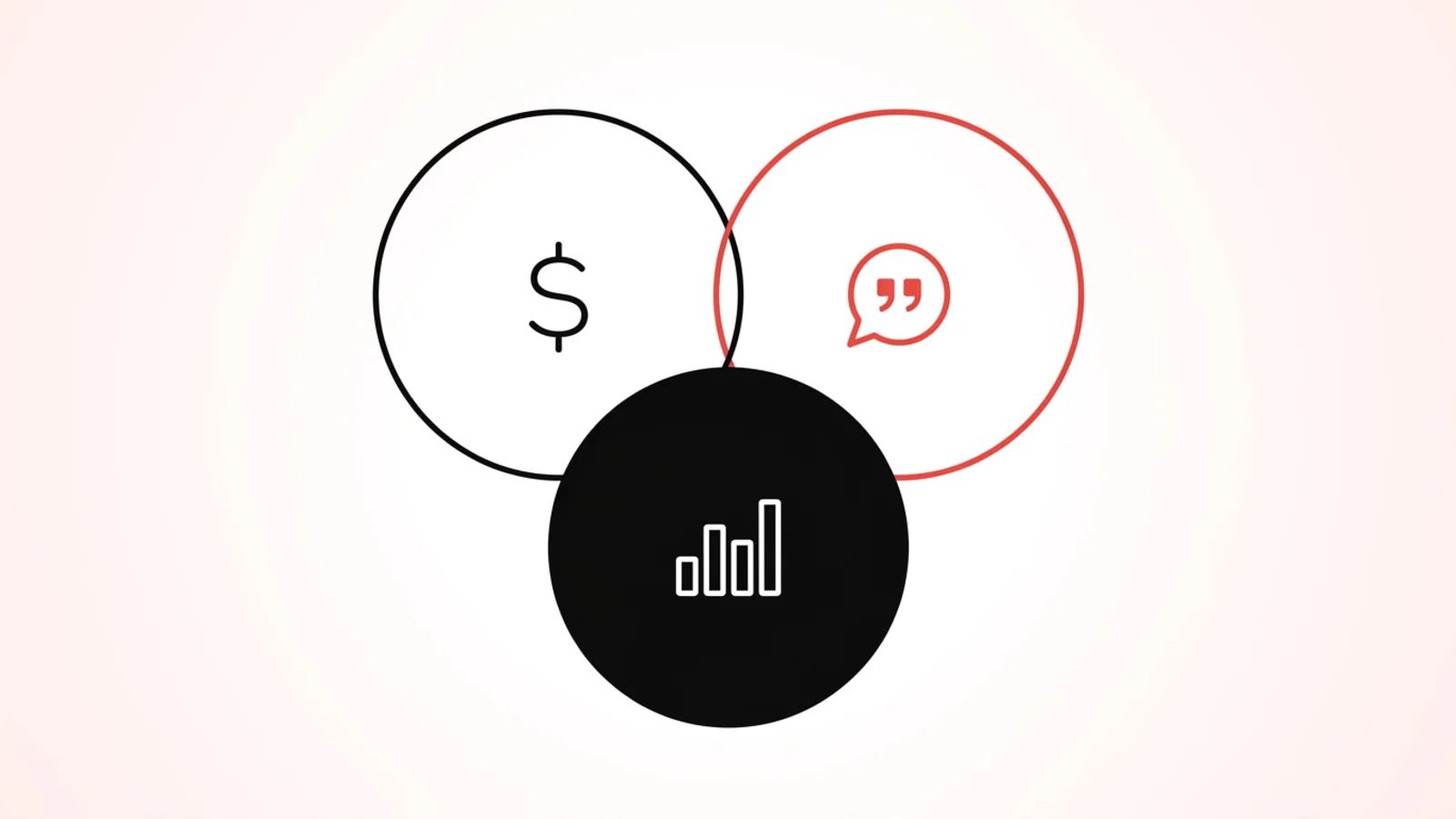 Three separate, non-overlapping circles labeled with a dollar-sign icon, a quote-bubble icon, and a ranking-bars icon, illustrating three channels that barely intersect
A Google Ads budget and a GEO citation strategy are not the same spend. A 50,000-keyword study found less than 12% overlap between advertiser domains and AI Mode citations, so a paid-search win should never be reported internally as a proxy for AI visibility progress.
Should marketing teams change their budget allocation based on this data?
Yes, at least in one specific way: stop justifying GEO or citation-optimization spend as something a paid-search budget already covers, and stop justifying paid-search spend by pointing at rising AI citation numbers. They are separate line items earning separate outcomes, and the data suggests a real budget shift toward GEO fundamentals, not an assumption that ad spend does double duty. Our GEO score reliability piece makes a related point from a different angle: a rising number on one dashboard, whether it is a citation score or an ad-driven traffic bump, needs its own verified attribution before it becomes a budget argument.
- Paid ads for immediate, bottom-funnel transactional intent where a click still converts directly
- GEO and content work aimed specifically at citation, evaluated on its own citation-rate metric
- Organic SEO as its own, separately measured channel with its own ranking signals
- Assuming a strong paid-search presence gives you a citation head start in AI Mode
- Reporting AI citation gains as a return on ad spend without separate attribution
- Deprioritizing GEO work because "we already show up in AI Mode through our ads"
How should GEO and paid-search teams work together given this data?
Treat AI Mode citation as its own discipline with its own budget line and its own measurement, not a byproduct of ad spend. Our AI citation tracking tools comparison covers how to measure citation rate directly rather than inferring it from ad or ranking performance, and our GEO optimization services target the retrieval and entity signals that actually drive citation, independent of what a paid-search team is bidding on.
If your team already runs Google Ads at scale, that spend is not wasted, it is simply answering a different question than "will AI Mode cite us." Our AI SEO services are built to close that specific gap, since the study's own conclusion is that no amount of ad spend substitutes for it.
Frequently asked questions
Does buying Google Ads help you get cited in AI Mode?
No. A study of 50,032 commercial keywords found that advertiser domains appeared among AI Mode's cited sources only 11.53% of the time, even after controlling for brand strength, showing no meaningful citation advantage from paid placement.
What percentage of commercial searches show an ad in Google AI Mode?
29.45% of the 50,032 commercial keywords studied showed a text ad in AI Mode, rising to 53.56% for keywords with a CPC of $10 or more, per SE Ranking's June 2026 analysis.
Do advertised URLs also rank organically for the same query?
Rarely; only 2.32% of advertised URLs ranked organically for the same query where their ad appeared, indicating paid placement and organic ranking are largely independent outcomes in AI Mode.
Are paid ads, AI Mode citations, and organic rankings connected in Google's system?
Based on available data, no; each is generated by a separate system (the ads auction, AI Mode's retrieval and summarization process, and the classic search index respectively), and success in one shows little correlation with the other two.
Should businesses stop running Google Ads if they want AI Mode citations?
No; ads and AI Mode citation serve different goals and should be budgeted and measured separately, since ads still capture immediate transactional intent while citation requires dedicated GEO and content work independent of ad spend.
How many ads does Google AI Mode show per query?
Most ad-triggering queries in the study showed two ads in the same AI Mode response (71.1% of cases), with the remainder showing a single ad (28.9%).
Where does this AI Mode ads and citation data come from?
The data comes from SE Ranking's analysis of 50,032 commercial keywords across 20 niches, collected June 30, 2026, and independently covered by Search Engine Journal and Search Engine Land.
Sources: AI Mode shows ads on 1 in 3 queries: 50K keywords studied (SE Ranking), Google AI Mode Ads Rarely Match The Sources It Cites (Search Engine Journal), Google AI Mode ads reach nearly 30% of queries: Study (Search Engine Land)
This post is part of our AI SEO guide. Related reading: ChatGPT Visibility Audit Guide, Why Isn't My Business Cited by AI? Mentions vs. Citations, How AI Chooses Which Brands to Recommend.

Adel tracks AI citation rates across ChatGPT, Perplexity, Gemini, and AI Overviews. He turns raw visibility data into actionable insights that guide our optimization strategy.
Full Bio →