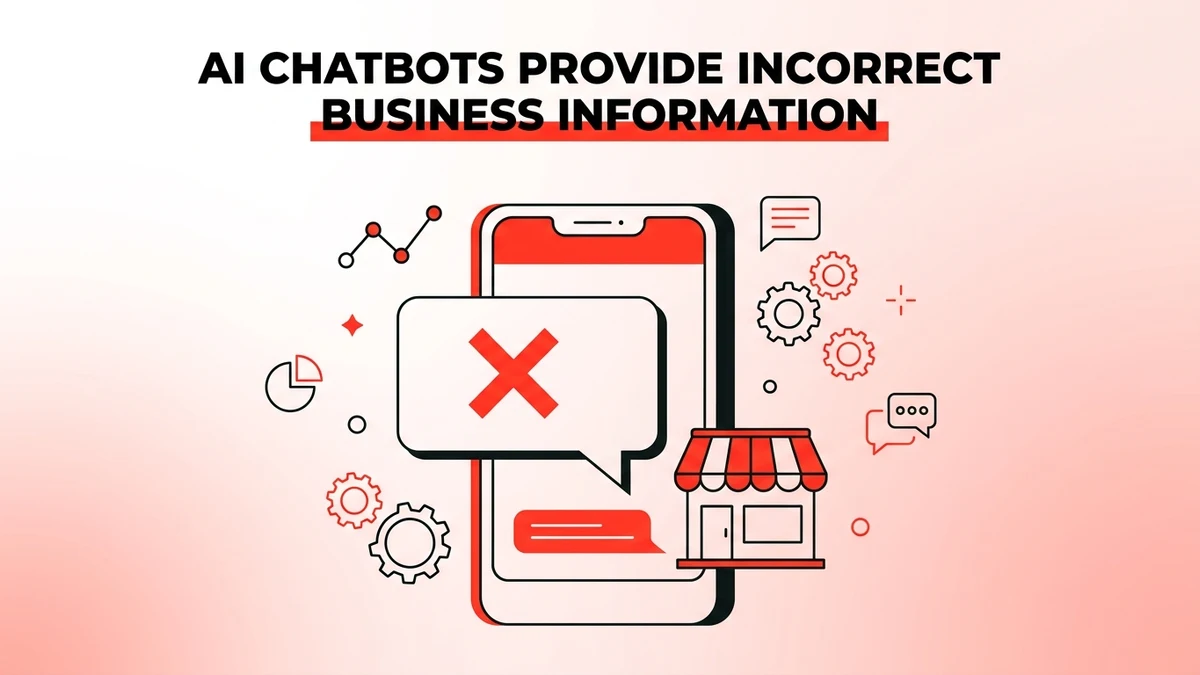
Ask ChatGPT what a business does, what it charges, or how to reach it, and there's a real chance the answer is wrong. Not missing. Wrong. A July 2026 study from AI visibility platform Searchable ran more than 13,000 prompts about London-based companies through ChatGPT, Perplexity, and Gemini, then checked the answers against Companies House filings and official company records. The result: 93% of companies studied got at least one materially wrong or missing answer, a bad phone number, an omitted service, a headcount pulled from nowhere.
That's a different problem from the one most GEO advice addresses. Most of it is about getting cited more often. This is about what happens when you're already being cited, just incorrectly. A prospective customer who gets no answer from ChatGPT moves on and tries something else. A prospective customer who gets a wrong phone number, an outdated service list, or your business confused with a same-named competitor across town acts on bad information, and either can't reach you or reaches the wrong company entirely. That's not a missed opportunity. That's active damage to a relationship that hadn't started yet.
What did the Searchable study actually find?
Searchable, a London-based AI visibility platform, queried ChatGPT, Gemini, and Perplexity with routine questions a prospective customer would ask before making contact: what does this company do, what services does it offer, how many people work there, what's the phone number, when was it founded. Each answer was checked against verified records, primarily Companies House filings and official company profiles.
Across the full sample, 93% of businesses had at least one answer that was wrong, incomplete, or simply unavailable. Around half of small and medium-sized businesses had outright false facts returned when asked directly about their own business. Larger companies (500+ employees) fared better but weren't clean either, with a 32% misinformation rate against roughly 50% for SMEs, a 56% relative gap. Searchable's co-founder Chris Donnelly also noted AI models were around five times more likely to confuse or misidentify an SME's brand name than a larger company's, a separate but related failure: not getting the facts wrong about the right business, but answering about the wrong business entirely.
The mechanism Searchable points to is digital footprint. Companies with a larger presence across news coverage, directories, review platforms, and other authoritative sources get represented more accurately, because there's more corroborating signal for the model to draw from or retrieve at query time. Smaller businesses, with thinner and less-maintained footprints, are the ones paying for it.
Why is being cited wrong worse than not being cited at all?
Not being cited is a missed opportunity. Being cited wrong is an active liability. If ChatGPT says nothing about your business, a customer's next move is usually to search elsewhere and eventually find you through some other channel. If ChatGPT confidently states the wrong opening hours, a service you don't offer, or a phone number that rings a different company, the customer acts on it. They show up when you're closed. They ask about something you don't sell. They call a number that isn't yours, maybe one that belongs to a competitor with a similar name, and never circle back to find the right one.
This is also a trust problem that outlives the single interaction. A customer who gets burned by bad information rarely blames the AI platform. They blame the business, because as far as they're concerned, that's where the information came from.
Why do AI chatbots get basic business facts wrong?
Four mechanisms show up repeatedly, and they apply well beyond this one study:
Stale training data. Large language models are trained on a snapshot of the web at some point in the past. If a business changed its phone number, pivoted its service list, or moved office after that snapshot, the model can state the old facts with total confidence, because as far as its training data is concerned, they're still current.
Live retrieval pulling from outdated pages. Tools with search capability (ChatGPT's search mode, Perplexity, Gemini with grounding) fetch pages at query time, but they're only as good as what's indexed. An old directory listing, a cached version of your site, or a third-party aggregator page that nobody's updated in three years can outrank your actual current site in what gets retrieved.
Entity confusion. Two businesses with the same or similar name, especially common with generic or location-based names, get merged or swapped in the model's output. This is the mechanism behind Searchable's finding that SME brand names get misidentified roughly five times more often than large companies' names do.
Unmaintained directory listings. Google Business Profile, Yelp, industry directories, old press mentions: these often contain your business's information from years ago, entered once and never revisited. Models that pull from these sources inherit whatever's sitting there, right or wrong.
Do accuracy rates differ by platform?
Searchable's July 2026 report gives an aggregate figure across ChatGPT, Perplexity, and Gemini combined, the 93% and 56% numbers above. It doesn't publish a breakdown of accuracy by individual platform, so there's no verified number for how the three compare against each other.
There's a plausible reason platforms could differ anyway. Gemini can ground its answers in Google Business Profile and Google Maps data, a single verified source businesses can edit directly. ChatGPT and Perplexity rely more on training-data recall and general web retrieval, pulling from whatever's indexed rather than one authoritative record. That's a reasonable explanation for why the platforms might behave differently, not a measured result from this study. Treat it as a mechanism worth understanding, not a stat worth quoting.
How do you check what AI platforms are currently saying about your business?
There isn't a shortcut around doing this manually, at least not yet. Open ChatGPT, Perplexity, and Gemini separately and ask each one the questions a real customer would ask: what does [your business] do, what areas or services does it cover, what's the phone number, what are the hours, how many people work there. Ask about your business by name, and separately ask a category question that should surface you ("best [category] in [your city]") to see if you show up correctly when you're not the direct subject of the question.
Compare every answer against your own records, not against what you assume the platform "should" know. Repeat this every few weeks rather than once, since training data and retrieval indexes both shift over time.
One thing worth being precise about here: tools like our own AI Visibility Checker audit technical readiness, whether AI crawlers can access your site, whether structured data is in place, whether your content is structured for extraction. That's a different question from whether ChatGPT or Gemini is currently saying accurate things about your business. Ours doesn't check live citation content or verify factual accuracy, and as far as we've seen, most self-serve tools in this category don't either. The only reliable way to find out what's actually being said about you right now is to ask the platforms directly.
Why does Google Business Profile hygiene matter more than most GEO advice suggests?
Gemini's grounding can pull from Google Business Profile and Google Maps data when it answers questions about a specific business, a retrieval path ChatGPT and Perplexity don't have the same access to. That means an hour spent making sure your Google Business Profile has the correct phone number, current hours, an accurate service list, and the right category has a plausible outsized effect on at least one major AI platform's output, even without a published study confirming exactly how large that effect is. This is a case where a genuinely boring maintenance task (checking a listing you probably haven't opened in months) is worth doing regardless, because it's one of the few inputs a business can directly control that a model reads without any interpretation layer in between.
Why should you audit for stale directories and name confusion, not just your own website?
Because your website isn't the only input these models draw from, and for the platforms without Gemini's direct GBP connection, it might not even be the primary one. A stale Yelp listing, an old press mention with your previous phone number, a directory entry nobody's touched since your business changed hands: all of these are candidate sources a model might retrieve and quote as fact.
Search for your business name plus a few identifying details (city, former address, previous phone number) and see what still comes up. If there's a same-named or similarly-named business in your industry or area, check whether AI platforms conflate the two when asked about either of you. This is tedious, unglamorous work, and it's also the actual fix for a problem that generic content marketing won't touch.
Not being cited by AI is a missed opportunity. Being cited wrong is active damage, because customers act on bad information instead of just moving on. Check what ChatGPT, Perplexity, and Gemini currently say about your business by asking them directly, since no self-serve tool verifies this for you. Then prioritize fixing Google Business Profile data (Gemini reads it directly) and auditing for stale directory listings and name confusion with similarly-named competitors, not just your own website's content.
Worried about what AI platforms are saying about your business?
AY Rank runs full AI visibility audits that go beyond crawler access and structured data, checking what ChatGPT, Perplexity, and Gemini are actually saying about your business today, and fixing what's wrong. Book a free GEO audit to find out where you stand.
FAQ
What percentage of businesses does AI get wrong information about?
Per Searchable's July 2026 study of London-based companies, 93% had at least one incorrect, incomplete, or missing answer when checked against verified records, and roughly half of small and medium-sized businesses had outright false facts returned. This is a UK/London-specific figure; the exact percentage may differ in other markets, though the underlying causes apply broadly.
Is Gemini more accurate than ChatGPT for business information?
Searchable's study didn't publish a verified breakdown by platform, so there's no confirmed figure for how Gemini, ChatGPT, and Perplexity compare against each other. What's plausible is that they differ: Gemini can ground answers in Google Business Profile and Google Maps data, while ChatGPT and Perplexity rely more on training-data recall and general web retrieval. Treat that as a reasonable explanation for why results might vary by platform, not as a measured statistic from this research.
How do I find out what AI chatbots are saying about my business?
Ask ChatGPT, Perplexity, and Gemini directly, individually, the same questions a customer would ask: services offered, phone number, hours, headcount, location. Compare the answers against your own records. There's currently no reliable automated tool that checks this for you; it requires manually prompting each platform.
Does fixing my Google Business Profile actually help with AI accuracy?
Plausibly, yes, especially for Gemini, which can ground answers in Google Business Profile and Google Maps data rather than reconstructing an answer from general web content. The Searchable study didn't publish per-platform numbers confirming the size of that effect, but an accurate, current Google Business Profile costs little to maintain and is one of the highest-leverage fixes available for this problem regardless of which platform benefits most.
Is this the same issue as not being cited by AI at all?
No. Not being cited (see our guide on why AI mentions but doesn't cite a business) means a platform has nothing to say about you. Being cited wrong means it has something to say, and that something is inaccurate. The fixes overlap, but the risk profile is different: one is a missed opportunity, the other is active misinformation that a real customer can act on.
How is this different from general GEO or local SEO advice?
Most GEO and local SEO advice, including our own guide to GEO for local businesses, focuses on prevention: NAP consistency, Google Business Profile optimization, structured data, getting cited more often in the first place. This is about detection and correction after the fact, checking what's already being said and fixing it, which is a separate step most advice skips entirely.
Sources: Searchable, London SMEs and AI misinformation research, July 2026 (via London Business Journal), Companies House
This post is part of our AI SEO guide. Related reading: Google Search Console's AI Overviews Report,, Domain Authority Doesn't Predict AI, Reddit's ChatGPT Citations Fell 86% in August.

Oussama leads technical and on-page SEO at AY Rank. He specializes in structured data engineering, crawl optimization, and building the entity architecture that makes AI models cite our clients.
Full Bio →