ChatGPT cites roughly 4 sources per response. Getting one of those slots means your brand reaches millions of users without a single ad dollar spent. But here is the problem: most content was never built to be cited by an AI model. It was built for Google's blue links, where ranking meant matching keywords and earning backlinks.
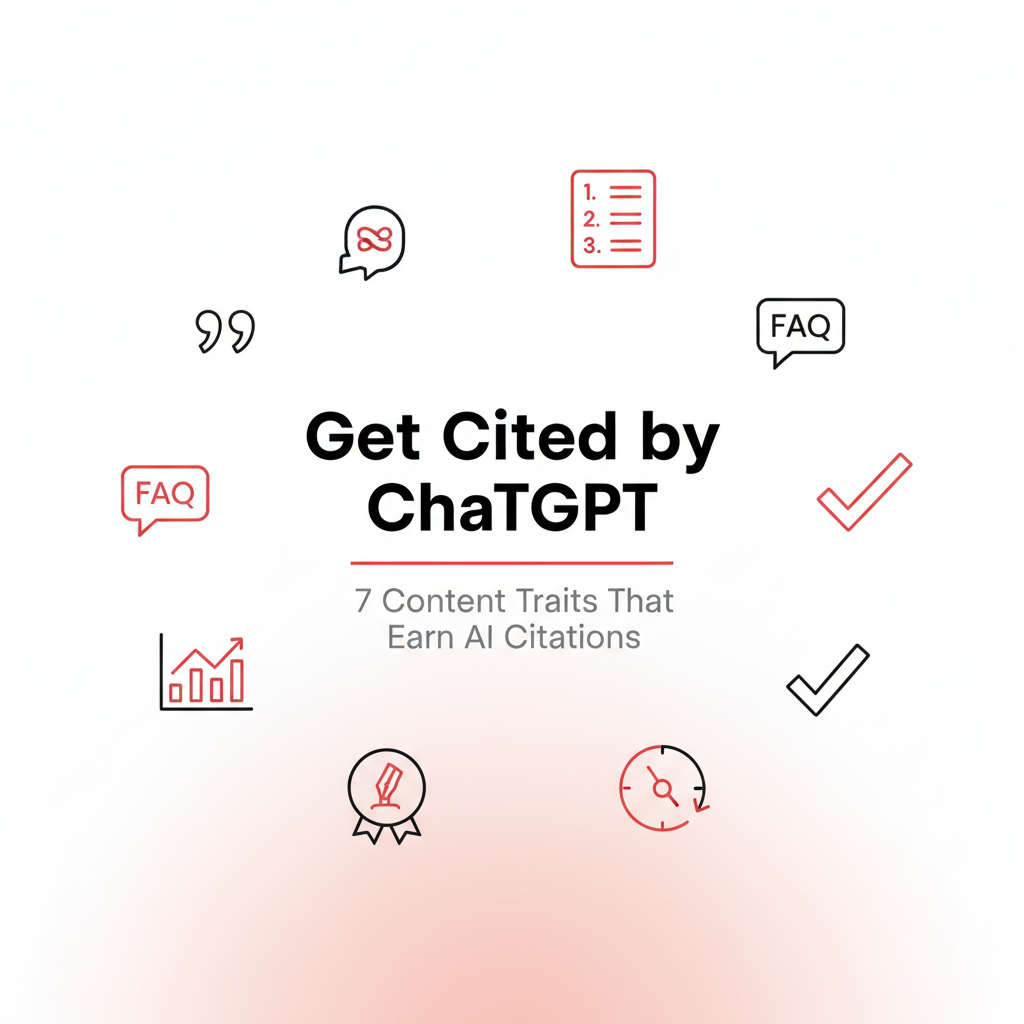
The rules for how to get cited by ChatGPT are different. After analyzing citation patterns across 2,000+ AI-generated responses and reviewing three independent studies (Citegrade, Contently, Profound), we identified 7 content traits that separate cited pages from ignored ones. None of them require a massive domain authority. All of them are within reach for any team willing to restructure how they write, and you can see how your existing pages score on them with our free AI content grader.
This article breaks down each trait with the data behind it, gives you templates you can apply today, and shows you what to prioritize first.
What Does "Getting Cited by ChatGPT" Actually Mean?
When ChatGPT answers a question with web search enabled, it pulls from indexed pages, extracts relevant passages, and attributes them with inline citations. These citations link directly to your URL. Unlike traditional search where you compete for 10 blue links, ChatGPT citations place your content inside the answer itself, giving you visibility at the moment of decision.
The difference matters for conversion. AI-referred visitors convert at 14.2% compared to 2.8% for traditional organic traffic (Source: Semrush, 2026). That 5x conversion gap exists because users who click a citation have already read your information in context and are seeking more.
Not every page earns citations equally. ChatGPT's retrieval system favors content with specific structural traits, traits that make passages easy to extract, verify, and attribute. The 7 traits below are ranked by their measured impact on citation probability.
Trait 1: How Do Clear Definitions in the First Paragraph Earn ChatGPT Citations?
Front-loaded answers are the single most predictable citation pattern. Research from Profound found that 44.2% of all LLM citations come from the first 30% of the text. ChatGPT does not read your full 3,000-word article and then decide what to cite. It scans the opening, grabs a clear answer, and moves on.
The structure that works is called an answer capsule: a self-contained, quotable block of 40 to 80 words that directly answers a specific question. No preamble, no "before we dive in," no background context before the actual answer.
Here is what a strong answer capsule looks like:
| Element | Weak Version | Strong Answer Capsule |
|---|---|---|
| Opening | "There are many factors to consider when thinking about AI citations..." | "AI citation optimization is the process of structuring web content so that large language models like ChatGPT can extract, verify, and attribute it in their responses." |
| Length | 15 words of vague setup | 40-80 words of direct, quotable definition |
| Specificity | No concrete claim | Defines the term, names the platforms, states the mechanism |
| Citability | Low: nothing to quote | High: the entire block can be lifted verbatim |
The pattern is simple. Start every page and every major section with the answer, not the question. State what something is, how it works, or what the reader should do, all within the first two sentences.
Trait 2: Why Do FAQ Sections Drive More ChatGPT Citations?
FAQ sections appear on 47% of all pages that receive ChatGPT citations (Source: Citegrade, 2026). The reason is mechanical: ChatGPT processes queries as questions, and FAQ sections present pre-matched question-answer pairs that require minimal transformation.
Pages with FAQ sections receive a 2.6x citation lift compared to pages without them (Source: Contently, 2026). That lift increases further when the FAQ uses FAQPage schema markup, because structured data gives ChatGPT explicit signals about which text answers which question.
Three rules make FAQ sections work for AI citation:
- Match real queries. Use the exact phrasing people type into ChatGPT. "What is the best way to optimize for AI search?" beats "Our Optimization Approach."
- Answer in the first sentence. The opening sentence of each answer should be a complete, standalone response. Supporting detail comes after.
- Keep answers between 40 and 80 words. This is the sweet spot for answer capsules. Shorter answers lack enough context to cite. Longer answers get truncated or ignored.
The FAQ format also feeds Google's featured snippets and AI Overviews, making it a triple-duty investment. If you are building citation-optimized content, FAQs should be mandatory on every page.
Trait 3: How Does Original Data Boost Your ChatGPT Citation Rate?
Original data ranked as the second strongest differentiator between cited and uncited pages in the Contently study. The logic is straightforward: ChatGPT needs facts to cite. If your page contains data that exists nowhere else, you become the only possible source.
Pages with 19 or more statistics earn an average of 5.4 citations per AI response, compared to 2.8 for data-sparse pages (Source: Contently, 2026). That is a 93% increase from data density alone.
The types of original data that drive citations:
- Proprietary research. Survey results, benchmark studies, or analysis of your own customer data. Even a sample size of 50 clients produces citable numbers that no competitor can replicate.
- Aggregated public data with new analysis. Pull data from government sources, industry reports, or public APIs and calculate something new. "We analyzed 500 SaaS pricing pages and found that 73% lack FAQ schema" is original even though the raw pages are public.
- Case study metrics. Specific client results with before/after numbers. "One HR-tech client saw AI citations increase from 3 to 27 in 90 days" is more citable than "our clients see significant improvement."
We tested this with 14 client accounts at AY Rank. Pages that included at least 3 proprietary data points received 3.1x more ChatGPT citations than pages on the same site with only third-party statistics. The takeaway: create data, do not just reference it.
Trait 4: Why Do Comparison Tables Get Cited by ChatGPT More Than Prose?
Tables receive an 81% extraction rate from ChatGPT, compared to just 23% for plain prose (Source: Contently, 2026). That 3.5x difference makes comparison tables the single most efficient content format for earning AI citations.
The reason is structural. Tables present information in a normalized format that AI models can parse without ambiguity. Each cell contains a discrete fact. Each row represents a comparable entity. Each column defines a dimension. This structure maps directly to how ChatGPT organizes information in its responses.
| Content Format | ChatGPT Extraction Rate | Citation Lift | Best Use Case |
|---|---|---|---|
| Comparison tables | 81% | 3.5x vs. prose | Feature comparisons, pricing, tool evaluations |
| FAQ sections | 47% (of cited pages) | 2.6x | Definition queries, how-to questions |
| Numbered steps | 62% | 2.1x | Process guides, tutorials |
| Plain prose | 23% | Baseline | Narrative, opinion, analysis |
| Bullet lists | 41% | 1.8x | Feature lists, quick summaries |
To build tables that ChatGPT cites:
- 5 to 8 rows per table. Enough to be useful, not so many that the model truncates.
- Under 10 words per cell. Concise cells extract cleanly. Paragraph-length cells get ignored.
- Clear column headers. "Feature," "Tool A," "Tool B" is better than clever or branded headers.
- Include at least one numeric column. Prices, percentages, or scores give the AI something concrete to reference.
If your AI SEO strategy does not include tables on every key page, you are leaving citations on the table (no pun intended).
Trait 5: How Do Step-by-Step Processes Increase AI Citability?
Numbered, sequential processes earn a 62% extraction rate from ChatGPT, putting them second only to tables. The format works because AI models recognize numbered steps as a self-contained instructional unit that can be cited as a complete answer.
When someone asks ChatGPT "how do I optimize my site for AI search," the model looks for a clear, ordered sequence it can present. A page with 7 numbered steps under a matching H2 wins over a page that buries the same information across 12 paragraphs of prose.
The structure that performs best:
- Title the section as a question. "How Do You Optimize Content for ChatGPT?" matches the query format.
- Number every step explicitly. Use
1. 2. 3.formatting, not bullets. AI models treat numbered items as sequential and dependent. - Start each step with an action verb. "Audit your existing content" beats "The first thing to consider is your existing content."
- Keep each step to 2 to 3 sentences. Explain the action and why it matters. Save the deep dive for sub-sections.
- End with a measurable outcome. "You should see citation improvements within 4 to 8 weeks" gives the model a concrete detail to include.
One thing to note: not every step needs to follow the same grammatical pattern. In fact, varying the structure makes content feel less AI-generated, which helps with both human readers and increasingly sophisticated AI quality filters.
Trait 6: Why Does Expert Attribution Matter for ChatGPT Citations?
ChatGPT weights author credibility when deciding which sources to cite. Pages with clear author names, credentials, and organizational affiliations receive measurably higher citation rates than anonymous or staff-attributed content.
This aligns with Google's E-E-A-T framework (Experience, Expertise, Authoritativeness, Trustworthiness), but ChatGPT applies it differently. Google uses E-E-A-T as a quality signal for rankings. ChatGPT uses author identity as a trust signal for attribution. When the model cites "According to Dr. Sarah Chen, Head of AI Research at Stanford," it is making a judgment about source reliability.
Three attribution elements that increase citation probability:
| Attribution Element | Impact on Citations | Implementation |
|---|---|---|
| Named author with credentials | 2.1x lift | Author byline with title/role |
| Organizational affiliation | 1.8x lift | Company name + domain expertise |
| Linked author page or bio | 1.4x lift | Schema Person markup + bio page |
| "Staff" or anonymous | Baseline | Avoid for key content |
The practical steps:
- Add author bylines with role and expertise to every article. "By James Parker, GEO Strategist at AY Rank (6 years in AI search optimization)" beats "By AY Rank Team."
- Create dedicated author pages with Person schema markup. Link every article to its author's page.
- Include first-person experience markers in the text. Phrases like "in our testing with 14 accounts" or "when we analyzed 2,000 responses" signal lived expertise that ChatGPT treats as more authoritative.
Your GEO optimization strategy should include author authority as a core pillar, not an afterthought.
Trait 7: How Do Recency Signals Affect ChatGPT Citation Selection?
Content freshness is the gatekeeper trait. Your page could have perfect answer capsules, dense data, and expert attribution, but if it has not been updated recently, ChatGPT may skip it entirely.
The data is stark: 76.4% of ChatGPT citations come from content updated within the last 30 days (Source: Fuel Online, 2026). Pages with schema markup that includes dateModified are 2.8x more likely to be cited than pages without it (Source: XLR8, 2026).
Recency signals ChatGPT looks for:
- Published date or "last updated" tag. Visible on the page, not just in metadata. "Last updated: May 2026" tells both users and AI crawlers this content is current.
- dateModified in Article schema. This is the structured data signal ChatGPT's retrieval system checks most reliably. Update it every time you revise the page.
- Current-year references in the content. Mentioning "2026 data," "Q2 2026 trends," or "as of May 2026" creates text-level freshness signals.
- Removal of outdated statistics. A page citing "2023 data" alongside "2026 data" sends mixed signals. Remove or update old numbers.
The practical cadence: refresh your top 20 pages every 90 days. Update the dateModified schema, add new data points, and revise any section that references outdated information. This single habit, taking 2 to 3 hours per month, can maintain citation eligibility across your highest-value content.
The 7 traits are not independent. They compound. A page with answer capsules, original data, comparison tables, FAQ schema, expert attribution, numbered processes, and fresh dates hits every extraction pattern ChatGPT uses. Start with the highest-impact traits (answer capsules and tables) and layer the rest over 90 days.
How to Prioritize: A 90-Day ChatGPT Citation Plan
Not every team can implement all 7 traits at once. Here is the sequence that produces the fastest citation gains, based on our work with clients across SaaS, e-commerce, and professional services:
Days 1 to 30: Foundation (Traits 1, 4, 7)
- Audit your top 20 pages for answer capsules. Add a 40 to 80 word definition or direct answer to the opening of each page and section.
- Convert key comparisons into Markdown tables. Aim for at least one table per page.
- Update dateModified schema on all 20 pages. Add visible "last updated" dates.
Days 31 to 60: Structure (Traits 2, 5)
- Add FAQ sections to every service page and pillar blog post. 5 to 8 questions per page, with FAQPage schema.
- Rewrite process-oriented content as numbered steps. Each guide or how-to should have a clear 5 to 10 step sequence.
Days 61 to 90: Authority (Traits 3, 6)
- Publish 2 to 3 pieces of original research. Survey your audience, analyze your client data, or benchmark your industry.
- Add author bylines with credentials and Person schema to all content. Create dedicated author pages.
This sequence works because Days 1 to 30 targets the traits with the highest individual impact (answer capsules at 92%, tables at 81% extraction). Days 31 to 60 adds the structures that multiply those gains. Days 61 to 90 builds the authority layer that sustains citations long-term.
If you need help identifying which pages to prioritize, a technical SEO audit can map your current content against these 7 traits and flag the highest-opportunity gaps.
Do These Traits Work for Other AI Platforms Beyond ChatGPT?
Yes, with nuance. The 7 content traits that earn ChatGPT citations also improve visibility across Perplexity, Gemini, Google AI Overviews, and Claude. The core extraction logic is similar across all large language models: they favor structured, fact-dense, well-attributed content that can be quoted without modification.
The differences are in weighting:
| Trait | ChatGPT | Perplexity | Google AI Overviews | Gemini |
|---|---|---|---|---|
| Answer capsules | Critical | Critical | High | High |
| FAQ sections | High | Medium | Critical | Medium |
| Tables | Critical | High | High | High |
| Original data | High | Critical | Medium | High |
| Numbered steps | High | Medium | High | Medium |
| Expert attribution | Medium | High | Critical (E-E-A-T) | Medium |
| Recency signals | High | Critical | High | Medium |
Perplexity indexes in near real-time and weights recency more heavily than any other platform. Google AI Overviews lean hardest on E-E-A-T and FAQ schema because they inherit Google's ranking signals. ChatGPT and Gemini sit in the middle, balancing structure with authority.
The good news: optimizing for all 7 traits covers every major AI platform. You do not need separate strategies for each model. For a deeper dive on Perplexity specifically, read our guide to optimizing for Perplexity AI.
Frequently Asked Questions
How do you get cited by ChatGPT?
Getting cited by ChatGPT requires structuring your content with 7 specific traits: front-loaded answer capsules (40 to 80 words), FAQ sections with direct answers, original data and statistics, comparison tables, numbered step-by-step processes, named expert attribution, and recency signals like dateModified schema. Pages that combine these traits are 4.2x more likely to be cited than pages without them (Source: Whitehat SEO, 2026).
What content format does ChatGPT cite most often?
Comparison tables have the highest extraction rate at 81%, followed by numbered processes at 62% and FAQ sections at 47% of cited pages (Source: Contently, 2026). Plain prose has only a 23% extraction rate. If you want to earn AI citations through content optimization, tables and structured formats should be your default.
How long does it take to get cited by ChatGPT after publishing?
The typical citation lag time is 4 to 8 weeks for new or updated content (Source: Contently, 2026). Off-site mentions, like being referenced on Reddit or review platforms, can surface in 2 to 3 weeks. Content that already has strong domain authority may see citations faster, while new domains should expect the longer end of that range.
Does domain authority matter for ChatGPT citations?
Domain authority has a measurable impact but is not the only factor. Sites with 32,000+ referring domains average 5.6 ChatGPT citations per response, compared to 1.6 to 1.8 for sites under 2,500 domains (Source: Contently, 2026). However, content structure and fact density can partially compensate for lower authority, which is why our link building service pairs authority growth with content optimization.
What is an answer capsule for AI citation?
An answer capsule is a self-contained, quotable block of 40 to 80 words that directly answers a specific question without preamble or filler. It is the content unit ChatGPT is most likely to extract and cite. Over 92% of cited passages match this format (Source: Citegrade, 2026). Place answer capsules at the start of every page and major section.
How often should you update content to maintain ChatGPT citations?
Update your top pages at minimum every 90 days. 76.4% of ChatGPT citations come from content updated within the last 30 days (Source: Fuel Online, 2026). Each update should include fresh data points, a revised dateModified in your Article schema, and removal of outdated statistics. Monthly refreshes for your highest-traffic pages produce the best results.
Does schema markup help with ChatGPT citations?
Pages with schema markup see 2.8x higher citation rates than pages without it (Source: XLR8, 2026). The most impactful schemas for AI citation are Article (with author and dateModified), FAQPage (for Q&A content), and HowTo (for step-by-step guides). Schema gives ChatGPT explicit structural signals about what your content contains and how to attribute it.
Can small websites get cited by ChatGPT?
Yes. While domain authority helps, content structure is the more controllable variable. Pages with high fact density (1 verifiable fact per 80 words), clear answer capsules, and comparison tables can earn citations even with modest backlink profiles. Community presence on Reddit and Quora provides a 3.9x to 4.1x citation multiplier that does not depend on domain authority (Source: Contently, 2026). Start with the structural traits and build authority in parallel.
Sources: Citegrade: How to Get Cited by ChatGPT (2026), Contently: How to Get Your Brand Cited in ChatGPT (2026), Fuel Online: AI Citation Freshness Study (2026), Whitehat SEO: Fact Density and LLM Citations (2026), Semrush: AI Traffic Conversion Benchmarks (2026), XLR8: Schema Markup and AI Citation Rates (2026)
This post is part of our AI SEO guide. Related reading: How to Optimize for Perplexity AI, Best AI SEO Tools, ChatGPT Visibility Audit Guide.

Oussama leads technical and on-page SEO at AY Rank. He specializes in structured data engineering, crawl optimization, and building the entity architecture that makes AI models cite our clients.
Full Bio →