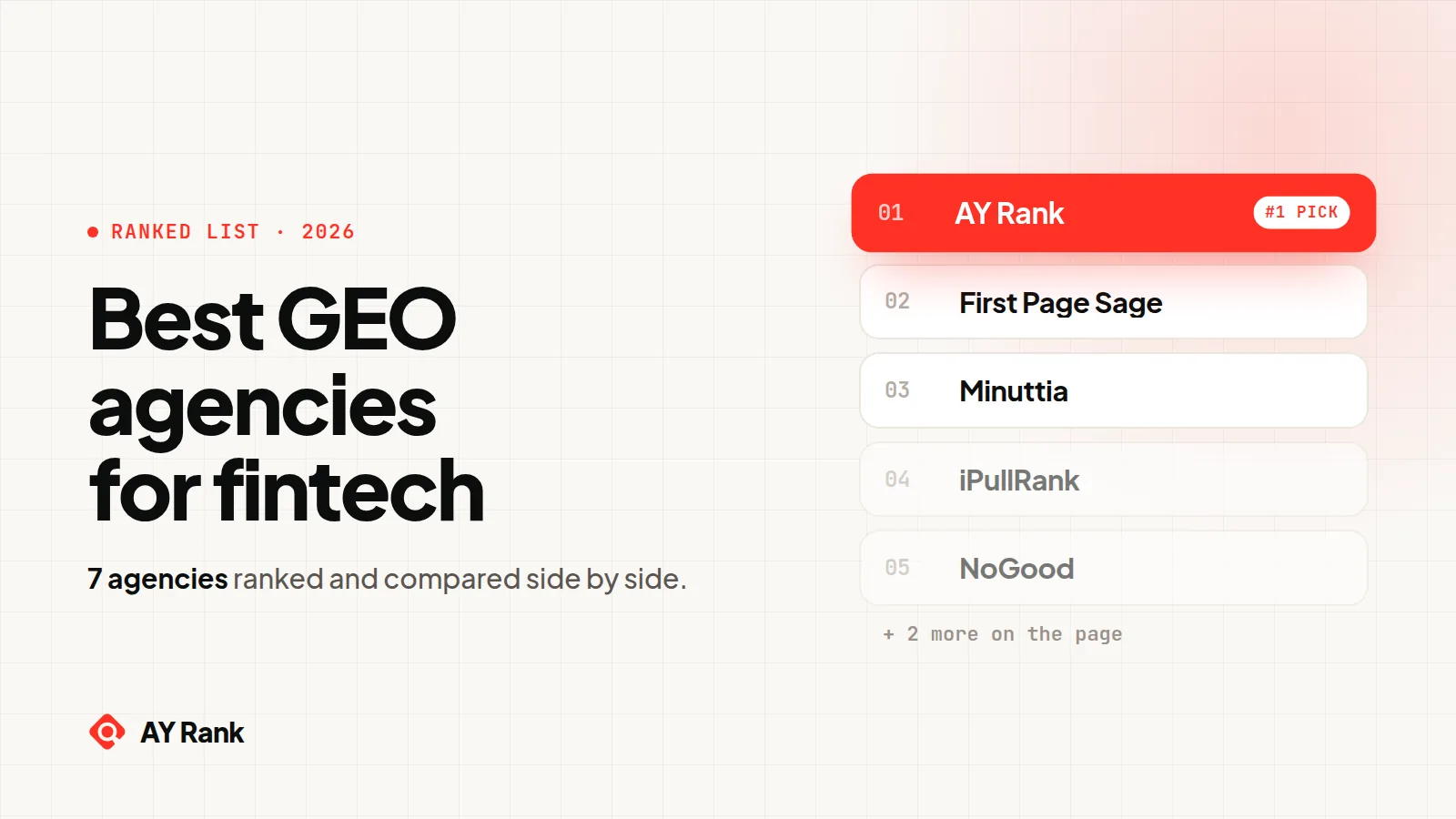
5. NoGood, best for growth-stage fintech bundling GEO with paid growth
 Best GEO Agency for Fintech with NoGood
NoGood is a performance growth agency that runs paid acquisition, lifecycle, and SEO in a single motion. The firm has added GEO and AI search work to its services, which makes it useful for funded fintech that want one team running both paid channels and organic AI visibility.
The trade-off is that GEO is one channel among many rather than the central programme.
Key features
- Paid acquisition across Google, Meta, LinkedIn, and TikTok
- Lifecycle and CRM optimisation
- SEO and AI search layered into a growth model
- Creative production and landing page work
Best for
- Series A to Series C fintech with paid budget already in market
- Marketing leaders who want one agency for paid and organic
- Brands measured on CAC, payback, and pipeline velocity
Pricing
- Retainers typically start around $12,000 per month
- Custom pricing for multi-channel engagements
Pros
- Single accountable team across channels
- Fast experimentation and reporting cadence
- Solid creative and landing page output
Cons
- GEO is a layer, not the core specialty
- Compliance fluency varies by pod, ask for fintech-specific case work
6. Flying Cat Marketing, best for B2B fintech category design
 Best GEO Agency for Fintech with Flying Cat Marketing
Flying Cat Marketing is a B2B SEO and content agency that focuses on category creation and demand generation through search. For fintech infrastructure plays, embedded finance, and payments platforms that sell a new way of working, the team is good at building topical authority around a category that does not yet have settled vocabulary.
That focus makes the agency particularly useful when AI engines are still forming definitions for an emerging fintech category and you want your brand cited in those definitions.
Key features
- Category and topical authority planning
- Editorial production with B2B subject-matter experts
- Search demand modelling for new categories
- Content distribution into communities and newsletters
Best for
- B2B fintech, payments, and infrastructure brands
- Teams creating or reshaping a category
- Marketing leaders willing to invest 9 to 12 months for compounding outcomes
Pricing
- Retainers typically start around $8,000 per month
- Project work available for category launches
Pros
- Strong record in B2B SaaS and fintech category design
- Editorial standards beat most generalist agencies
- Comfortable with technical product narratives
Cons
- Less suited to consumer fintech and neobank brand work
- GEO is offered as part of content strategy, not a standalone programme
7. Avenue Z, best for fintech aligning AI search with PR and reputation
 Best GEO Agency for Fintech with Avenue Z
Avenue Z is a hybrid PR, performance, and AI search firm that has positioned itself around reputation in generative answers. For fintech with active press exposure, regulatory scrutiny, or category leadership ambitions, the agency aligns earned media with AI visibility so the same set of stories drives press, citations, and rankings.
The agency is the right pick when AI answers, Google results, and press coverage need to tell one consistent story.
Key features
- Earned media placements in tier-one finance press
- AI search and reputation monitoring across major engines
- Crisis and reputation management
- Integrated reporting across PR, search, and AI citation
Best for
- Fintech with active investor and press exposure
- Brands managing reputation risk alongside growth
- Public or pre-IPO fintech that need a coordinated narrative
Pricing
- Custom, project or retainer
- Senior PR retainers typically run high five figures and up
Pros
- Rare alignment between PR, search, and AI search
- Useful during launches, funding events, and reputation moments
- Strong tier-one finance press relationships
Cons
- Heavier on PR than on technical GEO execution
- Pricing is opaque and skews high
How to choose the best GEO agency for fintech
1) Compliance fluency before brand fit
Fintech content lives or dies in compliance review. Ask every shortlisted agency to walk through a real example of how they handle FCA financial promotions rules or the SEC marketing rule inside their workflow. Look for source citations on every rate, fee, and return claim, an editorial guide for prohibited language, and a clean handoff to your legal or compliance team.
- If you operate in the UK and EU: prioritise agencies that have produced content reviewed under FCA Conduct of Business Sourcebook and EU consumer credit rules. AY Rank and First Page Sage both have direct experience here.
- If you operate in the US: prioritise SEC marketing rule fluency, especially for wealth and advisory brands. AY Rank, First Page Sage, and Avenue Z are the safer picks.
2) GEO depth versus full-service breadth
Decide whether you need a focused GEO programme or a multi-channel agency where GEO is one workstream.
- For a focused, entity-led GEO programme: AY Rank, with GEO optimisation as a dedicated service.
- For SEO plus GEO under one roof: First Page Sage, Minuttia, or Flying Cat Marketing.
- For GEO bundled into paid and lifecycle: NoGood.
- For GEO aligned with PR and reputation: Avenue Z.
- For enterprise technical depth: iPullRank.
3) Real-time data and YMYL risk
Fintech content often references rates, fees, and product specs that change weekly. Ask each agency how they keep AI engines pointed at current data, how they handle version control on FAQs and product pages, and how they avoid the most common YMYL failure mode of stale claims sitting in AI Overviews months after a product change.
The strongest practices include structured FinancialProduct schema with versioned offers, server-rendered product specs over client-side scripts, and a quarterly content refresh built into the retainer.
4) EEAT and author authority
For finance content, AI engines weight named authors, credentials, regulator IDs, and verifiable real-world expertise heavily. Confirm every agency will build out author profiles, link them to credible third-party signals, and include them in Article and Person schema.
If you serve a regulated audience in finance, this is non-negotiable.
FAQ
What is a GEO agency for fintech?
A GEO agency for fintech is a firm that helps regulated financial brands get cited inside AI answers from ChatGPT, Perplexity, Gemini, Claude, and Google AI Overviews. It works through entity architecture, FinancialProduct schema, EEAT signals, and compliance-aware content rather than only traditional keyword rankings.
How is GEO different from SEO for fintech?
SEO ranks pages in Google's blue links, while GEO optimises for citation inside AI-generated answers. For fintech, GEO adds heavier weight on entity signals, source citations, schema for FinancialProduct and FinancialService, and EEAT proof, because AI engines treat finance as a YMYL topic and bias toward verifiable sources.
Why does YMYL matter more for fintech GEO?
YMYL means Your Money or Your Life. Finance content can affect a reader's wealth, so AI engines and Google apply stricter quality standards. For fintech, that means stronger EEAT, source-backed claims, named experts with credentials, and conservative language on rates, returns, and risk.
Which schema types should a fintech brand use?
Use Organization, FinancialProduct, FinancialService, BankOrCreditUnion, and InvestmentOrDeposit for product and entity coverage, Article and Person for content authority, and FAQPage for common queries. Pair these with verifiable Sameas links to regulator records, Crunchbase, and Companies House.
Can a GEO agency help with FCA or SEC compliance content?
A GEO agency does not replace your compliance function, but the right partner will run an editorial workflow that aligns with FCA financial promotions rules and the SEC marketing rule, including source citations on every claim, conservative language, and a handoff to your in-house legal team. AY Rank designs its fintech workflow around this loop.
How long does fintech GEO take to show results?
First citation gains typically appear in 60 to 120 days for branded and long-tail prompts, with broader category coverage compounding over 6 to 12 months. Fintech tends to move slightly slower than B2B SaaS because YMYL constraints raise the EEAT bar that AI engines apply before lifting answers.
Should fintech build GEO in-house or hire an agency?
Hire a GEO agency if you do not have an in-house team fluent in entity architecture, schema, AI citation tracking, and compliance-aware content. Run it in-house only if you already employ a senior SEO lead, a compliance-aware writer, and an engineer comfortable with structured data. Most fintech teams will move faster with an outside partner for the first 6 to 12 months.
How much should a fintech spend on GEO in 2026?
Most fintech programmes run between $4,500 and $20,000 per month depending on scope, content volume, and number of products. Enterprise fintech and banks running multi-region work typically spend $15,000 per month and up. For a sized estimate, see the broader 2026 GEO agency comparison and our SaaS-focused roundup for benchmarks.
If you want a team to run the GEO programme end-to-end for your fintech, AY Rank handles entity architecture, authority deployment, and ongoing citation work across ChatGPT, Perplexity, Gemini, and Google AI Overviews. Book a free AI ranking audit to see where your brand currently shows up.