Most "AI SEO strategies" posts are traditional SEO advice with a new label stapled on. Write good content, add schema, build links, wait. None of that is wrong exactly, but none of it was tested against how ChatGPT, Perplexity, or Google's AI Overviews actually pick what to cite. That gap matters, because the retrieval step generative engines run before they write an answer behaves nothing like a Google crawl scoring 200 ranking signals. It fetches a handful of sources for a query, then an LLM reads them and decides what's worth quoting.
The clearest evidence on what actually moves that decision comes from a 2024 Princeton, Georgia Tech, and Allen Institute for AI study that built a benchmark specifically to test this: nine content interventions, measured against real generative engines, including a live run against Perplexity.ai. Some of the interventions barely worked. One made things worse. A couple moved visibility by double digits. That paper, plus a handful of platform-level facts (what Google actually does with FAQ schema now, which bots the major AI engines send, what llms.txt is and isn't) is the backbone of the nine strategies below. Each one names its mechanism and how to check whether it did anything for your pages.
Why "write good content" isn't a strategy you can test
A strategy you can't measure isn't a strategy, it's a hope. "Create high-quality, thorough content" fails that bar because there's no before-and-after signal attached to it. Every strategy below has one: a specific change, a specific place to look for the effect, and in most cases a real published number for what that change did in a controlled test.
Two ways to check whether any of this is working, used throughout:
- Direct query testing. Ask ChatGPT, Perplexity, or Google (in AI Overview mode) the exact question your page targets. Note whether your domain gets cited, and whether the wording it pulls matches a sentence you actually wrote. Repeat weekly; AI answers are not stable the way a Google rank position is.
- Server log crawler tracking. Grep your access logs for
GPTBot,PerplexityBot,ClaudeBot, andGoogle-Extended. A page that never gets a crawl from these user agents cannot get cited from that page's content, no matter how good the writing is.
1. Put the number in the first sentence, not the third paragraph
The study's "Statistics Addition" method, swapping qualitative claims for concrete numbers, was one of the two strongest interventions it tested. Run live against Perplexity.ai, it lifted the position-adjusted word count score 9% and the subjective impression score 37% over an unoptimized baseline. An LLM writing a summary reaches for the sentence that already contains a fact, because rephrasing a number is riskier than quoting it wholesale.
Go through your content and find every "significantly," "many," or "most," then replace it with the actual figure, sourced. "Conversion rates improved significantly" becomes "conversion rates rose from 2.1% to 3.4%." If you don't have the number to put there, that's usually a sign the claim shouldn't be in the piece at all.
To test this on your own site, pick five pages, rewrite the vague claims into cited numbers on half of them, leave the rest untouched as a control, then run direct query tests on both sets after two weeks.
2. Add real citations, especially on factual pages
"Cite Sources" was the other strong performer in the same study, and its effect showed up most on factual questions, where a citation gives the generative engine something to point to as verification. This has nothing to do with links for Google's link graph. It's about giving the model a reason to trust a sentence enough to repeat it.
Every factual claim in your content should carry a named, linked source in the same sentence or the one right after it. Not "studies show." A specific report, dataset, or named organization.
3. Quote named people and named sources directly
"Quotation Addition" was the single best-performing method in the study's live Perplexity.ai test, improving the position-adjusted word count score 22% over baseline, ahead of every other method tested there. A direct quote is a self-contained, attributable unit, exactly the shape an LLM prefers to lift wholesale into a generated answer.
Pull a real quote from a named executive, a support ticket, a customer interview, or an authoritative published source, and set it apart from the surrounding prose in a blockquote or its own short paragraph. Paraphrasing the quote into your own words loses the effect entirely; the study's gain came from actual quotation, not summary.
Track which of your pages carry a genuine attributed quote and which don't, then compare direct-query citation rates between the two groups over a month.
4. Stop optimizing for keyword density
Keyword stuffing, adding more query terms into the content the way classic SEO has done for two decades, was the study's baseline comparison for what not to do. It didn't just fail to help. Tested live against Perplexity.ai, it scored 10% worse than doing no optimization at all.
If a content brief or SEO tool is telling you to hit a keyword density target or work in more variations of your target phrase, ignore that instruction for anything meant to get cited by an AI engine. Write the sentence a knowledgeable person would actually say, once, clearly, and move on.
The two things that moved the needle most in a controlled test (real statistics, real quotations) both require adding genuine new information to a page. The one thing that made results worse (repeating the target keyword) requires no new information at all. That's the actual dividing line between AI SEO strategies that work and the ones that just feel like SEO.
5. Structure Q&A content for extraction, not for Google's FAQ rich result
Most FAQ-schema advice from 2022 is now half wrong. In August 2023, Google confirmed it would show FAQ rich results, from FAQPage structured data, "only for well-known, authoritative government and health websites," and stopped displaying them for everyone else. If your reason for adding FAQ schema was ever the little dropdown snippet in Google's results, that reason mostly stopped applying years ago.
What's still valid is the writing habit the schema was supposed to encourage. A clearly marked question-and-answer block, with the answer starting in its first sentence, is easy for any LLM to parse into a standalone extractable unit, independent of whether Google renders a rich result for it. The schema itself doesn't do that work; the answer-first writing does. Keep the schema, since it costs nothing and doesn't hurt, but stop writing for the rich result and start writing for the extraction.
Open your own FAQ section and check it question by question: does the very first sentence under each one fully answer it? If the real answer shows up in sentence three, that's the fix, regardless of what markup wraps it.
6. Let AI crawlers in, and know which one does what
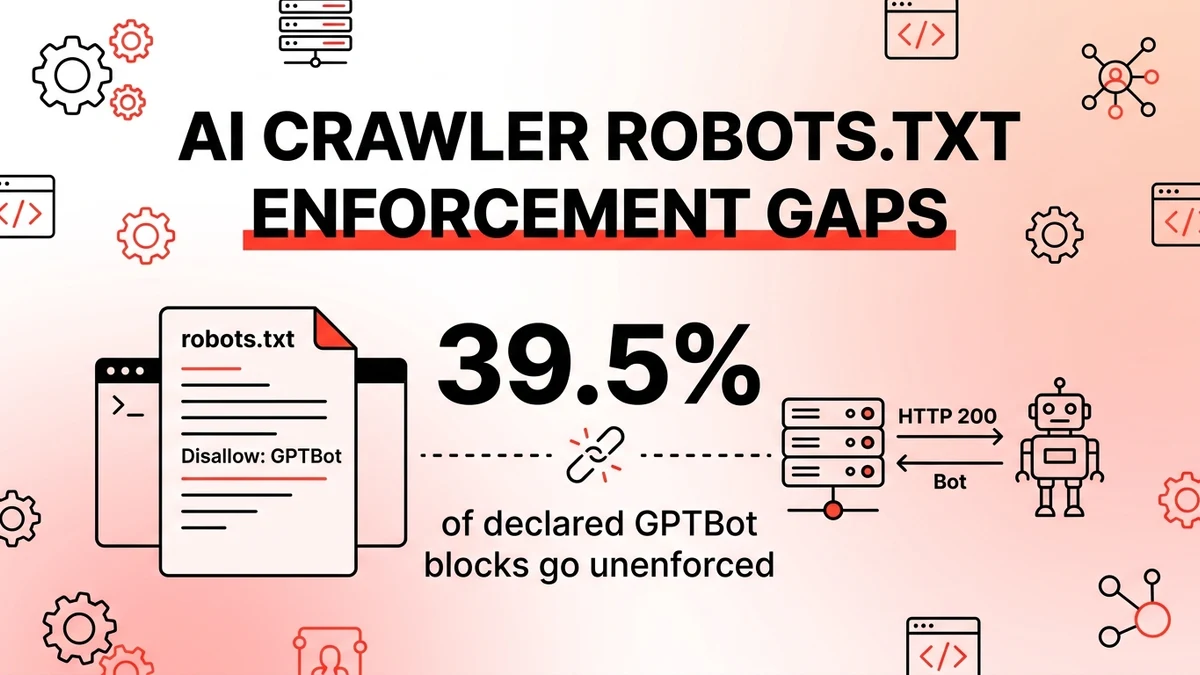
Each major AI engine sends its own named crawler, and they don't all do the same job. OpenAI's GPTBot and Anthropic's ClaudeBot fetch content to help train and ground their models. Perplexity runs two separate agents. PerplexityBot indexes sites for search results, while a second agent, Perplexity-User, fetches a specific page in real time only when a user's question sends it there, and is explicitly documented as not used for foundation-model training. Google's Google-Extended controls whether your content can be used for Gemini and AI Overviews' generative features, separately from normal Googlebot indexing.
Check robots.txt for blanket disallow rules left over from a "block all AI scrapers" panic. If the goal is citation, not just protection, GPTBot, PerplexityBot, ClaudeBot, and Google-Extended all need explicit allow rules, not a default block.
Then grep your server logs for each of those four user agent strings, by page, on a weekly basis. A page with zero hits from any of them in a month has an access problem no amount of rewriting will fix.
7. Get mentioned on sites you don't own
The Princeton/Georgia Tech/Allen AI paper frames the underlying problem well: generative engines "satisfy queries by synthesizing information from multiple sources," not by picking one winner the way a ranked list does. Your own page competing on its own merits is only half the game. The other half is whether independent, third-party sources (review sites, forums, comparison posts, press coverage) already describe your product the way you'd want an AI engine to repeat it.
Search for your brand alongside your category term on Reddit, G2, and the trade publications your buyers actually read. If nothing comes up, that's missing inventory, not a website problem you can fix by rewriting a page.
Run the direct-query test from the top of this article and write down every domain that gets cited alongside or instead of yours. That list is your real competitive set for AI visibility, and it's often not the same as your Google-ranking competitive set.
8. Ship llms.txt, but don't oversell what it does
llms.txt is a proposed plain-text file, introduced by Jeremy Howard's Answer.AI in September 2024, meant to give AI crawlers a clean, curated map of a site's key pages instead of making them guess from a sitemap built for humans. It is not an official web standard, and as of this writing no major AI company (OpenAI, Anthropic, Perplexity, Google) has published documentation confirming its crawlers actually read and use it the way robots.txt is universally respected.
Ship it anyway. It costs almost nothing to maintain, doubles as a clean internal map of your most important pages for your own reference, and carries no real downside if it turns out to do nothing.
Just don't claim a win from this one without evidence. Check your server logs specifically for requests to /llms.txt from the crawler user agents in strategy 6. If you see hits, at least one engine is reading it. If you never see a single request after weeks of publishing, that absence is your actual answer, not the file's presence on your server.
9. Separate "ranks in Google" from "gets cited in an AI answer" as two different jobs
The two systems overlap but aren't the same job. A page can rank #1 in Google and never get pulled into an AI Overview or a ChatGPT answer, while a page ranking #8 can get quoted directly because its phrasing happened to fit the query better. Treating one metric as a proxy for the other means you stop noticing when they diverge, which is exactly the gap the strategies above are built to close.
| Signal | What moves it in classic SEO | What moves it in generative engine retrieval |
|---|---|---|
| Primary unit measured | Ranking position for a query | Whether a specific span of text gets quoted |
| What "more" does | More backlinks generally help | More keyword repetition measurably hurt in testing |
| Best content shape | Long pages that cover every angle | Short, self-contained, answer-first spans |
| What earns trust | Domain authority, backlink profile | Named citations and direct quotations inside the text |
| How you check it | Search Console position tracking | Direct query testing plus crawler log checks |
- Adding real, sourced statistics in place of vague claims
- Writing the direct answer as the first sentence under any question heading
- Keeping crawler access open to indexing bots you actually want
- Google still rewards long, exhaustive pages that cover a topic from every angle; an LLM summarizing an answer often prefers the shortest source that answers the exact question
- FAQ schema's SEO payoff (the rich result) is gone for most sites, but its AI-extraction value is not
- Backlink volume correlates with Google rankings in ways that don't have a documented equivalent for generative engine citation
Track both. Search Console for position, and the direct-query method above for citation. A page that's strong on one and weak on the other tells you exactly which of the nine strategies above to apply to it next.
Building this into a repeatable process across a whole site, rather than testing it page by page, is what our GEO optimization services and content SEO work covers day to day. If crawler access turns out to be the actual blocker, that's a technical SEO audit question before it's a writing one.
FAQ
What are AI SEO strategies?
AI SEO strategies are tactics aimed at getting a page cited or quoted by generative engines (ChatGPT, Perplexity, Google AI Overviews, Gemini), which is a different outcome from ranking in Google's traditional blue links. The clearest controlled evidence on what actually works comes from a 2024 Princeton/Georgia Tech/Allen Institute for AI study (arXiv:2311.09735) that tested nine specific content changes against real generative engines.
Do AI SEO strategies replace traditional SEO?
No. Generative engines still draw heavily on pages that are already crawlable, indexed, and often already ranking, so technical SEO and content quality remain the foundation. AI SEO strategies are an additional layer on top: formatting and sourcing choices that change whether an already-discoverable page gets quoted once an engine has it in front of an LLM.
Does keyword stuffing still work for AI search?
No, and it measurably backfires. In a live test against Perplexity.ai, keyword-stuffed content scored 10% worse than content with no optimization applied at all, while adding real statistics and direct quotations improved visibility instead.
Does FAQ schema still help SEO in 2026?
Not for the Google rich result it was originally built for. Google confirmed in August 2023 that FAQ rich results now show "only for well-known, authoritative government and health websites." The Q&A structure itself still helps generative engines parse and extract individual answers, independent of whether Google renders a snippet for it.
Should I still add an llms.txt file?
Yes, as a low-cost addition, not a guaranteed win. It's a proposed (not officially adopted) plain-text crawler map introduced by Answer.AI in September 2024. No major AI company has published documentation confirming its crawlers act on it, so treat it as a cheap bet worth making rather than a strategy to build a plan around.
Which AI crawlers should I allow in robots.txt?
For citation, allow GPTBot (OpenAI), PerplexityBot (Perplexity's indexing bot, distinct from its real-time Perplexity-User agent), ClaudeBot (Anthropic), and Google-Extended (Google's Gemini and AI Overview training/grounding signal). Blocking all of them protects content from reuse but also removes any chance of being cited by that engine.
How do I measure whether any of this is actually working?
Run two checks regularly, not once. Ask the exact target query directly to ChatGPT, Perplexity, and Google's AI Overview, and note whether your domain gets cited and quoted verbatim. Then grep server logs for GPTBot, PerplexityBot, ClaudeBot, and Google-Extended hits by page. An AI SEO engagement typically sets up both as a standing check rather than a one-time audit.
How is this different from AEO or GEO as terms?
GEO (Generative Engine Optimization) is the academic and practitioner term for this discipline, coined in the Princeton/Georgia Tech/Allen AI paper cited throughout this article. AEO (Answer Engine Optimization) is used more loosely in marketing content to mean roughly the same thing: optimizing content to be the source an AI-generated answer pulls from, rather than the link a human clicks.
Sources: GEO: Generative Engine Optimization, arXiv:2311.09735 (Aggarwal et al., Princeton/Georgia Tech/Allen Institute for AI), Google Search Central: Changes to HowTo and FAQ rich results, Perplexity: Bot documentation, OpenAI: GPTBot documentation
This post is part of our GEO Optimization guide. Related reading: Microsoft's AEO and GEO Guide, GEO Scores Are Often Noise, Not a Real, Google's AI Optimization Guide.

Adel tracks AI citation rates across ChatGPT, Perplexity, Gemini, and AI Overviews. He turns raw visibility data into actionable insights that guide our optimization strategy.
Full Bio →